Why coffee processing wastewater defeats conventional clarification
Wet-process coffee mills consume 15–20 L of water per kilogram of green coffee bean (Applied Water Science critical review, 2019/2020), generating a stream that routinely overwhelms primary settling and conventional biological selectors. Field measurements near coffee processing plants record TSS of 2,260 mg/L and COD of 50,000 mg/L (Frontiers in Sustainability, 2025) — concentrations that turn an equalisation basin into a settling failure within hours. The contaminant fingerprint is the harder problem: melanoidins, polyphenols, caffeine, theobromine, trigonelline, chlorogenic acids, and tannins (Frontiers in Sustainability, 2025) are brown, low-pH, and largely recalcitrant to aerobic degradation, which is why CPW streams remain deeply coloured long after conventional activated sludge. Primary clarifiers can strip settleable solids, but colloids, high-MW melanoidins, and dissolved colour pass straight through, and the resulting secondary effluent still carries a colour load and an organic load that downstream disinfection or RO cannot tolerate. A dedicated membrane step between biology and reuse is the engineering response to that fingerprint — and UF, rated at 0.01–0.1 µm, is the separation that biology alone cannot deliver.
Where UF fits in a coffee wastewater treatment train
UF serves as the solid-liquid polish immediately after biological treatment and ahead of any disinfection or desalination step. The standard train is screening → flow and pH equalisation → anaerobic and/or aerobic biology → UF → optional RO and/or ozone-UV polish → reuse or discharge. The 2026 Materials/Basel integrated study (PMC13208775, published 16 May 2026) sequences biological treatment → activated carbon sorption → membrane filtration → ozone/UV, and reports 82.4–95.4% TOC removal, 0–77.4% NH4-N removal, 0–39.9% phosphate removal, and 96.3–99.8% turbidity reduction at pH 4.02–7.25 — with the membrane stage credited for the colloidal and suspended-solid cut that lets downstream UV and ozone work. An earlier anaerobic baffled bioreactor + microfiltration system, Tacias-Pascacio & Torrestiana-Sanchez 2019 (cited in the Springer 2019/2020 review), removed COD 81%, TS 72%, TSS 100%, and TDS 61%, confirming that a membrane stage is what delivers a near-zero TSS permeate. In the P&ID, UF therefore acts as the barrier for suspended solids, colloids, large organics, and most microbial load, producing a low-SDI, low-turbidity water that protects any downstream RO and that stabilises disinfection kinetics. A DAF system for suspended solids and FOG upstream of biology keeps the feed to UF within its solids tolerance.
UF membrane and operating parameters for coffee effluent
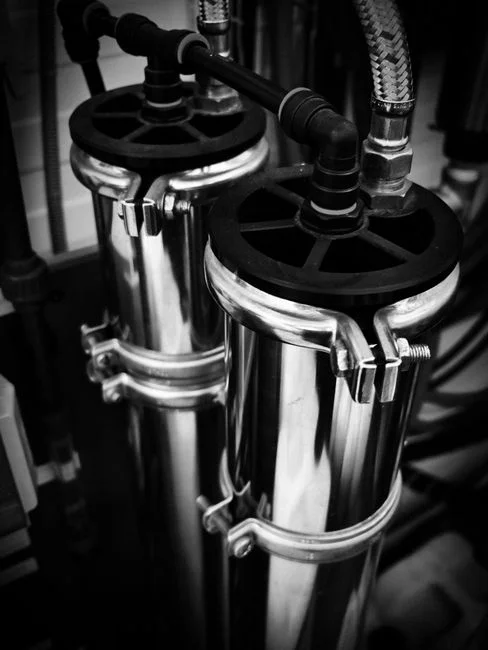
PVDF hollow-fibre membranes rated at 0.01–0.1 µm represent the default UF specification for coffee effluent, with 0.03 µm acting as the working sweet spot for retaining melanoidins and colloids that would otherwise foul a downstream RO. Microfiltration at 0.1–0.2 µm is too coarse — it lets the high-MW coloured fraction pass and shifts the fouling burden onto RO. PVDF is preferred over PES and cellulose acetate for coffee duty because of its oxidative tolerance to NaOCl CIP (typically 500–1,000 ppm, 30–60 min) and its tolerance of the suspended solids that biology rarely removes completely. The operating envelope on high-strength food and beverage UF duty is: gross flux 60–80 L/m²·h, net flux 40–60 L/m²·h after backwash, transmembrane pressure 0.5–1.5 bar, recovery 85–95%, and backwash every 20–60 min combined with periodic air-scour. Feed tolerance decides whether the upstream biology must be perfect — a typical industrial PVDF hollow-fibre ultrafiltration system accepts up to 300 ppm turbidity with automatic backwash, so the UF stage absorbs realistic effluent variability from an activated-sludge plant. A practical UF membrane elements and spares package should be specified against that envelope, not against the marketing flux of a clean-water datasheet.
| Parameter | Typical UF spec for coffee effluent | Engineering rationale |
|---|---|---|
| Membrane material | PVDF hollow-fibre | Oxidative tolerance for NaOCl CIP; handles high TSS |
| Pore size / MWCO | 0.03 µm (range 0.01–0.1 µm) | Retains melanoidins and colloids; protects downstream RO |
| Gross flux | 60–80 L/m²·h | Typical high-strength food and beverage UF duty |
| Net flux (after backwash) | 40–60 L/m²·h | Accounts for backwash water and relaxation cycles |
| TMP | 0.5–1.5 bar | Operating window; rising TMP is the fouling indicator |
| Recovery | 85–95% | Balance against concentrate bleed and cleaning frequency |
| Backwash interval | 20–60 min + air-scour | Holds fouling below CIP threshold on food effluent |
| Feed turbidity tolerance | ≤ 300 ppm (automatic backwash) | Defines the upstream biology specification |
| CIP chemistry | NaOCl 500–1,000 ppm; citric acid | Standard PVDF-compatible clean; restores flux |
UF versus MBR and RO: choosing the right membrane step
UF, MBR, and RO perform different separation functions at distinct points in the treatment train. UF is a separation polish after an existing activated-sludge plant. MBR combines biological degradation and solid-liquid separation in one tank by suspending the membrane directly in the bioreactor, which provides a smaller footprint and a higher MLSS than a conventional aeration tank. RO is a dissolved-ion separation for true reuse, and it fails quickly on high-organic, high-colloid feeds without aggressive pretreatment. The Springer 2019/2020 review notes a pressurised MBR deployed at an instant-coffee plant in Malaysia, but flags that colour and acidity removal were not reported — exactly the gap a downstream UF or RO polish closes. An MBR membrane bioreactor with <1 µm filtration, 60% smaller footprint than a conventional activated-sludge plant, and 10–2,000 m³/day capacity is the right call when biology is the bottleneck and the site is footprint-constrained. UF is the right call when the activated-sludge plant already exists and needs a polish. An industrial reverse osmosis system is the right call when the reuse end-use (boiler feed, cleaning water, irrigation) demands dissolved-salt and colour removal. For an in-depth cross-technology view, see the MBR vs alternatives comparison.
| Criterion | UF (post-biology) | MBR (biology + membrane) | RO (dissolved-ion separation) |
|---|---|---|---|
| Primary function | Solid-liquid polish | Biological degradation + separation in one tank | Dissolved-salt and colour removal |
| Typical pore / rejection | 0.01–0.1 µm | <1 µm (membrane slot) | Rejects ions; >99% salts |
| Footprint vs CAS | Modest add-on | ~60% smaller than CAS | Modular skid |
| Capacity range | 10–5,000+ m³/day (modular) | 10–2,000 m³/day | 5–5,000+ m³/day |
| Best-fit scenario on coffee effluent | Polishing an existing activated-sludge plant | Footprint-constrained greenfield; high MLSS | Final reuse step: boiler feed, cleaning water, irrigation |
| Cannot do alone | Cannot remove dissolved salts or true colour | Colour and acidity removal underreported (per Springer 2019/2020 review) | Cannot accept TSS >1 NTU without aggressive pretreatment |
| Field-data note | 96.3–99.8% turbidity reduction (Materials/Basel 2026, PMC13208775) | COD 81%, TSS 100% on anaerobic + MF (Tacias-Pascacio & Torrestiana-Sanchez 2019) | Requires UF permeate SDI <3 |
Pretreatment and chemistry: what UF needs upstream to stay clean
The dominant UF failure mode on coffee effluent is rapid, irreversible fouling from the colloidal melanoidin fraction, making upstream specification the primary determinant of membrane longevity. A rotary mechanical bar screen at the headworks protects pumps and membranes from fibrous debris, while equalisation buffers the pH and flow swings that the 2026 Materials/Basel train operated through (pH 4.02–7.25). Coagulation, flocculation, and a high-efficiency sedimentation tank drop TSS and oil/grease before the water reaches UF, and an automatic chemical dosing system stabilises pH and feed antiscalant where a downstream RO is in scope. The objective is to keep feed turbidity below the 300 ppm that the PVDF UF can absorb with automatic backwash — once feed turbidity climbs past that, backwash frequency rises, recovery falls, and CIP intervals collapse. On coffee effluent, the upstream specification is the more economical decision compared to frequent membrane change-outs.
Reuse economics, compliance and the 2026 decision framework
The economic case for UF is based on reducing the 15–20 L of freshwater consumed per kilogram of green bean, which the system converts into a reusable stream. The Frontiers in Sustainability 2025 study frames the energy-recovery angle — biogas from anaerobic digestion of CPW can fuel a combined heat and power (CHP) generator — and UF protects that revenue stream by keeping biomass inside the bioreactor rather than bleeding it out the clarifier. The 2026 selection framework involves four steps: (1) characterise the effluent for COD, TSS, colour, and pH; (2) pick the UF pore size and material (default: 0.03 µm PVDF hollow-fibre); (3) fix the pretreatment chain to meet the UF feed spec (≤300 ppm turbidity for a typical PVDF UF); (4) decide on downstream RO, UV steriliser, or ozone generator based on the reuse end-use — boiler feed, food-contact cleaning, or irrigation. The 2026 Materials/Basel paper uses ozone + UV as the final step after membrane filtration, and that sequencing (UF → ozone/UV) is the defensible 2026 reference point for any process engineer sizing a reuse line on a coffee effluent train. For an analogous polishing application, see the ultrafiltration for seafood processing wastewater guide and the suspended solids removal guide.
Frequently Asked Questions
What pore size UF is used for coffee wastewater?
The default is 0.01–0.1 µm PVDF hollow-fibre, with 0.03 µm as the working specification for retaining melanoidins, colloids, and the high-MW colour fraction that would otherwise foul a downstream RO.
Can UF alone meet discharge limits for coffee effluent?
UF alone handles TSS, turbidity, most suspended organics, and the bulk of the microbial load. It does not remove
Frequently Asked Questions
What pore size ultrafiltration is used for coffee processing wastewater?
Ultrafiltration (UF) membranes for coffee processing wastewater typically utilize a pore size range of 0.01 to 0.1 micrometers (µm). This specific range corresponds to a molecular weight cut-off (MWCO) between 10,000 and 100,000 Daltons, which is essential for effectively rejecting suspended solids, colloidal particles, and high-molecular-weight organic compounds like tannins and polysaccharides found in coffee effluent.
Can ultrafiltration alone treat coffee wastewater to discharge standards?
No, ultrafiltration is generally insufficient as a standalone treatment process for meeting environmental discharge standards. While UF effectively removes turbidity and suspended solids, it does not significantly reduce dissolved organic matter, specifically biochemical oxygen demand (BOD) and chemical oxygen demand (COD), which often exceed 5,000–10,000 mg/L in raw coffee wastewater. UF must be integrated with biological processes or advanced oxidation to reach regulatory limits for discharge.
How much water does wet coffee processing use per kilogram of green bean?
Traditional wet processing methods consume between 15 and 20 liters of water per kilogram of green coffee bean produced. However, modern, water-efficient mechanical demucilaging systems can reduce this consumption to approximately 1 to 5 liters per kilogram of green bean, significantly lowering the hydraulic load on downstream wastewater treatment systems.
What is the difference between UF and MBR for a coffee effluent plant?
Ultrafiltration (UF) is a physical separation process that acts as a filtration barrier for solids and colloids, whereas a Membrane Bioreactor (MBR) combines biological degradation with membrane separation. In an MBR, the UF or microfiltration membrane is submerged directly within the aeration tank, allowing for the simultaneous biological oxidation of organic pollutants and physical separation of the biomass, resulting in a significantly higher quality permeate than UF used alone.
What pretreatment does a UF system need before coffee wastewater?
To prevent rapid membrane fouling and irreversible scaling, UF systems require robust pretreatment, typically beginning with coarse screening (e.g., 1–2 mm) to remove coffee skins and debris. This must be followed by primary sedimentation or dissolved air flotation (DAF) to reduce oil and grease concentrations, and a fine filtration step (e.g., 50–100 µm cartridge or disc filters) to protect the sensitive UF membranes from abrasive particles and suspended solids that exceed the membrane's tolerance levels.