
Industrial primary clarifier design criteria start with gravity settling ahead of biological treatment. A primary sedimentation tank removes about 60% of suspended solids (TSS) and 30-40% of biochemical oxygen demand (BOD) at 1.5-3 hours retention and 30-50 m³/m²·day surface loading. Heavier solids settle as primary sludge at 1-3% solids, while grease and oils rise as scum for skimming. The US EPA's Primer for Municipal Wastewater Treatment Systems describes a clarifier as a unit that removes solids from wastewater by gravity settling or by coagulation.
How Primary Clarifiers Work Before Biological Treatment
A primary clarifier works by slowing wastewater so gravity can act: dense solids sink as sludge, FOG rises as scum, and clarified water leaves over a weir. At 1.5-3 hours retention and 30-50 m³/m²·day loading, the tank removes about 60% TSS and 30-40% BOD before aeration, cutting secondary-stage load.
The unit separates settleable and floatable solids by gravity before secondary treatment, protecting everything downstream. Sludge collects at 1-3% solids in a floor hopper; scum is skimmed at the surface into a trough. Correct sizing cuts aeration load and protects pumps and diffusers from abrasion and fouling.
Food processors with high fats, oils, and grease (FOG) illustrate the stake. Without early solids capture, organic load can foul aeration diffusers and inflate energy use in activated sludge. A correctly loaded settler stabilizes influent quality and lowers operating cost before biology begins.
For a deeper equipment-level overview of a primary clarifier, including selection trade-offs beyond this mechanics focus, see the companion engineering guide on this site.
Why Gravity Settling Protects the Biological Treatment Stage
Gravity settling is the lowest-cost physical cut of TSS and BOD before biology. Removing about 60% TSS and 30-40% BOD typically reduces biological treatment cost by 20-30% through lower aeration demand and less fouling. In industrial plants, that step also shields pumps, membranes, and fine-bubble diffusers from grit and fibrous solids.
A pulp mill in North America reported a 25% reduction in annual secondary-stage maintenance after surface loading and weir settings were corrected (HydropureWater field data, 2024). Primary sludge at 1-3% solids is rich in volatile solids (VS). According to EPA 2023 benchmarks cited in plant design practice, that sludge can yield about 0.3-0.5 m³ biogas per kg VS added in anaerobic digestion, supporting energy-recovery goals.
The US EPA's municipal primer adds three field-relevant numbers here. It notes that sewage solids separated from wastewater still contain around 98 percent water, which is why underflow pumping volumes dwarf dry-solids estimates. The same primer states that anaerobic solids digestion produces methane gas that can be recovered and used as a source of energy. It also reports that secondary treatment processes can remove up to 90 percent of the organic matter in wastewater, capacity that clean primary effluent protects.
Early organic load reduction also helps plants stay inside discharge envelopes that once cited Directive 91/271/EEC alongside China's GB 18918-2002. Directive (EU) 2024/3019 of 27 November 2024 recasts those urban wastewater rules. According to the European Commission, the revised directive entered into force on 1 January 2025. Per EUR-Lex, it repeals 91/271/EEC with effect from 1 August 2027.
Under Article 2, primary treatment means a physical or chemical process in which the incoming wastewater's BOD5 falls by at least 20% and total suspended solids fall by at least 50% (EUR-Lex, 2024). That floor sits below the 50-70% TSS and 25-40% BOD ranges many municipal designs still target in practice. The European Commission's summary extends collection and treatment duties to all urban areas of more than 1,000 inhabitants, and the directive's discharge table caps secondary-treated effluent at 35 mg/l total suspended solids.
The Physics of Gravity Settling in Wastewater Tanks

Settling velocity follows Stokes' Law: V = (g × (ρ_p − ρ_l) × d²) / (18 × μ), where g is gravity, ρ_p particle density, ρ_l liquid density, d particle diameter, and μ dynamic viscosity. Larger, denser particles fall faster; colloids below about 1 μm may stay suspended without coagulants.
Grit and sand above 100 μm often settle in minutes. Colloidal solids need chemical aid, such as a chemical dosing system for clarifier optimization and sludge conditioning, to reach design removal. Engineers size for the critical settling velocity — the slowest particle that must reach the floor before water exits.
Retention time and surface loading must keep flow laminar. Standard industrial targets remain 1.5-3 hours and 30-50 m³/m²·day. Raising wastewater temperature from 10°C to 20°C can lift settling velocity by about 30% as viscosity falls, which matters for seasonal plants.
Flow path is fixed: inlet energy dissipation, settling zone, effluent weir, and scum baffles. Settleable solids and floatables leave together, leaving clarified water for secondary treatment. The companion piece on the Primary Clarifier Working Principle: 2026 Engineering Specs expands hydraulic detailing for project teams.
What Industrial Primary Clarifier Design Criteria Matter Most?
Industrial settler dimensions follow flow rate and solids specific gravity, with side water depths usually 3-5 m. Circular tanks often span 10-50 m diameter with a 1:12 floor slope toward a central hopper. Rectangular tanks commonly use a 3:1 to 5:1 length-to-width ratio when footprint or modular expansion dominates.
Surface loading rates (SLR) shift by industry. High-strength slaughterhouse wastewater needs longer retention and lower SLR for fats and proteins. Typical ranges are summarized below:
| Industry Type | Surface Loading Rate (m³/m²·day) | Retention Time (Hours) | Typical TSS Removal (%) |
|---|---|---|---|
| Municipal Wastewater | 30 - 50 | 1.5 - 2.5 | 50 - 70% |
| Food & Beverage | 40 - 60 | 2.0 - 4.0 | 60 - 80% |
| Pulp & Paper | 20 - 40 | 3.0 - 5.0 | 70 - 90% |
| Chemical Processing | 25 - 45 | 2.5 - 4.5 | 50 - 75% |
Primary sludge yield typically ranges from 0.1 to 0.3 kg TSS per kg BOD removed (EPA 2023). For 2,000 kg BOD removed daily, expect 200-600 kg dry solids, plus much larger wet volume at 1-3% solids. A High-Efficiency Sedimentation Tank (Lamella Clarifier) or conventional scrapers must remove that sludge before fermentation lifts solids.
V-notch weirs remain standard for stable effluent withdrawal. Weir loading of 125-250 m³/m·day limits high-velocity pull that causes sludge carryover near the outlet.
How Do You Run a Primary Clarifier Surface Loading Rate Calculation?
The primary clarifier surface loading rate calculation is area math: divide design flow by tank surface area. A 500 m³/h stream at a target 40 m³/m²·day SLR needs about 300 m² of plan surface, before deducting weir zones. Always run the check at peak hourly flow, not daily average, because carryover failures happen at peaks.
Circular vs Rectangular vs Lamella Clarifier Comparison
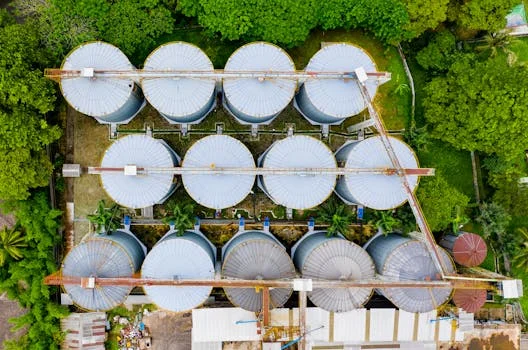
Circular tanks stay common where capital cost and simple rotating scrapers matter most. Rectangular tanks pack large flows more tightly and share walls to cut civil cost, at the price of chain-and-flight maintenance underwater. Lamella units stack inclined plates (often 60°) to raise effective area.
A lamella clarifier for compact industrial wastewater treatment can be up to 70% smaller than a conventional tank at equal capacity. Lamellas suit tight sites and skid packages, but they react faster to sudden solids spikes than deep conventional tanks.
| Clarifier Type | Footprint | CAPEX (Est. 2025) | Maintenance Level | Best Use Case |
|---|---|---|---|---|
| Circular | High | $500 - $1,200/m³ | Low | Municipal & general industrial |
| Rectangular | Medium | $800 - $1,500/m³ | Medium | Large-scale, modular plants |
| Lamella | Very Low | $1,000 - $2,000/m³ | High | Space-constrained urban sites |
What Shapes Clarifier Construction Cost and Schedule?
Clarifier construction cost is driven by excavation depth, wall area, and scraper complexity more than by nominal volume. The CAPEX bands above are US-market estimates for 2025 builds; for 2026 budget planning, hold contingency for steel and civil escalation. Shared-wall rectangular units and plate packs cut the footprint premium fastest when land is priced in.
Primary Clarifier Troubleshooting: Rising Sludge and Short-Circuiting
Short-circuiting sends water from inlet to outlet far faster than design retention, collapsing TSS removal. Fixes include inlet diffusers, weir leveling within ±3 mm, and baffles that break high-velocity currents.
Rising sludge often means sludge sat too long in the hopper. Anaerobic gas (nitrogen or methane) attaches to flocs and floats them. Pull sludge 1-4 times per day, and consider flocculant dosing for clarifier performance optimization when blanket density is weak. Food plants with high FOG need strong skimmers and surface spray to stop odor and effluent scum.
Primary Clarifier vs DAF Pretreatment Cost
Gravity settlers and dissolved air flotation (DAF) solve different solids. A DAF system for high-FOG or high-TSS industrial wastewater can reach 92-97% TSS removal, but capital and operating cost are often two to three times a clarifier. Choose settlers for heavy, settleable solids; choose DAF for light, fatty, or fibrous material that will not settle.
Many plants combine a rotary mechanical bar screen for coarse solids removal with a gravity settler. Payback usually comes from 20-30% lower aeration oxygen demand, less secondary chemical use, and optional biogas from primary sludge.
Operators who still need to explain how primary clarifiers work to non-process stakeholders can use the Stokes velocity and SLR tables above as a shared sizing language.
How Do You Select a Clarifier System for an Industrial Train?
Selecting a clarifier system starts with a 24-hour influent profile of TSS, BOD, FOG, temperature, and pH, including peaks. Area follows flow and design SLR: 500 m³/h at 40 m³/m²·day needs about 300 m² of surface. Then match geometry to footprint, sludge handling, and maintenance skill on site.
Teams asking how to design a primary clarifiers train from scratch can start with the companion explainer before fixing dimensions. Downstream, the companion data on secondary clarifier design paramter benchmarks helps size the biological-stage settler that follows.
Use this checklist before freezing civil drawings:
- Confirm peak-to-average flow and whether equalization is available upstream.
- Measure settleable solids fraction with a settling column, not TSS alone.
- Set SLR and retention for the critical particle, then check weir loading at peak.
- Size sludge withdrawal for 1-3% solids without overnight hopper storage.
- Decide circular, rectangular, or lamella against footprint and CAPEX bands above.
- Compare DAF only if FOG or floatable fiber dominates the solids mass.
- Plan scum, odor, and spare scraper or flight parts in the OPEX model.
How Does Gravity Thickener Design Affect Clarifier Underflow Density?
Gravity thickener design clarifier scope usually lands in one specification package, because both units share Stokes physics and sludge-density targets. The thickening check adds a sludge blanket zone below the settling zone, while the same 30-50 m³/m²·day logic still sizes the clarification surface. Sites co-thickening primary and waste activated sludge should verify both duty points in one settling-column test.
What Does Good Daily Clarifier Operation Look Like?
Daily clarifier operation centers on three readings: blanket depth, scum accumulation, and underflow concentration near 1-3% solids. Log weir condition and effluent turbidity each shift, because slow drift flags short-circuiting before effluent limits do. Most plants we size for run sludge withdrawal on timer plus blanket-probe interlock rather than a fixed schedule alone.
Who this is for: plant engineers and EPC teams sizing primary settling ahead of activated sludge, MBBR, or anaerobic digestion. Who should look elsewhere: sites whose solids are mostly emulsified FOG with little settleable mass — start with DAF screening instead. Next step: send a 24-hour composite plus peak flow through the inquiry form so surface area and hopper volume can be checked before bid drawings lock.
Frequently Asked Questions
How much TSS and BOD does a primary settler remove?
Well-operated industrial and municipal settlers commonly remove about 50-70% TSS and 25-40% BOD at 1.5-3 hours retention and 30-50 m³/m²·day surface loading. Directive (EU) 2024/3019 defines primary treatment as at least 50% TSS and 20% BOD5 reduction. Actual results track particle size, temperature, and whether coagulants are dosed.
How does primary clarifier surface loading rate calculation work at peak flow?
Divide peak hourly flow by the tank's plan surface area and compare the result with the sector SLR band from the table above. A 500 m³/h peak at 40 m³/m²·day calls for roughly 300 m² of surface. If the peak-hour value exceeds the band, add area or equalize flow upstream rather than deepening the tank.
How do you stop rising sludge in a primary clarifier?
Rising sludge stops when fresh sludge leaves the hopper before anaerobic gas lifts it, usually with 1-4 withdrawal cycles per day. Check blanket depth daily and interlock underflow pumping to it. If the blanket stays weak and dilute, flocculant dosing usually restores density and settles the floating flocs.
How does primary clarifier vs DAF pretreatment cost compare for fatty streams?
A primary clarifier usually wins on cost when solids settle unaided, since DAF capital and operating cost often run two to three times higher. DAF earns that premium at 92-97% TSS removal on FOG and light fiber that gravity cannot capture. Many plants screen, settle, then reserve DAF for the failure stream.
What surface loading rate should industrial plants use?
Many industrial designs target 30-50 m³/m²·day, then tighten or relax by sector. Pulp and paper often runs 20-40 m³/m²·day with longer retention, while some food plants accept 40-60 m³/m²·day when solids settle quickly. Always verify with settling tests at peak temperature and peak FOG.
When is a lamella unit better than a circular tank?
Choose lamella plates when footprint is scarce or a skid-mounted package is required; effective area can shrink civil works by up to about 70%. Prefer circular or rectangular deep tanks when influent solids swing hard, sludge inventory must buffer peaks, or submerged flight maintenance is harder to staff.
How often should primary sludge be withdrawn?
Most plants pull sludge one to four times per day so the hopper does not turn septic. Holding solids too long generates gas that floats the blanket and raises effluent TSS. Match pump cycles to measured blanket depth and keep underflow near 1-3% solids for stable digester feed.
Is a clarifier or DAF the right pretreatment?
Use a gravity settler for dense, settleable solids and when CAPEX must stay low. Use DAF when FOG or light fiber will not settle even at long retention. Many trains screen first, settle next, and reserve DAF for streams that fail a settling column test.