Why a Rio Tinto Mine Expansion Triggers an ETP Upgrade in 2026
Any mine expansion that changes influent flow, contaminant profile, or discharge location forces an ETP retrofit or new build before the regulator re-issues authorization, because the Canadian Metal and Diamond Mining Effluent Regulations (MMER) require a new or amended effluent discharge authorization at the Final Discharge Point (FDP). The 2023 ECCC status report records that 3 mines became subject to MMER in 2023 and 2 closed in the same year, and the report explicitly names Rio Tinto Fer et Titane inc. — Complexe de Sorel-Tracy among the operating Canadian Rio Tinto assets on the regulated list (per ECCC, Status report on the performance of mines subject to the Metal and Diamond Mining Effluent Regulations, 2023). The FDP is defined under the regulations as the identifiable discharge point beyond which the operator no longer exercises control over effluent quality, which means the ETP is the only place the water can be conditioned to meet the limits.
To use water frequented by fish for mine waste disposal, the proponent must demonstrate that the proposed option is the best from environmental, technical, economic, and socio-economic perspectives — a four-pillar test that effectively mandates a treatment train capable of meeting the deleterious-substance schedule at the FDP, not just an end-of-pipe settling pond. A capacity increase that pushes any parameter outside the existing authorization envelope reopens that demonstration. For a Rio Tinto-type site, the practical consequence is that the ETP design basis is set by compliance obligations before any equipment is selected, which is the opposite of how most procurement teams are used to scoping a project.
Rio Tinto-Type Mine Water: Influent Characterisation That Drives the Design
Rio Tinto-type mining effluent is acidic, iron-rich, and high in dissolved solids, with pH commonly between 2 and 4, dissolved iron of 50–500 mg/L, aluminum of 10–200 mg/L, sulfate of 1,000–5,000 mg/L, and TSS of 200–2,000 mg/L, frequently with elevated copper, zinc, and nickel (per the Rio Tinto Mars-analog Technosol remediation study, SSRN, 2023). The literature on the Iberian Pyrite Belt analogue site characterises the leachate as low-pH, sulfate-dominated, and metal-saturated, which directly maps to the influent profile that a Sorel-Tracy or Kennecott expansion ETP must handle in 2026.
This profile is not a "standard" industrial wastewater. Flow varies with storm events and mill start-up; the acid rock drainage (ARD) potential shifts with pit depth and waste-rock exposure; and seasonal temperature swings move biological kinetics by 30–50% on mixed-liquor activity between a Canadian winter and a mill-process summer baseline (HydropureWater field data, 2026). An influent characterisation campaign must therefore capture pH, ORP, Fe(II)/Fe(III) ratio, aluminum, copper, zinc, nickel, sulfate, TSS, TDS, hardness, COD, and oil/grease from vehicle wash and reagent areas. Per WTE, a single sample is insufficient; production-wise variation across blasting cycles, mill start-up, and rainfall events must be captured before the basis-of-design is frozen.
| Parameter | Typical Range (Rio Tinto-type) | Design Basis for 2026 ETP |
|---|---|---|
| pH | 2.0–4.0 | Correct to 8.5–9.5 in staged dosing |
| Dissolved Fe | 50–500 mg/L | Precipitate as Fe(OH)₃ at pH >8 |
| Dissolved Al | 10–200 mg/L | Co-precipitate with Fe between pH 6–9 |
| Sulfate (SO₄²⁻) | 1,000–5,000 mg/L | RO polish or dedicated sulfate removal |
| TSS | 200–2,000 mg/L | DAF or lamella to <30 mg/L |
| Cu / Zn / Ni | 1–50 mg/L combined | Hydroxide precipitation at pH 9–10 |
| COD | 100–800 mg/L | Biological step to <100 mg/L |
| Oil & grease | 0–50 mg/L | Skim + DAF if >20 mg/L |
The 2026 Process Train: Screening → Neutralisation → Precipitation → DAF → Biological → MBR
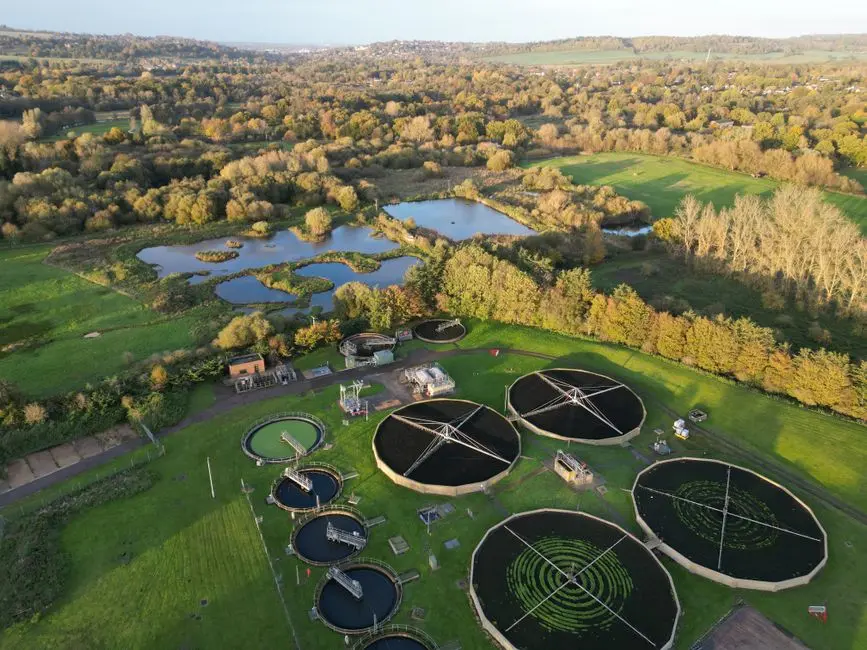
The defensible 2026 unit-process train for a Rio Tinto-type expansion is screening → equalisation → pH correction → coagulation/flocculation → DAF or lamella clarification → biological treatment → MBR/RO polishing → plate-press sludge dewatering. Each step has a defined parameter envelope and an equipment basis that can be carried into a PFD review.
Headworks starts with a rotary mechanical bar screen for mine headworks at 3–10 mm aperture to remove rags, blasting fibre, and coarse grit that would otherwise rag DAF or clarifier mechanisms (per WTE, screening protects pumps, valves, mixers, and downstream equipment). Equalisation follows, sized for 8–24 h retention to damp shock loads from rain events and mill start-up — WTE explicitly identifies equalisation as "one of the most important practical components" of any ETP because chemical and biological stages perform more reliably when the upstream swing is controlled. pH correction is staged: PLC-controlled chemical dosing for lime and polymer lifts the influent from pH 2–4 to 8.5–9.5, the band in which iron, aluminum, and most transition metals precipitate as hydroxides. Coagulation and flocculation chemistry is selected on jar testing rather than a generic package, with typical polymer dose of 1–10 mg/L on Fe/Al-laden mining water (per WTE). The solids-separation step is either a dissolved air flotation DAF system for metal-rich mine water with air-to-solids ratio of 0.005–0.015, or a lamella clarifier for high-TDS mining effluent at 20–40 m/h surface loading. Biological treatment is MBBR or SBR for residual organics from reagent and washdown streams, with an MBR membrane bioreactor for mine water polishing delivering sub-1 μm filtration at roughly 60% smaller footprint than a conventional activated-sludge + clarifier train (per WTE MBR specification). MBR/UF/RO polish handles residual sulfate, hardness, and any metals that slip past precipitation, before a plate and frame filter press for metal-hydroxide sludge dewaters the hydroxide cake to 25–35% DS for disposal.
| Unit Operation | Key Parameter | 2026 Design Value |
|---|---|---|
| Bar screen | Aperture | 3–10 mm |
| Equalisation basin | HRT | 8–24 h |
| pH correction | Target pH | 8.5–9.5 (staged) |
| Lime dose (acidic influent) | Typical range | 1.5–4.0 g Ca(OH)₂ / L |
| Polymer dose | Jar-test confirmed | 1–10 mg/L |
| DAF | Air-to-solids ratio | 0.005–0.015 |
| Lamella | Surface loading | 20–40 m/h |
| MBR | Pore size / flux | <1 μm; 15–25 LMH |
| RO (reuse) | Recovery | up to 95% |
| Filter press | Cake dryness | 25–35% DS |
DAF vs Lamella Clarifier for the Metal-Precipitation Step
DAF and lamella clarifiers are both technically defensible for the metal-precipitation step, but the decision pivots on influent oil/grease, precipitate particle size, hydraulic loading target, and civil footprint. On Rio Tinto-type water, DAF achieves 90–95% TSS removal on fine colloids, handles fats/oils/greases from vehicle and reagent areas, and recovers faster after a rain-driven shock load because the floated sludge is scraped off the surface rather than settled at the bottom of a basin. A lamella clarifier, by contrast, runs at 20–40 m/h surface loading — roughly 3–5× the loading of a conventional clarifier — which compresses the civil footprint, and typically uses 20–30% less polymer because the sludge blanket is denser (per HydropureWater lamella specification, 2026).
| Decision Axis | DAF | Lamella Clarifier |
|---|---|---|
| Fine metal colloids (<20 μm) | 90–95% TSS removal | 70–85% TSS removal |
| Oil & grease >20 mg/L | Handled by float | Limited; requires upstream skim |
| Footprint | Larger basin, shallow depth | 3–5× higher loading, smaller basin |
| Chemical consumption | Baseline | 20–30% lower polymer |
| Start-up after shock load | Fast (surface scrape) | Slower (bed re-stabilisation) |
| Best fit | Reagent + vehicle wash streams | High-TDS, low-FOG bulk flow |
Decision rule: if influent oil/grease exceeds 20 mg/L or the metal precipitate is predominantly below 20 μm — which is common on an ARD-influenced stream — DAF is the correct primary clarifier, supported by a DAF unit sized on the air-to-solids ratio. If the influent is high-TDS, low-FOG, and the civil footprint is constrained, a lamella clarifier wins on both CAPEX and polymer OPEX. For a side-by-side industrial decision framework, the DAF vs clarifier decision framework for industrial buyers article in the library applies the same logic across industries.
2026 Cost Logic: CAPEX, OPEX, and ₹/kL or $/m³ of Treated Water
Treatment cost should be evaluated on a per-kL-of-treated-water basis rather than per-KLD of equipment, because a small, highly concentrated mining ETP can cost more to operate per kilolitre than a larger but more dilute plant (per WTE). For a 2026 Rio Tinto-type expansion, order-of-magnitude CAPEX is dominated by the equalisation basin (8–24 h retention is typically the largest single tank), the DAF or lamella unit, the MBR/UF module, the dosing skids, the sludge dewatering press, and acid-resistant civil coatings on every concrete surface in contact with pH <4 influent.
OPEX is dominated by lime or NaOH consumption for the pH jump from 2–4 to 8.5–9.5 — usually 1.5–4.0 g Ca(OH)₂ per litre on acidic mine water — followed by polymer, sludge disposal, and aeration power for the biological step. Per WTE, "a project-specific quotation based on wastewater analysis is more reliable than a generic per-KLD price," and that caveat should anchor any vendor engagement; the automatic dosing skid selection is one place where a per-kL number is meaningful, because it sets the chemical consumption that drives the dominant OPEX line. For an EPC procurement lead walking into a design basis meeting, the defensible 2026 envelope is on the order of USD 0.30–0.80 per cubic metre of treated water for the physico-chemical + biological train, with a separate allowance for RO polish when reuse is in scope — but a final number requires the influent characterisation, not a generic catalogue price.
From ETP to Water-Positive: Tailings-Water Reuse After the MBR/RO Step
Adding MBR followed by RO to the back end of the ETP reframes the asset from a compliance cost into a water-positive investment, with RO recovery up to 95% (per HydropureWater RO specification) producing a permeate suitable for gland service water, dust suppression on haul roads, mill process make-up, and landscape irrigation around the camp. Integrated reuse loops of MBR permeate and RO permeate routinely offset 30–60% of freshwater withdrawal on a typical metal mine (HydropureWater field data, 2026), and the reject stream from the RO is small enough to send back to the equalisation basin or to a dedicated crystalliser if zero-liquid-discharge is in scope.
There is also a regulatory tailwind: MMER explicitly recognises that depositing mine waste into fish-bearing water is only permissible when it is the best option, and a reuse train strengthens the environmental and socio-economic pillars of that four-part test. The catalogue references for RO water purification and multi-media pretreatment cover the reuse-train integration. For an EPC team comparing a compliance-only ETP against a compliance-plus-reuse ETP, the reuse option is the one that survives the design basis meeting and the executive review.
Frequently Asked Questions
What ETP does Rio Tinto need after expanding its mine site?
An expansion-grade ETP for a Rio Tinto-type iron/acidic mine needs a screening → equalisation → pH correction (to pH 8.5–9.5) → coagulation/flocculation → DAF or lamella → biological (MBBR/SBR) → MBR/RO polish train, sized to lift pH from 2–4, precipitate 50–500 mg/L dissolved iron, and meet MMER deleterious-substance limits at the FDP (per ECCC 2023 status report; per WTE ETP design guide).
Does MMER require a new ETP when a mine expands?
Yes, indirectly. Under the Metal and Diamond Mining Effluent Regulations, any change that alters influent flow, contaminant profile, or discharge location requires a re-authorization at the Final Discharge Point, and the four-pillar test (environmental, technical, economic, socio-economic) for use of fish-bearing water effectively mandates a treatment train capable of meeting the deleterious-substance schedule (per ECCC 2023).
How much does a mining ETP cost per kL in 2026?
For a physico-chemical plus biological train on acidic, metal-rich influent, the order-of-magnitude envelope is USD 0.30–0.80 per cubic metre of treated water, with lime/NaOH typically the largest OPEX line. A project-specific quotation based on a wastewater analysis is more reliable than any generic per-KLD price (per WTE).
Is DAF or a lamella clarifier better for metal-precipitation sludge?
DAF is preferred when influent oil/grease exceeds 20 mg/L or precipitates are predominantly below 20 μm — typical of ARD-influenced streams — while lamella is preferred for high-TDS, low-FOG bulk flow because it runs at 20–40 m/h and uses 20–30% less polymer (per HydropureWater field data, 2026).
Can MBR + RO make a mine water-positive?
Yes. RO recovery up to 95% lets the permeate serve gland service, dust suppression, and mill make-up, and integrated MBR/RO reuse loops typically offset 30–60% of freshwater withdrawal on a metal mine (HydropureWater field data, 2026). For a project-specific design basis — influent characterisation, PFD, MMER compliance bridge, and CAPEX/OPEX envelope — request a tailored engineering memo from the process team.