Which Wastewater Streams Does a Sargodha Data Center Need to Treat?
A Sargodha data center should treat sewage, humidification or process drain, and cooling-tower blowdown as separate streams, then select treatment from the intended endpoint: reuse, compliant discharge or zero liquid discharge. Cooling blowdown normally requires equalization, suspended-solids removal, filtration and—where reuse is required—UF and industrial RO. Sanitary sewage needs biological treatment, while cooling and process drains need source-specific polishing. A Sargodha design must be based on local makeup-water analysis, measured flows, the receiving route and current Punjab Environmental Protection Agency requirements; no verified Sargodha-specific industrial discharge limits were provided here.
Stream segregation is the first design decision because a blended wastewater stream can dilute a sanitary contaminant load, expose membranes to unexpected oil or biofilm solids, and make equipment sizing untraceable to an operating cause. The Islamabad data-center design principle applies to Sargodha: sanitary and cafeteria flows belong in a package biological plant sized around occupancy, while the industrial train should be sized around data-hall and cooling loads (HydropureWater, 2026). This is also the separation used in the data-center wastewater and cooling treatment guide.
Ask whether the proposed facility uses evaporative cooling, hybrid cooling, once-through condenser cooling or a closed-loop system. The answer changes makeup-water demand, temperature load, chemical use and wastewater volume. A once-through condenser stream may be thermally loaded but chemically different from recirculating cooling-tower blowdown.
| Stream | Characteristic load | Required engineering information | Provisional treatment route |
|---|---|---|---|
| Sanitary sewage and cafeteria effluent | Organics, nutrients and pathogens; unrelated to cooling chemistry | Headcount, meal periods, average and peak flow, wastewater characteristics and destination | Package biological treatment; MBR where reuse quality warrants it; disinfection as required |
| Humidification or process drain | Suspended solids, corrosion products, biofilm fragments and treatment-chemical residues | Source process, operating schedule, temperature, chemicals, sampling points and reuse destination | Equalization, DAF or filtration, followed by membranes only if the endpoint requires it |
| Cooling-tower blowdown | Concentrated dissolved salts, suspended matter and residual cooling chemicals | Makeup flow, target CoC, evaporation, drift, measured blowdown, peak hourly discharge and water analysis | Operational optimization, filtration, UF and industrial RO for reuse |
| Once-through condenser or other thermal discharge | Heat load and variable water chemistry; limited cooling-chemical concentration | Source-water analysis, temperature, flow variability and receiving route | Cooling or heat-recovery assessment, filtration and discharge or reuse treatment as applicable |
For each stream, obtain average and peak flow, operating schedule, source water, chemicals used, temperature, sampling points and proposed reuse or discharge destination. A 2026 data-center blowdown treatment framework provides a related structure, but Sargodha flows and water chemistry must be measured rather than transplanted.
What Must Be Measured Before Equipment Is Sized?
Equipment sizing should begin with a measured water balance, not a catalogue flow rate. Establish design makeup-water flow, target cycles of concentration, evaporation, drift, measured blowdown and peak hourly discharge. Genesis Water Technologies reports that actual blowdown can exceed theoretical calculations by 15–30% because of unmeasured losses and emergency dumps (2026). That finding makes metering and operating records design inputs, not optional commissioning tasks.
Request a full ionic suite for both makeup water and blowdown: conductivity, TDS, pH, total hardness as CaCO3, silica, chloride, sulfate, iron, manganese, suspended solids, temperature and residual treatment chemicals. The cited blowdown benchmarks of TDS 1,200–6,000 mg/L and suspended solids 10–50 mg/L describe possible blowdown characteristics; they are not guaranteed Sargodha influent values (Genesis Water Tech, 2026). Use them to frame sampling questions, then replace them with site data.
Metals and metalloids also warrant a site-specific screen. The University of the Philippines Los Banos study of wastewater-irrigated urban farming sites in Sargodha reported elevated metals and metalloids in wastewater and soils, including arsenic and cadmium above permissible soil limits (University of the Philippines Los Banos, DOI 10.62550/ka186190). That study is not a complete industrial-effluent specification, but it is sufficient reason to test before selecting a discharge route or assuming that ordinary cooling treatment removes those contaminants.
| Design input | Why it changes the decision | Evidence or information required |
|---|---|---|
| Measured water balance | Controls blowdown, equalization and treatment capacity | Makeup, evaporation, drift, measured blowdown, emergency dumps and peak hourly discharge |
| Makeup and blowdown analyses | Determines membrane loading, scaling risk and chemical compatibility | Full ionic suite, suspended solids, temperature and chemical residuals |
| Local contamination screen | Determines whether additional treatment or discharge restrictions are required | Sargodha site sampling for metals, metalloids and other identified contaminants |
| Regulatory and receiving-water route | Defines the required endpoint and treatment envelope | Current Punjab Environmental Protection Agency consent conditions, sewer ownership, surface-water route and proposed receiving point |
Also define the endpoint before asking vendors to size equipment: sewer discharge, internal reuse, surface-water discharge, near-ZLD or full ZLD. The wastewater-requirements guide for a plant acquisition illustrates why a transaction or expansion review must establish the flow, water-quality and permit basis before selecting equipment. No verified Sargodha-specific industrial discharge schedule or receiving-water permit limit is supplied in the research, so the project should obtain those conditions from the relevant authority rather than infer them from Islamabad or Hyderabad.
How Should Cooling-Tower Blowdown Be Treated?
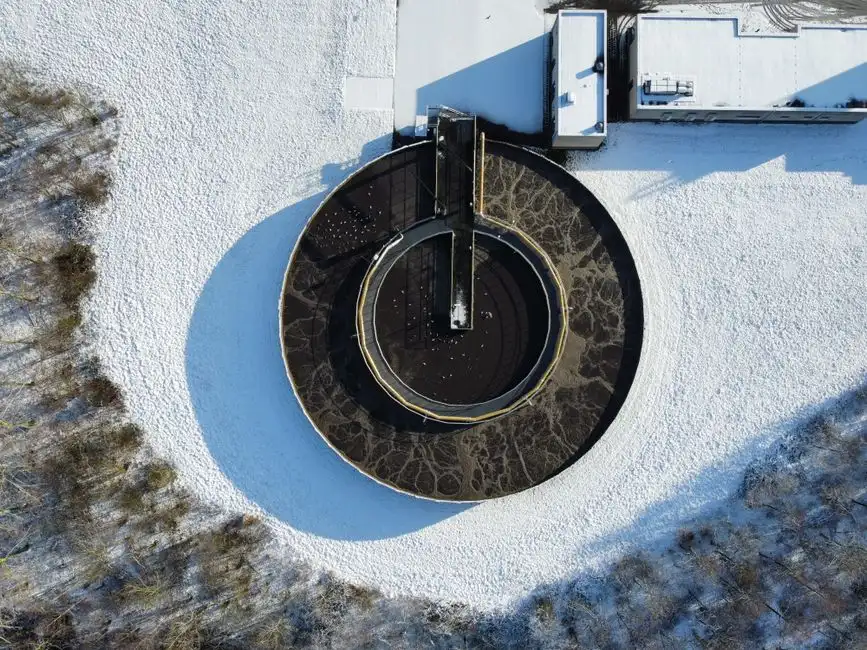
Cooling-blowdown treatment should proceed from source reduction to membrane polishing, with crystallizer or ZLD considered only after the permitted endpoint and brine route are established. First, repair leaks, eliminate unnecessary once-through cooling, correct premature blowdown triggers and assess whether self-cleaning filtration can reduce solids-driven losses before buying a large treatment plant (Genesis Water Technologies, 2026). If the cooling system can be made more efficient without compromising equipment protection, that usually reduces both makeup demand and treatment flow.
Use side-stream filtration as the cited pretreatment basis: 10–25 µm filtration at 1–5% of circulation flow for corrosion products, biofilm fragments and airborne dust before membrane systems (Genesis Water Tech, 2026). A multi-media filter for RO protection can then control residual suspended solids, while the actual SDI duty must be established from the selected membrane manufacturer and site water.
Add UF when bacteria, colloids or membrane fouling require stronger physical separation. The UF system for cooling-blowdown pretreatment and reuse described by HydropureWater uses 0.03 µm PVDF membranes, handles 2,000–40,000 L/h, accepts up to 300 ppm turbidity, and includes automatic backwash and air scour. These are equipment attributes, not confirmation that this capacity or configuration fits the proposed Sargodha duty.
Use industrial RO when the endpoint requires low-conductivity reuse. The Pakistan-specific reference gives 65–75% recovery, while the broader industrial reference gives 50–85% recovery and 95–99% salt rejection (HydropureWater, 2026; Genesis Water Tech, 2026). The industrial RO system for Sargodha blowdown reuse must therefore be selected against actual conductivity, hardness, silica and chemical data; nominal capacity alone is not a recovery guarantee.
| Process step | Design function | Selection condition | Key output to verify |
|---|---|---|---|
| Cooling optimization | Reduce unnecessary makeup and blowdown | Leaks, control logic and chemical program require review | Measured reduction in makeup and discharge |
| Side-stream or media filtration | Remove suspended solids and protect membranes | Filtrate quality and required flow are established from site analysis | Turbidity, suspended solids and SDI |
| UF | Provide stronger physical barrier against colloids and microorganisms | RO or reuse endpoint requires additional fouling control | Filtrate quality, recovery and cleaning demand |
| Industrial RO | Reduce dissolved salts for low-conductivity reuse | Endpoint requires it and membrane projection is feasible | Permeate conductivity, recovery and concentrate chemistry |
| Crystallizer or ZLD | Recover water and manage final concentrate | Permitted endpoint, concentrate route and lifecycle economics support the decision | Overall recovery, energy demand and solid-residue route |
Escalate to a crystallizer or ZLD only when the permitted endpoint, silica and hardness limits, concentrate route and lifecycle economics support it. The Islamabad guide notes that RO polishing or a fluidized-bed crystallizer may be needed at 6–8 CoC (HydropureWater, 2026). Sargodha’s operating CoC should therefore be selected jointly with the cooling chemistry and treatment train, not as an independent sustainability target.
What Treatment Does Sanitary and Process Drain Require?
Sanitary treatment should be sized around occupancy and sewage characteristics, not IT load. The Islamabad reference recommends a buried A/O package plant for staff and cafeteria flows (HydropureWater, 2026). For Sargodha, the underground integrated sewage treatment package is a candidate concept whose hydraulic capacity, treatment performance and disposal route must be checked against the project’s own flows and consent conditions.
Use an MBR where the required reuse quality justifies a compact biological system. The integrated MBR wastewater treatment system described by HydropureWater covers 10–2,000 m³/day and provides effluent filtered below 1 µm. These specifications support an initial feasibility comparison, but they do not establish the required biological loading, nutrient removal, disinfection duty or Sargodha permit compliance.
Humidification or process drain should not be treated as sewage merely because it enters the same building. Where suspended solids and biofilm carryover are present, DAF ahead of membranes can remove material that would otherwise foul an MBR. The cited design range is 10–50 mg/L suspended solids, and the Islamabad concept uses DAF to remove corrosion products and biofilm fragments (HydropureWater, 2026). The DAF unit for process-drain solids removal should be evaluated around the measured oily, colloidal and particulate load.
| Stream | Primary risk | Preferred unit-process stage | Decision trigger |
|---|---|---|---|
| Sanitary sewage and cafeteria flow | Organic loading, nutrients and pathogens | Package A/O biological treatment; MBR if reuse quality requires it | Occupancy flow, reuse endpoint and discharge conditions |
| Humidification or process drain | Corrosion products, biofilm fragments, oil or colloids | Equalization, DAF or filtration; further treatment only as required | Source chemistry and membrane-fouling risk |
| Combined sanitary and process treatment | Competing biological and solids loads | Use only after hydraulic and contaminant balances show compatibility | Demonstrated process compatibility and peak-flow control |
Evaluate DAF, coagulation and chemical dosing from influent testing. Transferring a food-processing or textile pretreatment design without confirming the Sargodha stream chemistry would add equipment without establishing its purpose.
Reuse, Compliant Discharge or Zero Liquid Discharge?
The endpoint must be fixed before membranes are selected because non-critical reuse, cooling-tower makeup reuse, compliant discharge, near-ZLD and full ZLD require different treatment trains and concentrate strategies. The zero liquid discharge engineering and cost guide is useful for understanding the advanced end of the decision, but it should not be used to assume that ZLD is required in Sargodha.
For modular physical separation followed by targeted treatment, potential non-critical endpoints include irrigation, toilet flushing and outdoor washing. Genesis Water Technologies reports that this implementation reduced makeup-water demand by 15–25% (2026). The percentage is a cited implementation result, not a guaranteed Sargodha saving; actual recovery depends on flow, chemistry, treatment performance and demand.
Cycles of concentration must be evaluated as a coupled cooling and treatment decision. At 4 CoC, blowdown is 25% of makeup-water volume; at 6 CoC it is 20%, representing a 20% reduction in blowdown volume, while scaling and biological risks increase without appropriate treatment (Genesis Water Technologies, 2026). Higher CoC should therefore follow leak control, chemistry review, filtration and a confirmed treatment route.
For RO concentrate, confirm a lawful disposal or recovery route before selecting RO recovery. A crystallizer or ZLD is a major process and energy decision, not an automatic addition. The broader ZLD reference reports 95–99% overall recovery, but cited capital cost of $3–8 million and operating cost of $5–15 per 1,000 gallons are indicative international ranges, not Sargodha prices (Genesis Water Tech, 2026).
| Endpoint | Treatment logic | Concentrate or residual-management issue | Key commercial question |
|---|---|---|---|
| Non-critical reuse | Equalization, physical separation and targeted treatment | Residual salts must not create a downstream use problem | Does the saving justify collection, treatment and distribution? |
| Cooling-tower makeup reuse | Filtration, UF and usually RO, subject to water chemistry | RO concentrate requires a confirmed route | What recovery and permeate quality can be guaranteed? |
| Compliant discharge | Treatment matched to current consent conditions | Discharge route and monitoring obligations must be confirmed | What is the lifecycle cost versus reuse? |
| Near-ZLD or full ZLD | High-recovery treatment followed by advanced brine management | Energy demand, solid residue and transport or disposal route | Does the constrained endpoint justify the added capital and operating burden? |
The commercial comparison should include avoided freshwater, avoided discharge charges, electricity, chemicals, membrane replacement, labor, spares, monitoring and final residual disposal. Without the Sargodha utility tariff, sewer charge, permit conditions and concentrate route, a project-level return on investment remains incomplete.
What Should a Sargodha Vendor Quote Include?
A comparable quote should define the engineering basis, performance guarantees, local execution risk and lifecycle cost for each stream. Request flow-by-flow sizing, equipment data sheets, membrane and chemical compatibility, duty/standby philosophy, control narratives, utilities demand, sludge and concentrate handling, commissioning tasks and warranty boundaries. Generic production capacity does not establish performance at the project’s actual peak flow and water chemistry.
The cited 50,000 GPD RO benchmark of $250,000–500,000 installed capital cost and $1.50–3.00 per 1,000 gallons operating cost is a directional comparison only, not a Pakistan or Sargodha quotation (Genesis Water Technologies, 2026). A Sargodha budget should obtain local quotations with the same duty basis, taxes, freight, civil works, installation, commissioning, training, spares and warranty scope. Membrane and chemical compatibility should be documented using the RO and UF membrane and filter-element specifications, while chemical dosing should be priced from measured loads rather than a nominal percentage.
| Commercial package | Required supplier information | Buyer check |
|---|---|---|
| Design basis | Flow schedule, water analyses, target endpoint, duty/standby philosophy | Inputs match site data and the approved concept |
| Performance guarantee | Recovery, permeate quality, energy consumption and test protocol | Guarantee is tied to actual water chemistry and operating conditions |
| Scope boundary | Civil works, power, controls, chemicals, sludge, concentrate, commissioning and training | Exclusions and provisional sums are visible |
| Execution risk | Local logistics, imported lead times, critical spares, installation sequence and warranty exclusions | Delivery risk is reflected in programme and price |
| Lifecycle cost | Energy price sensitivity, chemicals, membranes, labor, spares and disposal | Calculated over a defined period with a stated discount rate |
Require recovery and permeate-quality guarantees against the actual makeup-water analysis. Include local logistics, imported-equipment lead time, critical spares, operator training, energy-price sensitivity, membrane replacement and concentrate disposal. Ask for reference projects with comparable TDS, silica, suspended-solids and cooling-chemical conditions, and require the reference to state its treatment endpoint and operating experience. An automatic chemical dosing system should be compared on measured chemical demand, control response, material compatibility and operator interface—not tank capacity alone.
Implementation Checklist for a Sargodha Data Center
- Complete source separation, install flow metering, characterize makeup water and blowdown, and consult the Punjab Environmental Protection Agency about the receiving route and current consent conditions.
- Optimize cooling operations, leakage control and chemistry before freezing equipment capacity or committing to a higher CoC.
- Select the reuse, discharge, near-ZLD or full-ZLD endpoint. Then size filtration, biological treatment, UF, RO, disinfection, sludge handling and concentrate management against peak flow.
- Validate uncertain silica, metals, biofouling or chemical-compatibility conditions through bench or pilot testing before final equipment selection.
- Build the lifecycle-cost model from the water balance, energy, chemicals, membrane replacement, labor, spares, monitoring and residual-disposal requirements.
- Define commissioning tests, sampling points, operator training, spare parts and performance guarantees for each stream. Disinfection and solids handling should be included only where the approved endpoint requires them; an on-site chlorine dioxide generator and a plate-frame filter press for sludge dewatering are candidate scopes, not automatic inclusions.
Frequently Asked Questions
What treatment system is recommended for a data center in Sargodha?
Use separate treatment trains: a package biological system for sanitary sewage, source-specific solids removal for humidification or process drain, and an optimized cooling-blowdown train progressing from filtration to UF and industrial RO where the reuse endpoint requires it. Confirm final equipment selection from measured flows, Sargodha water chemistry and the permitted discharge or reuse route.
How much should a Sargodha data-center wastewater and cooling-blowdown treatment system cost?
No Sargodha quotation is supported by the research. Request separately priced options for sanitary treatment, blowdown filtration, UF/RO, disinfection, sludge handling and concentrate management. Use the cited $250,000–500,000 installed cost for a 50,000 GPD RO unit and $1.50–3.00 per 1,000 gallons operating cost only as international direction from Genesis Water Technologies (2026), then request Sargodha quotations with freight, civil works, utilities, commissioning and warranty scope included.
Should cooling-tower blowdown be reused or discharged in Sargodha?
Make the decision after metering actual blowdown, testing the water and establishing the receiving route and current Punjab Environmental Protection Agency conditions. Reuse is appropriate where a defined internal demand exists and the treatment train meets its quality requirements; discharge requires a confirmed lawful route and applicable consent conditions. Do not assume either route is available from the research supplied.
What should a wastewater-treatment supplier include in a data-center quotation?
Require stream-by-stream flows, water analyses, sizing calculations, equipment data sheets, membrane and chemical compatibility, recovery and permeate guarantees, utilities demand, controls, sludge and concentrate handling, commissioning tests, local logistics, delivery lead time, critical spares, training, warranty boundaries and lifecycle costs. For sizing or delivery risk, require references operating under comparable TDS, silica, suspended-solids and cooling-chemical conditions.
Which local tests and permits are needed before equipment selection?
Obtain makeup-water and blowdown analyses, suspended-solids and temperature data, residual cooling-chemical information, and a site-specific metals/metalloids screen. In parallel, identify the sewer owner or surface-water route and obtain the current Punjab Environmental Protection Agency consent requirements for the intended endpoint. No verified Sargodha-specific industrial discharge limit was available in the research, so it must be confirmed rather than imported from another city.