Which wastewater rules apply to a Lugoff-area mining or metals plant?
Mining and metals plants near Lugoff meet sewer pretreatment requirements by characterizing each wastewater stream, identifying applicable federal and state permit conditions, and meeting the local sewer authority’s limits for parameters such as metals, pH, and TSS. Federal rules may apply: 40 CFR Part 436 covers mineral mining and processing discharges, while 40 CFR Part 440 covers ore mining and dressing, with both incorporated into NPDES permits. A typical treatment sequence is equalization, pH correction, coagulation, DAF or lamella clarification, multimedia filtration, and RO when dissolved salts or metals remain. Final design depends on measured chemistry, peak flow, permit limits, sludge handling, and reuse targets.
The applicable rule depends on the operation and the discharge pathway, not simply on the term “mine.” The US EPA states that 40 CFR Part 436 governs wastewater from mine drainage, mineral processing, and stormwater runoff. It was promulgated in 1975 and amended in 1976, 1977, 1978, and 1979; EPA says those requirements are incorporated into NPDES permits (US EPA, 2026-02). The agency’s regulation is the federal floor, not a substitute for the current permit or local pretreatment requirements.
For metal-bearing ore operations, 40 CFR Part 440 covers wastewater from ore mines and processing operations. Its listed sources include groundwater generated during extraction, equipment-cooling and dust-control water, precipitation entering mines, milling and beneficiation, chemical leaching, and contaminated stormwater at storage facilities. EPA says the Ore Mining Effluent Guidelines are incorporated into NPDES permits (US EPA, 2026). The precise applicability provisions in Part 440 must still be checked for the proposed facility and process.
| Regulatory layer | What it governs | Document the designer needs |
|---|---|---|
| 40 CFR Part 436 | Mine drainage, mineral-processing wastewater, and stormwater runoff; requirements are incorporated into NPDES permits (US EPA, 2026-02). | Current NPDES permit and applicable subpart. |
| 40 CFR Part 440 | Wastewater from covered ore mining, milling, beneficiation, leaching, support water, and contaminated stormwater (US EPA, 2026). | Applicability determination, current NPDES permit, and discharge monitoring requirements. |
| State authorization | State-administered water-discharge conditions and related implementation requirements. | Current state permit or approval and correspondence with the agency. |
| POTW industrial pretreatment | Local sewer authority limits and discharge conditions for industrial users. | Local sewer permit, sewer-use ordinance, written local limits, monitoring, reporting, and fee requirements. |
The EPA source lists several Part 436 subparts as reserved, including Dimension Stone, Lightweight Aggregates, Lithium, Ball Clay, Feldspar, Talc/Steatite/Soapstone/Pyrophyllite, and Garnet (US EPA, 2026-02). A reserved subpart requires the operator to verify whether current federal numeric limits apply; it is not a basis for assuming that no local limits apply.
The supplied research contains no Lugoff-specific sewer limits, flows, or prices. A Tenino-area or generic POTW limit cannot be substituted for a verified Lugoff requirement. Before selecting equipment, obtain the current NPDES permit, state discharge authorization, local sewer permit, sewer-use ordinance, and POTW written limits. The mining acquisition wastewater due diligence provides a useful document-review pattern, but local requirements must come from the receiving authority.
Characterize the wastewater before choosing a treatment train
Mine-water treatment cannot be designed from a generic metal or TSS limit because drainage, dewatering, process water, tailings-pond effluent, and stormwater carry different chemistry and flow behavior. The Society for Mining, Metallurgy & Exploration notes that impacts depend on the commodity, deposit, extraction method, and processing method, including crushing, screening, washing, flotation, and leaching (SME, technical briefing).
Acid mine drainage, also called acid rock drainage, can form when oxygen and water react with sulfide minerals such as pyrite and pyrrhotite in exposed rock or tailings. The resulting acidic water can mobilize metals, sulfate, and other dissolved solids (SME, technical briefing). Dewatering discharge may vary with geology. Process water may contain reagents and dissolved ore constituents, while tailings-pond effluent may contain fine solids, processing chemicals, and leached metals. These streams should not be assumed interchangeable.
| Wastewater stream | Potential characteristics | Data needed before design |
|---|---|---|
| Acid mine or rock drainage | Low pH; mobilized metals; sulfate and dissolved solids. | pH, flow, full metals profile, conductivity or TDS, alkalinity where relevant. |
| Dewatering discharge | Variable geology-dependent quality; possible significant metal loading. | Representative sampling by operating condition, peak and average flow, pH and metals profile. |
| Process water | Reagents, dissolved ore constituents, and potentially high TDS. | Reagent inventory, pH, metals, conductivity or TDS, and discharge frequency. |
| Tailings-pond effluent | Fine solids, processing chemicals, and leached metals. | Suspended solids, metals, pH, flow profile, and chemical inventory. |
| Stormwater | Variable solids, acidity, and metal loading. | Representative wet-weather events, flow estimate, source areas, and permit monitoring points. |
Request representative peak and average flows, pH, the metals profile, suspended solids, conductivity or TDS, the process-reagent list, and the local limits for pH, metals, and TSS. Sampling design should identify whether a permit governs a point source, an aggregate discharge, stormwater, or another category; the supplied research does not provide a Lugoff sampling or flow schedule.
Size equalization and pumping against the highest anticipated daily discharge and peak flows, because those conditions drive basin volume and pump selection. That conclusion is consistent with the supplied mining-water treatment research, which identifies peak flow—not average flow—as the governing condition for equalization and pumping. Flow values themselves must come from the site.
Treatment should be integrated with pollution prevention rather than used to excuse uncontrolled drainage. SME supports preventing or minimizing acid drainage and contaminant migration, maximizing water recycling, and incorporating pollution prevention and treatment into mine planning throughout the mine lifecycle (SME, technical briefing). A comparison of biological treatment options for mining wastewater may be relevant only after the source characterization establishes whether biological treatment is relevant.
How the pretreatment process removes metals and solids
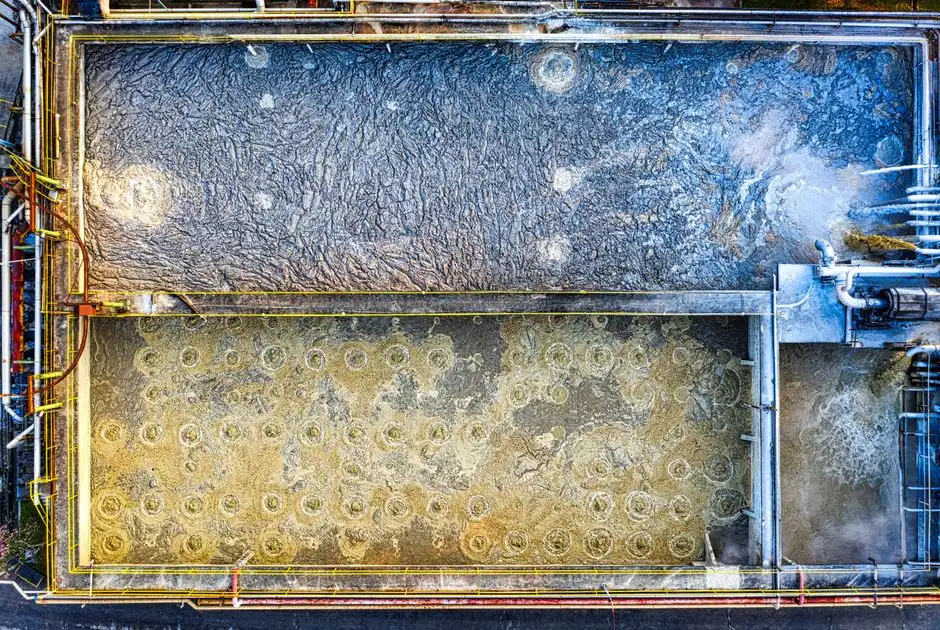
A defensible mining wastewater treatment train normally assigns one contaminant-removal function to each stage: equalization buffers flow and chemistry, pH correction supports precipitation, coagulation and flocculation prepare solids for separation, DAF or lamella removes the bulk solids, filtration protects downstream membranes, and RO addresses residual dissolved metals and salts. The final configuration must be selected from measured chemistry and verified discharge limits, not from a standard package name.
Lime can raise pH so dissolved metals precipitate as hydroxides and can also remove gypsum. A PMC review cited in the supplied research describes lime raising pH above 10 before thickening (PMC review, 2024-02). That operating range must be validated through jar and pilot testing because the correct pH depends on the metals present and the precipitation objective. Coagulation and flocculation then create settleable or floatable flocs. Chemical selection should match the floc required by the next separation step rather than follow a generic chemical recipe.
| Process step | Primary function | Design information required |
|---|---|---|
| Equalization | Buffers peak flows and influent chemistry variation. | Peak and average flow, diurnal profile, required detention and mixing basis. |
| pH correction | Supports metal-hydroxide precipitation and gypsum removal. | Influent pH, alkalinity, metals profile, target pH, chemical demand, and settleable-solids testing. |
| Coagulation and flocculation | Forms flocs suitable for the selected separation method. | Jar tests, coagulant and flocculant compatibility, mixing energy, and expected sludge characteristics. |
| DAF or lamella | Removes precipitated and suspended solids. | Floc behavior, oil and fines content, hydraulic loading, underflow or float removal, and footprint. |
| Multimedia filtration or UF | Removes turbidity and colloids before RO. | Required outlet SDI, flow, membrane material, flux, and cleaning strategy. |
| RO polish | Removes residual dissolved metals and salts. | Feed chemistry, recovery conditions, rejection basis, concentrate management, and verified discharge target. |
| Sludge dewatering | Separates precipitated solids from the liquid treatment stream. | Solids generation, settleability, cake target, cycle time, and disposal or beneficial-use pathway. |
Use DAF when the treatment objective calls for buoyant floc, oil, or floatable fines. A DAF system for floatable mining solids must be evaluated against actual floc behavior, solids loading, and polymer compatibility. Use lamella clarification where sludge volume and footprint drive the decision, particularly for metal-hydroxide sludge. The high-efficiency sedimentation tank is relevant to that comparison, but a catalogue selection cannot substitute for settling and hydraulic testing.
Multimedia filtration removes residual turbidity and colloids and protects membranes. Specify the required SDI after filtration rather than relying only on inlet turbidity. An multimedia filter for RO pretreatment should therefore be specified against outlet membrane-protection requirements, not simply filter outlet clarity.
RO is the final polishing step when dissolved salts or trace metals remain above the applicable limit. AMPAC USA reports more than 99% rejection of dissolved metals and salts (AMPAC USA, 2025-09). That is a literature benchmark, not a site guarantee. Chemical precipitation also creates a sludge-management obligation; a plate-and-frame press may be used to dewater metal-hydroxide sludge, and cake production must be included in the overall plant design.
Choose clarification and polishing from the discharge target
DAF and lamella clarification are not interchangeable names for the same function: DAF separates buoyant floc, while lamella separates settled floc using inclined plates. The correct choice follows from the wastewater, the selected precipitation chemistry, and the physical constraint that matters most to the site.
| Condition | Preferred technology | Supplier verification required |
|---|---|---|
| Buoyant floc, oil, or floatable fines | DAF | Float loading, air-to-solids ratio, polymer compatibility, surface-solids removal, and expected effluent quality. |
| Heavy metal-hydroxide sludge with a footprint constraint | Lamella clarification | Solids loading, plate spacing, settling area, underflow characteristics, and sludge removal. |
| Fine colloids before RO | UF or multimedia filtration | Required feed condition, target SDI, flux, cleaning method, and validated membrane-feed data. |
| Dissolved salts or metals remain above the local limit | Industrial RO | Feed chemistry, recovery basis, rejection, pretreatment, concentrate route, and performance test protocol. |
DAF is the preferred clarification option for buoyant floc, oil, or floatable fines. Lamella is preferred when heavy metal-hydroxide sludge and footprint constraints dominate. A DAF system for floatable mining solids should therefore be selected for the right physical separation mechanism, not merely because it is a common mining-water unit operation.
For fine colloids before RO, UF or multimedia filtration should follow the required feed condition. The supplied UF catalog specifies 0.03-micron PVDF membranes, capacity from 2,000 to 40,000 L/h, automatic backwash, and air scour. These are catalogue specifications, not a Lugoff sizing recommendation. The site must supply actual flow, chemistry, target SDI, and operating conditions.
Use RO when residual dissolved metals or salts must be removed or when reuse economics justify the added treatment. AMPAC USA reports 50–70% recovery for AMD feed and 70–85% recovery for the RO stage of a ZLD train (AMPAC USA, 2025-09). An industrial RO polishing system must be guaranteed against the verified discharge limit and actual feed chemistry, not against a generic recovery claim.
Control the train, monitor the permit, and manage the sludge

Treatment performance is only auditable when chemical dosing, instrumentation, sampling, reporting, and sludge handling operate as one compliance system. A one-time treatment skid without a defined control and monitoring plan does not demonstrate continuous compliance with a permit.
- Specify PLC-controlled dosing of lime, coagulant, flocculant, and pH adjuster, with pre-wired controls and HMI integration. The automatic chemical dosing system should be linked to the plant control narrative, interlocks, alarms, and chemical-reservation strategy.
- Include continuous pH, flow, and conductivity monitoring. The supplied LiqTech reference identifies these as useful control and self-monitoring parameters (LiqTech, 2025-08).
- Require a POTW self-monitoring and reporting plan that defines sampling points, frequencies, calibration, record retention, laboratory methods, notification, and response actions for excursions.
- Connect chemical-precipitation residuals to sludge collection, thickening, and dewatering. A plate-and-frame filter press for chemical-precipitation sludge requires a defined cake target, cycle time, filtrate-return arrangement, and disposal pathway.
The control narrative should also address automatic dose adjustment, chemical-tank capacity, low-level and high-high pH interlocks, power-loss behavior, flush sequences, and data export. These items are necessary engineering inputs even where the supplied research provides no site-specific operating values.
Sludge is part of the treatment train, not a residual issue for operations. pH correction and chemical precipitation generate metal-bearing solids whose volume and dewatering characteristics affect reagent use, filtrate quality, and operating labor. The contractor should identify every aqueous and solid return stream, including filter-press filtrate and DAF subnatant recycle.
The supplied research provides no complete-train price for a Lugoff operation. Equipment selection and cost should therefore rest on a site-specific quotation and documented basis of design, including flow, chemistry, local limits, controls, membranes, sludge handling, commissioning, and O&M. Any proposed reuse benefit should also be tied to a defined water balance rather than assumed.
Build a bid package that reduces compliance and sizing risk
An auditable bid package starts with the same source-by-source wastewater data used to establish the discharge target. If those documents are missing, bidders will either price around unresolved risk or standardize an unsuitable train. The buyer should issue the permit limits, sampling results, process description, flow basis, sludge criteria, and reuse objectives as mandatory attachments.
| Required bid input or deliverable | What the buyer should state or require |
|---|---|
| Wastewater characterization | Source-by-source peak and average flow in m³/h, representative pH and metal profile, suspended solids, conductivity or TDS, and reagent inventory. |
| Discharge basis | The sewer authority’s written limits for metals, pH, and TSS, plus the applicable NPDES and state conditions. |
| Treatment objectives | Desired recovery percentage, reuse application, and whether zero-liquid discharge is required. |
| Process boundaries | Defined equalization, pH correction, coagulation, DAF or lamella, multimedia filtration, UF, and RO duties, including which streams each unit receives. |
| Performance commitments | Guaranteed outlet performance, guaranteed process flow, chemical-consumption assumptions, membrane-recovery conditions, and pass/fail test methods. |
| Execution scope | Control narratives, startup and training scope, O&M requirements, spare parts, and sludge-handling responsibilities. |
Ask each bidder to define the treatment boundaries and the evidence supporting them. For example, a bidder relying on RO should state the feed-water assumptions, expected recovery at those assumptions, concentrate disposition, pretreatment criteria, and outlet guarantee. A clarification supplier should identify solids loading, expected floc behavior, hydraulic capacity, and underflow or float handling.
Use the AMPAC USA literature result of more than 99% rejection of dissolved metals and salts as a benchmark only (AMPAC USA, 2025-09). The final guarantee must be tied to actual feed chemistry and the verified discharge limit. Likewise, the reported 40–60% reduction in freshwater consumption for RO-enabled internal reuse is an economic evaluation input, not a guaranteed site outcome (AMPAC USA, 2025-09). The industrial water-consumption reduction strategies can support the reuse business case, while the 2025 industrial water-reuse technology and compliance review provides context for comparing alternatives.
Before award, reconcile every guarantee with the NPDES permit, state authorization, POTW permit, written local limits, and approved water balance. Reject a proposal that leaves feed chemistry, peak flow, concentrate management, sludge disposal, or local limits as assumptions outside the quotation.
Frequently Asked Questions
Does treatment equipment alone establish compliance for a Lugoff mine or metals plant?
No. The current NPDES permit, state authorization, local sewer permit, sewer-use ordinance, and written POTW limits must be reviewed together. Equipment should be selected against those conditions and demonstrated through the required monitoring and reporting plan.
What cost inputs are needed for a complete pretreatment quotation?
Request a site-specific quotation based on peak and average flow, representative chemistry, verified local limits, sludge criteria, reuse objectives, controls, membrane treatment, and O&M scope. The supplied research contains no Lugoff complete-train price, so a defensible price cannot be stated without those inputs.
How should a mining wastewater treatment supplier be qualified?
Check installations using the same unit operations at comparable flow scale. Review chemical-dosing and PLC integration, membrane-feed conditioning, performance guarantees, commissioning, training, O&M support, and how the supplier tested each performance claim. Relevant unit operations can include DAF or lamella, multimedia filtration, UF, RO, and sludge dewatering.
Should a Lugoff-area plant choose DAF or lamella clarification?
Choose DAF for buoyant floc, oil, or floatable fines. Choose lamella for heavy metal-hydroxide sludge where sludge volume and footprint drive the design. Confirm the decision with representative settling, floatation, and hydraulic testing rather than relying on catalogue descriptions.
When is RO necessary for mining wastewater pretreatment?
RO is appropriate when residual dissolved metals or salts must be removed to meet the verified discharge limit, or when reuse economics justify membrane treatment. It is unnecessary as an automatic default where precipitation, clarification, and filtration already achieve the required quality.
Related Equipment
- industrial RO polishing system — specifications, capacity range, and technical data