Why Tampa Food and Beverage Wastewater Forces the DAF-vs-Clarifier Question
Tampa-area food and beverage plants — citrus juice concentrate, citrus pulp processing, seafood (oyster, shrimp, finfish), dairy, soft drink bottling, and bottled water — produce wastewater that rarely behaves like a textbook municipal stream. FOG on these sites routinely runs 200–1,500 mg/L, BOD 1,500–5,000 mg/L, TSS 500–3,000 mg/L, and pH swings 3–11 from clean-in-place chemicals (per industry-typical food/bev wastewater characterization, 2026). The Hillsborough County POTW and City of Tampa industrial pretreatment programs enforce 2026 discharge limits that typically cap oil and grease at 100 mg/L daily max, TSS at 250–300 mg/L daily max, and pH at 6.0–10.0 — a clarifier-only train rarely meets the FOG number on raw food/bev influent.
Florida's Gulf Coast climate compounds the problem. Warm ambient temperatures and long retention times in unconditioned tanks accelerate anaerobic breakdown of settled FOG, generating hydrogen sulfide and floating sludge that punishes under-performing clarifiers. In 2024–2025, Hillsborough County's industrial pretreatment program increased inspection frequency on food processors and tightened surcharge schedules for FOG and temperature exceedances (Hillsborough County industrial pretreatment updates, 2024–2025). The 2026 cost of non-compliance — surcharges, consent-order monitoring, and remediation — now exceeds the incremental operating cost of running a properly sized DAF for most mid-size Tampa plants, which is why the DAF-vs-clarifier question has stopped being academic.
How a Dissolved Air Flotation System Works for Food and Bev Wastewater
A dissolved air flotation system removes FOG and fine suspended solids by attaching them to microbubbles, not by waiting for them to sink. Recycle water is pressurized to 60–80 psig in a saturator vessel until dissolved air reaches near-saturation; on depressurization into the flotation tank, 30–50 micron microbubbles form and rise through the influent, capturing oil droplets, FOG globules, and chemically flocculated fine solids (Clearwater Industries DAF specifications, 2026-04). The floated blanket is scraped by a paddle skimmer into a collection trough; heavier settleable solids drop to a bottom auger or hopper for separate removal. This dual-mode handling — floatables plus a fraction of settleables — is one reason DAF fits food/bev streams more cleanly than a pure clarifier.
Chemical conditioning upstream is non-optional on food/bev waste. Coagulant (alum, ferric chloride, or polyaluminum chloride) plus an anionic or cationic polymer flocculant grows the floc to a size bubbles can lift, and jar testing is the standard method for setting dose (Clearwater Industries, 2026-04). Hydraulic retention time inside the DAF tank is typically 20–40 minutes, an order of magnitude shorter than a clarifier's 1.5–2.5 hours (per WEF Sedimentation Fact Sheet, as cited by Bristola, 2026), which is why a DAF footprint runs 60–80% smaller than an equivalent clarifier. The dissolved air flotation (DAF) system spans 4–300 m³/h across 13 standard sizes, which covers the typical 50–250 m³/day small-to-mid-size Tampa processor in a single skid or two-skid modular configuration.
How a Gravity Clarifier Works and Where It Falls Short on Food/Bev Streams
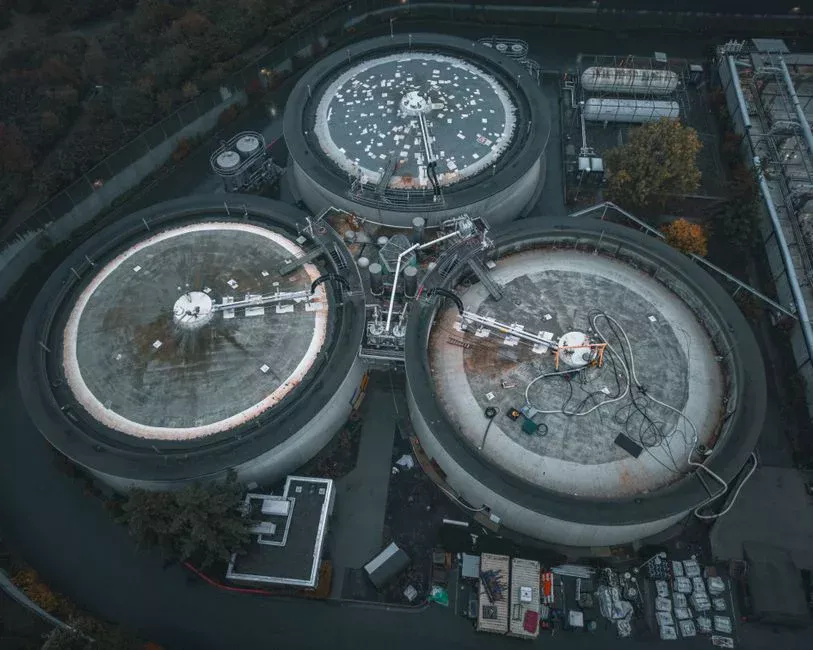
A gravity clarifier relies on 1.5–2.5 hours of hydraulic retention time to settle suspended solids under quiescent conditions (Bristola, citing the WEF Sedimentation Fact Sheet, 2026). Circular units use slowly rotating scraper arms — tip speed around 10 ft/min — to push settled sludge to a central hopper; rectangular units use chain-and-flight scrapers to a cross-collector. Primary clarifier sludge reaches 2–6% dry solids (per Andreoli et al., as cited by Bristola, 2026), which is downstream-compatible with a plate and frame filter press for sludge dewatering; secondary (waste activated) sludge is far more dilute at 0.6–1.0% dry solids and is rarely the relevant stream at a food/bev plant running primary treatment only.
The clarifier's failure mode on Tampa food/bev streams is mechanical and predictable. Emulsified FOG, free oils, and light organic solids do not settle under gravity — they pass through the clarifier, coat the effluent weir, or carry over into the discharge, routinely breaching the 100 mg/L FOG daily max that Hillsborough County and City of Tampa pretreatment programs enforce. Hopper geometry must meet Ten States Standards (minimum 1.7:1 slope, withdrawal lines ≥6-inch diameter at ≥3 ft/s) to prevent bridging, anaerobic gas lift, and H₂S accumulation (Bristola, 2026). Secondary clarifier blanket depth should stay under 1–3 feet; once it climbs, rising sludge pushes effluent TSS past the 30 mg/L 30-day average required by 40 CFR 133.102. A HydropureWater high-efficiency lamella sedimentation tank addresses the footprint weakness of a conventional clarifier by adding inclined plates, but it still cannot lift emulsified FOG — that is the structural gap a DAF fills.
DAF vs Clarifier for Tampa Food and Bev: 2026 Side-by-Side Comparison
The matrix below is the decision artifact a procurement or environmental engineer can bring into a vendor meeting. Numbers are drawn from Clearwater Industries DAF performance ranges (2026-04), Bristola's clarifier settling and sludge data (2026), and standard 40 CFR 133.102 secondary treatment thresholds.
| Parameter | Dissolved Air Flotation (DAF) | Gravity Clarifier (primary, circular) |
|---|---|---|
| FOG removal efficiency | 70–95% on emulsified and free FOG (Clearwater, 2026-04) | <20% on emulsified FOG; relies on gravity settling only (Bristola, 2026) |
| TSS removal efficiency | 80–95% with coagulant + polymer | 50–70% with coagulant; lower without CEPT |
| Footprint (relative) | 20–40% of equivalent clarifier | Largest civil footprint in the train |
| Hydraulic retention time | 20–40 minutes | 1.5–2.5 hours |
| Typical influent FOG range | 100–3,000+ mg/L | <150 mg/L; degraded above that |
| Sludge dry solids | 3–8% float; thicker, easier to dewater | 2–6% primary underflow |
| OPEX driver | Polymer dose + saturator pump electricity | Scraper torque maintenance + sludge hauling |
| FDEP Chapter 62-625 / POTW fit | Hits 100 mg/L FOG daily max; meets 40 CFR 133.102 TSS on most streams | Rarely meets 100 mg/L FOG daily max on raw food/bev |
| Best-fit Tampa sub-sector | Citrus juice, seafood, beverage bottling, dairy, any emulsified-oil process | Grit removal, high-density settleables, post-DAF polish, some brewery applications |
| Retrofit ease on constrained Tampa sites | High — small footprint, modular skids | Low — large tank + deep hopper civil works |
The FOG row is decisive. A Tampa citrus juice concentrate plant discharging 600 mg/L FOG to a clarifier will exit the clarifier with most of that FOG still in the water; a DAF at the same load removes 70–90% of it in a single pass and brings the effluent under the 100 mg/L daily max without a polish stage.
Tampa and Florida 2026 Regulatory Map: FDEP, POTW, and FOG Limits
FDEP Chapter 62-625 establishes the framework for industrial wastewater pretreatment in Florida, and local POTW programs — Hillsborough County and City of Tampa among them — layer site-specific numeric limits on top (FDEP Rule 62-625.400 series, 2026). Operators should always confirm the current limits with their receiving POTW before locking in equipment; POTW limits can be more stringent than the state baseline and change on a permit-renewal cycle. FOG caps in the Tampa area typically run 100–200 mg/L daily max with 50–100 mg/L monthly average, and these numbers — not the BOD or TSS cap — are the binding constraint for most food/bev plants.
If a plant discharges to surface water rather than a POTW, the secondary treatment standard at 40 CFR 133.102 applies: 30 mg/L TSS 30-day average, 45 mg/L 7-day average, ≥85% removal. A clarifier-only train on raw food/bev influent rarely hits this, which is why direct dischargers in the citrus and seafood processing corridors are required to add biological or advanced treatment downstream. 40 CFR Part 503 governs biosolids handling for any sludge leaving the plant, whether that sludge is DAF float or clarifier underflow routed to a plate and frame filter press for dewatering. In 2024–2025, Hillsborough County increased inspection frequency on food processors and revised surcharge schedules for FOG, TSS, and temperature exceedances (per Hillsborough County industrial pretreatment program updates, 2024–2025); the financial delta between compliant and non-compliant operation now outweighs the DAF operating premium at most mid-size plants.
2026 Decision Framework: Which Technology Fits Your Tampa Plant
Use this four-branch logic to map your influent profile to the right equipment, and use the chemical and headworks links as a forcing function for the supporting systems.
- Choose DAF when influent FOG is above 150 mg/L, BOD is above 1,500 mg/L, emulsified oils are present, or the site footprint is constrained. This covers most Tampa citrus juice, seafood processing, beverage bottling, and dairy operations. Pair the DAF with a properly sized automatic coagulant and polymer dosing system upstream to hit the 80–95% TSS removal range.
- Choose gravity clarifier when the influent is dominated by high-density settleable solids, FOG is below 100 mg/L, and ample footprint exists. Typical fits: produce washing, some brewery operations, or a post-DAF polish step in a hybrid train.
- Choose hybrid DAF + lamella clarifier train when flow exceeds 100 m³/h with FOG in the 200–500 mg/L range. The DAF handles FOG and light solids; the lamella polish, such as a HydropureWater inclined-plate sedimentation tank, captures the remaining TSS to meet a 30 mg/L POTW cap without expanding civil works.
- Always install rotary bar screening at headworks before either technology. A rotary mechanical bar screen for headworks protects the DAF or clarifier from rags, plastics, fruit pulp, and shellfish debris that would otherwise jam scrapers and skimmers — a non-negotiable step for Tampa citrus and seafood processors.
A practical cross-check: if your jar test cannot reliably remove FOG to under 100 mg/L on a settling-only basis, the clarifier path is closed and a DAF — or DAF plus lamella — becomes the engineering answer, not a preference.
2026 Cost Bands and ROI Snapshot for Tampa Food and Bev Plants
DAF CAPEX in 2026 typically runs $40,000–$250,000 depending on flow rate and material of construction, anchored to the 4–300 m³/h standard model range (DAF pricing band, 2026). Clarifier CAPEX on a per-unit basis is often lower, but the larger tank diameter and deeper hopper add civil and structural cost that erases the apparent saving on constrained Tampa sites. DAF OPEX is polymer- and electricity-driven (recirculation pump and air saturator), while clarifier OPEX is lower in chemicals but higher in sludge hauling and scraper mechanism maintenance.
For a mid-size Tampa food plant at 50–100 m³/h, a DAF plus lamella polish typically pays back the DAF premium over a clarifier in 18–36 months through reduced FOG surcharges, lower sludge hauling volume from a thicker float, and avoided FDEP non-compliance penalties — these are illustrative payback ranges, not guaranteed figures, and depend on local surcharge structure and influent variability. Sludge dewatering downstream of either system with a plate and frame filter press for sludge dewatering recovers additional value by cutting hauled waste volume; budget $15,000–$80,000 for a small-to-mid press unit depending on plate count and capacity. Treat all of these as 2026 budget anchors to bring to vendors, not as fixed quotes.
Frequently Asked Questions
What FOG removal efficiency can a Tampa food plant expect from a DAF versus a clarifier?
A properly sized DAF with chemical conditioning typically removes 70–95% of emulsified and free FOG in a single pass, while a gravity clarifier removes under 20% on emulsified FOG because oils do not settle under quiescent conditions (Clearwater Industries, 2026-04; Bristola, 2026). For a Tampa plant facing a 100 mg/L FOG daily max, a DAF is the realistic path to compliance on raw food/bev influent.
Does a DAF meet FDEP Chapter 62-625 and Hillsborough County POTW pretreatment limits?
A DAF sized to the influent load and paired with coagulant plus polymer dosing can meet typical Tampa-area FOG caps of 100–200 mg/L daily max and TSS caps of 250–300 mg/L, and can hit the 30 mg/L TSS 30-day average under 40 CFR 133.102 for direct dischargers (FDEP Rule 62-625, 2026; 40 CFR 133.102). Confirm site-specific POTW limits with Hillsborough County or the City of Tampa before finalizing equipment selection.
When does a hybrid DAF plus lamella clarifier make sense for a high-load food plant?
A hybrid DAF plus lamella clarifier train is the right call when flow exceeds roughly 100 m³/h and FOG runs 200–500 mg/L — the DAF lifts FOG and light solids, and the lamella polish captures remaining TSS to meet a 30 mg/L POTW cap without expanding civil works. For Tampa plants in this band, a dissolved air flotation (DAF) system upstream of a HydropureWater high-efficiency lamella sedimentation tank is the most common 2026 configuration.
How should DAF float or clarifier underflow sludge be handled downstream?
Route DAF float (3–8% dry solids) or clarifier primary underflow (2–6% dry solids) to a plate and frame filter press for dewatering; this cuts hauled waste volume substantially and produces a cake that can be handled under 40 CFR Part 503 biosolids rules. For most Tampa food plants, pairing either clarifier with a filter press is the standard 2026 sludge handling path.