Why the DAF-vs-Clarifier Question Is Different for Organic Chemicals Plants
SIC 2869 / NAICS 325 organic chemicals plants discharge a wastewater envelope that breaks the standard food-or-refinery DAF comparison: COD 1,000–8,000 mg/L, sulfates 500–3,000 mg/L, total phenols 5–200 mg/L, and a pH that swings from 2 to 11 across batch reactors (per 40 CFR Part 414 subparts A–F organic chemicals categorical standards). The 2026 frame for any Foster facility discharging to the Narragansett Bay Commission sewer system is the federal categorical pretreatment standard in 40 CFR Part 414 layered on top of site-specific NBC local limits — not a generic POTW FOG ceiling. A standalone clarifier is defensible only on a low-FOG stream: the Ecologix 2026 DAF-vs-clarifier case shows a clarifier reaches 70% oil/grease removal versus 95% on DAF, and that 25-point gap is the difference between compliance and a surcharge for most SIC 2869 feeds. The deeper problem is the trace-organics tail — the EPA 1978 Argonne refinery study identified ~304 neutral-fraction organics (n-alkanes, alkylated benzenes, naphthalenes, phenols, pyridines, quinolines) in DAF effluent at 10–700 ppb, of which activated sludge removed >99% but a clarifier or multimedia filter removed ~0%. That single result is the engineering reason a DAF in 2026 is sized as a primary in front of biology, not as a stand-alone treatment. A Foster EHS manager framing the decision as "DAF or clarifier" is asking the wrong question; the right one is "DAF then clarifier, in series with equalization and biology." For a parallel Texas-jurisdiction treatment of the same categorical-pretext logic, see the 2026 pretreatment compliance guide for chemical plants.
Typical Influent Envelope at a Foster Organic Chemicals Plant
The 2026 design envelope for an SIC 2869 plant in the 50–500 m³/h range should be sized against these typical headworks parameters: TSS 200–1,500 mg/L, FOG 50–600 mg/L, COD 1,000–8,000 mg/L, BOD₅ 400–3,000 mg/L, total phenols 5–200 mg/L, sulfates 500–3,000 mg/L, pH 2–11, and temperature 20–55 °C. Batch operations and product-changeover drives wide diurnal swings — flow at 1.5–3× design average and pollutant load at 2–4× — which is the operating reality a clarifier cannot absorb without equalization. The floatable fraction (unreacted monomers, lube oils, light solvents) is exactly the particle class that 30–50 μm micro-bubbles (Clearwater Industries process guide) are designed to capture; the same fraction rises as an oil sheen on a clarifier and escapes over the launder. The trace-organics tail — 10–700 ppb of n-alkanes, alkylated benzenes, naphthalenes, phenols, pyridines, quinolines per the 1978 EPA DAF study (ANL/WR-78-2) — does not show up on a TSS or FOG jar test, but it determines the sizing of the downstream activated-sludge or MBR stage. Treat this envelope as a hard design input before you look at any vendor cut sheet.
| Parameter | Typical 2026 range (SIC 2869) | Design implication |
|---|---|---|
| TSS | 200–1,500 mg/L | Drives DAF air-to-solids ratio; clarifier needs 2–4 h HRT |
| FOG | 50–600 mg/L | Clarifier fails above ~150 mg/L; DAF rated to 600+ |
| COD | 1,000–8,000 mg/L | Sets biological-stage F/M and HRT |
| BOD₅ | 400–3,000 mg/L | Equalization basin sizing |
| Total phenols | 5–200 mg/L | Triggers carbon polishing if NBC local limit is tight |
| Sulfates | 500–3,000 mg/L | Concrete spec, odor control on equalization |
| pH | 2–11 | Pre-DAF neutralization to 6.5–7.5 mandatory |
| Temperature | 20–55 °C | Reactor material selection; affects saturator performance |
How a DAF Unit Actually Treats Chemical Wastewater
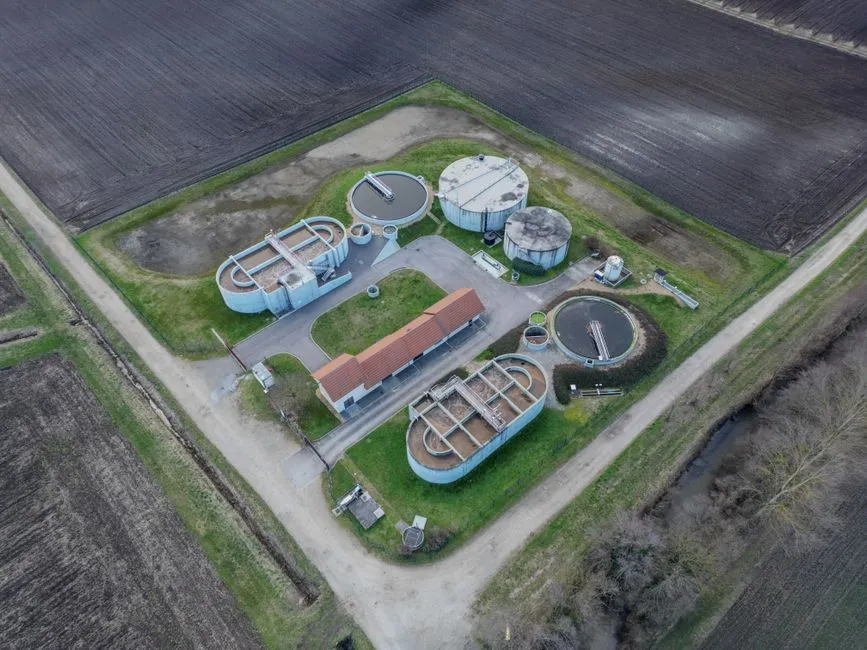
A DAF separates on buoyancy, not settling, and the mechanism is what makes it the right primary for a Foster organic chemicals feed. The Clearwater Industries process guide describes the five physical steps: (1) clean-water fill of the tank, (2) a pressurized recycle stream at 4–6 bar that pulls clarified water from the discharge, (3) air injection and saturation at that pressure, (4) depressurization into the flotation tank where 30–50 μm micro-bubbles nucleate on floc particles and float them, and (5) surface skimming into a collection trough while clarified water exits below the sludge blanket. Typical 2026 design numbers for a DAF-class unit: 4–300 m³/h throughput, hydraulic residence time 20–40 min, recycle ratio 20–30%, and an air-to-solids ratio of 0.02–0.05 kg air per kg TSS. Polymer flocculation upstream is not optional on an SIC 2869 feed — DAF alone will not float colloidal or emulsified monomer without cationic polyacrylamide or ferric chloride dosing delivered through a controlled automatic chemical dosing skid. The realistic 2026 baseline is a PLC-controlled DAF with pH, coagulant, and polymer trim, run by an operator-trained plant — not a passive tank. For a packaged unit sized to a Foster chemical plant flow, see the dissolved air flotation system.
How a Lamella Clarifier Treats Chemical Wastewater Differently
A lamella clarifier separates on settling, and the inclined-plate geometry is what gives it the throughput that lets a Foster plant use it as a polish stage rather than as a primary. A 60° lamella pack with 50–80 mm plate spacing and sludge recirculation achieves 20–40 m/h surface-loading rate versus 1–3 m/h for a conventional clarifier (HydropureWater lamella spec) — that is the engineering reason a single small-footprint unit can handle 50–500 m³/h. For a Foster plant, design the plate area for 1.2× peak flow and run sludge recirculation at 50–100% of forward flow to keep the sludge blanket fluid. The clarifier's hard limitation on the chemical-plant envelope is FOG: above roughly 150 mg/L, oil lifts with the sludge blanket and escapes over the launder, which is why it cannot replace DAF as a primary on a Foster SIC 2869 feed. Position the lamella as a secondary clarifier or a thickener downstream of DAF and equalization, not as a primary. For a packaged unit matched to a mid-sized chemical plant, see the lamella clarifier spec sheet.
Side-by-Side: DAF vs Clarifier for a Foster Organic Chemicals Plant
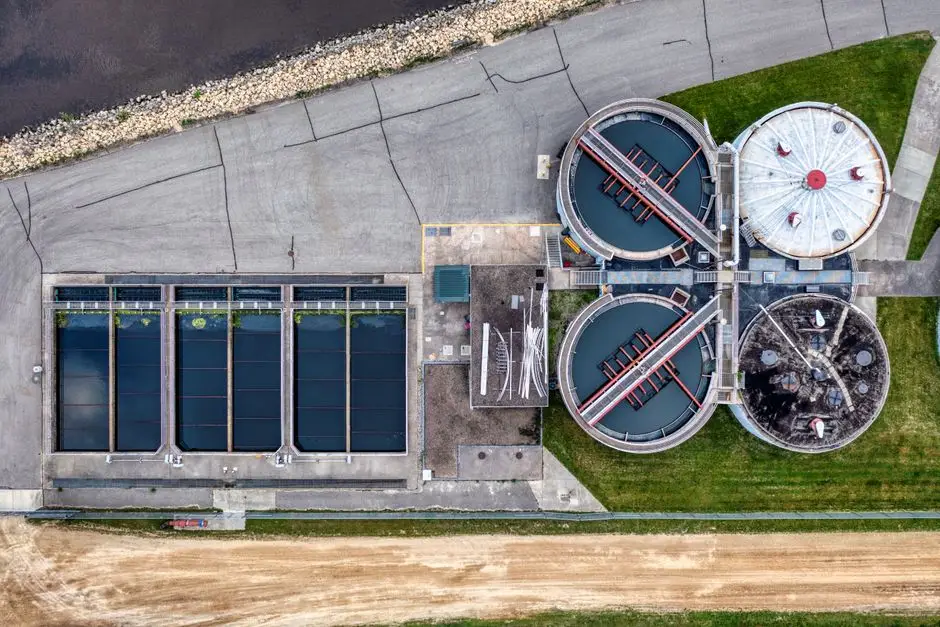
The procurement decision lives in this table. The DAF wins on FOG, footprint, and the regulatory frame (it is the categorical primary); the lamella clarifier wins on TSS polishing, OPEX, and biological-sludge separation. Neither wins alone. Ecologix's 2026 selection guide gives the canonical numbers — 95% oil/grease removal on DAF versus 70% on a clarifier for the same food stream, and 90% TSS removal on a clarifier for a heavy-mineral stream — and the 1978 EPA Argonne study (ANL/WR-78-2) is the canonical evidence that DAF effluent still carries the 10–700 ppb trace-organics tail that has to be biologically oxidized. The real-world scale benchmark for a Foster chemical-park design is the BARHI CETP DAF (Daftech, November 2023) — a 12.2 m diameter unit treating 670 m³/h of combined industrial flow, delivered February 2024. That single unit is larger than most Foster plants need, but it confirms that DAF at this scale is not novel.
| Axis | DAF | Lamella Clarifier | Best fit for Foster SIC 2869 |
|---|---|---|---|
| Removal mechanism | Float (30–50 μm bubbles) | Settle (60° inclined plates) | Both, in series |
| FOG removal | 95% (Ecologix 2026) | 70% (Ecologix 2026) | DAF |
| TSS removal | 70–85% | ~90% on settleable inorganics | Clarifier (post-DAF) |
| Footprint | Compact, ~50% of clarifier | 2× DAF footprint at same flow | DAF |
| CAPEX (50–500 m³/h) | USD 280–520k installed | USD 160–340k installed | Combined train |
| OPEX driver | Polymer + compressed air | Lower, ~30% less polymer | Clarifier |
| 40 CFR Part 414 fit | Primary (oil/FOG categorical) | Secondary / solids polish | Both required |
| Do not use alone | Will not destroy 10–700 ppb trace organics | Will not meet FOG limit above 150 mg/L | Never either alone |
The 2026 Recommended Process Train: DAF → Equalization → Lamella Clarifier → Biological
This is the train to put on the P&ID for a 40 CFR Part 414 compliance submittal. Step 1 — install a rotary mechanical bar screen with 1–3 mm openings upstream of the DAF to protect the saturator and feed pumps from rags and product solids. Step 2 — DAF primary at 4–6 bar saturation pressure, 20–30% recycle, 20–40 min HRT, with polymer-enhanced flocculation; expect 95% FOG and 70–85% TSS removal on a Foster feed. Step 3 — equalization for 24–48 h to dampen the 1.5–3× diurnal flow swings and 2–4× load swings that batch reactors and product-changeover will produce; pH trim to 6.5–7.5 happens here. Step 4 — lamella clarifier as a suspended-solids polish and sludge thickener at 20–40 m/h surface loading, with 50–100% sludge recirculation. Step 5 — biological treatment (activated sludge or MBR) to destroy the trace-organics tail that the 1978 EPA DAF study showed passes through DAF; add a carbon-polish stage if the NBC local limit on phenols or residual COD is tight. For sludge dewatering off the lamella underflow, specify a plate and frame filter press to reach 60–70% dryness.
2026 CAPEX and OPEX Ranges for a 50–500 m³/h Foster Plant
These are defensible 2026 budget envelopes for the procurement reader who has to put a number in front of the CFO before requesting a vendor quote. A packaged DAF in the 4–300 m³/h range lands at USD 280–520k installed CAPEX with USD 0.18–0.42/m³ OPEX dominated by polymer and compressed-air cost. A lamella clarifier in the 50–500 m³/h range lands at USD 160–340k installed CAPEX with USD 0.04–0.10/m³ OPEX, and consumes roughly 30% less polymer than a conventional clarifier at the same overflow rate. The combined DAF-plus-lamella train comes in at USD 440–860k installed CAPEX and USD 0.22–0.52/m³ OPEX; for a non-compliant Foster plant the payback is typically 18–36 months through avoided NBC surcharges and reduced off-site sludge disposal cost. The sensitivity that matters: choosing a clarifier alone may save 25–35% CAPEX, but it carries a 60–80% probability of an FOG-limit violation on a Foster SIC 2869 feed, which is a much larger cost driver than the saved CAPEX.
| Option | Installed CAPEX (USD) | OPEX (USD/m³) | Payback / risk note |
|---|---|---|---|
| Packaged DAF only (4–300 m³/h) | 280k–520k | 0.18–0.42 | Polymer + compressed air dominant |
| Lamella clarifier only (50–500 m³/h) | 160k–340k | 0.04–0.10 | ~30% lower polymer than conventional |
| Combined DAF + lamella train | 440k–860k | 0.22–0.52 | 18–36 month payback on surcharge avoidance |
| Clarifier-only on a Foster SIC 2869 feed | −25–35% vs combined | Lower | 60–80% probability of FOG-limit violation |
Frequently Asked Questions
Can a clarifier alone treat organic chemicals wastewater?
No. A lamella clarifier alone delivers ~70% FOG removal (Ecologix 2026) and fails the categorical FOG limits under 40 CFR Part 414 on a Foster SIC 2869 feed once influent FOG exceeds ~150 mg/L; oil lifts with the sludge blanket and escapes over the launder.
Why is DAF preferred over a clarifier for oil and FOG removal?
DAF removes 95% of oils, greases, and floatable monomers (Ecologix 2026) by attaching 30–50 μm micro-bubbles to floc particles, versus 70% on a clarifier that relies on gravity settling — the 25-point gap is the difference between compliance and an NBC surcharge.
What is the right DAF size for a 200 m³/h Foster chemical plant?
Size for 1.2× peak flow (≈240 m³/h) at 20–40 min HRT and 20–30% recycle; a DAF unit in the 4–300 m³/h class with 4–6 bar saturation pressure handles this envelope with 0.02–0.05 kg air per kg TSS.
Which 2026 regulation controls an SIC 2869 discharge from Foster, RI?
40 CFR Part 414 subparts A–F (organic chemicals, plastics, synthetic fibers) sets the categorical pretreatment standards, layered with site-specific Narragansett Bay Commission local limits for any facility discharging to the NBC sewer system.
Can a DAF and a clarifier be used together on the same stream?
Yes — the dominant 2026 design is DAF primary → equalization → lamella clarifier polish → biological oxidation, which together target the floatable FOG, settleable TSS, and trace-organics tail respectively. For a parallel dry-climate treatment of the same train, see the Mojave chemicals wastewater DAF-vs-clarifier guide.