
Why Watertown Mining and Metals Plants Are Rethinking Clarification in 2026
Watertown's industrial corridor along the Charles River watershed — and the upstream Blackstone watershed that feeds municipal supplies serving greater Boston — sits under the Massachusetts surface water discharge standards (314 CMR 9.00) and EPA Region 1 NPDES permits, both of which set tight, 2026-enforceable limits on total recoverable metals, TSS, and oil and grease from mining and metals-finishing sources. Layered on top are two new operating realities: PFAS watch-list parameters (six new analytes on the 2025 NPDES renewal cycle) and a Boston-area sewer surcharge that has climbed 18–22% since 2023, punishing plants that send settleable solids to the POTW instead of capturing them on site. Floor space inside the I-95/Route 16 industrial belt now runs roughly $22–28 per square foot triple-net, which means a 12 m × 6 m conventional clarifier footprint can quietly consume $25,000 per year in real-estate opportunity cost before a drop of water is treated.
The three streams that drive most 2026 capex decisions in this market behave very differently: mining tailings water (high TSS 1,500–8,000 mg/L, residual flotation reagents, often emulsified lube oils), metal-finishing rinse water (moderate TSS 200–1,200 mg/L, dissolved nickel, copper, zinc, chromium), and equipment wash water (low-to-moderate TSS, intermittent oils and grinding swarf). A DAF system and a lamella clarifier do not handle those three streams interchangeably, and that gap is the reason most 2026 retrofits in Watertown are pairing them rather than choosing between them.
How a DAF and a Clarifier Actually Work
A dissolved air flotation (DAF) unit pressurizes a recycle stream of clarified water with air at 4–6 bar, then releases that stream at atmospheric pressure inside a flotation cell; the released air forms 10–100 µm micro-bubbles that attach to flocculated suspended matter and float it to the surface, where a skimmer removes the floated layer (per the WWD Magazine technical description of the process). The micro-bubbles give DAF a unique ability to capture fine particles below 25 µm, emulsified oils, and the surface-active flotation reagents (xanthates, dithiophosphates) that conventional settling cannot reliably remove.
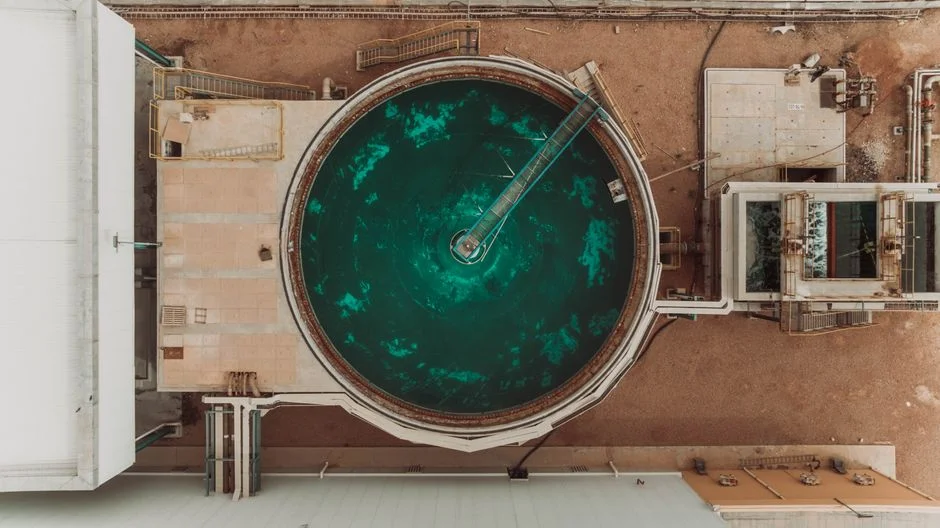
A lamella clarifier — the high-rate gravity device most often called simply a clarifier in 2026 industrial bid docs — uses a stack of inclined plates spaced at 50–80 mm; coagulant-conditioned water flows upward between the plates while settleable solids drop onto the plate surfaces and slide down into a sludge hopper, with clarified effluent collected by peripheral weirs. Lamella designs achieve 20–40 m³/m²·h of equivalent surface loading in roughly 20–30% of the footprint of a conventional rectangular clarifier at the same flow. Because these two technologies utilize different physical mechanisms, understanding their chemical requirements is essential for accurate system selection.
DAF vs Clarifier: Removal, Footprint and Operating Cost Side by Side
The differences between DAF and clarifier systems center on six measurable parameters, as shown in the table below. Actual performance must be confirmed by jar testing on the specific ore or rinse-water matrix before any capex commitment.
| Parameter | DAF system | Lamella clarifier |
|---|---|---|
| TSS removal on mining/metals streams | 80–95% (typical engineering range) | 60–85% on settleable-only streams (typical engineering range) |
| Total recoverable metals after coagulant dosing | Single-digit mg/L achievable (per EPA TRD on metal-bearing waste treatment, nepis.epa.gov) | Effective for hydroxide precipitates above pH 9; weaker on colloidal metals |
| Oil & grease / flotation reagent removal | High — micro-bubbles attach to emulsified oils and surface-active reagents | Low to moderate — emulsified oil typically passes through |
| Surface loading / footprint | 5–25 m³/m²·h cell area; tall, compact skid | 20–40 m³/m²·h equivalent loading on inclined plates; small floor footprint (per HydropureWater lamella spec) |
| Dominant OPEX driver | Air compressor kWh + polymer dose | Coagulant dose + sludge pumping |
| Chemical consumption | Polymer + coagulant; floc aids typically required | Can run with up to 30% less chemical on settleable hydroxide streams (per HydropureWater lamella spec) |
| Cold-climate tolerance (New England winter) | Higher — bubble-contact flotation is less viscosity-sensitive than Stokes settling | Lower — cold water raises viscosity, drops settling rate 15–25% below 10 °C |
The trade-off the table makes explicit: DAF buys you removal quality and reagent flexibility at the price of compressed-air energy, while a lamella clarifier buys you footprint and chemical economy at the price of stream specificity. For tailings water and finishing rinse water with entrained oils, DAF wins on quality. For steady, low-oil, settleable hydroxide streams, the lamella wins on total annualized cost.
Decision Matrix: Which Technology Matches Your Watertown Stream
Stream characteristics dictate the optimal technology, and the matrix below condenses the engineering judgment used in 2025–2026 plant retrofits in the northeast US.
| Stream profile | Recommended primary | Why |
|---|---|---|
| TSS > 1,000 mg/L, fine particles, oils, residual flotation reagents | DAF system for mining and metals wastewater | Micro-bubbles capture sub-25 µm particles and emulsified oils that gravity cannot |
| Metal hydroxide sludge (pH 9–10.5), low oil, steady flow | High-efficiency lamella clarifier for metals hydroxide sludge | Dense hydroxide floc settles well; lamella footprint fits tight Watertown sites |
| Variable flow, mixed ore feed, water reuse target from tailings | DAF primary + lamella polish | DAF handles the variable load; lamella polishes for reuse, per Seven Seas Water description of DAF in tailings water reuse |
| Cold indoor installation (winter < 5 °C) | DAF preferred for primary; lamella only if stream is pre-warmed or insulated | Viscosity penalty on gravity settling below 10 °C erodes lamella performance 15–25% |
For any permitting conversation, anchor the recommendation in the EPA Technical Resource Document on metal-bearing waste treatment, which remains the engineering reference MassDEP reviewers expect to see cited. A reader who wants the broader context on how a DAF and a clarifier compare in a different regulatory and climate envelope can also review this DAF vs clarifier comparison for Conroe mining wastewater.
2026 Cost Picture: CAPEX, OPEX and Lifecycle for a Watertown Plant
Capex for a packaged DAF system (saturator, floc tube, flotation cell, control panel) sized for a 50 m³/h mining stream sits in the mid-five-figure to low-six-figure USD range as an engineering estimate; lamella clarifier capex for the same flow typically lands at 40–60% of an equivalent DAF (engineering estimate based on HydropureWater product family positioning). The lamella advantage on capex narrows once you add the DAF's polishing role into the same total flow path — the two units together rarely cost less than 1.3× a single oversized DAF, and they typically cost more.
Opex is where the two diverge most sharply. DAF electricity draw is dominated by the recycle pump and air compressor at roughly 0.08–0.15 kWh per cubic meter treated; polymer consumption drives the chemical line. Lamella opex is dominated by coagulant consumption (ferric chloride or lime) and downstream sludge pumping — for a metal hydroxide stream, coagulant cost can be 60–70% of the opex line item. The table below gives a compact 2026 sketch; actuals depend on jar-test results, polymer selection, and Boston-area power rates (~$0.16–$0.21/kWh commercial, 2026-Q1).
| Cost line | DAF-dominant stream | Lamella-dominant stream |
|---|---|---|
| CAPEX (50 m³/h, 2026 engineering estimate) | Mid-5 to low-6 figures USD | 40–60% of DAF capex |
| Electricity share of OPEX | Higher (compressor + recycle pump) | Lower (no compressor) |
| Chemical share of OPEX | Moderate (polymer + coagulant) | Higher (coagulant + sludge handling) |
| Sludge volume to handle | Float layer, 2–4% of feed | Settled sludge, 3–6% of feed |
| Downstream dewatering | Plate and frame filter press for mining sludge — cake 25–35% DS | Plate and frame filter press for mining sludge — cake 25–35% DS |
| Chemical dosing control | PLC-controlled coagulant and polymer dosing system | PLC-controlled coagulant and polymer dosing system |
For a more detailed 2026 cost baseline by technology, the St. Louis industrial breakdown provides a useful cross-check on capex and opex ratios in 2026 CAPEX and OPEX breakdown for industrial wastewater plants.
How the Two Technologies Fit Into a 2026 Treatment Train
Most Watertown plants running both technologies in 2026 do so as a sequence, not a choice. The dominant train looks like this: rotary bar screening, equalization, pH adjustment and coagulation, flocculation, DAF primary clarification, lamella polishing, sludge holding, then a plate and frame filter press for mining sludge to drop hauling volume. The DAF does the heavy lift on TSS, oils, and flotation reagents; the lamella catches the carryover and tightens the effluent to reuse quality on tailings-water recycle loops.
For plants with a 2026 water-reuse target, an MBR or RO polishing stage can be added downstream of the lamella, but that is an escalation path, not the primary clarification decision. Upstream of the DAF, a rotary mechanical bar screen protects the floc tube from ragging, and a compact coagulation/equalization package keeps hydraulic residence time consistent when ore-feed swings. For engineers who want the underlying physics of the pressurization step, the pressure flotation system engineering deep dive walks through saturator design and bubble-size distribution in detail.
Frequently Asked Questions
Is a DAF or a clarifier better for tailings water in Watertown's 2026 climate?
For tailings water with TSS in the 1,500–8,000 mg/L range, residual flotation reagents, and intermittent lube oils, a DAF is the correct primary; a clarifier alone will underperform on fines and reagents and will lose settling rate in January when influent drops below 5 °C. Most 2026 retrofits use DAF primary followed by a lamella polish for water reuse.
What removal efficiency can a DAF realistically hit on total metals in a mining stream?
Frequently Asked Questions
Should a Watertown mining plant choose DAF or a clarifier for high-TSS wastewater in 2026?
For high-TSS mining wastewater, a clarifier is typically preferred for bulk solids removal, while a DAF is better suited for fine particles and oil-water emulsions. If the influent TSS consistently exceeds 2,000 mg/L, a high-rate lamella clarifier provides a more stable primary separation stage, whereas a DAF is optimized for polishing flows with low-density particles that resist gravity settling.
What TSS removal rate can a DAF realistically achieve on mining tailings water?
In 2026, a properly engineered DAF system utilizing optimal coagulation and flocculation chemistry can achieve TSS removal rates between 85% and 95%. Performance depends heavily on the specific gravity of the tailings; particles with a specific gravity near 1.0 are ideal for DAF flotation, whereas heavier mineral particles are more effectively managed through initial sedimentation.
Is a lamella clarifier enough on its own for metal-finishing rinse water, or do I still need a DAF?
A lamella clarifier alone is often insufficient for metal-finishing rinse water if the process includes emulsified oils or complexed heavy metals that require air-assisted flotation. While the clarifier will settle out metal hydroxides, a DAF is frequently required as a secondary polishing step to meet stringent discharge standards for sub-micron particles and dispersed lipids that do not settle by gravity alone.
How much does a DAF system cost for a 50 m³/h mining wastewater stream in 2026?
As of 2026, the capital cost for a modular DAF system rated for 50 m³/h typically ranges from $180,000 to $320,000, depending on the metallurgy of the tank construction and the complexity of the saturation system. Operational costs, including chemical dosing and energy consumption, generally add an additional $0.15 to $0.40 per cubic meter treated, depending on the specific influent chemistry.
Can a DAF and a lamella clarifier be used together in the same treatment train?
Yes, integrating these technologies is a standard high-efficiency practice for complex mining wastewater. The lamella clarifier acts as the primary solids separator to remove dense mineral fines, significantly reducing the solids loading on the downstream DAF unit, which then performs the final polishing to remove residual light-phase contaminants and achieve discharge-compliant water quality.