Why the DAF-vs-Clarifier Decision Matters for a Greenfield Chemical Plant in 2026
Greenfield, Indiana's Hancock County hosts a tight cluster of SIC 28 and SIC 29 manufacturers whose effluent flows to the Greenfield WWTP under an Indiana IDEM pretreatment permit. A primary clarifier that cannot hold TSS, FOG, and dissolved metals under steady control is the first domino: resludge cycles, NPDES excursions, and an expensive redo on a 2026 line that is supposed to run for 20 years. The decision is anchored in 327 IAC 5 (Indiana's adoption of 40 CFR 403 categorical standards), EPA 40 CFR Part 414 for organic chemicals, and the tightening 2026 envelope from the EPA Multi-Sector General Permit (MSGP) metals update plus PFAS NPDES monitoring now appearing in Indiana POTW pretreatment letters. The core trade-off is mechanical: a dissolved air flotation clarifier lifts low-density, colloidal, oil-coated particles on 20–40 micron micro-bubbles and is the proven answer for emulsified FOG, while a conventional gravity clarifier relies on density differential and wins only on high-flow, low-TSS, settleable streams with minimal chemistry. The two technologies solve different wastewater problems, and the Indiana pretreatment gate forces a buyer to pick the one that matches their actual influent — not the cheaper-looking one on a quote sheet. For a deeper compliance walkthrough, see the Greenwich Twp chemical-plant pretreatment compliance guide.
How a Dissolved Air Flotation Clarifier Actually Works on Chemical Wastewater
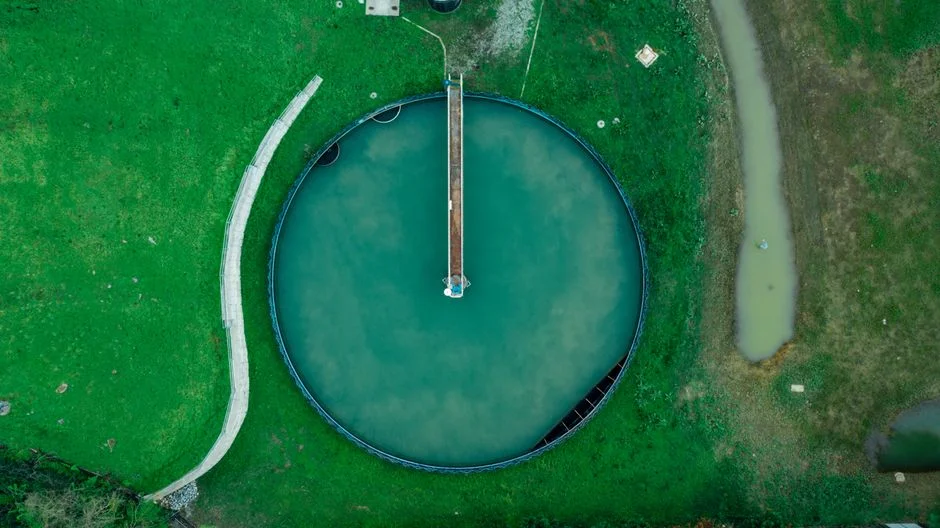
A DAF unit saturates a side-stream of clarified effluent with air at 60–80 psig in an air mixing tube, then releases that pressure into the main flotation tank. The pressure drop nucleates a dense cloud of 20–40 micron micro-bubbles (DAF Corp's Micro Bubble Generator is the industry reference for consistent bubble size with zero coarse air) that attach to flocculated particles and lift them to the surface in a matter of minutes, where a rotating scoop skims the float. Operating envelope on chemical streams is well-defined: 20% recycle rate, 10 cm/min float velocity, hydraulic retention around 20–30 minutes (per the chemical-DAF operating window published in Desalination, 2010, S5). Chemical conditioning is what makes or breaks DAF on a chemical influent — coagulant dosing at pH 4.5–5.5 (ferric chloride or alum) plus 1.0 mg/L cationic polymer is the documented recipe for >99% phosphorus removal and 65 ± 25% suspended solids reduction in a chemical-DAF train (S5). A conventional gravity clarifier is a different machine: a rectangular or circular basin running at 1–2 m/h surface loading with 2–4 hours of retention, with sludge scraped from the bottom. No bubbles, no float — just Stokes-law settling of particles denser than water. Materials matter in Greenfield chemical service: DAF tanks ship in 304L stainless as standard with 316L available for chloride-bearing streams (JBT Marel offers 304, 316, or concrete tank options per S2), while concrete clarifiers dominate the large municipal-flow segment where footprint is cheap and chemistry is simple. Understanding these physical differences is essential for selecting the correct unit.
DAF vs Gravity Clarifier: Side-by-Side Performance on Chemical Wastewater
The numbers below come from manufacturer performance data (DAF Corp FC Maximizer and RC UniMax, JBT Marel Dafinci) cross-checked against the Desalination 2010 chemical-DAF dataset. They are the screenshot a procurement lead needs to put in front of a plant manager.
| Parameter | DAF (FC Maximizer / RC UniMax / Dafinci) | Gravity Clarifier |
|---|---|---|
| TSS removal on chemical influent | 85–98% (FC Maximizer 92–98%, RC UniMax 85–90% per S3; JBT up to 90% per S2) | 40–70% on chemical streams, often lower on colloidal TSS |
| Flow range (per unit) | 10–11,000 gpm (S3) | Scales to 50+ MGD but requires multiple basins above ~1 MGD |
| Footprint relative to duty | 3–5× smaller than equivalent gravity clarifier; shallow circular or rectangular tank | Large concrete basin; deep excavation, long retention |
| FOG / emulsified oil handling | Proven — bubble-flotation lifts oil-coated floc (S2: "optimal separation of pollution fractions") | Poor; requires prior chemical emulsion break |
| Phosphorus removal (with FeCl3 + polymer) | >99% P removal documented (S5) | 10–30% without dedicated coagulant |
| Sludge consistency (DS) | 2–4% DS float (S3), easy to dewater with a plate and frame filter press | 0.5–2% DS underflow, high water content |
| Chemistry demand | Coagulant + polymer dosing required; ~1.32 Fe/P molar ratio (S5) | pH adjustment / settling aid only; lower reagent cost but lower removal |
| Materials | 304L / 316L SS standard; skid-mount available (S3) | Concrete with coated scum baffles |
| Typical effluent TSS target | <20 ppm filterable solids at 2,000 ppm loading (S3) | 50–150 ppm typical on chemical waste |
The single line a buyer should screenshot is the TSS row: 85–98% DAF vs 40–70% gravity on the same chemical influent is the difference between passing and failing the local POTW's pretreatment limit.
CapEx and OPEX: What a 2026 Greenfield Buyer Should Actually Budget
The table below uses rule-of-thumb ranges, not fabricated unit pricing, because vendor quotes vary with materials, automation, and site conditions. Use it to frame the conversation with a dissolved air flotation system supplier or a concrete basin contractor.
| Cost line | DAF skid (10–500 gpm, 304 SS) | Equivalent gravity clarifier (concrete basin + scraper) |
|---|---|---|
| Unit CapEx per gpm | Higher per gpm for the skid | Lower per gpm for the basin |
| Civil works (excavation, concrete, building) | 30–50% lower — shallow tank, skid-mountable, pre-wired (S3) | Higher — deep basin, rebar, long cure time |
| Footprint / site civil cost | 3–5× smaller footprint (per comparison above) | Baseline |
| Reagent OPEX | Ferric chloride or alum + ~1.0 mg/L cationic polymer (S5); add a PLC-controlled coagulant and polymer dosing skid | pH/settling aid only |
| Energy OPEX | Saturation pump + compressor for recycle air | Sludge scraper drive, low kW |
| Sludge hauling OPEX | Lower volume, 2–4% DS float dewaters efficiently downstream | Higher volume, watery underflow (0.5–2% DS) |
| Downstream biological / RO loading | Reduced substantially (S2: "subsequent steps of the biological treatment can also be reduced") | Larger downstream units required |
| Typical 50–200 gpm Greenfield line payback | 18–36 months via lower civil + downstream sizing | Lower CapEx but higher downstream CapEx |
For a 100 gpm chemical line, the DAF CapEx premium is typically recovered in 18–36 months because the DAF unit shrinks the downstream biological basin (or eliminates a tertiary step) and cuts sludge hauling volumes by 50–70% versus a clarifier underflow. Always pilot before committing — a 60 gpm pilot on your actual wastewater is the cheapest insurance you can buy.
Decision Framework: When to Pick DAF, When to Pick a Clarifier in Greenfield
Use these four rules in order on your own influent data. If three of four point the same way, that is your answer.
Rule 1 — Influent TSS and FOG. If TSS routinely exceeds 500 mg/L, or the stream carries emulsified oil or free FOG, default to DAF. Gravity settling on colloidal or oil-coated particles is unreliable and will fail the POTW's local limit within weeks.
Rule 2 — Flow versus footprint. Greenfield sites are tight. If equivalent hydraulic loading exceeds 2 m/h and civil space is constrained, DAF wins on footprint alone (3–5× smaller per the comparison matrix).
Rule 3 — Chemistry tolerance and materials. If pH swings 4–9 across batch campaigns, or chloride/TDS runs elevated, specify a 316L stainless DAF tank (per JBT Marel material options, S2) or a coated concrete clarifier with proper alloy hardware. Carbon steel will not survive a typical chemical-plant effluent.
Rule 4 — Compliance driver. If Total Phosphorus or categorical metals limits apply to your discharge, the chemical-DAF >99% P removal pathway (S5) eliminates a dedicated tertiary coagulation step. If your local POTW pretreatment letter cites 40 CFR Part 414 organic chemicals limits, the 85–98% TSS cut upstream buys you margin on the biological step that follows.
Default 2026 recommendation for a new chemical line in Greenfield: a DAF primary (size for peak flow, not average) followed by a high-efficiency lamella clarifier polishing stage for solids that escape the float. The hybrid is the lowest-risk path because it gives you both the FOG/colloid removal of DAF and the polishing TSS cut of lamella settling at a fraction of the footprint of a full secondary clarifier. For a parallel review of the same decision in a neighboring Indiana corridor, see the DAF vs clarifier for chemicals wastewater in McIntosh guide.
2026 Compliance Watchlist for Greenfield Chemical Dischargers
Three regulatory items will reshape the primary clarification choice between now and the end of 2027, and all three push buyers toward higher-upstream TSS removal.
EPA MSGP metals update. The Multi-Sector General Permit revision tightens monitoring of copper, lead, zinc, nickel, and chromium at chemical SIC code facilities through 2026. A DAF that consistently hits <20 ppm filterable TSS (S3) dramatically reduces the mass-loading contribution from upstream solids carryover.
PFAS NPDES monitoring. Indiana POTW pretreatment letters are now arriving with PFAS monitoring requirements, and activated-carbon polishing is the expected downstream response. Design the primary clarifier/DAF to deliver a low-TSS, low-FOG stream so the carbon beds do not foul prematurely.
Indiana 327 IAC 5 and 40 CFR Part 414. Categorical pretreatment standards for organic chemicals (TTO and metals limits) drive the need for consistent TSS removal upstream of any biological or RO step. Pilot testing on your actual wastewater (DAF Corp and JBT Marel both offer on-site pilot feasibility studies, S3) is the only defensible basis for a 2026 CapEx commitment. The DAF sizing engineering specs for tank-bottom water guide walks through the calculation. Also scan the DAF vs API separator cost comparison for an oil-and-water stream alternative.
Frequently Asked Questions
Is a DAF or clarifier better for chemical plant wastewater
Frequently Asked Questions
DAF or clarifier for chemicals wastewater in Greenfield, Indiana — which is better in 2026?
For chemical wastewater in Greenfield, the choice depends on the specific gravity and particle size of your contaminants. In 2026, Dissolved Air Flotation (DAF) is typically preferred for chemical plants where contaminants are lighter than water, such as oils, greases, or light flocculated solids, as it offers a smaller footprint and faster separation times compared to traditional gravity clarifiers. Clarifiers remain the superior choice for heavy inorganic solids or high-density metal precipitates that settle rapidly via gravity without the need for air injection.
What TSS removal can a DAF system achieve on chemical plant wastewater?
A properly optimized DAF system can achieve Total Suspended Solids (TSS) removal efficiencies of 85% to 98% for chemical wastewater. Performance is highly dependent on the influent particle size distribution and the application of appropriate coagulants and flocculants to create a floatable sludge blanket. Consistent removal rates at the higher end of this spectrum usually require automated pH control and precise polymer dosing.
Does dissolved air flotation remove phosphorus from chemical wastewater?
Yes, DAF is highly effective at removing phosphorus, provided it is first converted into a solid phase through chemical precipitation. By dosing metal salts such as ferric chloride or aluminum sulfate, dissolved orthophosphates are converted into insoluble flocs that are then captured by the air bubbles in the DAF unit. This process can typically reduce total phosphorus levels to below 1.0 mg/L, helping facilities meet stringent local discharge permit limits.
How much does a DAF system cost for a 100 gpm chemical line?
For a 100 gpm chemical wastewater application, capital costs for a skid-mounted DAF system typically range from $120,000 to $250,000. This price variance is driven by the materials of construction—such as 304 vs. 316 stainless steel for chemical compatibility—the level of instrumentation for automation, and the complexity of the integrated sludge handling equipment. Operating costs should also factor in electricity for the recycle pump and air compressor, as well as recurring chemical feed expenses.
Do I need a chemical dosing system with my DAF clarifier?
Yes, a chemical dosing system is essential for the effective operation of a DAF unit in chemical wastewater treatment. Because most chemical contaminants possess a neutral or negative surface charge that prevents aggregation, dosing systems are required to inject coagulants to neutralize charges and flocculants to bridge particles into larger, buoyant flocs. Without a properly calibrated dosing system, the DAF will fail to effectively float the influent solids, resulting in poor effluent quality.