The Regulatory Chain an Organic Chemicals Plant Must Satisfy
Industrial organic chemicals plants near Greenwich Twp, NJ meet pretreatment limits by operating under an NJPDES Significant Industrial User (SIU) permit that incorporates federal categorical standards at 40 CFR Part 414 (Organic Chemicals, Plastics, and Synthetic Fibers) on top of the local POTW's sewer-use ordinance. The discharge then passes through a staged pretreatment train — equalization, oil/water separation, pH neutralization, biological oxidation, and polishing by adsorption or membrane filtration — to bring BOD, COD, TSS, phenols, and VOCs below the local control authority's numerical limits before entering the sewer.
The U.S. EPA frames the National Pretreatment Program as "a cooperative effort of federal, state, and local environmental regulatory agencies established to protect water quality," and it works on the same authorization model as the NPDES permit program: EPA authorizes states, and authorized states approve local municipalities to perform the day-to-day "permitting, administrative, and enforcement tasks for discharges into the municipalities' publicly owned treatment works" (POTWs), with POTW defined at 40 CFR 403.3(q). For an organic chemicals plant, that translates to a three-tier chain: EPA sets the categorical baseline (here, 40 CFR Part 414), NJDEP administers the authorized state pretreatment program, and the local Control Authority POTW issues the SIU permit and enforces numerical discharge limits in the sewer-use ordinance. The two current EPA reference documents an engineer should pull before designing or upgrading pretreatment are Attachment 2-1: State and Territory Program Authorization Status (December 2024) and Attachment 3-1: Summary of Categorical Standards (December 2024).
The practical consequence of this delegation is dual limits: the federal categorical standard under 40 CFR Part 414 applies, and the local sewer-use ordinance applies, and the stricter of the two governs. A plant that only benchmarks against the federal ceiling can still be in violation locally. In 2026, three enforcement priorities shape any new pretreatment capital plan in this corridor: PFAS source control and monitoring (EPA multi-sector effort), cyber-secure SCADA at pretreatment works (CISA/EPA joint guidance in effect since 2024), and climate-resilient POTW infrastructure (flooding and wet-weather I&I around the Delaware River). Each of these will surface as permit conditions during an SIU renewal or a capacity expansion.
What Organic Chemicals Manufacturing Discharges Into the Sewer
An organic chemicals plant typically segregates its wastewater into three streams: process wastewater (the main organic load — solvents, reactants, intermediates, product washwater), cooling water (lower-strength but contaminated with leak oils and heat exchanger leakage), and sanitary wastewater from on-site facilities. The contaminant classes that drive the engineering are well defined: high BOD/COD, total suspended solids, oil & grease (often reported as hexane-extractables), phenols and aromatic organics, VOCs, sulfides, cyanides, pH excursions, temperature, and, increasingly in 2026, PFAS from fluorinated process aids and surfactants. A single grab sample rarely characterizes this effluent because batch reactions, tank turns, and campaign changes produce slug loads — equalization is therefore the first engineering decision, not an afterthought.
Each contaminant class points to a preferred unit operation, and the table below maps the typical organic chemicals effluent to the technology that addresses it. The mapping is drawn from the standard pretreatment technology stack and is the basis for building a defensible process train.
| Contaminant class | Typical source in an OCPSF plant | Preferred unit operation(s) | Typical removal / target |
|---|---|---|---|
| Oil & grease / hexane-extractables | Solvent handling, pump seal leaks, product washwater | API/CPI separator → dissolved air flotation system | <50–100 mg/L to sewer; DAF commonly removes 80–95% of emulsified oil |
| Total suspended solids | Resins, catalyst fines, batch carryover | Screening → sedimentation / lamella clarifier | >90% TSS reduction achievable with screening + sedimentation + coagulation (per pulp & mill case data) |
| BOD / COD | Solvents, intermediates, product washwater | Aerobic (activated sludge) or anaerobic (UASB) + biological polishing | BOD5 <250–400 mg/L typical local limit; anaerobic effective for high-strength streams |
| Phenols / aromatic organics | Resin manufacture, dye/dye intermediates, agrochemical actives | Biological → advanced oxidation (O3, H2O2/UV, Fenton) → activated carbon | Phenol to <0.5 mg/L in many local ordinances; AOPs degrade recalcitrants that biology leaves behind |
| VOCs | Solvent storage, reactor vents, equipment cleaning | Steam stripping, activated carbon, source control (closed vents) | Stripping removes >95% of volatile organics; carbon polishes to ppb levels |
| pH excursions | Acid/base wash steps, neutralization salt byproducts | Equalization → neutralization (lime, soda ash, H2SO4) | pH 6–9 band required by essentially every municipal sewer ordinance |
| Sulfides / cyanides | Process chemistry, certain catalysts | Chlorination/oxidation (cyanides); alkaline chlorination or biological (sulfides) | CN- typically <1 mg/L; S2- <1–10 mg/L depending on local limit |
| PFAS (2026 emerging) | Fluorinated surfactants, fluoropolymer processing aids | Source segregation → ion exchange or RO concentrate; no destruction in conventional pretreatment | State/EPA action levels in the low ng/L to μg/L range; under active rulemaking |
| Temperature | Heat exchanger leaks, exotherms | Equalization + cooling tower / heat exchanger | Typically <40 °C (104 °F) at POTW headworks |
The mapping shows why the textile/AOP and mining/IX-RO case studies are instructive for organic chemicals plants: a textile mill used advanced oxidation and membrane filtration to knock down recalcitrant dyes, and a mining operation paired ion exchange with reverse osmosis to bring heavy metals below reuse and discharge limits. Both plants solved a "biology isn't enough" problem, which is the same problem an organic chemicals plant faces on the phenol/VOC/PFAS side of its contaminant list.
A Reference Pretreatment Train for Organic Chemicals Plants
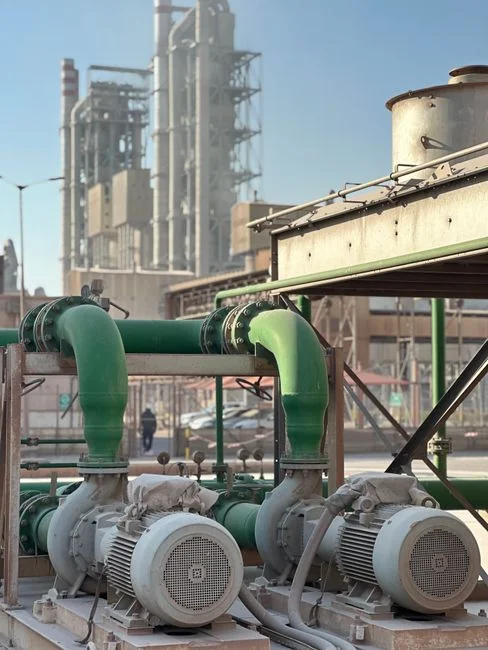
A defensible baseline for an organic chemicals plant discharging to a POTW in the Delaware River industrial corridor runs through seven stages. Treat it as a starting point that an engineer adapts after bench and pilot data, not as a one-size-fits-all specification.
Stage 1 — Screening. A GX rotary mechanical bar screen at the headworks removes rags, plastics, and debris that would otherwise rag up downstream pumps, plug nozzles, and upset biological reactors. Coarse-to-fine screening protects every downstream unit and is the cheapest insurance in the train.
Stage 2 — Equalization and flow buffering. Batch reactor turnovers, campaign switches, and wash cycles all generate slug loads. Equalization dampens these swings and is the single most important design decision; without it, biology and chemistry downstream will fail intermittently rather than continuously. The standard pretreatment guidance flags wastewater variability as a core design driver for exactly this reason.
Stage 3 — Oil, grease, and suspended-solids removal. Free and emulsified oils are knocked down with an API or CPI separator ahead of a dissolved air flotation system; DAF also captures a fraction of colloidal organics and TSS. Settleable solids then go to a high-efficiency lamella clarifier. The pulp and mill case in the reference data achieved more than 90% TSS reduction with a screening + sedimentation + coagulation + biological train — that order of magnitude is a reasonable target for an organic chemicals plant once chemistry is matched to the feed.
Stage 4 — pH neutralization and chemical conditioning. A PLC-controlled chemical dosing system with lime, soda ash, or sulfuric acid brings pH into the 6–9 band required by essentially every municipal sewer-use ordinance, while coagulant and flocculant dosing (ferric chloride, alum, or cationic polymer) is tuned to the clarifier feed. In 2026, PLC-controlled dosing with closed-loop pH feedback is the baseline expectation, not an upgrade.
Stage 5 — Biological treatment. Aerobic activated sludge handles moderate-to-high BOD reliably; anaerobic treatment — UASB, anaerobic lagoon, or expanded-bed — is the right call for very high-strength organic streams (chemical oxygen demand above several thousand mg/L) and produces a biogas byproduct that partially offsets operating cost. The standard pretreatment guidance explicitly notes that anaerobic treatment "is effective for treating high-strength organic wastewater." Many organic chemicals plants run a hybrid: anaerobic on the concentrated reactor bottoms, aerobic polishing on the combined flow.
Stage 6 — Polishing for recalcitrants. Advanced oxidation (ozone, H2O2/UV, or Fenton) breaks down phenols and other aromatics that pass through biology; granular activated carbon or a membrane stage (UF followed by RO for reuse) polishes the effluent to local limits. For plants facing a tight local total-toxic-organics or phenol limit, this stage is non-negotiable — see the comparable oil and grease removal technology comparison for how a polishing decision framework reads in practice.
Stage 7 — Continuous monitoring. Online pH, temperature, flow, conductivity, and TOC or COD analyzers feed a SCADA system, with alarms on the SIU permit parameters. Continuous monitoring is not a nice-to-have — it is the only way to demonstrate compliance to the Control Authority POTW and to catch a slug before it costs a permit violation.
Why the Local POTW Is the Real Gatekeeper Around Greenwich Twp
EPA's framework page is explicit: the agency authorizes local municipalities to perform "permitting, administrative, and enforcement tasks for discharges into the municipalities' publicly owned treatment works." That means the local Control Authority POTW — not EPA — runs the day-to-day compliance relationship with an organic chemicals plant, and the sewer-use ordinance is the controlling instrument. In the Gloucester County / Delaware Avenue industrial corridor around Greenwich Twp, receiving POTWs commonly impose local limits for phenols, oil & grease, sulfide, and total toxic organics that are tighter than the 40 CFR Part 414 categorical baseline, because the receiving plant has its own effluent quality and biosolids constraints. A new or expanding organic chemicals plant should request a wastewater discharge survey from the receiving POTW and run a pilot test of the proposed pretreatment train before commissioning; relying solely on federal categorical numbers is a common cause of post-startup noncompliance findings.
In 2026, NJDEP's pretreatment program remains authorized and active, and pretreatment compliance has become a closing-condition item in M&A transactions in this corridor — buyers and lenders routinely require a Phase II wastewater audit during due diligence. Plant owners planning a capacity expansion or an acquisition should treat the SIU permit, the local limits, and the condition of existing pretreatment assets as a discrete workstream rather than as a footnote in the environmental review. For a structured pre-acquisition checklist, the factory ETP due diligence checklist walks through the legacy-asset questions a buyer should answer before closing.
Choosing Between Source Reduction, On-Site Pretreatment, or Off-Site Hauling
An organic chemicals plant has three strategic options for compliance: reduce pollutants at source through process optimization, material substitution, or waste minimization; install on-site pretreatment to meet sewer limits; or pre-treat partially and haul residual waste to a licensed centralized treatment facility. Each option maps to a different plant profile. Source reduction is most cost-effective when the contaminant comes from a known unit operation — for example, switching a solvent wash to a closed-loop washer or to a less toxic solvent, or recovering catalyst from a batch instead of water-washing it to drain. On-site pretreatment wins when flow is high, the contaminant mix is reasonably consistent, and discharge to the sewer is the lowest-cost disposal path. Off-site hauling fits small-volume, highly variable, or hard-to-treat wastes (some PFAS concentrates, certain AOP brines) where the capital cost of in-house treatment cannot be justified.
Three 2026 drivers are pushing plants toward source reduction and on-site water recycling rather than end-of-pipe treatment alone: rising PFAS scrutiny under EPA's multi-sector effort and pending categorical-standard revisions, the December 2024 EPA categorical-standards update that tightened several OCPSF subcategory limits, and tighter local limits that make discharged water uneconomical when reuse is feasible. Treated effluent reused as cooling-tower makeup or boiler feed simultaneously reduces discharge volume and fresh-water draw — a useful hedge against a future Delaware River basin drought rule.
The practical next-step sequence for any organic chemicals plant considering a pretreatment project is: wastewater characterization → bench testing → pilot testing → SIU permit application → engineering design → equipment procurement → installation → commissioning and monitoring. Plants that compress this sequence, or that skip the pilot step, are the ones that discover their DAF, MBR, or RO unit is mis-sized six months after start-up. For a compact biological side, an MBR integrated wastewater treatment package is a common 2026 choice for plants needing reliable BOD/TSS polishing in a small footprint; for plants that must hit a tight local dissolved-solids or trace-organic limit, a final reverse osmosis water purification stage is the workhorse. Plants weighing equipment trains for different industries can also compare against the Glasgow KY transportation equipment pretreatment guide to see how a different industry builds its reference train under similar dual-limit pressure.
Frequently Asked Questions
What is the federal categorical standard for organic chemicals plants?
The binding federal categorical standard for organic chemicals, plastics, and synthetic fibers (OCPSF) manufacturers is 40 CFR Part 414. The current single-document reference a plant engineer should pull is EPA's Attachment 3-1: Summary of Categorical Standards (December 2024), which lists the subcategories, the regulated parameters, and the numerical limits that apply to indirect discharges.
Do local POTW limits override federal categorical limits?
Yes, in the sense that the local sewer-use ordinance and the SIU permit can impose numerical limits that are stricter than the federal categorical baseline, and the stricter of the two governs. The EPA National Pretreatment Program framework is explicit that POTWs are approved to enforce local limits to prevent pass-through and interference at the receiving treatment plant.
Which unit operation is most important for an organic chemicals plant?
Equalization. Batch organic-chemistry operations produce slug loads — pH swings, solvent pulses, sudden temperature changes — that defeat downstream biological and chemical treatment if they are not buffered. A correctly sized equalization basin with mixing and aeration is the single highest-leverage investment in the train.
Is DAF or a clarifier better for removing oil and grease from an organic chemicals effluent?
DAF typically wins when the oil is emulsified or when colloidal organics are present, because microbubble flotation captures what gravity settling cannot. A lamella clarifier is preferred when the load is dominated by settleable solids and the oil content is low. Site-specific jar testing on the actual plant effluent is the only reliable way to choose; the standard pretreatment guidance recommends pilot testing precisely because feed characteristics vary plant to plant.
How does an organic chemicals plant handle PFAS in 2026?
Source reduction and segregation of high-PFAS streams are the practical near-term path. Conventional biological treatment and most physicochemical pretreatment do not destroy PFAS — they only move it between phases. Plants should identify PFAS-containing process aids, segregate those streams, and send the segregated concentrate to a treatment technology capable of destruction (thermal oxidation, supercritical water oxidation) or long-term containment, while keeping the segregated approach off the main SIU discharge until EPA's multi-sector PFAS rule is finalized.