Why Berlin Hotels Face a Different Compliance Wall in 2026
Berlin hotel discharges into the municipal sewer are governed by a four-layer compliance stack that effectively functions as a 2026 regulatory wall for any new build or major retrofit. The legal foundation is §57 of the WHG (Wasserhaushaltsgesetz), which classifies hotels as Indirekteinleiter — indirect dischargers — and requires a pre-discharge permit from the receiving WWTP operator, in Berlin's case Berliner Wasserbetriebe. Over that sits the BWG (Berliner Wassergesetz, last amended 2024), which obliges the Senatsverwaltung für Mobilität, Verkehr, Klimaschutz und Umwelt (SenMVKU) to document the permit and to enforce state-level inspection rights. The federal Abwasserverordnung (AbwV) Annex 1 sets the general municipal discharge parameters — BOD, COD, TSS, NH4-N, P-total — that even indirect hotel discharges must respect when the receiving Berlin WWTP treats them as a contributing load.
At the European level, the revised Urban Waste Water Directive 91/271/EEC (consolidated 2024 amendments) tightens effluent thresholds to BOD ≤25 mg/L, COD ≤125 mg/L, and TSS ≤35 mg/L for agglomerations above 10,000 PE equivalent; Berlin hotels discharging into combined-sewer districts that ultimately route to the Schönerlinde or Ruhleben plants fall under this envelope. In 2026, Berlin WWTPs are also under heightened micro-pollutant and PFAS scrutiny from the SenMVKU, which in practice pushes pretreatment expectations upstream onto hotel operators. A defensible 2026 specification must satisfy all four layers simultaneously, not just the WHG minimum.
Berlin Hotel Wastewater Characteristics: What the Plant Must Treat
A Berlin hotel generates 130–180 L per guest-night of mixed wastewater, with diurnal peak-to-average ratios of roughly 2.5:1 driven by morning shower blocks, lunch service, and evening housekeeping. Raw influent typically carries BOD 250–400 mg/L, TSS 200–350 mg/L, and FOG 50–150 mg/L from kitchens, laundry, and bathrooms — loadings that sit 30–60% above domestic residential wastewater. Laundry effluent contributes surfactant and pH spikes in the 9–11 range, so a flow-equalization tank upstream of the biological stage is standard practice to keep pH within the 6.5–8.0 band the biomass needs.
The tropical-resort subtype behaves differently. Tropical Islands operates process water at approximately 26 °C, and the former AquaDom held its saltwater between 26–27 °C (Wikipedia, AquaDom entry). At those temperatures, biological kinetics accelerate by roughly 40% per 10 °C (standard Arrhenius behaviour), pushing BOD loading rates up and demanding reactor volumes sized for the higher mixed-liquor suspended solids an MBR can carry. Pool and spa backwash adds 1–3% of total flow with elevated chlorine residual and TDS, and must be dechlorinated via activated carbon contact or sodium bisulfite dosing before it merges with the main biological feed. Finally, the Berlin winter design condition matters: outdoor ambient temperatures reach −9 °C on severe nights (the AquaDom collapse occurred at an overnight low of −9 °C, 16 December 2022), so any outdoor equalization tank, sludge line, or reactor wall requires insulation and heat-tracing to keep mixed-liquor above 8 °C for sustained nitrification.
Process Selection: MBR vs SBR vs Conventional Activated Sludge for Berlin Resorts
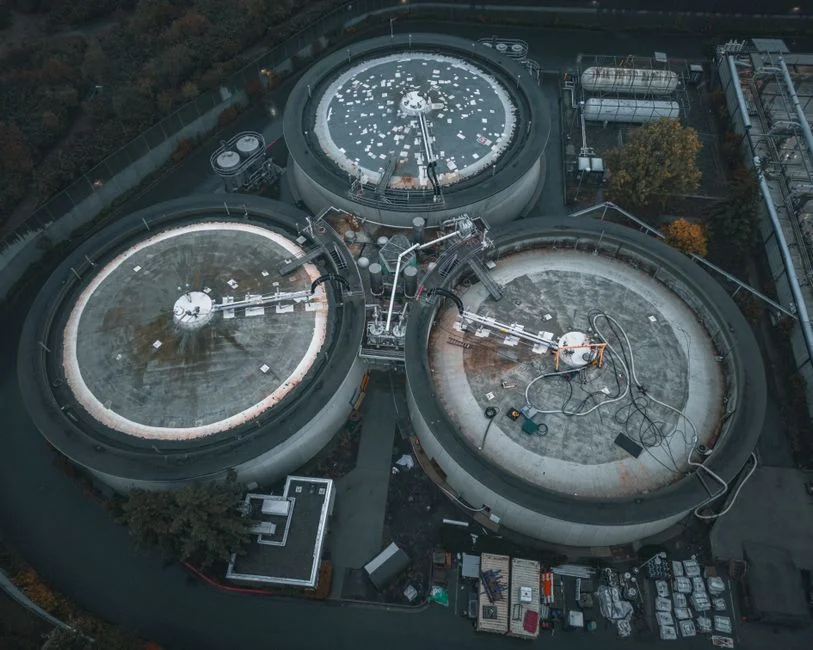
The dominant 2026 decision for a Berlin hotel is between MBR, SBR, and conventional activated sludge (CAS). The three architectures differ in CAPEX, footprint, effluent quality, and reuse-readiness — and the right pick depends on whether the operator plans to reuse treated effluent for irrigation or toilet flushing.
MBR (membrane bioreactor) couples an activated-sludge reactor with submerged PVDF flat-sheet or hollow-fibre membranes at 0.1–0.4 μm pore size. It produces reuse-quality effluent: COD ≤50 mg/L, BOD ≤5 mg/L, NH4-N ≤5 mg/L, and TSS essentially undetectable. The cost is energy — 0.6–0.9 kWh/m³ — and a footprint roughly 60% of a CAS plant at the same capacity. SBR (sequencing batch reactor) runs a single-tank fill–react–settle–decant cycle, has lower CAPEX and simpler controls, and is well-suited to 50–300-room Berlin hotels; typical effluent is BOD ≤20 mg/L, TSS ≤30 mg/L — adequate for BWG indirect discharge but below reuse quality. CAS with a secondary clarifier remains the lowest-CAPEX option but produces the weakest effluent (TSS 20–30 mg/L), and the tightening 2026 EU UWWTD thresholds make it a poor fit for any hotel planning a 10–15-year operating horizon.
For tropical-resort subtypes — Tropical Islands-scale operations or any facility with sustained 26–28 °C process water, on-site kitchens, and high FOG loading — MBR is preferred over SBR because the membrane's complete biomass retention handles the FOG and surfactant shock loads from food-and-beverage operations without bulking-sludge events.
| Parameter | MBR (PVDF submerged) | SBR | Conventional Activated Sludge |
|---|---|---|---|
| Effluent BOD (mg/L) | ≤5 | ≤20 | ≤25 |
| Effluent COD (mg/L) | ≤50 | ≤90 | ≤125 |
| Effluent TSS (mg/L) | ≤1 | ≤30 | ≤30 |
| Effluent NH4-N (mg/L) | ≤5 | ≤10 | ≤15 |
| Specific energy (kWh/m³) | 0.6–0.9 | 0.3–0.5 | 0.25–0.4 |
| Footprint (relative) | 0.6× | 1.0× | 1.4× |
| Reuse-ready? | Yes (irrigation, toilet flushing) | No (polishing required) | No |
| 2026 EU UWWTD compliant | Yes | Marginal | Often no |
For packaged plant layouts, a factory-built MBR membrane bioreactor system or a skid-mounted underground integrated sewage treatment unit both fit Berlin hotel basements or service-yard footprints; the WSZ underground format is often selected for heritage-protected sites where above-grade equipment is undesirable.
Pretreatment Chain: Screening, Grit Removal, and FOG Management
Downstream MBR and SBR performance is set by the headworks. A fine rotary bar screen with 2–5 mm aperture removes rag, plastic, and fibrous material before it reaches the membranes; this is a non-negotiable step for any MBR installation. FOG removal follows, and for hotel kitchen waste streams a DAF unit is the 2026 standard — DAF achieves 70–90% FOG removal on 50–150 mg/L influent and protects the biological stage from oil-shock events. Flow equalization with a 24-hour HRT smooths the 2.5:1 peak-to-average diurnal pattern and stabilizes MBR hydraulics.
Laundry pH spikes (9–11) are neutralized by automatic chemical dosing — typically sulphuric acid or CO₂ injection — upstream of the bioreactor, with a target band of 6.5–8.0. Pool backwash is segregated and dechlorinated with activated carbon contact or sodium bisulfite before it joins the main flow. The standard pretreatment chain is therefore: rotary mechanical bar screen → grit chamber → DAF system for FOG removal → equalization tank → automatic chemical dosing system → biological reactor. Skipping or undersizing any one of these is the most common engineering miss in Berlin hotel plant retrofits.
Disinfection and Effluent Polishing for 2026 Reuse Compliance
Reusing treated hotel effluent for irrigation or toilet flushing under EU Drinking Water Directive 2020/2184 and DWA-A 198 requires polishing the MBR or SBR effluent to a defined microbial standard. The 2026 preferred disinfection chemistry for Berlin hotel reuse is chlorine dioxide (ClO₂) — broad-spectrum, no trihalomethane formation, stable residual in the reuse loop, and accepted by Berliner Wasserbetriebe for on-site reuse when the residual is quenched before any discharge to sewer. UV disinfection is the chemical-free alternative and is often combined with ClO₂ in a polishing train: UV for primary microbial inactivation, ClO₂ for residual carry-through to the point of use. Tertiary filtration with a multi-media or disc filter drops TSS to <5 mg/L before UV to protect transmittance, typically targeting UVT >65% at 254 nm.
DWA-A 198 sets the reuse quality targets operators must hit: BOD ≤5 mg/L, TSS ≤5 mg/L, and E. coli ≤100 CFU/100 mL for toilet flushing, with ≤200 CFU/100 mL permitted for landscape irrigation. Online monitoring of pH, conductivity, turbidity, free chlorine, and NH4-N is the standard 2026 audit trail demanded by SenMVKU. The disinfection train is sized with an on-site chlorine dioxide generator fed from the downstream side of a multi-media filter, which is the configuration most EPCs in Berlin specify for hotel retrofits in 2026.
Greywater Reuse Economics: 2026 ROI for Berlin Hotels
Reuse turns MBR from a CAPEX line item into a cost-recovery asset. The 2025/2026 Berliner Wasserbetriebe commercial water tariff sits at approximately €2.10/m³, and Berlin wastewater tariffs add another €2.50–€3.00/m³, putting the true marginal cost of fresh water for a hotel at roughly €4.60–€5.10/m³ once both potable intake and sewage disposal are included. A 200-room hotel at 70% occupancy generates 25–35 m³/day of greywater that, after MBR + UV + ClO₂ polishing, can be redirected to toilet flushing (30–45% substitution) and landscape irrigation. That yields €8,000–€25,000/year in freshwater cost avoidance depending on occupancy and reuse ratio.
CAPEX benchmarks for 2026: a packaged MBR plus reuse plant for a 200-room Berlin hotel lands in the €180,000–€320,000 range, versus €90,000–€160,000 for an SBR-only plant without reuse. Payback periods are 4–6 years for MBR + reuse and 3–4 years for SBR-only, but the MBR figure carries less BWG non-compliance risk because the stricter effluent gives the operator headroom against tightening 2026 EU UWWTD thresholds. The Radisson Collection reopened in February 2025 with a 24-metre vertical garden of approximately 2,000 plants replacing the destroyed AquaDom (Wikipedia, AquaDom entry) — a clear signal that Berlin's hospitality market is moving toward documented freshwater reduction and planted feature investments that reuse systems can directly serve. Comparable specifications for cold-climate hotel plants are useful reference points; the Calgary hotel wastewater treatment guide covers similar winter-temperature design constraints, while the Santiago Chile hotel wastewater guide is a useful tropical-resort counterpoint.
2026 Compliance Checklist for a Berlin Hotel Wastewater Project
The following checklist maps the engineering deliverables to the 2026 regulatory stack and should be cleared with SenMVKU and Berliner Wasserbetriebe before commissioning.
| Item | Owner | Trigger / Threshold | Reference |
|---|---|---|---|
| Indirekteinleiter-Genehmigung under WHG §58 | Berliner Wasserbetriebe | Any discharge to municipal sewer | WHG §58 |
| BWG state-level permit and SenMVKU notification | SenMVKU | Design capacity >8 m³/day | BWG (2024 amendment) |
| EU UWWTD effluent limits verified | EPC / process engineer | BOD ≤25 mg/L, COD ≤125 mg/L, TSS ≤35 mg/L | UWWTD 91/271/EEC (2024 revision) |
| Berlin-climate design envelope | Civil / process engineer | Winter ambient −9 °C; summer +35 °C | AquaDom incident 16 Dec 2022; DWD |
| AbwV Annex 1 parameter check | Process engineer | BOD, COD, TSS, NH4-N, P-total at discharge | AbwV Annex 1 |
| Reuse-loop water-quality plan | Operations / QHSE | DWA-A 198 + EU 2020/2184 | DWA-A 198 |
| Pretreatment coordinator engagement | Owner / EPC | Pre-design stage | Berliner Wasserbetriebe |
Frequently Asked Questions
What size wastewater plant does a 100-room Berlin hotel need?
Design flow basis is 8–15 m³/day for a 100-room hotel at 70–80% occupancy, with a 1.5 peaking factor applied to the equalization tank and downstream hydraulic profile. Biological reactor sizing follows from a BOD loading of 250–400 mg/L at that flow, giving a working volume of roughly 12–20 m³ for an MBR at MLSS 8,000–10,000 mg/L, or 20–30 m³ for an SBR at MLSS 3,500–5,000 mg/L.
Does a tropical resort in Berlin need different treatment than a city hotel?
Yes. Tropical-resort subtypes such as Tropical Islands operate process water at approximately 26 °C, which raises BOD loading rates and biological kinetics by roughly 40% per 10 °C above standard mesophilic design. MBR with PVDF submerged membranes is preferred over SBR in this regime because complete biomass retention handles FOG and surfactant shock from high-volume food-and-beverage operations without bulking-sludge failures.
Is greywater reuse legal in Berlin hotels?
Yes, greywater reuse for toilet flushing and landscape irrigation is legal in Berlin under EU Drinking Water Directive 2020/2184 and DWA-A 198, provided the reuse loop is documented, BWG state-level approval is in hand, and the polishing train meets DWA-A 198 microbial targets (E. coli ≤100 CFU/100 mL for toilet flushing, ≤200 CFU/100 mL for irrigation).
How does the 2022 AquaDom collapse affect hotel water-feature design?
The collapse on 16 December 2022 — triggered in part by a 35 °C thermal delta between the −9 °C outdoor air and the 26 °C tank water (Wikipedia, AquaDom entry) — pushed Berlin's hospitality market away from large-volume aquatic features. The Radisson Collection reopened in February 2025 with a 24 m vertical garden of about 2,000 plants, which directly increases irrigation demand that a hotel-side reuse system can supply.
What is the 2026 CAPEX range for a Berlin hotel MBR plant?
For a 200-room Berlin hotel, a packaged MBR + reuse plant in 2026 lands in the €180,000–€320,000 range, with the lower end for skid-mounted standardized units and the upper end for full custom builds with tertiary filtration and ClO₂ polishing. An SBR-only plant without reuse runs €90,000–€160,000 at the same scale.
Related Equipment
- MBR flat sheet membrane module — specifications, capacity range, and technical data