Why Dallas Factories Are Re-evaluating Their ETP and DAF Choices in 2026
Dallas–Fort Worth industrial discharge loads have grown faster than municipal POTW headwork capacity in the past 24 months, and that gap is forcing plant engineers to re-spec primary and secondary treatment on-site. Food processing, fabricated metals, and the semiconductor corridor along I-35 are all generating wastewater streams that exceed what a standard sewer-use ordinance can absorb. A Dallas factory typically needs a DAF unit integrated into a full industrial ETP — DAF alone removes up to 99% TSS and 99% FOG, but a complete ETP also requires biological secondary treatment and TCEQ-compliant polishing for discharge to the Trinity River basin or North Texas reuse networks.
Two compliance anchors govern every Dallas industrial discharge. The Texas Commission on Environmental Quality (TCEQ) issues permits under 30 TAC Chapter 305, with effluent limits set by watershed and stream standards. Any plant sending wastewater to a Dallas-area POTW must additionally satisfy EPA categorical pretreatment standards under 40 CFR Part 403 plus the local surcharge schedule. Practically, that means a facility's treatment train must be designed to the stricter of the two rules — POTW headwork limits, or direct-discharge TCEQ limits if the plant is on a Trinity River tributary or a reuse line.
The third pressure is water stress. North Texas utilities are investing heavily in advanced treatment — Veolia's ANITA Mox deammonication process for sidestream treatment, which targets a 60% reduction in mainstream oxygen demand, was at 90% design completion at DFW-area utilities as of June 2025 (GlobalWET, 2025-06). When regional utilities are pushing biological nutrient removal to this level, industrial plants face an implicit expectation that on-site effluent quality should match. The 2026 ETP/DAF selection question is therefore not "do I need treatment" but "how much of the treatment train do I run on-site versus push to the POTW."
DAF vs Full ETP: What Each Dallas Plant Actually Needs
A dissolved air flotation system is a primary clarifier: it generates micro-bubbles (typically 20–80 µm) that attach to suspended solids, free oil, and colloidal matter, floating them to the surface for skimming. A full industrial effluent treatment plant (ETP) is the complete train — influent screening, flow equalization, primary clarification (DAF or sedimentation), biological secondary treatment (aerobic MBBR, SBR, or anaerobic), and tertiary polishing (filtration, nutrient removal, disinfection). The two are not interchangeable, and the right answer for a Dallas plant depends on the discharge path and influent characterization.
DAF removal performance is well documented for the food-processing sectors that dominate DFW industrial flows. Under baseline poultry-slaughterhouse conditions, DAF achieves 74% TSS removal and 99% FOG removal (Hixson field data). With optimized coagulant selection and operating parameters, more recent data from poultry operations shows DAF reaching up to 99% TSS removal, 85% BOD₅ reduction, and 98% phosphate removal (Hixson, 2024-2025). Those numbers are why DAF is the workhorse primary treatment technology for food processing.
The decision logic, drawn from the standard food-processing wastewater framework (preliminary → primary → secondary → tertiary), is straightforward. A DAF alone is sufficient when the Dallas plant discharges to a municipal STP with a strong pretreatment program — the POTW takes the biological load. A full ETP with biological secondary treatment is required when the plant discharges directly to surface water in the Trinity River basin, sends effluent for on-site reuse, or operates in a categorical industry with EPA-mandated effluent limits. Hixson notes that food processors "typically require an ETP, often with pretreatment before discharging to a municipal STP to meet pretreatment standards" — a point that applies directly to Dallas dairy, meat, and bakery operations. A useful regional parallel is the slaughterhouse DAF pretreatment guide covering biological treatment sequencing.
DAF Removal Performance: What Dallas Plants Can Realistically Target
Published DAF removal figures cluster into a narrow band, but the operating point a Dallas plant can sustain depends on coagulant chemistry, hydraulic residence time, and air-to-solids ratio. The table below consolidates Hixson's field data into targets a Dallas engineer can write into a design basis.
| Contaminant | DAF Removal Range (Optimized) | Baseline Removal | Key Operating Lever |
|---|---|---|---|
| Total Suspended Solids (TSS) | 85–99% | 74% | Coagulant type (PAC, alum, polymer); air-to-solids ratio 0.02–0.06 |
| Fats, Oils & Grease (FOG) | 95–99% | 99% | Temperature (35–45 °C optimal); emulsion breaker dosing |
| BOD₅ | 60–85% | 50–60% | Coagulant selection; HRT 20–40 min |
| Phosphate (PO₄³⁻) | 90–98% | 70–80% | Ferric chloride or alum dose; pH 6.5–7.5 |
| Heavy metals (as precipitates) | 70–95% | 60% | pH adjustment; sulfide or hydroxide precipitation upstream |
DAF also functions as a FOG and TSS buffer for whatever biological process sits downstream. FOG shock loads are a recurring problem in Dallas food and dairy operations, and a DAF unit ahead of the aeration basin prevents loss of MLSS and keeps the secondary stage on its design curve. The skimmed float — typically 3–6% dry solids — then goes to a plate and frame filter press for dewatering to a handleable cake (18–25% DS) for disposal. Without that dewatering step, DAF float becomes a hauling cost problem within weeks.
Matching the Treatment Train to Dallas Industry Profiles
DFW's industrial mix is unusually broad for a single metro — food, fabricated metals, petrochemical, and a growing semiconductor/electronics footprint. Each industry maps to a different DAF-first or DAF-plus-biology configuration.
| Industry (DFW Concentration) | Recommended Train | DAF Role | Key Co-Treatment |
|---|---|---|---|
| Food processing (dairy, meat, bakery, edible oil) | DAF → MBBR or SBR → tertiary clarification | Primary FOG/TSS removal; 95–99% FOG target | Polymer dosing; pH 6.5–7.5; covered tank for odor |
| Fabricated metals & metalworking | DAF → chemical precipitation → pH adjustment | Oil/emulsion breakout; TSS 85–95% | Emulsion-breaking chemistry; chromium reduction if applicable |
| Pulp & paper, textile, petrochemical | DAF → biological polishing | Primary solids and FOG removal | Equalization; nutrient (N/P) supplementation for biology |
| Semiconductor & data center cooling blowdown | DAF → RO (or UF pretreatment) | Silica and TSS reduction upstream of membranes | Antiscalant; pH adjustment; often paired with MBR |
Flow rate drives model selection within each train. The HydropureWater DAF range covers 4–300 m³/h across 13 standard models, which spans the typical North Texas single-shift factory envelope (most DFW food and metal plants sit in the 20–80 m³/h band). Larger plants, or those with batch discharge patterns, size toward the 100–300 m³/h models. Food processors evaluating skid packaging should review the skid-mounted treatment plant selection guide, and metals plants comparing clarification options can cross-reference the DAF vs clarifier comparison.
Sizing a DAF for a Dallas Factory: Flow, Footprint, and Climate
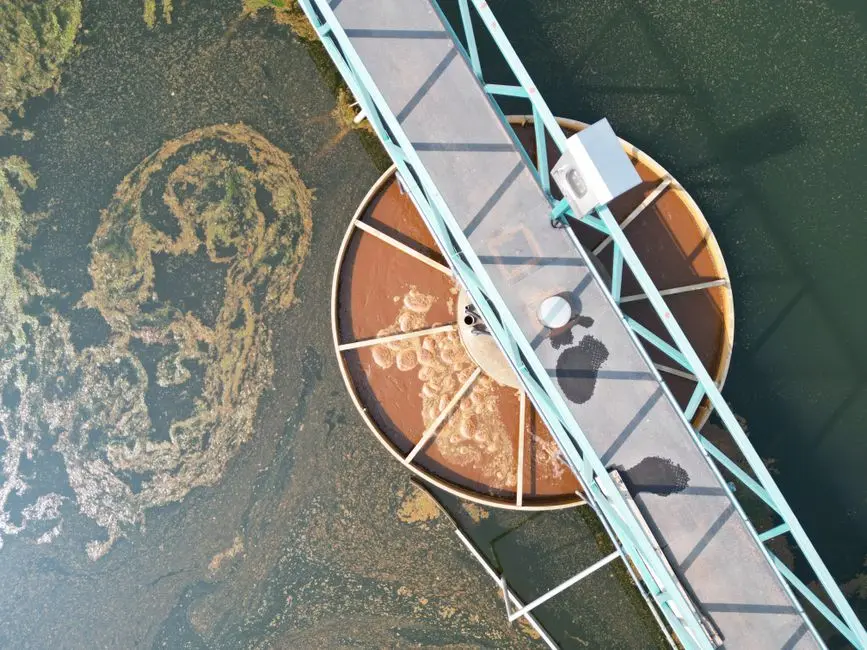
The four engineering inputs a Dallas plant must lock down before vendor selection are: peak hourly flow, influent TSS and FOG concentrations, target removal efficiency, and required hydraulic retention time. HRT for DAF typically runs 15–40 minutes depending on the application — lower end for metalworking emulsions, upper end for high-FOG food streams. A DAF machine specifications selection guide walks through the calculation method, but the rule of thumb is that DAF surface overflow rate should land at 10–25 m/h for floc-blanket operation.
Climate is a non-trivial factor in North Texas. Summer ambient temperatures routinely exceed 35 °C from June through September, and uncovered DAF tanks accelerate biological activity in the float layer, increasing odor potential and float putrefaction. For any Dallas installation near a residential zone, an enclosed or covered DAF tank with odor control is recommended. Winter is the opposite problem — influent temperatures in metalworking can drop to 10–15 °C, which depresses FOG solubility and can actually improve DAF oil removal but may require influent heating for downstream biology to maintain mesophilic activity.
Operator staffing is a real constraint. The DAF includes automatic skimming and micro-bubble recirculation, which reduces the daily operator-hour commitment to roughly 1–2 hours per shift. For a Dallas plant with a lean EHS team (often a single EHS manager covering multiple sites), that operating profile materially changes the total cost of ownership calculation. Skid-mounted packaged systems cut install time on site to 3–5 days versus 3–4 weeks for a stick-built concrete tank.
Compliance in Dallas: TCEQ, EPA Pretreatment, and Reuse Options
TCEQ industrial discharge permits are issued under 30 TAC Chapter 305, and the effluent limits inside the permit are driven by the receiving stream's water-quality standards. For Dallas plants discharging to a Trinity River tributary, that typically means tighter limits on BOD₅, TSS, and ammonia than the national default. Direct-discharge permits also require toxicity testing (whole effluent toxicity, or WET) on a defined schedule, which has to be designed into the treatment train from day one — biology alone is not always enough to pass a WET test, and tertiary polishing is often required.
Plants discharging to a Dallas-area POTW operate under EPA categorical pretreatment standards (40 CFR Part 403) plus the local sewer-use ordinance. Categorical standards apply to specific industries — metal finishing, electronics, food processing with significant FOG loading — and set maximum allowable concentrations for parameters like oil & grease, total metals, and pH. The 40 CFR 403 general and specific prohibitions also block discharges that "cause pass-through" or "interference" at the POTW, which is the legal hook municipalities use to enforce FOG limits on food processors. The North Texas reuse-water market is the third compliance pressure: as cities like Plano, Frisco, and Irving expand reuse infrastructure for irrigation and industrial make-up, plants sending effluent to those networks face additional turbidity, pathogen, and nutrient limits that go beyond standard TCEQ permit conditions.
Decision Framework: Choosing the Right DAF or ETP for a Dallas Plant
Four decision rules cover the configurations a Dallas plant will encounter in 2026. Each is mapped to the equipment configuration that satisfies it.
| Decision Rule | Plant Condition | Required Configuration | Primary Equipment |
|---|---|---|---|
| Rule 1 | Discharging to a municipal STP with a strong pretreatment program | DAF only | Dissolved air flotation system + sludge dewatering |
| Rule 2 | Discharging to Trinity River basin or sending to reuse network | Full ETP with biological secondary | DAF + MBR membrane bioreactor system + tertiary disinfection |
| Rule 3 | High-FOG industry (dairy, meat, edible oil refining) | DAF must be the first stage regardless of downstream | DAF as primary, with covered tank for odor control |
| Rule 4 | Fabricated metals or oily wastewater | DAF + automatic chemical dosing | DAF paired with an automatic chemical dosing system for pH and coagulant control |
For a regional benchmark on similar DAF-vs-clarifier decisions in adjacent markets, the DAF vs clarifier for petroleum wastewater guide covers the same trade-offs in a comparable regulatory environment.
Frequently Asked Questions
What is the minimum DAF system size for a small Dallas food plant?
For a single-shift food or metalworking operation discharging 15–25 m³/h with TSS under 800 mg/L and FOG under 300 mg/L, a DAF unit in the 20–30 m³/h range with 20–30 minute HRT is the typical minimum. The DAF line starts at 4 m³/h for very small batch operations, but most Dallas plants size to handle peak hourly flow with a 1.5× safety factor rather than average flow, to prevent upset during cleaning cycles.
If my Dallas plant already discharges to a POTW under a pretreatment permit, do I still need biological treatment?
No — EPA 40 CFR Part 403 categorical pretreatment standards and the local sewer-use ordinance govern POTW discharges, and the POTW provides biological treatment. A DAF primary clarifier plus sludge dewatering is typically sufficient, provided FOG and TSS are within the local sur-charge thresholds. A full ETP with biological secondary becomes mandatory only if the plant moves to direct discharge, on-site reuse, or is required by TCEQ to meet limits stricter than the POTW's headwork.
What role does biological treatment play downstream of DAF, and when is it required?
Biological secondary treatment (aerobic MBBR, SBR, or anaerobic) is required when BOD₅ and COD reductions beyond what DAF can deliver (typically 50–85%) are needed to meet a direct-discharge or reuse limit. For a Dallas plant discharging to a Trinity River tributary, BOD₅ limits of 20–30 mg/L usually cannot be reached by DAF alone, so an MBR membrane bioreactor system downstream of the DAF becomes the standard configuration. The biological stage also stabilizes the wastewater for any downstream RO or reuse polishing.