Start with the water balance, not a treatment skid
An Ile-Ife data center should establish its source-water chemistry, cooling-loop blowdown flow and Osun State discharge conditions before buying a treatment skid. The plant must serve two distinct duties: preparing raw or alternative source water for cooling makeup, and recovering or treating concentrated cooling-tower blowdown. Equipment selection follows from the measured water balance, reuse target, permit limits and available power—not from a generic global data-center design.
Cooling accounts for 80–90% of data-center water demand, according to Genesis Water Technologies (2025). Ecologix (2025–2026), as cited in the Ilorin research, reports that global AI hyperscale facilities consume 1.14–1.70 million L/day, with evaporative losses accounting for about 60% of that total. These are global benchmarks, not Ile-Ife design loads. At approximately four cycles of concentration, 25–30% of makeup water becomes blowdown, according to Genesis Water Technologies (2025).
Build the project water balance from four inputs:
- IT load and facility PUE;
- Ile-Ife design wet-bulb temperature and other weather data;
- Cooling-system configuration and operating schedule; and
- Operating cycles of concentration, plus measured evaporation, makeup and blowdown flows.
The procurement boundary must retain two flows. The first is raw or treated source water used as cooling makeup. The second is concentrated blowdown destined for recovery or permitted discharge. Source-water chemistry, cooling-tower operating chemistry and discharge consent are separate design questions. The data-center blowdown treatment framework provides a useful process structure, but its local values should not be transferred to Ile-Ife.
Characterize Ile-Ife source water and cooling blowdown
Measured water chemistry must be the gate between the water balance and equipment sizing, because source-water treatment and cooling-loop blowdown recovery impose different contaminant-removal duties. For Ile-Ife, obtain representative data for the proposed borehole, municipal connection or surface-water source and for the cooling blowdown. The supplied research contains no verified Ile-Ife analytical values, so no local hardness, TDS or turbidity limit should be assumed.
Test source water and blowdown for TDS, hardness, alkalinity, silica, iron, TSS, turbidity, SDI, pH, HPC and conductivity. Also record the cooling chemicals used, including biocides, corrosion inhibitors, scale inhibitors and pH-adjustment products. Water Utility Report (2026-04-14) explains that cooling-tower blowdown can contain elevated salts, heavy metals, biocides, corrosion inhibitors and altered pH. UGA Extension (2026) identifies the same chemical categories, including anticorrosion, antiscaling and biocidal additions, as relevant contaminants that may require treatment before discharge.
| Parameter | Cooling-tower target from Genesis Water Technologies (2025) | Ile-Ife design use |
|---|---|---|
| TDS | 500–1,500 mg/L | Confirm makeup chemistry, concentration factor and recovery target |
| Hardness, as CaCO₃ | Below 200–400 mg/L | Determine whether hardness or total TDS controls membrane choice |
| TSS | 10–25 mg/L | Size side-stream filtration and pretreatment |
| HPC | Below 10,000 CFU/mL | Assess biological control and pretreatment |
| pH | 6.5–8.5 | Check chemical compatibility and treatment controls |
| Alkalinity, as CaCO₃ | 50–200 mg/L | Assess scaling potential and recovery limits |
| Blowdown TDS | Global preliminary envelope: 1,200–6,000 mg/L, or 4–8× makeup | Replace with measured Ile-Ife values; Genesis Water Technologies (2025) links the envelope to cycles of concentration and source-water quality |
Run a 4–6 week source-water pilot that covers harmattan, dry-season and rainy-season conditions before finalizing RO sizing. The Ilorin research identifies seasonal source-water variation as a design risk, and the same need applies to Ile-Ife. Record source chemistry, treatment results and membrane performance together so that fouling, recovery and cleaning decisions rest on site evidence.
Build pretreatment around the highest fouling risk
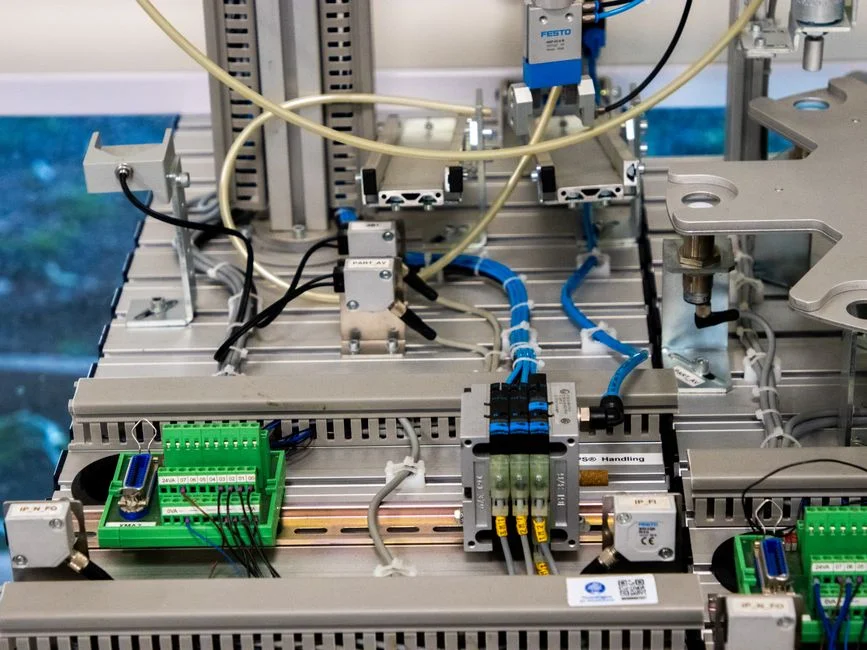
Pretreatment should remove the contaminants most likely to foul or damage the selected membrane train, and each stage should have a defined duty. Where the raw intake contains debris, trash, plastics or fibrous material, install a rotary mechanical bar screen to protect downstream pumps, valves and membrane equipment.
For source water, multi-media filtration can remove turbidity, suspended solids and colloids while supporting the SDI required by RO. The design should be based on measured source-water results and membrane requirements; the supplied research provides no Ile-Ife SDI or turbidity value that can safely be substituted.
Cooling-loop solids require a separate control step. Genesis Water Technologies (2025) specifies side-stream filtration at 1–5% of circulation flow with 10–25 µm removal. This stage reduces blowdown TSS before the water enters recovery equipment, while allowing the operator to control suspended solids within the cooling program.
Where finer solids removal is required before RO, a hollow-fiber UF pretreatment system is specified in the research at 0.01–0.1 µm, 10–30 psi and 90–95% recovery. UF removes suspended solids, bacteria and high-molecular-weight organics before RO.
Residual oxidizing biocides require specific control because they can oxidize polyamide membranes. The research recommends reviewing chlorine dioxide or UV for polishing disinfection and using non-phosphate scale inhibitors to reduce downstream phosphorus loading. Treat iron, hardness and silica as site-specific inputs; do not assume that a cartridge filter, softener or general-purpose pretreatment skid will remove them adequately. A linked water-treatment parts, valves and media package should be specified only after the pilot identifies the required media and control strategy.
Choose RO or NF for dissolved-solids control
RO is the stronger general option for broad TDS reduction, while NF becomes attractive when hardness is the controlling constraint and lower membrane energy demand has technical and commercial value. Neither route should be ordered before the measured feed chemistry, required recovery and concentrate route are confirmed together.
| Design issue | Industrial RO route | NF route |
|---|---|---|
| Primary application | Broad TDS reduction and permeate reuse | Hardness control when TDS reduction requirements are less demanding |
| Rejection | 95–99%, according to Genesis Water Technologies (2025) | Not stated in the supplied research; assess from measured feed and target water |
| Recovery | 50–75%, according to Genesis Water Technologies (2025) | 70–85%, according to Genesis Water Technologies (2025) |
| Operating pressure | Not stated in the supplied research | 75–150 psi, according to Genesis Water Technologies (2025) |
| Permeate quality | 10–50 mg/L TDS, according to Genesis Water Technologies (2025) | 30–50% of feed TDS, according to Genesis Water Technologies (2025) |
| Energy comparison | Baseline | 30–40% lower energy use than RO, according to Genesis Water Technologies (2025) |
| Decision gate | Use when permeate reuse and TDS removal justify the duty | Confirm against measured conductivity, hardness, silica and recovery limits |
NF’s lower operating pressure does not automatically establish lower lifecycle cost. The project must account for water chemistry, recovery, membrane cleaning, concentrate disposal, power cost and the required reuse quality. A configured industrial reverse osmosis system may still be appropriate where broad dissolved-solids control is required.
Specify PLC-controlled antiscalant and chemical dosing, conductivity and pressure instrumentation, membrane-cleaning provisions and permeate-quality interlocks. A PLC-controlled automatic dosing system should cover the chemicals confirmed by the cooling and pilot programs. If hardness removal is confirmed as necessary, evaluate an industrial water-softening stage against the measured profile rather than inserting it by default.
Resolve concentrate before selecting the end-use strategy

Concentrate management is the main commercial and regulatory decision because membranes remove contaminants from the reusable stream but produce a smaller residual stream that still requires an approved destination. Permitted discharge should be the baseline option, subject to NESREA requirements, FMEnv standards and the applicable Osun State environmental consent conditions. The Ilorin research identifies these three regulatory layers; its finding that timelines must be confirmed locally should be applied to Osun State rather than importing Kwara State conditions.
| Strategy | Consent and operating risk | Capital and energy reference | Conditional application |
|---|---|---|---|
| Reuse with permitted concentrate discharge | Requires an acceptable discharge point, monitoring plan and applicable Osun State consent | 50,000 GPD BWRO: US$250,000–500,000 installed and US$1.50–3.00 per 1,000 gallons treated, according to Genesis Water Technologies (2025) | Default candidate when measured permeate can return as cooling makeup and concentrate discharge is permitted |
| Partial ZLD through mechanical vapor compression | Reduces discharge volume but adds power demand, maintenance and distillate-management requirements | 95–98% concentrate recovery, distillate TDS below 10 mg/L, US$1–3 million for 10,000–30,000 GPD and 15–25 kWh per 1,000 US gallons of distillate, according to Genesis Water Technologies (2025) | Use when discharge volume must fall sharply but full ZLD capital is not justified |
| Full ZLD through RO, evaporator and crystallizer | Highest power, maintenance and solids-handling burden | US$3–8 million for data-center-class capacity, according to Genesis Water Technologies (2025) | Reserve for a case where discharge is effectively prohibited |
These dollar values are global reference envelopes, not quotations for Ile-Ife. Request naira-denominated pricing with freight, import duties, installation, commissioning, controls, membrane replacement and media replacement identified separately. The Ilorin research identifies membrane elements as particularly exposed to naira-dollar movement and import duty.
Genesis Water Technologies (2025) reports that treated wastewater is typically 30–50% cheaper than potable water. The Ile-Ife business case must still use local tariffs, discharge levies and consent conditions. A chlorine dioxide generator may be relevant to polishing disinfection, but it does not solve concentrate disposal.
Give the treatment train independent power and standby capacity. Loss of blowdown treatment must not force uncontrolled cooling-tower bleed or scaling. Determine the required redundancy from the cooling-system operating philosophy and available generation rather than adding it as an unspecified allowance.
Procure, pilot and permit in the right sequence
The safest sequence is characterize, pilot, consult the authorities, fix the process basis, then procure. Begin with a 4–6 week source-water pilot spanning harmattan, dry season and rainy season. The pilot should compare pretreatment alternatives, membrane recovery, cleaning frequency and permeate quality before RO elements are selected.
Give EPC suppliers one common data request:
- Measured source-water and blowdown analyses;
- Facility IT load, PUE, wet-bulb design data and measured cooling flows;
- Cycles of concentration, chemical program and cooling-control philosophy;
- Osun State consent conditions, receiving point, monitoring frequency and discharge limits;
- Permeate reuse target and concentrate destination;
- Available electrical supply, standby-generation requirements and operating hours;
- Trained operators and the proposed maintenance responsibility; and
- Separate prices for membrane elements, skid, installation, freight, import duties, commissioning, controls and long-term membrane or media costs.
Engage NESREA, FMEnv and the relevant Osun State environmental authority early to confirm the discharge point, monitoring frequency and sampling locations. The cited global permit range of 6–18 months is not a confirmed Nigerian timetable and must not be placed in the project schedule without local confirmation.
Before comparing bids, specify automatic backwash, membrane cleaning, permeate diversion, conductivity alarms, high-pressure protection and safe concentrate handling. Equipment scope can be compared through the RO and UF membrane-element package and, where disinfection is selected, a UV polishing system. The wastewater treatment cost and ROI framework can structure the commercial comparison, but its Puebla values are not Nigerian price evidence.
Frequently Asked Questions
How much should an Ile-Ife data center budget for cooling blowdown treatment, and which costs are included?
No Ile-Ife quotation can be given without the measured flow, chemistry, reuse target and concentrate route. As non-quotation benchmarks, Genesis Water Technologies (2025) gives US$250,000–500,000 installed for a 50,000 GPD BWRO system and US$1.50–3.00 per 1,000 gallons treated. Ask each bidder to itemize membranes, skid, installation, freight, import duties, commissioning, controls, power redundancy and consumables. Treat every benchmark as global until a Nigerian supplier submits a compliant offer.
Should the project use UF plus RO, or is NF sufficient?
Use UF plus RO where broad TDS removal and dependable permeate reuse are required. Consider NF when measured hardness is the controlling constraint and its 70–85% recovery and lower energy demand remain adequate after checking conductivity, silica and concentrate disposal, according to Genesis Water Technologies (2025). The final choice must also reflect whether permeate re-enters the cooling loop and whether available power supports the selected recovery.
How should an EPC supplier be selected for a data-center blowdown skid?
Check the supplier’s verified process design against the site water balance and pilot results. Require membrane performance data, controls scope, electrical-load details, standby provisions, commissioning support, operator training, references, spares and lifecycle-cost disclosure. A compliant quotation should show how the proposed equipment meets the measured feed chemistry and the eventual Osun State consent conditions rather than rely on generic data-center capacity claims.
When is MVC or full ZLD justified instead of permitted discharge?
Choose partial ZLD through mechanical vapor compression when consent conditions or site constraints require a major reduction in discharge volume but full ZLD capital is not justified. Reserve full ZLD for cases where concentrate discharge is effectively prohibited. The decision must compare consent risk, concentrate volume, CAPEX, energy cost, maintenance and solids handling; water savings alone are not a sufficient basis. Genesis Water Technologies (2025) provides global reference ranges, not an Ile-Ife recommendation.
What testing is required before ordering an Ile-Ife treatment plant?
Complete a site water balance and test source water and blowdown for TDS, hardness, alkalinity, silica, iron, TSS, turbidity, SDI, pH, HPC and conductivity. Review the biocide, corrosion-inhibitor, scale-inhibitor and pH-control program, then run a 4–6 week pilot that represents harmattan, dry-season and rainy-season conditions. Only after these inputs and the discharge route are confirmed should membrane elements, recovery, pretreatment and final equipment be ordered.