Size the Irbid Blowdown Stream Before Choosing Equipment
An Irbid data center generally needs a pretreatment and membrane train sized around its cooling-tower blowdown, not a generic sewage plant. For an evaporatively cooled 100 MW facility, the supplied research indicates up to approximately 2 million L/day of water withdrawal, with 20–30% leaving as liquid blowdown—about 400,000–600,000 L/day. A UF+RO reuse system is the practical baseline, while partial zero liquid discharge with mechanical vapor compression should be evaluated when discharge limits or concentrate disposal make reuse-only treatment risky. Final design in Irbid must use site-specific source-water testing, cooling chemistry, discharge permit terms and receiving-system capacity.
Cooling-tower blowdown is the concentrated residual stream left when water evaporates but dissolved solids and treatment chemicals remain, as explained by Water Utility Report (2026). The same source identifies salts, heavy metals, biocides, corrosion inhibitors and altered pH as possible constituents, with actual composition governed by source water, chemical dosing and cycles of concentration.
The published example is a screening basis, not an Irbid design load. ide-tech.com, as cited by HydropureWater’s 2026 Amman engineering article, states that a 100 MW data center can withdraw up to approximately 2 million L/day, of which 70–80% evaporates and 20–30% exits as liquid blowdown. Applying that stated percentage to the same withdrawal basis gives approximately 400,000–600,000 L/day. This estimate must not be transferred directly to an Irbid facility with a different cooling configuration, operating schedule or expansion plan.
Request the following before requesting an equipment price:
- Daily makeup, evaporation and blowdown measurements, including instantaneous and seasonal peaks.
- Cooling configuration, operating hours, design cycles of concentration and future expansion.
- Makeup-water source, chemical program, temperature and expected water-level changes.
- Separate flows for sanitary wastewater, cooling blowdown and other industrial process streams.
- Redundancy requirements, bypass philosophy and operating scenarios.
General sanitary wastewater must remain a separate balance. A biological sewage unit does not replace treatment for dissolved salts, treatment chemicals and concentrated tower residuals. The practical sizing sequence is therefore: establish the source-water balance, isolate the blowdown stream, measure variability, and then size the treatment skid against the verified peak flow and required recovery. Further site-specific context is available in this data-center blowdown treatment guide for a water-stressed location.
Characterize Irbid Water and the Wastewater Quality Risk
Irbid source-water testing must determine whether the blowdown can be reused, blended into another stream or discharged directly; the published Amman figures are only preliminary screening values. The 2026 Amman engineering basis reports a TDS range of 1,200–6,000 mg/L across typical tower operating conditions, with the upper end associated with higher cycles of concentration. It also states that local tap values vary by season and source well. Neither point establishes Irbid values.
Commission a source-water and blowdown sampling program covering the following parameters across representative operating conditions:
| Parameter | Design question |
|---|---|
| TDS and conductivity | Establish salinity, concentrate volume and membrane loading. |
| Calcium, magnesium, hardness and alkalinity | Assess carbonate scaling and whether partial softening is required. |
| Sulfate and silica | Determine sulfate and silica scaling constraints on RO recovery. |
| pH, chloride and residual chlorine | Define corrosion, membrane compatibility and disinfection requirements. |
| Biocide and corrosion-inhibitor residuals | Check treatment compatibility with membranes and the reuse loop. |
| Metals where relevant | Identify constituents requiring removal or controlled disposal. |
| Turbidity, SDI15 and TOC | Set pretreatment and UF feed-quality criteria. |
Ask the site team to document the chemical program, including biocide type and dose, corrosion inhibitor, dispersant, antiscalant and any legacy phosphate products. A change in chemical formulation can change both membrane compatibility and discharge chemistry.
The research describes a TDS threshold below 1,500 mg/L as a de facto ceiling for water-stressed governorates, including Amman. It is not evidence of a confirmed universal Jordanian or Irbid permit limit. The project must obtain current written conditions from the Ministry of Water and Irrigation, JSMO and the relevant sewer or receiving authority. Where treatment chemicals are dosed separately, their metering and containment should be coordinated through an automatic chemical dosing system only after compatibility review.
Permit review must also address cumulative receiving-system load. Water Utility Report (2026) asks whether the local wastewater system has assessed cumulative discharges from multiple data centers, not merely whether each facility has an individual connection. That assessment should cover discharge volume, concentrate chemistry, treatment capacity and emergency controls.
Build a Pretreatment-to-Reuse Treatment Train
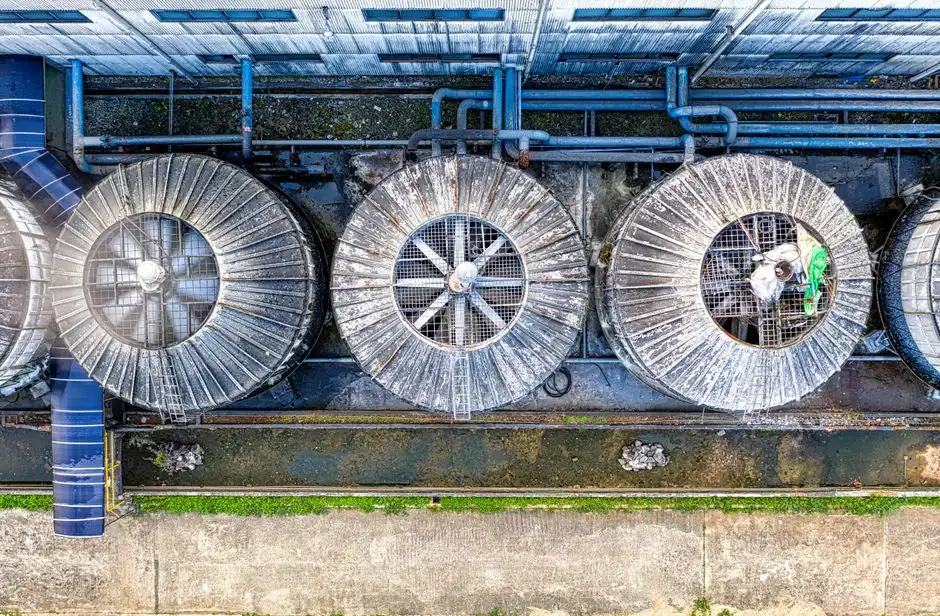
A defensible reuse train sequences solids removal before UF and RO because suspended solids, corrosion products and biofilm fragments can shorten membrane life or raise feed-side pressure. The published 2026 design basis uses side-stream filtration or multi-media filtration, followed by UF and then RO. RO permeate returns to cooling-tower makeup; the RO concentrate requires a separately engineered route.
| Stage | Published performance basis | Irbid engineering requirement |
|---|---|---|
| Side-stream filtration | Continuous treatment of 1–5% of circulation flow at 10–25 µm in the cited side-stream design. | Confirm flow split, solids loading, backwash and sludge-retention arrangement from actual tower data. |
| UF | PVDF hollow-fiber systems accept up to approximately 300 NTU feed turbidity, operate at 10–30 psi with automatic backwash and reach 90–95% recovery. The cited 50,000 GPD application reports permeate turbidity below 0.5 NTU and SDI15 below 3. | Verify the selected module against measured feed chemistry, temperature and backwash-water conditions. |
| RO | The research reports 95–99% TDS rejection, 10–50 mg/L permeate TDS and 50–85% recovery, with recovery constrained by CaCO3, CaSO4 and silica scaling. | Perform source-specific scaling calculations, confirm antiscalant and acid or pH conditioning, and validate recovery through pilot testing. |
The hollow-fiber UF pretreatment protects the downstream industrial RO blowdown reuse system; it does not replace the need for chemical-compatibility testing. Antiscalant, acid or pH conditioning, optional partial softening and biocide control should be included where justified by the scaling model and chemical audit.
Do not assume that RO permeate can be returned directly to every cooling tower. Assess the tower’s chemistry limits, make-up blending, corrosion risk, biocide program and discharge consequences together. Water Utility Report (2026) makes the governing point: recycled water reduces pressure on freshwater supplies but does not eliminate water-quality management; it changes the chemistry challenge.
- Remove suspended solids and retained solids with side-stream or multi-media filtration.
- Apply UF to control turbidity, SDI and particulate loading.
- Protect RO with verified scaling control and suitable pretreatment.
- Return RO permeate to the tower only after blending and water-quality checks.
- Route concentrate to an approved discharge or further treatment.
Choose Between Reuse, Partial ZLD and Full ZLD
The strongest 2026 choice depends on the Irbid concentrate route, not simply on the highest recovery available. Reuse-only UF+RO is defensible when the permitted route can accept the concentrate, the blended discharge remains compliant and freshwater savings justify the treatment train. The supplied research reports 60–85% recovery for this configuration, compared with 50–85% for the RO stage itself.
| Option | Published recovery and output | Main decision gate |
|---|---|---|
| UF+RO reuse | 60–85% overall recovery in the cited configuration; RO permeate reported at 10–50 mg/L TDS. | Can the concentrate be blended and lawfully discharged without unacceptable receiving-system impact? |
| Partial ZLD: UF+RO+MVC | MVC recovers 95–98% of RO concentrate as distillate below 10 mg/L TDS; overall recovery reaches 85–95%, and liquid-waste reduction is 80–90%. | Does the site have sufficient electrical capacity, land and a permitted route for the residual brine? |
| Full ZLD: UF+RO+MVC+crystallizer | Overall recovery reaches 95–99%, with residual brine converted to solid salts. | Is there an approved solid-waste route, suitable land and a justified operating-cost case? |
The cited data-center-class full-ZLD estimate is $3–8 million in capital cost and $5–15 per thousand gallons in operating cost. MVC alone is reported at 15–25 kWh per 1,000 US gallons. These values are screening references, not Irbid quotations; local power tariffs, climate, equipment scope and installation conditions can materially change the result.
The research offers a screening rule rather than an Irbid mandate: if an applicable sewer permit is achievable and discharge fees are below approximately $8 per thousand gallons, reuse-only may be defensible; above that threshold, or where TDS or phosphorus creates permit risk, partial ZLD is the stronger default. Full ZLD is justified primarily where liquid discharge is prohibited or unavailable.
For Irbid, require each proposal to identify the exact concentrate destination. A lined evaporation pond, permitted off-site disposal and sewer discharge are different risks and should not be combined in one unqualified quotation. Obtain freshwater cost, sewer fees, available waste heat, electricity tariff, land availability, climate data and the current discharge permit before locking the configuration. Additional RO and UF membrane elements can then be specified against the verified hydraulic and chemistry basis.
Budget the System Without Hiding Operating Costs
A preliminary budget must separate treatment equipment from civil work, utilities, concentrate management and recurring membrane costs. The supplied research cites a 50,000 GPD RO skid at $250,000–$500,000 installed, with operating cost of $1.50–$3.00 per thousand gallons treated. The same source places a 10,000–30,000 GPD MVC unit at $1–3 million in capital cost and 15–25 kWh per 1,000 US gallons. These figures retain their stated capacity and source scope; they are not quotations for Irbid.
| Budget package | Items to price | Buyer check |
|---|---|---|
| Equipment capital | Filtration, UF, RO, chemical storage and dosing, instrumentation, membranes, pumps and controls. | Confirm flow, recovery, redundancy, materials, warranty and performance guarantees. |
| Site works | Foundations, piping, electrical supply, drainage, buildings, access and commissioning. | Identify civil and utility exclusions explicitly. |
| Pretreatment | Acid or pH control, antiscalant, optional softening and membrane-compatible chemical control. | Price consumables and verify dosing ranges. |
| Concentrate and solids | Blending or disposal infrastructure, transport, evaporation-pond provisions and filter or sludge dewatering. | Require a destination and unit-cost basis for every residual stream. |
| Recurring OPEX | Energy, chemicals, membrane replacement and cleaning, media, spare parts, sludge disposal and service. | Use the supplier’s replacement assumptions and provide a multi-year cash-flow schedule. |
The research treats RO and UF membrane replacement as recurring operating expenditure, not a general contingency. Require suppliers to state the assumed cleaning interval, replacement interval and consumable price basis. If pretreatment generates sludge or filter solids, include collection, storage, plate-frame filter-press dewatering and final disposal rather than assuming those solids disappear into the liquid balance.
Request quotations on the same flow, recovery, duty/standby configuration, utility boundary and concentrate-disposal basis. Otherwise, equipment-only prices will not be comparable.
Test Reuse Impacts and Prepare the Permit File
A short-term pilot or side-stream test using actual Irbid source water and representative cooling chemistry should establish scaling, membrane performance and achievable recovery before final equipment selection. The test record should include feed and permeate chemistry, normalized productivity, pressure rise, rejection, recovery, chemical demand and any pretreatment changes.
EngrXiv (2026) reports that UF+RO energy use in its wastewater scenario grows to more than five times the freshwater case. The same study identifies the countervailing benefit: improved cycles of concentration reduce blowdown and chemical consumption. Its indirect water penalty is approximately 0.93 L/m³, less than 0.1% of the direct displacement benefit, while treatment energy accounts for roughly 80% of the difference in global-warming potential between the wastewater and freshwater cases. The procurement comparison should therefore include both freshwater displacement and energy—not one without the other.
Prepare the permit and commissioning package around:
- Measured discharge volume and concentrate chemistry.
- Blending assumptions and the compliance point.
- Biocide, antiscalant, acid and inhibitor residuals.
- Sludge or filter-media generation and disposal.
- Continuous monitoring points and calibrated instruments.
- Emergency bypass, isolation and spill-response arrangements.
Do not represent the below-1,500 mg/L TDS value from the research as a confirmed Irbid statutory limit. Obtain written site-specific permit conditions before final process selection, and verify how the Ministry of Water and Irrigation, JSMO and the receiving authority apply them.
For microbial control, assess UV and chlorine dioxide against the reuse-loop chemistry, residual requirements and discharge obligations. A chlorine-dioxide generation system or UV sterilization system should not be selected solely because it is common in reuse designs; compatibility with the existing biocide program and the permitted residual strategy must be demonstrated.
Frequently Asked Questions
What preliminary budget should an Irbid data-center blowdown system include?
Use the published 50,000 GPD RO estimate of $250,000–$500,000 installed and $1.50–$3.00 per thousand gallons treated only as an order-of-magnitude benchmark for that capacity. The cited 10,000–30,000 GPD MVC estimate is $1–3 million in capital cost. A firm Irbid quotation requires measured design flow, recovery duty, source-water analysis, concentrate destination, utilities, civil scope, redundancy and chemical consumption. The supplier’s industrial reverse osmosis cost guide provides a framework, not a local offer.
Should equipment be selected from the data-center power rating?
No. Campus power rating provides only an initial screening clue. Equipment selection should be controlled by measured makeup and blowdown, operating hours, seasonal demand, cycles of concentration, source-water chemistry, required recovery, permit limits, expansion and redundancy. For Irbid, confirm these inputs through source-water testing and current permit discussions before issuing a firm order.
When is partial ZLD preferable to UF+RO reuse?
Compare them on the complete concentrate route, not only on recovered-water volume. UF+RO is simpler where concentrate can be blended and lawfully discharged. Partial ZLD is stronger where permit risk, freshwater value or discharge cost justifies adding MVC; the research reports 85–95% overall recovery and 80–90% liquid-waste reduction for that configuration. The remaining brine still needs an approved destination.
What evidence should suppliers provide before equipment selection?
Require a membrane-compatibility statement, source-specific scaling calculation, guaranteed flow and recovery basis, process and instrumentation diagrams, utility demand, control philosophy, membrane-cleaning and replacement assumptions, spare-parts scope, service response and local project references. The references should demonstrate comparable cooling-blowdown chemistry and concentrate management rather than ordinary potable-water installation alone.
Is the below-1,500 mg/L TDS threshold an Irbid discharge limit?
No. The research describes it as a de facto ceiling in water-stressed governorates, not as a confirmed Irbid legal limit. The project must obtain current written site-specific conditions from the Ministry of Water and Irrigation, JSMO and the relevant sewer or receiving authority, including limits for discharge volume, TDS, phosphorus, treatment-chemical residuals and cumulative receiving-system loading.
Related Equipment
- industrial RO blowdown reuse system — specifications, capacity range, and technical data