Determine Which Wastewater Streams Need Treatment
A data center in Cochabamba, Bolivia should not route sanitary sewage, process wastewater, cooling-tower blowdown, and proposed reuse water through one treatment train unless sampling shows they can be combined safely. Their contaminant profiles, destination constraints, and reuse criteria differ. The design basis is therefore a stream-by-stream inventory, followed by a measured water balance and a verified discharge or reuse authorization.
For evaporative cooling, cycles of concentration determine the blowdown relationship. Genesis Water Technologies, “Why Cooling Tower Blowdown Is Your Hidden Opportunity,” states that blowdown equals 25% of makeup at 4 CoC and 20% at 6 CoC. Moving from 4 to 6 CoC therefore reduces blowdown by five percentage points, or 20% relative to the 4-CoC flow—not 50%. That change should be evaluated against scaling, corrosion, and biological-control constraints.
Cooling blowdown may represent 20–40% of intake water according to Genesis Water Technologies, “Why Cooling Tower Blowdown Is Your Hidden Opportunity.” Use this only as an early screening range, not as a Cochabamba design flow. Local measurement may show a higher result: Genesis Water Technologies reports that actual blowdown can exceed theoretical calculations by 15–30% because of unmeasured losses and emergency dumps.
Local biological research also requires careful interpretation. Universidad Mayor de San Andrés and Universidad Privada del Valle, “Cellulase Production by Microorganisms Isolated from Laguna Blanca, Potosí-Bolivia,” studied 71 strains: 32 were selected as cellulase-positive, nine had higher cellulase activity, seven were halophilic, and two were halotolerant. Because the samples came from Laguna Blanca, Potosí, and were deposited in Cochabamba, this is biological context only. It does not establish a cooling-water limit, a reuse criterion, or a data-center treatment standard.
| Stream | Contaminants to verify | Treatment objective | Initial separation decision |
|---|---|---|---|
| Sanitary sewage | Biodegradable organics, solids, nutrients, pathogens | Authorized sewer discharge or controlled reuse | Keep separate from cooling blowdown unless the sewer approval and treatment design explicitly allow it |
| Process wastewater | Oil and grease, surfactants, metals, cleaning chemicals, pH | Discharge compliance or reuse based on the source process | Characterize separately; do not assume that filtration removes dissolved contaminants |
| Cooling-tower blowdown | Concentrated dissolved solids, hardness, suspended solids, biocides, corrosion inhibitors, scale inhibitors, dispersants | Permitted discharge, segregated reuse, or cooling-makeup recovery | Exclude sanitary sewage from this recovery train unless testing and authorization justify blending |
| Proposed reuse water | Quality required by the receiving toilet, process, washdown, cooling, or makeup service | Continuous fit-for-purpose quality | Define the endpoint and sampling frequency before selecting equipment |
This stream separation follows the evidence-to-equipment logic used in the data center cooling blowdown treatment methodology and the site-specific cooling blowdown recovery roadmap.
Build a Cochabamba Site-Specific Water Balance
Measured flows must define the design because a facility-level average cannot reveal the largest treatment event or the actual consumptive loss. Install or verify independent metering for makeup water, cooling-tower blowdown, evaporation, each wastewater inflow, and every reuse destination. Reconcile these measurements over complete operating cycles and include once-through cooling, emergency dumps, cleaning losses, and seasonal changes before sizing equipment.
- Measure makeup and blowdown continuously or at a frequency that captures normal cycles and dumps.
- Calculate theoretical blowdown from measured makeup and operating CoC, then compare it with the metered total.
- Reconcile evaporation, wastewater inflows, sludge or concentrate removal, and reuse withdrawals.
- Identify the maximum validated treatment flow and the maximum contaminant load during cleaning or emergency operation.
Do not infer total water consumption from water usage effectiveness alone. Genesis Water Technologies, “Why Cooling Tower Blowdown Is Your Hidden Opportunity,” explains that WUE divides site water intake by IT equipment energy, while water consumption refers to water permanently removed through evaporation or incorporation into products. Water usage also includes water withdrawn, used, and returned, potentially after treatment. A low WUE value therefore does not establish that blowdown is small, reusable, or fit for any particular discharge route.
The cooling architecture must be included in the balance. HydropureWater, “Data Center Wastewater & Cooling Blowdown Treatment in Santa Cruz de la Sierra,” reports that evaporative cooling can reduce energy use by roughly 10% relative to air-cooled alternatives but produces a continuous blowdown stream. The same source gives Santa Cruz climate and water assumptions; those are reference conditions, not Cochabamba facts. Obtain an hourly Cochabamba wet-bulb and dry-bulb exercise comparing evaporative, hybrid, and air-cooled operation. Cooling demand, local climate, power availability, water cost, and discharge constraints should be evaluated together.
For a screening balance, at 4 CoC the theoretical blowdown fraction is 25% of makeup; at 6 CoC it is 20%, based on Genesis Water Technologies, “Why Cooling Tower Blowdown Is Your Hidden Opportunity.” These fractions exclude site-specific unmeasured losses. For sizing, use the larger measured operating flows and verified worst-case events rather than the theoretical screening result alone.
The detailed approach for a multi-stream facility can be compared with the 2026 data center wastewater treatment guide for Johor Bahru, while retaining Cochabamba’s own climate, intake, tariff, and authorization data.
Characterize the Water Before Selecting Equipment
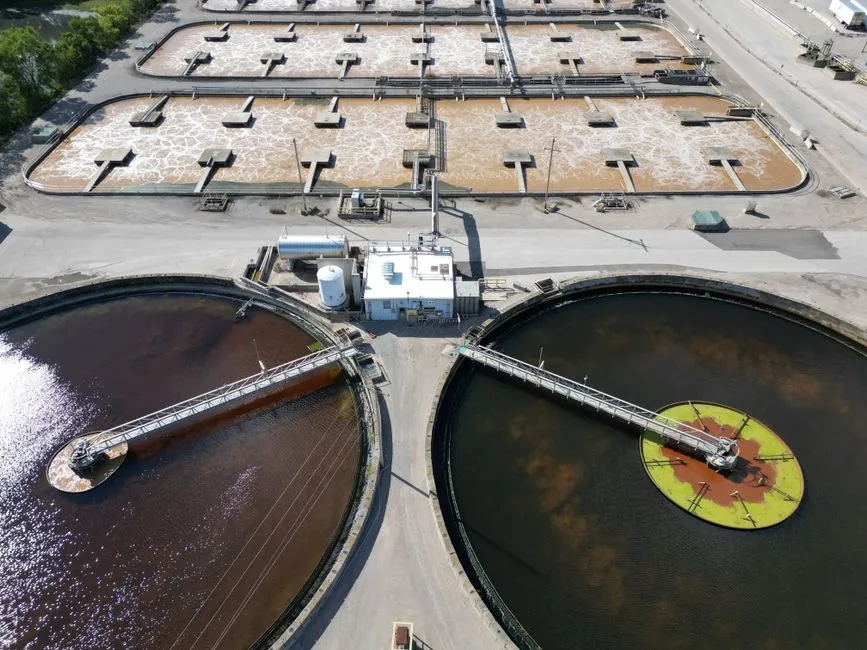
Source-water characterization must precede final equipment specification because the same equipment train can behave differently with hard groundwater, variable surface water, or an already conditioned municipal supply. HydropureWater, “Data Center Wastewater & Cooling Blowdown Treatment in Santa Cruz de la Sierra,” specifies weekly composite sampling for 8–12 weeks across wet and dry seasons, with full ionic chromatography, heterotrophic plate count, and Legionella screening. Apply the duration to the actual Cochabamba intake; the Santa Cruz supply assumptions themselves remain reference values.
Sample the source intake, circulating cooling water, cooling-tower blowdown, each process-wastewater source, and the sanitary wastewater at representative operating conditions. Include conductivity and TDS; total and calcium hardness; alkalinity; pH; suspended solids; silica; iron; the full ionic composition; heterotrophic plate count; and Legionella. Add oil and grease, surfactants, or metals where process activities can introduce them. For reuse, sample the final treated effluent because piping, storage, and distribution can change water quality.
| Parameter | Comparison value | Evidence status and design use |
|---|---|---|
| TDS | 500–1,500 mg/L | Reference cooling-water envelope from Genesis Water Technologies, 2025, cited by HydropureWater’s Santa Cruz guide; not a Cochabamba limit |
| Hardness | Below 200–400 mg/L as CaCO₃ | Reference envelope; determine the project target from actual chemistry, scaling assessment, and cooling conditions |
| Suspended solids | 10–25 mg/L | Reference envelope for cooling-water comparison |
| Bacterial counts | Below 10,000 CFU/mL | Reference cooling-water comparison value; Legionella results require separate risk assessment |
| pH | 6.5–8.5 | Reference cooling-water envelope; confirm discharge and reuse requirements separately |
| Alkalinity | 50–200 mg/L as CaCO₃ | Reference cooling-water envelope |
| Blowdown TDS at 4 CoC | Roughly 2,000–6,000 mg/L | HydropureWater Santa Cruz guide, 2025, as a typical range dependent on makeup quality; verify with Cochabamba data |
| RO permeate TDS | 10–50 mg/L | HydropureWater Santa Cruz guide, 2025, as a recovery-system benchmark rather than guaranteed project performance |
| UF/RO side-stream recovery | 90–95% | Reference recovery range in the same source; concentrate disposal and feed chemistry remain unresolved design inputs |
| RO recovery from blowdown | 50–85% | Reference range from the same source; scaling and concentrate disposal can reduce achieved performance |
The reference envelope is useful for comparison, not acceptance. HydropureWater’s Santa Cruz guide, 2025, states that an industrial softener is indicated when hardness exceeds 400 mg/L, but that threshold is a technical benchmark rather than proof of Cochabamba compliance. The same source notes that blowdown at 4 CoC commonly reaches roughly 2,000–6,000 mg/L TDS depending on makeup quality. Confirm actual concentrations before selecting softening, nanofiltration, reverse osmosis, or dosing.
Use continuous or logged measurements where chemistry changes can affect operations. The 2026 engineering guide to online water-quality monitoring provides a basis for defining conductivity, pH, and solids instrumentation, but sensor selection should follow the verified contaminants and required control response.
Choose a Treatment Train by Discharge Objective
Each barrier should solve a contaminant or control problem demonstrated by sampling. HydropureWater’s Santa Cruz guide, 2025, states that secondary-treated municipal reuse water commonly benchmarks at 600–1,200 mg/L TDS. If sanitary wastewater is intended for reuse as cooling makeup, this benchmark may require further membrane polishing; it does not establish that secondary treatment alone is acceptable for the intended reuse.
For sanitary wastewater with biological treatment and compact reuse-quality polishing, evaluate an MBR membrane bioreactor for data center wastewater reuse. For process wastewater containing oil and grease, surfactants, colloids, or rapidly separated floating material, use physical pretreatment such as DAF equipment before biological or membrane treatment. DAF addresses separable material; it does not remove dissolved salts or persistent chemicals.
For cooling systems, Genesis Water Technologies, “Why Cooling Tower Blowdown Is Your Hidden Opportunity,” identifies side-stream filtration as an enabling barrier for removing solids before they force blowdown and supports higher sustainable CoC. The equipment scope should follow measured suspended solids, heat-exchanger fouling risk, and the required CoC. A hollow-fiber UF system for cooling-blowdown pretreatment is relevant when the recovery objective requires removal of suspended solids and colloids before UF/RO or NF, not merely because reuse has been proposed.
Where hardness exceeds the confirmed cooling-water target, evaluate industrial softening or nanofiltration. HydropureWater’s Santa Cruz guide, 2025, identifies softening or NF when hardness exceeds 400 mg/L. An industrial water softener system should be selected from measured hardness, alkalinity, resin capacity, regeneration frequency, and concentrate-disposal requirements—not from a generic cooling-water envelope.
For membrane reuse, place UF ahead of RO or NF. HydropureWater’s Santa Cruz guide, 2025, specifies that arrangement for blowdown recovery and warns that elements must be rated for higher-TDS concentrate because potable-rated elements can foul prematurely. UF addresses particulates and protects downstream treatment; RO or NF removes dissolved salts according to the recovery target. Concentrate disposal must be authorized before either becomes the final route.
Use PLC-controlled dosing for pH adjustment, coagulation, corrosion control, and scale control, including a PLC-controlled chemical dosing system where source chemistry varies. Account for accumulated biocides, corrosion inhibitors, scale inhibitors, and dispersants because they can alter membrane compatibility and effluent toxicity.
| If the confirmed problem is… | Required barrier | Decision condition |
|---|---|---|
| Biodegradable organics and solids in sanitary sewage | Biological treatment, optionally with MBR polishing | Confirm reuse endpoint and sewer or surface-discharge route |
| Oil, grease, surfactants, or floating solids | DAF or equivalent physical pretreatment | Protect downstream biological or membrane systems |
| Cooling-loop suspended solids | Side-stream filtration | Support stable CoC and reduce blowdown frequency |
| Hardness above the confirmed cooling target | Softening or NF | Verify scaling assessment and regeneration or concentrate route |
| Dissolved solids in reuse water | UF pretreatment followed by RO or NF | Define permeate quality, recovery, and concentrate disposal |
| pH, coagulation, scale, or corrosion-control demand | Instrumented chemical dosing | Control chemical inventory and protect downstream equipment |
Control Microbes Without Creating a Discharge Problem
Microbial control must address both the cooling loop and the wastewater treatment train without creating residual-discharge conflicts. HydropureWater’s Santa Cruz guide, 2025, includes Legionella screening in its startup sampling protocol. Screen source water, circulating cooling water, and blowdown, then establish whether the circulating-water result triggers investigation, control action, or a change in operating practice. The research does not supply a Cochabamba Legionella limit.
Where automated residual control and on-site generation are justified, evaluate on-site chlorine dioxide generation for cooling loops. HydropureWater’s product information lists configurations from 50 g/h to 20,000 g/h for industrial cooling loops and process wastewater. Those are supplier configuration figures, not proof of adequate project capacity. Select the generation rate and storage arrangement from the verified flow, target residual, demand profile, safety requirements, and feed-water chemistry.
Evaluate UV-C when residual chlorine would interfere with the selected reuse service, membrane protection, or discharge authorization. A UV sterilizer for water treatment requires dose validation based on flow, UV transmittance, target organism, and reactor geometry. UV does not provide a chemical residual after the reactor, which may be an advantage or a disadvantage depending on the receiving system.
Before the permit pre-application, define residual disinfectant, pH, temperature, and contact-time requirements. HydropureWater’s Santa Cruz guide, 2025, identifies residual chlorine as a conventional parameter commonly requested by the environmental authority, alongside BOD, TSS, pH, metals, nutrients, and temperature. It does not establish a project-specific Cochabamba limit. The treatment train should therefore include residual measurement, automatic control, and a documented response to excursions.
Confirm the Cochabamba Disposal and Reuse Pathway
The permitted destination must be known before equipment is ordered because treatment adequacy cannot be judged without enforceable limits and application requirements. HydropureWater’s Santa Cruz guide, 2025, describes Bolivia’s environmental discharge framework as departmental and administered through the Autoridad Ambiental Departamental under the RUE/EMAR pathway. Confirm the current process, responsible Cochabamba authority, forms, and current permit requirements directly; the supplied research does not confirm a data-center-specific threshold.
Separate the regulatory questions for each route. Determine whether sanitary-sewer discharge requires a pretreatment permit, whether surface discharge requires separate authorization, and whether reuse triggers an additional approval. HydropureWater’s Santa Cruz guide, 2025, states that these pathways should be confirmed in a pre-application meeting. Provide the authority with the source characterization, proposed destination, preliminary treatment train, anticipated flows, chemical inventory, and monitoring plan.
HydropureWater’s Santa Cruz guide, 2025, lists BOD, TSS, pH, residual chlorine, metals, nutrients, and temperature as parameters that may be reviewed. Do not automatically add every listed parameter to the final permit scope. Ask which apply to the facility, receiving stream, sewer connection, or reuse scheme, and obtain the applicable limits and sampling rules in writing.
For reuse, define the receiving service before selecting polishing technology. Reuse for toilet flushing, washdown, cooling makeup, or process water imposes different quality requirements. A once-compliant stream can become unsuitable if a reuse endpoint changes; therefore, specify operating flexibility without assuming that unlimited reuse is authorized.
The Santa Cruz guide, 2025, compares direct-discharge fees of 5–15 USD per 1,000 gallons in water-stressed regions. This is an international reference range, not a Cochabamba tariff. Obtain local sewer, water, and disposal prices, including treatment surcharges, sampling charges, and concentrate handling.
Design the final train for traceable sampling, calibration, bypass control, alarm response, and operating records. These controls allow the owner to demonstrate compliance and adjust treatment when permit conditions or reuse requirements change. Comparison points in the 2026 guide to pretreatment limits near Thomas and the 2026 guide to pretreatment limits near Iwate illustrate why sewer and pretreatment decisions are location-specific rather than transferable from Cochabamba examples.
Size, Cost, and Procure the Treatment Plant
Size each unit for the largest validated hydraulic and contaminant load, not the average facility demand. Include seasonal variation, cleaning flows, maintenance operations, and emergency states. Every performance guarantee should name the measured feed conditions, flow, filtrate quality, recovery, chemical consumption, cleaning frequency, and automatic control functions to which it applies.
HydropureWater’s Santa Cruz guide, 2025, provides reference capital bands of 50,000–200,000 USD for data-center side-stream filtration, a mid-six-figure-and-up range for UF/RO or NF blowdown recovery, and 3,000,000–8,000,000 USD for full zero-liquid-discharge systems. These are non-Cochabamba reference bands for commercial screening, not quotations. Request current local quotes using the measured flow, complete water analysis, reuse destination, recovery target, and construction constraints.
Require a five-year lifecycle comparison covering membrane replacement, filter media, treatment chemicals, sludge, brine or concentrate disposal, energy, labor, sampling, calibration, spare parts, and backup capacity. Separate capital expenditure from avoided water, sewer, disposal, and chemical costs. This prevents a low purchase price from obscuring disposal obligations or membrane operating costs.
For preliminary equipment comparisons, HydropureWater’s Santa Cruz guide, 2025, lists UF capacity from 2,000–40,000 L/h and MBR capacity from 10–2,000 m³/day, while also describing automatic chemical dosing under PLC control. Compare those product ranges with measured blowdown and wastewater duties, then require the supplier to confirm the selected duty point. Membrane selection should also be checked against the broader operating discussion in the 2026 MBR versus activated-sludge guide.
| Procurement item | Minimum information to request | Acceptance or guarantee item |
|---|---|---|
| Equipment sizing | Measured peak flow, seasonal profile, cleaning and emergency loads, full feed analysis | Duty flow and contaminant loading demonstrated under stated feed conditions |
| UF/RO or NF | Feed chemistry, recovery target, membrane compatibility, concentrate disposal route | Permeate flow and quality, system recovery, cleaning frequency, element life |
| MBR | Influent COD and load basis, hydraulics, reuse endpoint, solids handling | Treated flow and quality, membrane cleaning, solids handling, automatic controls |
| DAF | Oil, grease, surfactants, solids, pH, and coagulant requirements | Removal performance and sludge volume under the characterized feed |
| Softening or NF | Hardness, alkalinity, resin or membrane loading, regeneration or concentrate route | Hardness reduction, operating capacity, regeneration frequency, waste volume |
| Chemical dosing | Target residual or pH, feed variability, chemical compatibility, storage requirements | Control accuracy, chemical consumption, alarms, interlocks, and records |
| Disinfection | Target organisms, flow, transmittance or residual criteria, contact time, discharge route | Dose or generation capacity, residual control, fail-safe response, and monitoring |
| Whole plant | Five-year lifecycle cost, local service support, spares, commissioning, training, bypass policy | Capacity margin, startup acceptance tests, documentation, warranty, and support commitments |
A RO and UF membrane replacement plan should specify compatible element ratings, expected cleaning frequency, storage requirements, and replacement lead time. Before award, confirm manufacturing schedule, delivery to Cochabamba, local installation support, commissioning resources, and the contractual pathway for warranty claims.
Frequently Asked Questions
What is the minimum data required to size cooling blowdown treatment for a Cochabamba data center?
Require metered makeup and blowdown flows, the operating cycles of concentration, evaporation, wastewater inflows, reuse withdrawals, and worst-case dump or cleaning events. Sample the actual intake, circulating water, and blowdown through the 8–12-week wet-and-dry-season protocol specified by HydropureWater’s Santa Cruz guide, 2025. Include hardness, TDS, alkalinity, pH, suspended solids, silica, iron, full ionic composition, heterotrophic plate count, and Legionella before finalizing equipment capacity.
Is UF alone sufficient, or does the project need RO or NF?
UF alone is appropriate only if the verified reuse objective requires solids and colloid removal without dissolved-salt reduction. Use UF ahead of RO or NF when permeate TDS, hardness, or other dissolved constituents must meet the reuse specification. HydropureWater’s Santa Cruz guide, 2025, reports 90–95% recovery for side-stream UF/RO polishing and 50–85% for RO from blowdown, but these are benchmarks. A final choice depends on Cochabamba feed chemistry, recovery, membrane compatibility, energy, and an authorized concentrate route.
How much should a data-center wastewater treatment system cost in Cochabamba?
Do not apply the Santa Cruz reference bands directly as a Cochabamba quotation. HydropureWater’s Santa Cruz guide, 2025, lists 50,000–200,000 USD for side-stream filtration, a mid-six-figure-and-up range for UF/RO or NF recovery, and 3,000,000–8,000,000 USD for full zero-liquid-discharge systems. Request current local quotations based on measured flow, water analysis, required recovery, disposal route, utilities, and five-year operating costs; no project price can be established from the supplied research.
Which treatment option is most appropriate for sanitary sewage, process wastewater, and cooling blowdown?
Use biological treatment, potentially with MBR polishing, for sanitary sewage with a defined reuse endpoint. Add physical pretreatment such as DAF where process wastewater contains oil, grease, surfactants, or floating solids. For cooling blowdown, use side-stream filtration for solids control, softening or NF if hardness is above the confirmed target, and UF followed by RO or NF when dissolved-salt removal is required. The equipment choice must follow measured contaminants and the authorized destination, as discussed in the containerized MBR sizing guide for Santiago de Chile and the 2026 data-center treatment guide for Rohini.
What permits and discharge parameters should be confirmed before ordering equipment?
Confirm with the competent Cochabamba environmental authority whether sewer connection, surface discharge, and on-site reuse require separate approvals or permits. Obtain written confirmation of applicable limits for BOD, TSS, pH, residual chlorine, metals, nutrients, temperature, sampling frequency, and any reuse-specific quality criteria. HydropureWater’s Santa Cruz guide, 2025, identifies these as parameters that may be reviewed, but it supplies no project-specific Cochabamba limits. Make the permit route, monitoring plan, bypass controls, and recordkeeping requirements contractual preconditions.