Start with the permit, not the treatment train
Mining and metals plants near Hughes meet sewer pretreatment requirements by segregating wastewater, equalizing flow and chemistry, adjusting pH, precipitating and clarifying metals, filtering the effluent, and monitoring it against the receiving publicly owned treatment works’ sewer requirements. The U.S. EPA states that mining point-source discharges to surface waters require NPDES authorization; sewer discharges instead fall under the Clean Water Act pretreatment framework administered by the POTW. No supplied source identifies the exact Hughes-area POTW or its numerical local limits, so its ordinance, permit, monitoring rules, and applicable 40 CFR Part 403 provisions must be obtained before equipment sizing.
The first design gate is therefore document control, not procurement. EPA’s industrial wastewater guidance confirms the distinction: NPDES covers point-source discharges to surface waters, while indirect sewer discharges are evaluated under the pretreatment framework intended to prevent interference with POTWs. A plant may have both obligations if it discharges stormwater or other wastewater directly to surface water and sends process wastewater through a sewer.
Obtain and reconcile the following before defining equipment flow or performance guarantees:
- The receiving POTW’s current sewer-use ordinance and industrial-user permit.
- The site’s wastewater characterization, discharge points, and sampling history.
- Any applicable categorical pretreatment standard and subcategory.
- State requirements and discharge monitoring reports or correspondence.
- Industrial wastewater monitoring records, upset notices, and prior enforcement actions.
Do not transfer numerical limits from another municipality, another mining district, or a commercial article into the Hughes permit basis. Commercial references disagree on the applicable ore-mining provision, so verify the classification directly against the current 40 CFR text. The linked mining and metals sewer-limit compliance guide and DAF-versus-clarifier selection for mining wastewater provide comparison material, but neither substitutes for the Hughes-area permit package.
Characterize each wastewater stream before blending it
Source segregation is the basis of a defensible treatment envelope because contact water, washwater, process wastewater, drainage, and episodic discharges do not share the same chemistry, flow pattern, or reuse value. A single blended average can conceal an acidic batch, a metal-rich pit-leach pulse, or relatively clean stormwater that should be reused rather than treated.
Build a 12-month source-by-source dataset and supplement it with an intensive campaign covering operating modes that routine records miss. For each stream, record flow, duration, batch volume, pH, total and dissolved metals identified by the POTW, TSS, hardness, sulfate, TDS, and any other regulated constituent. Record minimum, maximum, average, and campaign conditions separately. An average flow is not a valid equalization or treatment design basis when a significant portion of the discharge is intermittent.
The OSMRE 2023 mine-drainage study provides a useful chemistry warning, not a Hughes design limit. Its three raw Pennsylvania sources had pH from 3.13 to 4.58. The Hughes Borehole sample in Portage, Pennsylvania, had median pH 3.23, iron of approximately 10 mg/L, and aluminum of approximately 10 mg/L. Those results show why acidic, metal-bearing flow must remain a distinct design case.
| Design input | Evidence to record | Why it controls the design |
|---|---|---|
| Flow history | Continuous flow, batch volume, discharge duration, storm response | Determines equalization and peak hydraulic loading |
| Chemistry history | pH, total and dissolved permit metals, TSS, hardness, sulfate, TDS | Defines precipitation and polishing requirements |
| Operational variability | Minimum, maximum, average, campaign length, source conditions | Distinguishes routine flow from controlling events |
| Discharge configuration | All sewer entry points and off-site contact-water crossings | Prevents an uncontrolled stream from bypassing treatment |
Use the industrial wastewater treatment station planning guide to structure the characterization package, but preserve source-level data through mass balance, sampling, and treatment selection.
Equalize and protect the biological treatment process
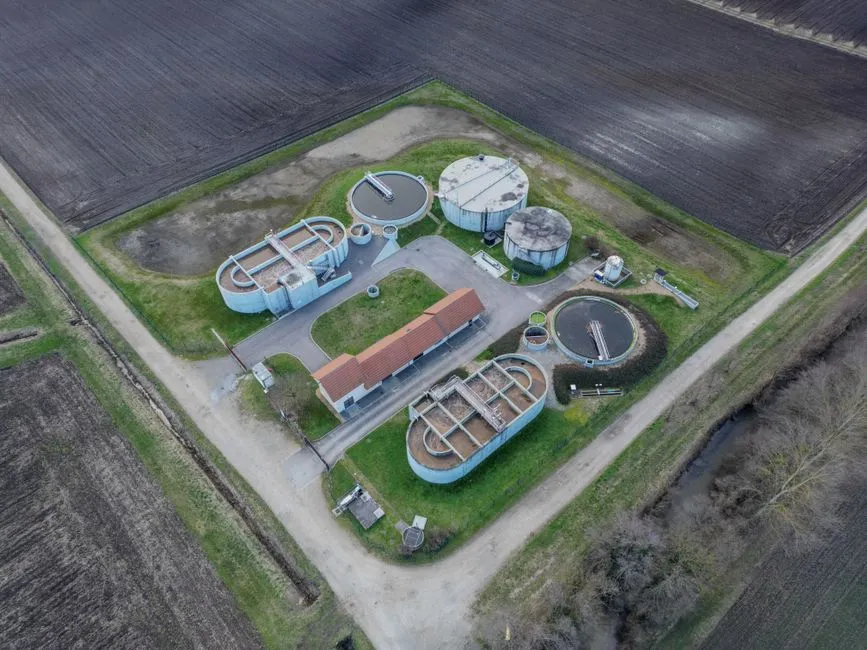
Equalization must contain a complete batch and blend it into a controlled chemical feed; otherwise a short acidic or high-metal release can pass through the clarifier before operators detect the excursion. Size the basin from actual batch volume, discharge duration, downstream hydraulic limits, and required treatment continuity—not average daily flow alone.
The OSMRE 2023 study reports that approximately 15% of Pennsylvania mine-drainage discharges, 22% of underground mines, and 16% of surface mines were within two miles of a wastewater treatment plant. Those figures establish proximity to established infrastructure in Pennsylvania. They do not prove that the receiving POTW serving a Hughes-area plant will accept mine drainage, and they do not substitute for its sewer-use ordinance or hydraulic capacity analysis.
Install online pH, flow, and turbidity measurement at locations that allow both treatment control and permit sampling. Define high-level alarms, automatic feed reduction or shutdown, and a diversion or hold-and-test response. An excursion should stop the release to sewer until the operator verifies chemistry and authorizes discharge. A PLC-controlled chemical dosing system can implement feed interlocks, but the control narrative must identify every alarm, hold condition, and manual recovery step.
Set the pH target from jar tests, not a universal recipe
The pH window must be established by site testing because hydroxide precipitation performance depends on the specific metal, ligand chemistry, competing ions, and required residual concentration. The governing pH for treatment and the permitted pH for sewer discharge are separate design constraints: the process target may be higher or lower than the legal discharge range.
Run jar tests across the characterized concentration range and evaluate pH correction together with coagulation and flocculation. Measure residual dissolved metals and settleability after settling; pH alone does not demonstrate that a metal-hydroxide precipitate will separate or that the remaining solids will meet the sewer requirement.
Use a PLC-controlled dosing system to adjust acid or alkali and feed coagulant from measured flow and process signals. The controller should be capable of staged dosing, rate limits, reagent inventory alarms, and automatic diversion on invalid pH readings. Chemical compatibility, containment, ventilation, and reagent delivery all require project-specific design.
Do not transfer a commercial article’s generic pH range, equalization period, or claimed metal-removal performance into a Hughes permit. Likewise, the OSMRE 2023 co-treatment results describe municipal treatment experiments, not industrial pretreatment limits. Where pH adjustment and hydroxide precipitation cannot achieve the required residual metal concentration, evaluate sulfide precipitation, ion exchange, or another validated process. Sulfide systems require reagent-residue controls and a designed off-gas safety system.
| Decision point | Required test or input | Acceptance basis |
|---|---|---|
| pH correction | Characterized source concentration range | Jar-test dose response and process control range |
| Metal precipitation | Total and dissolved metals in the permit | Required residual concentration with representative solids |
| Coagulation and flocculation | Mixing energy, dose sequence, pH interaction | Settleability, filtration response, and filtrate quality |
| Advanced polishing | Residual chemistry after clarification | Validated performance and reagent-residue controls |
The automatic chemical dosing system and coagulant dosing design guide support equipment development, but final reagent selection remains a bench-test and mass-balance decision.
Precipitate metals and separate the resulting solids
DAF and lamella clarification serve different hydraulic and solids-removal problems. DAF is the stronger candidate when the stream contains oil, grease, or fine colloidal material; lamella clarification is commonly favored for metal-bearing floc where footprint and hydraulic loading are controlling. Pilot testing and a whole-plant solids mass balance remain necessary because settled sludge properties and filtration demand can reverse a preliminary equipment choice.
The supplied commercial product catalog covers 4–300 m³/h across 13 standard models for the DAF system for mining wastewater solids separation and identifies metalworking and municipal pretreatment applications. Its lamella product page states 20–40 m/h surface loading and chemical-consumption reduction of up to 30%. These are product design claims, not guaranteed performance at a Hughes-area site.
| Selection issue | DAF | Lamella clarification |
|---|---|---|
| Primary separation function | Floats oil-associated and fine colloidal material | Separates settleable metal-bearing floc by inclined plates |
| Strongest fit | Streams requiring oil, grease, or colloidal-particle removal | Metal-hydroxide sludge where footprint is constrained |
| Required validation | Particle floatability, loading, recovered-sludge stability | Floc settleability, surface loading, carryover |
| Common downstream issue | Filtration loading from residual float or dispersed solids | Sludge blanket and solids carryover management |
Account for sludge generation, settleability, storage, filtration, and dewatering before selecting the clarifier. The high-efficiency sedimentation tank is a candidate for a lamella-based duty, while the DAF versus clarifier selection for mining wastewater provides a useful bid-comparison framework.
Keep final polishing conservative. The OSMRE 2023 study found that continuous mine-drainage co-treatment increased effluent iron loading and reduced effluent pH by approximately 0.5 unit. Although that result concerns municipal co-treatment, it supports online monitoring and a demonstrated final-effluent response rather than reliance on clarification performance alone.
Polish the clarified effluent before the sewer
Polishing equipment should answer a documented residual, such as TSS carryover after clarification, not a generic desire for clearer water. Multimedia filtration provides a solids-removal barrier and requires a backwash-water and waste-stream balance. Size the filter and backwash system for peak flow and the operating cycle, not average daily flow.
Where reuse or RO protection is part of the project, ultrafiltration can serve as a pretreatment barrier for the membrane system. The supplied commercial reference describes UF systems operating from 2,000 to 40,000 L/h with 0.03-micron PVDF membranes, automatic backwash, and air scour. These are catalog specifications; site validation must establish flux, fouling behavior, cleaning demand, and compatibility with the final water chemistry.
| Final barrier | Primary function | Required design check |
|---|---|---|
| Multimedia filtration | Remove residual suspended solids | Peak flow, backwash cycle, headloss, waste handling |
| Ultrafiltration | Remove colloids before reuse or RO | Flux, membrane chemistry, cleaning, pretreatment |
| UV | Microbial inactivation when required | POTW requirement, transmittance, dose validation |
| Chlorine dioxide | Microbial control where chemical treatment is selected | Residual requirement, dosing, safety, by-products |
Use UV or chlorine dioxide only when microbial control is required by the POTW or another project constraint. The OSMRE 2023 result of 1.5-log pathogen inactivation during municipal co-treatment does not establish an industrial pretreatment requirement. The multi-media filtration system and ultrafiltration system should therefore be evaluated against the final permit and project objectives.
Prove compliance with sampling, controls, and acceptance testing

Compliance must be demonstrated at the points, frequencies, averaging periods, and analytical methods identified by the governing Hughes-area permit and applicable categorical rules. Obtain the local sampling-point requirement, sample-preservation instructions, laboratory method specification, averaging period, reporting process, and bypass or upset provisions before drafting the acceptance protocol.
Test the installed system under representative normal, peak, campaign, storm, and start-up conditions. A single low-flow laboratory run does not establish treatment of a batch discharge or performance during a chemical-feed upset. Develop the performance test around the full treatment train, including equalization, chemical dosing, clarification, filtration, and diversion behavior.
Track influent and final-effluent pH, TSS, and the metals or other pollutants named in the permit. Record flow and mass loading so operators can distinguish concentration compliance from dilution. Define automatic high-level diversion, chemical-overdose protection, power-failure response, spare blowers where applicable, and a manual sampling station that prevents an unchecked excursion from reaching the sewer.
Use the UV sterilization system or chlorine dioxide generation equipment only when disinfection belongs in the approved train. Final compliance depends on the actual Hughes-area permit, verified site data, and witnessed performance testing—not on catalog removal claims.
Manage the metal-bearing sludge as part of pretreatment
Metal-bearing sludge is a treatment-product stream with its own regulatory classification, handling requirements, and disposal route. Test it for the metals and characteristics relevant to that classification before specifying storage, dewatering, transport, or disposal. Clarifier and DAF selection should reflect the expected solid-generation rate and resulting cake-handling burden.
The supplied plate-and-frame press catalog covers filtration areas from 1 m² to 500 m² and manual, hydraulic, and fully automatic PLC-controlled configurations. Compare bids against measured or calculated solids production, batch duration, cake characteristics, filtrate quality, wash-water demand, operator labor, and maintenance—not filter area alone.
Evaluate filtrate return to the head of the plant, wash-water segregation, cake storage, transport, and disposal cost before finalizing the clarifier or filter press. The plate-and-frame sludge dewatering system and the sludge dewatering supplier-selection framework provide useful procurement structure. Do not place filter-press or DAF equipment in the hydraulic design until influent characterization, treatment chemistry, and the solids-generation calculation are available.
Turn the permit into a procurement and commissioning plan
Equipment bids should follow approval of the governing limits, wastewater characterization, process mass balance, treatment train, instrument list, controls narrative, and performance-test protocol. Bids issued against generic mine-water chemistry can appear comparable while embodying different compliance assumptions.
Require each supplier to state design flow, peak-flow basis, equalization duty, chemical-consumption assumptions, guaranteed final-effluent parameters, control philosophy, utility requirements, redundancy, startup support, operator training, and commissioning acceptance criteria. For DAF and lamella packages, use the same wastewater chemistry, footprint, recovered-sludge handling, maintenance, controls, and life-cycle cost basis.
| Bid item | Information the buyer must require | Reason it matters |
|---|---|---|
| Design basis | Average and peak flow, batch volume, chemistry range | Prevents incompatible sizing assumptions |
| Performance guarantee | Final permit limit and representative test conditions | Makes acceptance criteria enforceable |
| Mass balance | Water, chemicals, sludge, filtrate, and waste streams | Exposes omitted downstream duties |
| Controls and safeguards | Alarms, interlocks, diversion, power-failure response | Limits uncontrolled sewer releases |
| Commercial support | Parts, training, startup, remote monitoring, service scope | Supports reliable long-term operation |
Include operator training, chemical-storage compatibility, parts availability, remote monitoring, and after-sales support in the commercial evaluation. The DAF versus clarifier selection for mining wastewater and clarifier comparison for industrial wastewater can structure equivalent bid review, but neither establishes Hughes compliance.
If the plant lacks 12 months of representative influent data, place a formal hold point between shop approval and final sizing. Release that hold point only after the monitoring program identifies the controlling flow and chemistry conditions and the selected process demonstrates acceptable performance under representative tests.
Frequently Asked Questions
What are the exact Hughes-area sewer limits for mining and metals wastewater?
No exact Hughes-area numerical limits were available in the supplied research. Request the receiving POTW’s current sewer-use ordinance, industrial-user permit, applicable monitoring forms, and written confirmation of any categorical pretreatment requirements. Verify the current 40 CFR Part 403 provisions and the plant’s permit rather than relying on values from another municipality.
How much equalization and treatment capacity does a mining or metals plant need?
Average flow alone is insufficient. Equalization and treatment sizing must reflect peak batch volume, campaign duration, wastewater chemistry, downstream hydraulic limits, and the final permit limit. If representative flow and chemistry history is missing, obtain it through monitoring before approving equipment capacity or performance guarantees.
Should the plant use DAF, lamella clarification, multimedia filtration, or ultrafiltration?
Use DAF for a stream requiring effective separation of oil-associated or fine colloidal material; use lamella clarification for suitable metal-bearing floc where hydraulic loading and footprint dominate. Multimedia filtration provides solids polishing, while ultrafiltration is a barrier for reuse or RO protection. Bench or pilot validation with site chemistry must determine the final train.
How should a buyer compare treatment suppliers and control project cost?
Require a transparent water, chemical, and solids mass balance plus a performance guarantee tied to the final permit limit. Obtain itemized equipment, installation, reagent, sludge-disposal, utilities, training, maintenance, and lifecycle costs, and separately request lead time and acceptance-test deliverables. These inputs support a comparable budget without inventing a price before the site and permit basis are known.
Related Equipment
- DAF system for mining wastewater solids separation — specifications, capacity range, and technical data