Why Omdurman Is a Special Case for Data Center Water
In Khartoum State, less than 5% of generated wastewater receives adequate treatment before discharge, while more than 95% is released directly or indirectly to surface water and aquifers (IJSR, Dec 2025). West Omdurman is the binding receptor for that load: the upper Nubian aquifer supplies most domestic and agricultural demand, and on-site septic tanks, cesspits and soakaways are documented sources of microbiological and chemical contamination of both the Nubian and the overlying Quaternary aquifers (IJSR, Dec 2025). A separate IJSR framework study from Dec 2025 explicitly positions reclaimed water as a tool to reduce irrigation abstraction from the Nubian aquifer and lower contaminant loads reaching it.
Layer the Sahara-zone climate on top of that hydrogeology. Open-loop evaporative cooling in Khartoum operates at near-year-round ambient temperatures in the low-to-mid 40s °C, which pushes evaporation rates and cycles-of-concentration (CoC) math toward the high end of any global benchmark. A generic hyperscale design — fresh Nubian intake, single-pass cooling tower, blowdown to sewer — fails on three independent axes here: it over-abstracts from a stressed aquifer, it returns warm, chemically dosed blowdown to a receiving environment with almost no treatment buffer, and it ignores a regulator and public that are already alert to water-quality deterioration. Any defensible design has to start with the Omdurman context, not with a reference architecture imported from a temperate grid.
What Cooling Blowdown and Site Wastewater Actually Look Like
Two streams hit the treatment train at an Omdurman data center, and they need to be characterized separately before equipment is selected. The sanitary stream is medium-strength municipal wastewater consistent with Khartoum State: BOD₅ ≤250 mg/L, COD ≤500 mg/L, TSS ≤250 mg/L, total nitrogen ≤40 mg/L and total phosphorus ≤8 mg/L (IJSR, Dec 2025). That profile is the design basis the West Omdurman advanced WWTP uses for its 60,000 m³/d reference plant, and it is a reasonable surrogate for the on-site sanitary load of a 5–15 MW facility once occupant equivalents are added.
Cooling-tower blowdown is a different animal. As pure water evaporates, dissolved solids — silica, calcium hardness, alkalinity, TDS, suspended solids — and residual treatment chemicals (anti-scalants, phosphonates, biocides) concentrate in the recirculating water. Blowdown is the bleed required to keep that chemistry inside scaling and microbiological limits; it is the dirty side of the cooling loop (NC State, Sep 2026; Genesis Water Technologies, 2026). Discharging it warm also creates thermal pollution that can lower dissolved oxygen in the receiving water (NC State, Sep 2026).
The blowdown ratio at steady state is governed by CoC: blowdown ≈ 1/(CoC−1) of makeup water. At 4 CoC, blowdown is roughly 25% of makeup; at 6 CoC, it falls to about 20% — a 5-percentage-point, not 50%, reduction. Pushing past 5–6 CoC without advanced pretreatment escalates biological fouling and scaling risk sharply (Genesis Water Technologies, 2026). Field experience also shows measured blowdown routinely exceeds the theoretical 25% by 15–30% because of unmeasured leaks and emergency dumps (Genesis Water Technologies, 2026). The Khartoum ambient adds a further penalty: higher evaporation per kW of heat rejected, which raises makeup and therefore absolute blowdown volume even at the same CoC.
| Stream | Key parameters | Design implication |
|---|---|---|
| Sanitary wastewater (Khartoum State basis) | BOD₅ ≤250 mg/L, COD ≤500 mg/L, TSS ≤250 mg/L, TN ≤40 mg/L, TP ≤8 mg/L (IJSR, Dec 2025) | Biological stage sized to medium-strength domestic load; MBR or CAS with N/DN |
| Cooling-tower blowdown, 4 CoC | Blowdown ≈ 25% of makeup; concentrated silica, hardness, TDS, anti-scalants, biocides (NC State, Sep 2026; Genesis Water Technologies, 2026) | Softener + RO train needed to recover as cooling-tower makeup; DAF/lamella for suspended solids |
| Cooling-tower blowdown, 6 CoC | Blowdown ≈ 20% of makeup; higher scaling and biofouling risk above 5–6 CoC (Genesis Water Technologies, 2026) | Cap CoC without advanced pretreatment; do not chase >6 CoC |
| Measured vs theoretical blowdown | Actual blowdown typically 15–30% above theoretical due to leaks and emergency dumps (Genesis Water Technologies, 2026) | Sub-meter makeup and blowdown before sizing reuse equipment |
Treatment Train Required for an Omdurman Data Center
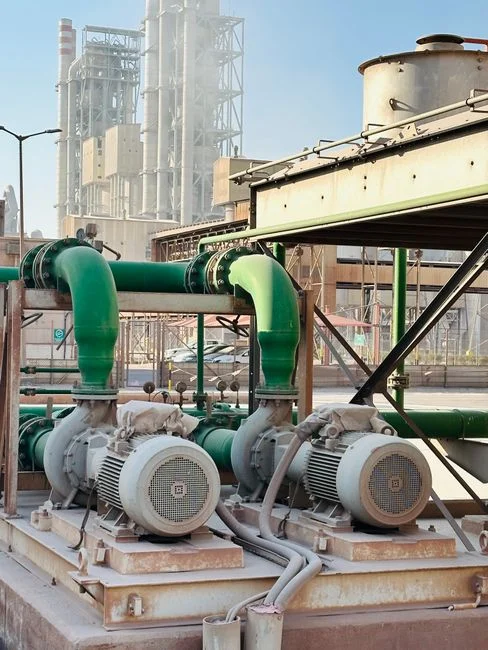
The train has to cover four duties simultaneously: protect downstream membranes and ion-exchange units, polish sanitary effluent to the West Omdurman advanced-WWTP benchmark, recover blowdown as cooling-tower makeup, and handle the resulting sludge. The sanitary line mirrors the unit operations in the IJSR Dec 2025 design for West Omdurman: rotary mechanical bar screens plus grit removal feed a biological stage with nitrification/denitrification, then secondary clarification, rapid sand filtration and UV disinfection. For a data-center footprint, the MBR membrane bioreactor for the sanitary wastewater line is the more practical choice than conventional activated sludge because it compresses clarification and polishing into a single tank, tolerates variable loads and produces a low-SDI effluent that is friendly to any downstream reuse step.
The blowdown side-stream is where the water-saving case is made. A DAF for blowdown suspended-solids and FOG removal or a lamella clarifier knocks down the bulk solids; a multi-media filter for turbidity and SDI reduction then drops SDI to the feed threshold RO needs; a twin-tank water softener upstream of RO strips calcium hardness so the RO membranes do not foul with carbonate scale; finally, an industrial RO for blowdown-to-makeup reuse closes the loop so that only evaporation drives fresh makeup demand. A rotary mechanical bar screen at the headworks protects the whole train from ragging.
Sludge from both lines reports to a plate-and-frame filter press for sludge dewatering for cake handling and off-site disposal, mirroring the thickening → stabilization → dewatering line in the IJSR Dec 2025 design. A chlorine dioxide generator provides residual disinfection for the cooling loop and on-site potable water, complementing UV on the sanitary line.
| Stream | Unit operation | Function | Source basis |
|---|---|---|---|
| Combined influent | Rotary mechanical bar screen + grit removal | Protect downstream biological and membrane stages | Matches IJSR Dec 2025 headworks |
| Sanitary | MBR with N/DN | BOD/COD/TN removal in compact footprint | Replaces CAS from IJSR Dec 2025 where footprint/power are constrained |
| Sanitary | Rapid sand filtration + UV | Polishing and disinfection to advanced-WWTP effluent quality | IJSR Dec 2025 advanced-WWTP design |
| Blowdown | DAF or lamella clarifier | Suspended solids, FOG, chemical flocs | Genesis Water Technologies 2026 Stage 4 |
| Blowdown | Multi-media filter | Turbidity and SDI reduction ahead of RO | Standard RO pretreatment |
| Blowdown | Water softener | Drop hardness to protect RO from carbonate scale | Genesis Water Technologies 2026 Stage 3/4 |
| Blowdown | RO (or UF-only for non-makeup reuse) | Closed-loop-quality water back to cooling tower | Genesis Water Technologies 2026 Stage 5 |
| Combined sludge | Plate-and-frame filter press | Dewater to cake for off-site disposal | IJSR Dec 2025 sludge line |
Equipment Selection for the Sudanese Operating Context
Selection in Sudan is driven less by reference architectures and more by what survives intermittent grid power, a limited skilled-operator pool and constrained spares logistics. Modular, skid-mounted, fully automatic packages are the right starting point because the West Omdurman design itself relies on standard criteria rather than highly bespoke unit operations (IJSR, Dec 2025), and the same logic applies to the data center. A WSZ underground integrated sewage treatment package is a defensible sanitary option for small colocation footprints, and the JY integrated water purification skid covers polishing and reuse for sites that do not need a full MBR. Where non-makeup reuse is enough, a UF system for blowdown polishing is a leaner substitute for the full RO train.
Right-sizing matters more than headline throughput. Hyperscale RO and ion-exchange trains built for 100+ MW sites are uneconomic at 5–15 MW: capital cost per gallon treated runs 3–4× higher than at hyperscale, and the operational complexity exceeds available staff expertise (Genesis Water Technologies, 2026). Modular blowdown units in the 100–300 GPM range are the realistic fit for a Khartoum-area facility and deliver impact without needing a dedicated RO team. An automatic chemical dosing system with UPS-backed controls keeps chemistry stable through power dips and reduces daily operator burden.
The CoC strategy should be conservative. Hold the loop at 4–6 CoC with chemistry that minimizes dissolved-solids loading so the downstream softener and RO are not overwhelmed; do not chase >6 CoC without advanced pretreatment, because the biological and scaling penalty outweighs the marginal water saving (Genesis Water Technologies, 2026). If higher CoC is forced by intake cost, replace complex chemical regimes with physical-treatment programs so blowdown is clean enough for downstream recovery (Genesis Water Technologies, 2026) — relevant where chemical import logistics are constrained.
Reuse, Discharge and Permit Risk in Khartoum State
Permit risk in Khartoum State is dominated by the Nubian aquifer as the binding downstream receptor. Less than 5% of the state's wastewater is currently treated to any modern standard, and the regulator and public have a documented interest in groundwater quality (IJSR, Dec 2025). The defensible compliance target is therefore the IJSR Dec 2025 advanced-WWTP effluent — bar screening through UV — applied as the floor for the sanitary line and as the design discipline for any blended discharge.
Treated blowdown should be prioritized for cooling-tower makeup so that only evaporative loss draws fresh Nubian water; this is the S5 Stage 5 outcome, where the loop closes and makeup demand drops by an order comparable to the 15–25% reuse range cited in the source (Genesis Water Technologies, 2026). Discharge — whether to sewer, to a Khartoum-State watercourse or to a reuse zone — must control temperature, residual chlorine/bromine, anti-scalant carryover and salinity, because the same pathways that drive thermal pollution and salinity loading in the NC State Sep 2026 review apply directly here.
Site selection should align with the phased, zone-based reuse strategy proposed for West Omdurman (IJSR, Dec 2025). Projects that sit inside a designated priority zone can move faster through permitting and may benefit from any future reuse incentives tied to the framework. The Omdurman-specific guide on our blog covers the regulatory sequencing in more detail; for comparison, our Curitiba data center blowdown case study shows how a different climate still ends up at the same closed-loop discipline.
Phased Roadmap and ROI Logic for the Project
Stage 1 is measurement. Install sub-metering on makeup, blowdown, evaporation and conductivity. Field data consistently show that measured blowdown exceeds the theoretical 25% by 15–30% because of unmeasured leaks and emergency dumps (Genesis Water Technologies, 2026), and that gap materially changes the reuse business case. Without a real baseline, the capex proposal will not survive a finance-committee review.
Stage 2 is optimization of existing assets: leak repair, control-sequence tuning, self-cleaning filtration to reduce suspended solids forcing premature blowdown. This sequencing is generic to any blowdown-reuse program and applies directly to a Sudan site (Genesis Water Technologies, 2026).
Stage 3 is chemistry simplification. Replace complex anti-scalant/biocide rotations with physical-treatment programs so blowdown is clean enough for downstream recovery (Genesis Water Technologies, 2026). In Sudan this also reduces dependence on imported chemical logistics.
Stage 4 is modular blowdown treatment. Deploy a 100–300 GPM modular system matched to facility scale — DAF or lamella plus media filtration plus softener, with RO added where makeup-grade reuse is the target (Genesis Water Technologies, 2026). For deeper design context, our RO design criteria deep-dive walks through the SDI, recovery and pretreatment targets.
The ROI must be built on total cost of water — capex, avoided utility costs, deferred aquifer-protection levies and license-to-operate risk — not just the line-item water bill. A payback that looks marginal on water savings alone usually improves to 3–5 years once deferred capex, reputational exposure and regulatory risk are included (Genesis Water Technologies, 2026). For a peer review of how a similar closed-loop program lands in a different regulatory climate, see our Kigali data center water and blowdown guide; the cross-reading is useful when justifying the closed-loop choice internally. The our Khartoum-specific data center water treatment guide ties this roadmap back to the local regulatory sequence.
Frequently Asked Questions
Is open-loop evaporative cooling viable for an Omdurman data center given Nubian aquifer stress?
Open-loop cooling is technically operable but commercially and reputationally risky in Khartoum State because the Nubian aquifer is the binding receptor and >95% of the state's wastewater is already discharged without adequate treatment (IJSR, Dec 2025). A hybrid architecture — adiabatic or chilled-water closed loop for the bulk of the year with evaporative assist only at peak ambient — is the defensible compromise for hyperscale, and a fully closed loop with air-side economization is the conservative choice for a colocation build. The minimum action regardless of topology is to cut fresh intake by reusing blowdown as makeup so that only evaporation drives new demand (Genesis Water Technologies, 2026).
What cycles of concentration and blowdown ratio should we design for at ~43°C ambient?
Design for 4–6 CoC. At 4 CoC, blowdown is roughly 25% of makeup; at 6 CoC, about 20% — a 5-point reduction, not 50% (Genesis Water Technologies, 2026). The Khartoum ambient raises absolute evaporation, so even with the same CoC, the volumetric blowdown stream is larger than in a temperate climate. The buyer should request from the supplier a site-specific evaporation curve at design wet-bulb, an expected CoC operating window, and the chemistry regime that holds scaling and microbiological risk inside that window without chasing >6 CoC.
Which unit operation gives the biggest water-saving payback — RO, MBR, DAF or softener?
Each plays a different role and they are not substitutes. MBR is the sanitary-line workhorse and its value is footprint, effluent quality and SDI-friendly effluent for any downstream reuse (IJSR, Dec 2025). DAF or lamella is the cheapest first step on the blowdown side and removes the suspended solids that foul everything downstream. Softener is what protects the RO from carbonate scale and is the cheapest insurance for RO uptime. RO is what actually closes the loop by turning blowdown back into cooling-tower makeup. The biggest single water-saving step on a Sudan site is the blowdown-to-makeup RO train (Genesis Water Technologies, 2026); the cheapest first step is DAF plus media filtration. The supplier should be asked to model both capex and opex for the combined train, not just the headline unit.
How do we size a modular blowdown treatment system for a 5–15 MW Khartoum-area facility?
Size off measured blowdown, not off the 25% theoretical number, because field data show measured blowdown routinely exceeds theoretical by 15–30% (Genesis Water Technologies, 2026). For a 5–15 MW evaporative-cooled site, modular units in the 100–300 GPM range are the realistic fit; hyperscale RO/IX trains typically push capital cost per gallon treated 3–4× higher at this scale (Genesis Water Technologies, 2026). The buyer should request from the supplier a flow-and-load datasheet tied to the design CoC window, a confirmed SDI at the RO feed, a power draw per cubic meter treated, a control philosophy that survives grid dips, and a spares list that can be air-freighted to Khartoum. Compliance evidence to request alongside the quote: confirmation that the proposed sanitary line meets the IJSR Dec 2025 advanced-WWTP effluent benchmark and that the blowdown train holds temperature, residual oxidant, anti-scalant and salinity inside the receiving-environment limits cited in NC State Sep 2026.