Why Johannesburg Industrial Sites Are Re-Specifying ETPs in 2026
Johannesburg sits in one of South Africa's most water-stressed catchments, and a 2016 review in the South African Journal of Science (Jaiyeola & Bwapwa, 2016) frames innovative wastewater treatment and reuse as a national priority for water-scarce countries, including South Africa, on the basis that industrial users such as breweries discharge high organic loads that must be remediated before any reuse is possible. A decade later, the same pressure shapes every 2026 effluent treatment plant decision in the city.
Industrial buyers in Johannesburg are typically specifying an ETP for one of three drivers, and the process train changes with the driver. The first driver is regulatory discharge compliance against the limits attached to the site's water-use licence. The second is on-site reuse for process water, boiler feed, cooling-tower make-up, or irrigation. The third is a hybrid, where the plant must meet a discharge limit today and be upgradeable to a reuse specification as the site's water balance tightens. Pinning the driver down first is what stops a 2026 RFQ from drifting into a generic catalogue exercise.
The supplier market is mature and concentrated. RevenueBase's South Africa shortlist, recorded on Sep 19, 2026, lists multiple Johannesburg-HQ EPC and design-build contractors covering sewage, industrial effluent, and potable water scopes, including WEC Water, Becon Watertech, LWT, Inenzo Water, Aqua Horizon Technologies, PuraPlan, and Ulmo Water, and the shortlist also includes a Johannesburg-area contractor whose recorded scope explicitly covers wine-cellar effluent treatment alongside sewage and potable water — relevant for beverage sites with a Cape-Winelands-to-Johannesburg supply chain.
The practical takeaway for a 2026 buyer: an ETP decision in Johannesburg is a technology-plus-supplier decision, not a catalogue pick, and the rest of this guide is structured to make both halves of that decision defensible.
How an Effluent Treatment Plant Works: The 2026 Process Train
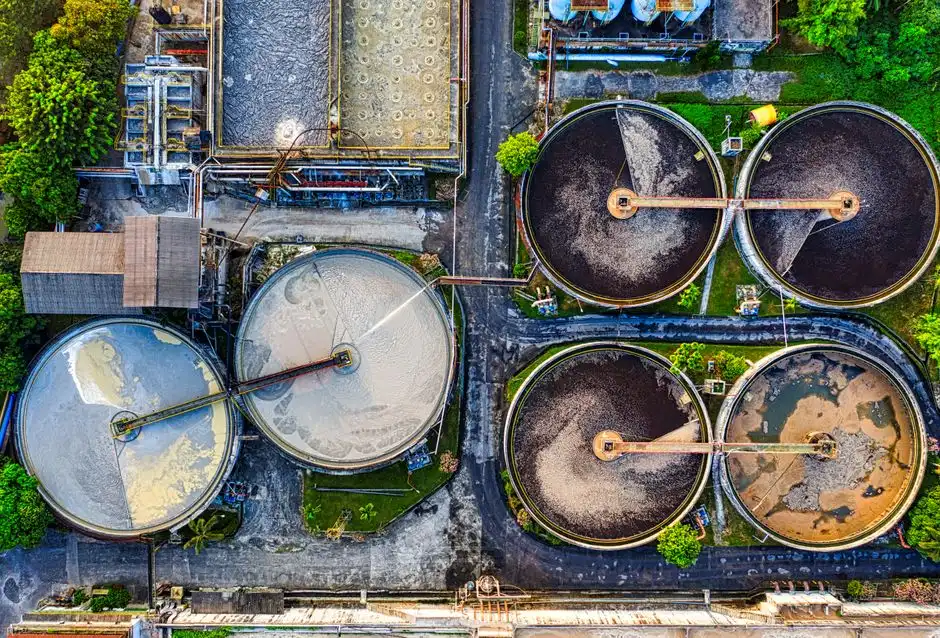
An industrial effluent treatment plant in Johannesburg is a process train, not a single unit, and any RFQ that asks for "a treatment plant" without naming the stages will produce answers that cannot be compared. The 2026 process train typically combines four functional blocks: pre-treatment, biological treatment, solid-liquid separation, and polishing or disinfection. Pre-treatment covers screening, grit removal, and — for effluents carrying oil, grease, or colloids — DAF pre-treatment as a fats-oil-and-greases (FOG) and suspended-solids removal step ahead of the biological stage. Biological treatment is either aerobic (conventional activated sludge, MBR), anaerobic (UASB, anaerobic lagoon), or a hybrid. Solid-liquid separation is then either a secondary clarifier downstream of conventional activated sludge, or a submerged membrane cassette inside the aeration tank, which is the defining feature of an MBR biological train. Polishing and disinfection cover sand or carbon filtration, membrane polishing (UF/NF/RO), constructed wetlands, UV, or chlorine dioxide depending on the discharge or reuse target.
The South African Journal of Science review on brewery wastewater (Jaiyeola & Bwapwa, 2016) is explicit that combinations of processes — not single units — are used to improve the quality of final effluent, and that the review evaluates anaerobic and aerobic systems alongside membrane, carbon nanotube, activated carbon, electrochemical, algal pond, and constructed-wetland options. The same combinatorial logic applies in 2026 Johannesburg practice: a single biological reactor will not turn a high-strength food or refinery stream into a reusable effluent on its own.
MBR versus conventional activated sludge is the single most common 2026 trade-off. MBR delivers a smaller footprint, higher effluent quality, and a more stable sludge age, at the cost of membrane replacement, aeration energy, and stricter operator discipline. Conventional activated sludge with a clarifier is lower capex, simpler to operate, and easier on operators without a membrane background, but it produces a clarifier overflow that may not meet a reuse spec without downstream polishing.
Sludge handling is a process line in its own right, not an afterthought. Plate-and-frame filter presses and lamella clarifiers with sludge recirculation are standard Johannesburg practice, and a 2026 spec should treat the dewatering line as a separately costed scope rather than bundling it into the biological tankage.
Choosing the Right Treatment Train by Influent Type
The first engineering decision in any Johannesburg ETP spec is the influent type, because it determines whether the biological stage is aerobic, anaerobic, or a hybrid, and whether polishing is required at all. Map your effluent to the table below before you talk to suppliers.
| Influent type | Recommended primary train | Polishing step | Evidence anchor |
|---|---|---|---|
| Brewery / food & beverage (high-strength organic) | Anaerobic + aerobic biological, or aerobic + MBR | Constructed wetland or NF for reuse | Jaiyeola & Bwapwa, SAJS 2016 — anaerobic and aerobic systems identified as effective for brewery wastewater because of their high removal efficiencies |
| Refinery / oily effluent | DAF for oil/grease, then biological or membrane | Forward osmosis or RO for high-purity reuse | Forward osmosis PRO-mode study on local oil refinery effluent (Membranes, Basel, Oct 2021, PMC8623933) |
| Textile / dye | Biological for COD/BOD, then advanced oxidation or membrane | Constructed-wetland polishing for targeted contaminants | Lei, Wageningen WU thesis 8189 (doi:10.18174/575408) |
| Pharmaceutical | Biological + advanced oxidation, with source control on actives | Activated carbon or RO for trace organics | See related pharmaceutical wastewater treatment in South Africa guidance |
| Municipal / packaged sewage | Containerized MBR or A/O package plant (1–80 m³/h) | Disinfection only unless reuse specified | packaged A/O sewage plant spec range |
| Hotel / resort | MBR or SBR with disinfection | Reuse for irrigation | See related hotel and resort wastewater treatment in South Africa guidance |
For high-strength organic effluents such as brewery, food, and beverage streams, an anaerobic-plus-aerobic train is the workhorse, often followed by an MBR step where footprint is constrained. Jaiyeola and Bwapwa (SAJS 2016) identify anaerobic and aerobic systems as effective options for brewery wastewater because of their high removal efficiencies, and the same review also catalogues membrane, carbon-nanotube, activated-carbon, electrochemical, algal-pond, and constructed-wetland options for downstream polishing.
For oily and refinery effluents, a DAF pre-treatment stage for oil and grease is the standard first move, after which the train branches into biological or membrane treatment depending on the discharge target. The forward-osmosis PRO-mode study (Membranes, Basel, Oct 2021, PMC8623933) demonstrates that a cellulose triacetate (CTA) membrane on a local oil refinery effluent delivered 100% SO₄ rejection, 95.66% CO₃ rejection, and a flux recovery of 95% after cleaning, with an average water flux of 3.78 ± 0.13 L/m²·h and a reverse solute flux of 1.56 ± 0.11 g/m²·h over a 30-hour run, using manual scrubbing and chemically enhanced osmotic backwash as the cleaning regime. The trade-off is real: that flux is low relative to a RO train, and fouling control is the operating-cost driver.
For textile and dye effluents, biological treatment takes out the bulk COD and BOD — see the related textile wastewater treatment in South Africa engineering guide for the technology stack — and a polishing step is then chosen from advanced oxidation, membrane, or constructed-wetland options. Sludge dewatering on these trains should always be specified with a plate-and-frame sludge dewatering press sized to the biological yield, not assumed.
For municipal, packaged, and rural sites, a packaged A/O sewage plant in the 1–80 m³/h range covers most small-to-medium flows with built-in sedimentation and disinfection, and pairs naturally with DF-series MBR membrane modules where a higher effluent quality is required at the same footprint. The decision rule that consistently saves 2026 Johannesburg buyers from over-specifying is: pick the biological stage first to hit COD and BOD targets, then add a polishing stage only if the discharge or reuse limit actually demands it. For a deeper head-to-head on biological stages, see the COD and BOD removal technology comparison.
Polishing for Reuse: When Nanofiltration and Constructed Wetlands Pay Off
Polishing is the step that turns a compliant effluent into a reusable one, and the 2026 decision is between a membrane train, a nature-based train, or a hybrid of both. The evidence base is unusually clean for this comparison because the two leading options each have a dedicated PhD thesis to anchor them.
| Polishing option | Best-fit end-use | Operating profile | Evidence anchor |
|---|---|---|---|
| Direct nanofiltration (NF) | Process water, boiler feed, irrigation, indirect potable | Higher capex, membrane replacement, energy for high-pressure pump | Schrader, University of Twente PhD thesis, doi:10.3990/1.9789036523325 |
| Constructed wetlands | Micropollutant polishing where land is available | Low opex, large footprint, passive operation | Lei, Wageningen WU thesis 8189, doi:10.18174/575408 |
| Forward osmosis (CTA membrane) | High-rejection desalination of industrial brine or refinery effluent | Low flux (3.78 L/m²·h in the refinery case), fouling-sensitive | Membranes (Basel), Oct 2021, PMC8623933 |
| RO (brackish or high-recovery) | Boiler feed, high-purity reuse | Higher energy than NF, tighter pretreatment requirements | General engineering practice; specify RO polishing train against the reuse spec |
| UV or chlorine dioxide disinfection | Final microbial barrier for reuse water | Low opex, no chemical residue (UV); residual control (ClO₂) | General engineering practice; chlorine dioxide generation for residual-bearing reuse loops |
Nanofiltration as a reuse polishing step is well-supported in the academic record. Schrader's PhD thesis at the University of Twente (doi:10.3990/1.9789036523325) frames nanofiltration as a suitable technology to polish WWTP effluent to EU WFD standards and consequently produce an effluent quality suitable for agricultural or (in)direct potable usage, with the study's objective being to assess the potential of direct nanofiltration as a technique for effluent reclamation. That framing maps directly onto a Johannesburg reuse target: process water, boiler feed, or irrigation.
Constructed wetlands for polishing are the lower-opex alternative when land is available. Lei's PhD thesis at Wageningen (WU thesis 8189, doi:10.18174/575408) investigates the removal of micropollutants from WWTP effluent by constructed wetlands, which is the right evidence base for a Johannesburg site that needs low-energy polishing of trace organics rather than TDS reduction. The trade-off is footprint: wetlands are passive and cheap to run, but they need land the biological train does not.
Forward osmosis and advanced membrane options sit at the high-spec end. The oil-refinery FO case (Membranes, Basel, Oct 2021, PMC8623933) demonstrates that CTA forward osmosis membranes can deliver near-complete ionic rejection, but the operating envelope is narrow: the study's average water flux of 3.78 ± 0.13 L/m²·h, a reverse solute flux of 1.56 ± 0.11 g/m²·h, and the need for manual scrubbing and chemically enhanced osmotic backwash all drive opex. A Johannesburg buyer should treat FO as a polishing option for high-rejection, low-volume reuse — not as a bulk RO substitute.
The 2026 buyer's rule: nanofiltration pays off when the reuse end-use is process water, boiler feed, or irrigation and the site is footprint-constrained; constructed wetlands pay off when land is available and the goal is micropollutant polishing at low opex; an RO polishing train is the right call when the reuse spec demands the lowest possible TDS. Final microbial control on any of these trains is typically delivered with UV or a chlorine dioxide generator for residual-bearing loops.
Johannesburg ETP Supplier Landscape: 2026 Shortlist
The Johannesburg supplier market is dense enough that the 2026 buyer's first task is to filter it by scope. RevenueBase's South Africa company graph, recorded on Sep 19, 2026, lists 89 company matches for "effluent treatment plant companies" associated with South Africa, and within that set the following Johannesburg-HQ contractors are recorded as exact matches and form a defensible shortlist for a 2026 industrial ETP RFQ.
| Supplier | HQ | Recorded capability (RevenueBase, Sep 19, 2026) |
|---|---|---|
| WEC Water | Johannesburg | EPC contractor in the water and wastewater treatment sector |
| Becon Watertech | Johannesburg | 40-year company specialising in water and sewage treatment solutions |
| LWT | Johannesburg | Complete range of mechanical equipment with in-house design, manufacture, installation and commissioning for sewage, water treatment, and industrial duty |
| Inenzo Water | Johannesburg | Mechanical contractor with decades of experience in municipal water and wastewater treatment |
| Aqua Horizon Technologies | Johannesburg | Over three decades of expertise in sustainable water and wastewater treatment |
| PuraPlan | Johannesburg | Design and project services company focusing on water and wastewater treatment |
| Ulmo Water | Johannesburg | EPC and design-build contractor focusing on turnkey water and wastewater solutions |
| Johannesburg-area EPC contractor (wine-cellar scope) | Johannesburg area | Design, construction and operation of treatment plants including sewage, potable water, and wine-cellar effluent treatment |
Capability differentiation matters as much as headcount. WEC Water and Ulmo Water are recorded as EPC and design-build contractors, which means they will hold the contract end-to-end including civils, commissioning, and operator training. Becon Watertech and Aqua Horizon Technologies are recorded as longer-established design and manufacturing houses, which makes them strong on the packaged-skid scope. LWT and Inenzo Water are recorded as mechanical contractors with in-house manufacture, which is a better fit when the civils are already in place and the buyer needs a mechanical retrofit. PuraPlan is recorded as a design and project services firm, which suits a buyer who needs an owner's-engineer or design review ahead of an EPC award. The wine-cellar-scope contractor recorded by RevenueBase (Sep 19, 2026) is the natural starting point for beverage sites with a Winelands-to-Johannesburg supply chain.
All capability statements above are taken directly from the RevenueBase company graph recorded on Sep 19, 2026, and should be re-verified against the supplier's own current literature before RFQ release, since the source explicitly notes the company graph is a snapshot.
Sizing, Cost Drivers, and 2026 Procurement Checklist
Five inputs must be fixed before a Johannesburg ETP spec goes to market, because every cost line downstream is a function of these five. The first is influent flow in m³/h or m³/day together with the diurnal pattern, since a brewery effluent peak at midday and a refinery's 24-hour steady flow size the equalisation tank very differently. The second is the influent load profile: COD, BOD, TSS, FOG, ammonia, pH, and temperature, all of which set the biological tankage and the aeration duty. The third is the target discharge standard or reuse end-use, which decides whether polishing is required at all. The fourth is the available footprint and the site's three-phase power capacity, which constrain the choice between a packaged skid and a civil build. The fifth is the site's existing desludging and chemical-handling capability, which decides whether the plate-and-frame sludge dewatering line and the PLC-controlled chemical dosing scope are new or retrofit.
Cost drivers to request quotes on explicitly are: civil works versus packaged skid, biological tankage, membrane modules and the replacement schedule, chemical dosing systems, sludge dewatering, and commissioning plus operator training. For an MBR train, the membrane modules are a recurring cost line and should be costed on a per-cassette basis, with the operating flux and the clean-in-place regime stated. The headworks bar screen and the high-efficiency sedimentation tank should be specified explicitly rather than left to the supplier's default, since both are frequent sources of under-sizing on Johannesburg retrofits.
Reuse-specific adders lift capex materially and should be costed as a separate line. These are: an RO or NF polishing train, a UV disinfection for reuse water skid or a chlorine dioxide generator for residual-bearing reuse loops, and treated-water storage. Bundling them into the base capex number is the most common 2026 RFQ error and the one that produces the most uncomfortable bid comparisons.
The 2026 lead-time sanity check is straightforward: Johannesburg EPCs typically quote 8–16 weeks for design and fabrication of packaged units, and longer for full civil builds. Any supplier quoting a packaged ETP at a shorter lead time without a stated hold point for influent characterisation should be treated with caution, and a pilot test on a variable influent should be costed into the schedule. Confirm with the shortlisted supplier that the proposed train meets the latest South African discharge requirements applicable to the site's water-use licence, and that the polishing step is sized to the reuse end-use water-quality spec.
Frequently Asked Questions
What is the typical cost of an effluent treatment plant in Johannesburg in 2026?
There is no defensible single number. Cost scales with influent flow and load, the target discharge or reuse spec, and whether the plant is a packaged skid or a civil build, so the only sound 2026 answer is to break the project into the five cost drivers in the procurement checklist (civil works, biological tankage, membranes, chemical dosing, sludge dewatering) and ask each shortlisted supplier to price each line as a separate schedule. Any supplier that quotes a single lump sum without a breakdown is one you cannot compare.
Which Johannesburg-based companies design and build industrial effluent treatment plants?
The RevenueBase shortlist recorded on Sep 19, 2026 is the defensible starting point: WEC Water and Ulmo Water are recorded as EPC and design-build contractors, Becon Watertech and Aqua Horizon Technologies as longer-established design and manufacturing houses, LWT and Inenzo Water as mechanical contractors with in-house manufacture, and PuraPlan as a design and project services firm. The right shortlist for a given site depends on whether the scope is turnkey EPC, mechanical retrofit, or owner's-engineer design review, and that decision should drive which of the seven you bring to RFQ.
How long does it take to install an effluent treatment plant in Johannesburg?
Packaged systems typically quote 8–16 weeks for design and fabrication. Full civil builds run longer. Variable influents add a pilot-test phase on top, and the pilot hold point should be written into the contract so it does not become a disputed variation later.
Do Johannesburg effluent treatment plants need to meet a specific discharge standard?
Yes. The discharge limit is set by the site's water-use licence and the latest South African discharge requirements applicable to the sector, and the reuse end-use spec adds a second compliance layer on top. Confirm with the shortlisted supplier that the proposed train is sized against both the licence and the reuse spec before you award.