What Counts as a Large Municipal Wastewater Treatment Plant in 2026
A large municipal wastewater treatment plant in 2026 is a multi-stage facility handling tens of thousands to millions of m³/day of domestic sewage under a US NPDES permit. The treatment train typically runs from headworks screening and grit removal through primary sedimentation, biological treatment (often activated sludge or MBR), secondary clarification, tertiary filtration, and disinfection, with NPDES discharge limits and growing water-reuse pressure under UN SDG 6 driving tighter effluent quality (per UN 2017 World Water Development Report, as cited in JETIR 2023).
Operationally, a "large" municipal plant is benchmarked against two defensible metrics: service population and average daily flow. Plants above roughly 50,000 m³/day average dry-weather flow are generally classed as large; very large utilities exceed 500,000 m³/day and often serve populations above one million (per JETIR 2023, Visakhapatnam case study and EPA design guidance context). A 50 MLD plant in 2026 typically demands a multi-train biological stage, full tertiary filtration, and dedicated sludge handling — a different procurement profile than a 5 MLD package plant.
Municipal WWTPs are legally and operationally distinct from industrial plants. Influent is dominated by domestic sewage, with industrial contributors controlled by EPA pretreatment programmes that cap allowable pollutant loadings before discharge to the sewer. The US regulatory basis is the NPDES permit programme under the Clean Water Act, which sets site-specific effluent limits for any discharge to waters of the United States (per EPA, Municipal Wastewater). In 2026, the three converging drivers are tighter effluent limits (nutrients, trace contaminants), reuse targets aligned with UN SDG 6, and energy/carbon reduction pressure on aeration — the single largest electrical load in most large plants (per the aeration state-of-the-art review in Water Science & Technology, 2008).
How Sewage Reaches the Plant: Collection Systems and Peak Flows
Peak wet-weather flow — not average dry-weather flow — is what defines large-plant operability in 2026. Headworks, primary tanks, and biological reactors must be sized to absorb short-term hydraulic peaks several times the daily average without losing treatment efficiency or triggering permit excursions.
Two sewer archetypes dominate US infrastructure. Combined sewers use a single pipe for sanitary sewage and stormwater; under wet weather they overflow when stormwater volumes exceed treatment capacity, creating the combined sewer overflows (CSOs) that the EPA CSO policy is designed to minimise (per EPA, Municipal Wastewater). State and local authorities have generally not permitted construction of new combined sewers since the first half of the 20th century (per EPA). Separate sanitary sewers carry only wastewater but are designed with some allowance for higher flows during storm events.
Aging sanitary sewers are not watertight. Cracks, faulty seals, and improper connections admit stormwater as infiltration and inflow (I/I) — large volumes of which can cause sanitary sewer overflows (SSOs) and operational upsets at the treatment plant, including reduced biological reactor efficiency, solids washout from clarifiers, and disinfection capacity loss (per EPA). The EPA CSO policy encourages municipalities to maximise wet-weather flows to the treatment plant to decrease uncontrolled overflows in the collection system — which transfers the hydraulic burden directly onto the WWTP headworks and equalisation.
For the design engineer, the consequence is concrete: in 2026 a large municipal plant is planned against a peak-to-average ratio of 2.5–4× for combined-sewer service areas and 1.5–2.5× for separate sanitary service with significant I/I. Primary tanks and biological reactors must be checked at peak hydraulic loading, not just average, and headworks screening must be sized to sustained peak flow with dual overload protection.
The 2026 Large-Plant Treatment Train: From Headworks to Disinfection
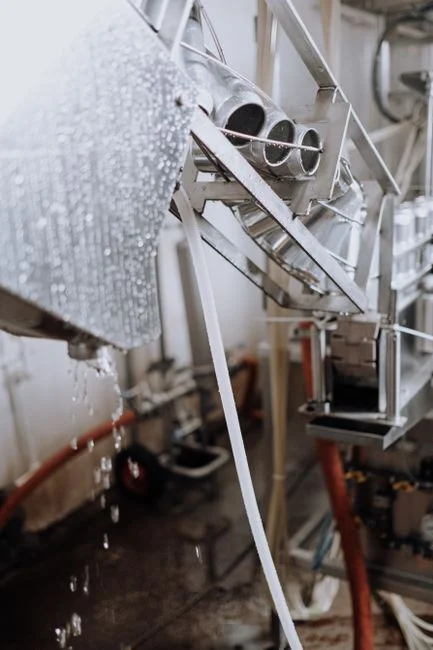
The 2026 large-plant treatment train is a sequence of unit processes that progressively remove solids, organic matter, nutrients, and pathogens before discharge or reuse. The table below maps each stage to its function, typical design parameters, and the equipment families used.
| Stage | Function | Typical parameters (2026 large plant) | Common equipment |
|---|---|---|---|
| Headworks | Remove rags, plastics, debris; grit; flow equalisation | Screen aperture 3–10 mm; grit removal >95% of 0.2 mm particles | Mechanical bar screens, grit chambers, equalisation basins |
| Primary treatment | Settleable solids removal | 50–65% TSS, 20–35% BOD removal (per JETIR 2023) | Primary clarifiers, Imhoff tanks, lamella settlers |
| Secondary (biological) | Dissolved organic and nutrient removal | MLSS 2,000–4,000 mg/L (ASP); HRT 4–8 h; SRT 5–25 d | Activated sludge, trickling filters, RBCs, MBR |
| Secondary clarification | Biomass separation (unless MBR) | Surface overflow 1.0–1.7 m/h at average flow | Secondary clarifiers (omitted in MBR) |
| Tertiary filtration | TSS/turbidity polishing to RO-protection levels | TSS <5 mg/L; turbidity <1 NTU; SDI <3 for RO feed | Multi-media filter, DGMF, UF, lamella polishing |
| Disinfection | Pathogen inactivation | UV dose 30–40 mJ/cm² typical; CT for chlorine | UV, chlorine contact, ClO₂ |
| Sludge line | Thickening, dewatering, disposal/reuse | Cake dryness 18–28% with plate press; 0.5–1.5% polymer on dry solids | Gravity thickener, plate-and-frame filter press, centrifuge |
At headworks, mechanical bar screens remove the bulk of debris before grit chambers strip abrasive particles. A rotary mechanical bar screen for municipal headworks sized to peak wet-weather flow with dual overload protection is the standard first defence. Primary clarifiers then capture settleable solids; the JETIR 2023 Visakhapatnam case study reports removals of 50–65% TSS and 20–35% BOD at conventional primary settling, consistent with US design manuals.
Biological treatment is the largest energy load and the largest performance lever. Activated sludge, trickling filters, and rotating biological contactors remain standard; an MBR membrane bioreactor system integrates a submerged membrane module — typically 0.1–0.4 μm pore size — directly into the bioreactor, replacing the secondary clarifier and producing near-reuse-quality effluent. Submerged PVDF flat sheet MBR modules in the DF family deliver the same function with a flat-sheet geometry that tolerates higher solids and simplifies cleaning.
Tertiary treatment in 2026 large plants is built around coagulation, flocculation, sedimentation (often lamella), and filtration. A multi-media filter for RO pretreatment handles the bulk of polishing; DGMF plus UF plus RO trains are documented in advanced Indian plants (per JETIR 2023). Disinfection typically uses chlorination for cost and residual, a UV sterilizer for chemical-free disinfection where chlorine-resistant Cryptosporidium and Giardia are a concern, or chlorine dioxide for combined oxidation and residual across large flows. The sludge line ends with a plate and frame filter press for sludge dewatering, producing a cake suitable for landfill or land application.
Matching Unit Processes to Plant Size and Effluent Targets
Process selection in 2026 is driven by two variables: flow band and effluent target (discharge to surface water vs reuse). The matrix below maps typical flow ranges to the unit processes that most often fit.
| Flow band (avg daily) | Service population (typical) | Biological stage | Solids separation | Tertiary | Disinfection |
|---|---|---|---|---|---|
| <20,000 m³/day (small) | 25,000–100,000 | Package activated sludge or MBR | Integrated clarifier or MBR | Optional; lamella polishing if reuse | UV or chlorine |
| 20,000–100,000 m³/day (medium) | 100,000–500,000 | Conventional activated sludge; MBR where footprint is constrained | Secondary clarifier (or MBR) | Multi-media filter; UF if reuse | UV + chlorine residual |
| 100,000–500,000 m³/day (large) | 500,000–2 million | Conventional ASP (often multi-train); MBR for high-strength or reuse | Secondary clarifier (or MBR) | Multi-media + UF; lamella for TSS polishing | UV and/or ClO₂; chlorine for residual |
| >500,000 m³/day (very large) | >2 million | Conventional ASP with nutrient removal; MBR for confined sites | Large secondary clarifiers or MBR | Full multi-media + UF + RO for reuse | UV primary, ClO₂ or chlorine for residual |
The defining trade-off in the medium and large bands is between conventional activated sludge and MBR. MBR delivers near-reuse-quality effluent (typically TSS <5 mg/L, turbidity <1 NTU) with a footprint roughly 60% smaller than a conventional ASP at the same loading, but at higher membrane-replacement and aeration energy cost. For high-rate lamella polishing, surface loading rates of 20–40 m/h are the design range. A multi-media filter is the right choice for RO pretreatment by SDI reduction; UF handles tight particulate and microbial control when reuse is the goal. Disinfection is selected by chemistry: chlorine for cost and residual, UV for chlorine-resistant protozoa and zero-DBP effluent, and ClO₂ for combined oxidation and residual across large flows.
Energy, Aeration, and the 2026 Operational Hot Spots

Aeration in activated sludge and MBR plants is typically the single largest energy consumer in a large municipal WWTP, often 50–60% of total plant electricity (per the aeration state-of-the-art review in Water Science & Technology, 2008). Fine-bubble diffuser retrofits and dissolved oxygen (DO) control — including ammonia-based aeration control — are the first two levers a 2026 plant evaluates. Pump stations are the second major load: influent lift, return activated sludge (RAS), waste activated sludge (WAS), and effluent discharge pumps. Smart pump monitoring and predictive maintenance for municipal wastewater is the 2026 norm for large utilities, pairing vibration and current sensors with failure-prediction models.
Sludge handling is the third hot spot. A plate and frame filter press for sludge dewatering is a major electrical and polymer load; polymer conditioning and target cake dryness (typically 18–28% dry solids for municipal sludge) drive OPEX more than any other sludge-line variable. A 2026 large plant is judged on both effluent quality and energy/carbon intensity, so the maintenance programme is as regulated as the discharge permit — the 2026 preventive maintenance checklist for wastewater plants now sits alongside the NPDES compliance file in most large utilities. A 2026 DAF unit is sized against hydraulic loading and air-to-solids ratio, and the DAF capacity and sizing guide for 2026 is the reference for thickening upgrades.
Selecting Equipment for a Large Municipal WWTP: 2026 B2B Checklist
Procurement for a 2026 large municipal plant is a stage-by-stage decision. The checklist below ties each treatment stage to the equipment specification and the operating envelope it must meet.
- Headworks screening: continuous-duty rotary mechanical bar screen for municipal headworks, sized to peak wet-weather flow with 3–10 mm aperture, dual overload protection, and raked-solids dewatering.
- Primary clarification: lamella or high-rate sedimentation tank to maximise footprint efficiency at large flows; surface loading 20–40 m/h on the lamella face.
- Biological treatment: MBR membrane bioreactor system with submerged PVDF flat sheet MBR modules for near-reuse effluent in space-constrained sites; conventional activated sludge with secondary clarifier where footprint is not limiting.
- Tertiary polishing: multi-media filter for RO pretreatment for SDI reduction; add UF when reuse-quality effluent is the target.
- Disinfection: UV sterilizer for chemical-free disinfection at 30–40 mJ/cm² dose for chlorine-resistant protozoa; ClO₂ generator for combined oxidation and residual across large flow ranges.
- Sludge dewatering: plate and frame filter press for sludge dewatering with PLC-controlled cycle, polymer dosing, and target cake dryness of 22–28%.
For each stage, the procurement evaluation should test four envelopes: peak hydraulic capacity, effluent quality at peak load, energy and polymer consumption per m³ treated, and availability of the supplier's after-sales service in the plant's region. A 2026 supplier that does not publish measured energy use at representative municipal flows is flagged during technical evaluation.
Frequently Asked Questions
What flow is considered a large municipal WWTP?
A large municipal wastewater treatment plant is typically defined as one treating above ~50,000 m³/day average dry-weather flow; very large utilities exceed 500,000 m³/day and serve populations above one million (per JETIR 2023 and EPA design context).
What is the typical treatment train in a large municipal WWTP?
The 2026 large-plant train runs headworks screening → grit removal → primary sedimentation → biological treatment (ASP or MBR) → secondary clarification (unless MBR) → tertiary filtration → disinfection, with a parallel sludge line for thickening and dewatering.
How are US municipal WWTPs regulated?
US municipal WWTPs discharging to waters of the United States must hold an NPDES permit under the Clean Water Act, with site-specific effluent limits covering BOD, TSS, nutrients, and residual chlorine (per EPA, Municipal Wastewater).
Why is aeration a 2026 priority?
Aeration is the single largest electrical load in most large plants — typically 50–60% of total plant electricity (per Water Science & Technology, 2008) — so blower efficiency, diffuser type, and DO control are the dominant OPEX and carbon levers in a 2026 retrofit.
Can large municipal plants produce reuse water?
Yes. Tertiary filtration plus UF and RO trains can deliver reuse-quality effluent supporting UN SDG 6 targets, with documented DGMF + UF + RO installations in advanced Indian plants (per JETIR 2023) and an increasing number of US utilities adding reuse capacity in 2026.