Why a zone-based PM checklist is a permit-defense document, not just an operations tool
A preventive maintenance checklist for a wastewater plant organizes inspection and service tasks by the six process zones — preliminary treatment, primary clarification, aeration, secondary clarification, disinfection, and sludge handling — and assigns each item a frequency (per shift, weekly, monthly, quarterly, annual) and a three-tier priority. Under NPDES permits, a single equipment failure can trigger Clean Water Act civil penalties of up to $25,000 per day per violation, which is why Critical items must be physically inspected on every shift, not assumed from SCADA readings alone.
U.S. plants operate under EPA NPDES (40 CFR Part 122) and the Biosolids Rule (40 CFR Part 503); U.K. plants under the Water Industry Act 1991, EA discharge consent conditions, and BS EN 12255; EU plants under the Urban Wastewater Directive 91/271/EEC, the WHG Water Resources Act, the AbwV ordinance, and DWA-A 131 dimensioning standards. A written checklist that records technician sign-off, timestamp, and photo evidence at the point of inspection is the only audit output that satisfies all five frameworks without re-assembly. That is the regulatory case for treating the document as evidence, not as paperwork.
The three-tier model is the operational spine: Critical items are regulatory-mandatory or produce immediate permit exceedance if missed (chlorine residual, DO, secondary sludge blanket, chlorine residual out-of-range in either direction); Monitor items generate a work order with a defined re-inspection interval (bearing temperature trends, oil analysis, SVI drift); Routine items are documented and trended for lifecycle planning (paint condition, media changeover, annual sump cleanout). The reason physical inspection cannot be replaced by SCADA is the propagation window: dissolved oxygen shortfall, blocked screening, and a rising sludge blanket all cross into permit exceedance inside 4–8 hours. SCADA samples every few seconds but cannot see a rag caught in a rake, a scum arm that has stopped rotating, or a UV sleeve that has fouled. The audit record that defends the permit is the one a technician signed, photographed, and time-stamped at the asset.
Zone 1 — Preliminary treatment: bar screens, grit removal, and headworks protection
Headworks damage cascades downstream within hours. A blocked screen or failed grit classifier propagates debris into aeration diffusers, primary sludge pumps, and UV sleeves, where the same contamination costs an order of magnitude more to clear. The per-shift inspection must verify bar screen rake travel end-to-end, confirm the grit classifier is discharging, and flag any visible carry-over of rags or grit past the screen — the most common early indicator of a worn rake tooth or a misaligned chain. Weekly, the screen chamber is washed down, rake teeth and chain tension are inspected, and the grit hopper level is checked against the pump-out schedule. Monthly, measure the differential level across the screen; a rising dP under steady flow is the first signal of blinding, before the rake starts chattering. Inspect seal water strainers and spray nozzles at the same cadence — a clogged nozzle halves cleaning effectiveness and forces the rake to do mechanical work the water should be doing.
Runtime-hour triggers for the headworks: replace the rake drive chain at the OEM interval, typically 4,000–8,000 operating hours depending on load, and grease bearings per the table in the maintenance manual. For procurement, the checklist row that reads "verify rake travel and grit discharge per shift" maps directly to a vendor SKU — for example a rotary mechanical bar screen for headworks screening — so a planner can tie each inspection record to a specific installed asset.
Zone 2 — Primary clarification: sludge blanket, scum arm, and underflow pumps
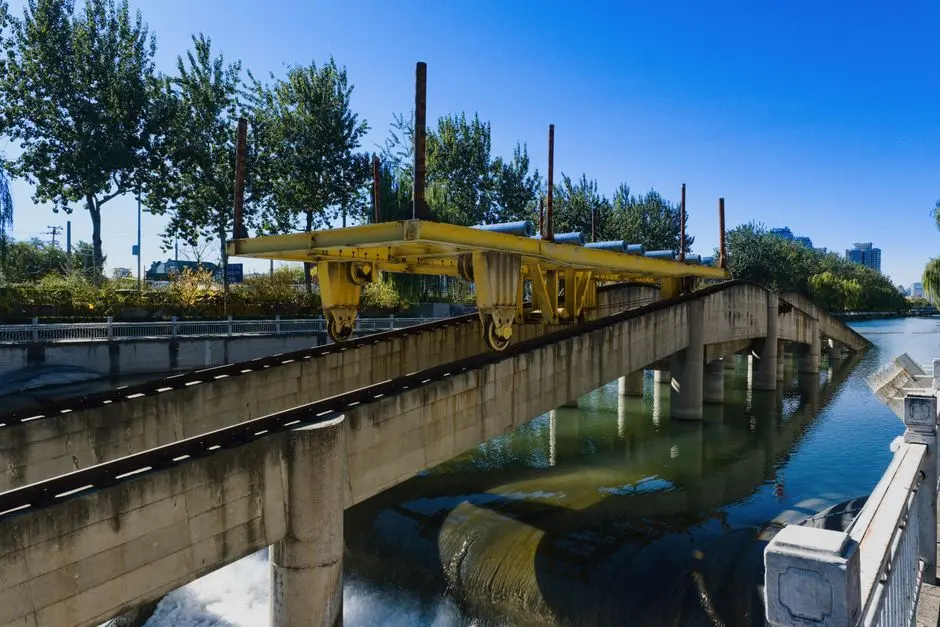
Primary clarifier condition is the variable that protects the aeration basin from a biological upset. The per-shift record must log the sludge blanket level — typically held 0.5–1.0 m below the effluent weir, with the exact setpoint plant-specific — and verify that the scum arm is rotating and skimmings are discharging. A failed scum arm increases TSS and BOD loading to aeration and accelerates biological process upset within 4–8 hours; the same 4–8 hour window that applies to a DO shortfall downstream applies to a hidden primary failure upstream. Weekly, drain and inspect the scum trough for grit accumulation and check the drive torque on the rotating arm mechanism. Monthly, verify the underflow pump curve against design by reading the drawdown rate and the line pressure against the original pump curve sheet, and inspect sludge withdrawal piping for blockage at the take-off.
When primary footprint is constrained and a higher overflow rate is needed, the checklist can flag an upgrade path to a lamella clarifier for primary and secondary settling — the same inspection tasks apply, with a much shorter retention time and a corresponding tightening of the per-shift inspection window.
Zone 3 — Aeration and biological treatment: DO control, blowers, and MLSS
Aeration is the highest-exposure zone. Dissolved oxygen shortfall translates to permit exceedance within 4–8 hours, which is why DO and blower condition are Critical-priority items with fixed per-shift response times. Per shift, the operator logs DO at the basin midpoint and end — target 1.5–2.5 mg/L for conventional activated sludge, with the setpoint adjusted by plant-specific SRT and loading — records MLSS, and walks the blower inlet filters to confirm they are clean. Weekly, sample SVI to detect rising sludge volume index before it triggers clarifier failure, and pull an aeration diffuser for visual on a sample point to check for fouling or hole elongation. Monthly, calibrate the DO and pH probes against a standard buffer, and inspect the blower bearings for temperature rise, the gearbox oil level, and the vibration signature against the baseline.
Runtime-hour triggers are the second key layer: blower bearing grease is typically due at 2,000 operating hours, oil change at 4,000–6,000 hours, and valve diaphragm replacement at 8,000 hours — all OEM-dependent and conditional on the actual duty cycle. The third layer is the linked process zones: the RAS and WAS pump maintenance schedule is the work order set that returns solids to the basin at the right rate, and a missed WAS line inspection will show up in the aeration DO log within the same 4–8 hour window. Night and weekend rounds cannot skip this row.
Zone 4 — Secondary clarification and Zone 5 — Disinfection: protecting the effluent permit

The liquid stream closes at the secondary clarifier and disinfection stage, and the effluent permit is the document that ties them together. Per shift on the secondary clarifier, the operator logs the sludge blanket, the drive torque on the rake mechanism, and the effluent TSS. A rising blanket or rake failure produces a TSS exceedance that is a direct permit violation; the value must be quantitative, not a "looks OK" hand-wave. Weekly, verify scum collection is active and inspect effluent weirs for algal fouling, which can bias the TSS reading. Per shift on disinfection, chlorine residual must be inside the permit range in either direction — a residual of 0.0 mg/L and a residual of 5.0 mg/L are both reportable NPDES events. UV lamp hours must be tracked against the validated dose curve; an untracked lamp is a permit exposure that the inspector will catch on the first lamp-hour log review. Monthly, clean the UV quartz sleeves, calibrate the chlorine analyzer against DPD, and verify CT calculations for the contact basin.
Equipment references for this zone are direct: a UV sterilizer for effluent disinfection with logged lamp hours and a chlorine dioxide generator for residual control with a calibrated analyzer are the assets the checklist rows should be parented to in the CMMS.
| Parameter | Secondary Clarifier | UV Disinfection | Chlorine / ClO₂ Disinfection |
|---|---|---|---|
| Per-shift inspection | Sludge blanket level, rake torque, effluent TSS | Lamp status, validated dose, ballast alarms | Residual reading (in-range both directions), flow |
| Weekly inspection | Scum collection, weir algal fouling | Sleeve visual check for fouling | Analyzer response check, cylinder stock |
| Monthly inspection | Pump curve verification, drive oil | Clean quartz sleeves, re-torque seals | CT verification, DPD calibration |
| Runtime-hour trigger | Rake drive oil at 4,000–6,000 h | Lamp replacement at OEM life (typ. 8,000–12,000 h) | Generator pump head at 4,000 h |
| Priority tier | Critical | Critical | Critical |
Zone 6 — Sludge handling: thickeners, digesters, and dewatering
Sludge handling is where a PM gap becomes a balance-sheet event rather than a permit event. A failed digester heating system or a centrifuge shutdown can produce emergency biosolids disposal costs of $50,000–$200,000 for a single event (per OxMaint field data, 2025-08), which is the number that converts the biosolids line item from a maintenance line to a management-level risk. Daily, the operator logs digester temperature (mesophilic target 35–37°C), feed rate, and gas production, and checks the centrifuge or belt press oil and polymer levels. Weekly, inspect the digester mixing system for gas-recirculation or mechanical-mixer performance, and check the polymer dose calibration on the dewatering equipment — a drifting polymer pump is the single most common source of high-cake-moisture excursions. Monthly, pull a thickener drive oil sample for analysis, inspect the rake torque trend, and verify the dewatering cake solids target against the disposal contract (typically 18–25% DS for landfill, higher for incineration).
The procurement reference for the dewatering row is a plate and frame filter press for sludge dewatering, and the OPEX lever for the polymer line is covered in the engineering guide on polymer dose optimization in sludge dewatering.
Frequencies, runtime-hour triggers, and the three-tier priority matrix
The matrix below is the single reference that converts a generic "check the blowers" line into a work order with a due date and a priority. Frequency buckets follow the Lakeside maintenance guidance (2025): daily flow/pressure/chemicals, weekly filter and screen cleaning, monthly sensor calibration, quarterly gasket and seal replacement, and annual full-condition assessment. Runtime-hour triggers are the second column; the priority column is the third. Cross-process items from the STP/WTP PM checklist (Ekdant Enviro Services, 2024) — lubrication, motor and bearing heating, gearbox oil, blower filter, standby pump trial run, pump-to-motor alignment, pump glands, panel bolts and lock, earth continuity in conductors, annual sludge cleaning in collection sump, painting of pipes/vessels/pumps, and media changeover for PSF/ACF and softener salt regeneration — are mapped into the same matrix so nothing is dropped between zones.
| Zone | Task | Frequency | Runtime-hour trigger | Priority |
|---|---|---|---|---|
| All zones | Standby pump trial run | Weekly | — | Critical |
| All zones | Lubrication (per OEM) | Monthly | 2,000 h grease / 4,000–6,000 h oil | Monitor |
| All zones | Motor and bearing temperature | Per shift (logged) / monthly (physical) | — | Monitor |
| All zones | Pump-to-motor alignment check | Quarterly | — | Monitor |
| All zones | Pump gland inspection | Weekly | — | Monitor |
| All zones | Panel bolts, lock, earth continuity | Monthly | — | Critical |
| All zones | Annual sludge cleaning in collection sump | Annual | — | Routine |
| All zones | Painting of pipes, vessels, pumps | Annual | — | Routine |
| All zones | PSF / ACF media changeover | Annual | — | Routine |
| All zones | Softener salt regeneration | As required | — | Monitor |
| Zone 1 | Bar screen rake travel, grit discharge | Per shift | — | Critical |
| Zone 1 | Rake chain replacement | — | 4,000–8,000 h | Monitor |
| Zone 2 | Sludge blanket level, scum arm rotation | Per shift | — | Critical |
| Zone 3 | DO at midpoint and end of basin | Per shift | — | Critical |
| Zone 3 | DO / pH probe calibration | Monthly | — | Critical |
| Zone 3 | Blower bearing grease | — | 2,000 h | Monitor |
| Zone 3 | Blower oil change | — | 4,000–6,000 h | Monitor |
| Zone 3 | Blower valve diaphragm | — | 8,000 h | Monitor |
| Zone 4 | Secondary sludge blanket, rake torque, effluent TSS | Per shift | — | Critical |
| Zone 5 | Chlorine residual in-range check | Per shift | — | Critical |
| Zone 5 | UV lamp hours vs validated dose | Per shift | 8,000–12,000 h lamp life | Critical |
| Zone 6 | Digester temperature, feed, gas production | Daily | — | Critical |
| Zone 6 | Polymer dose calibration on dewatering | Weekly | — | Monitor |
| Zone 6 | Thickener drive oil sample | Monthly | — | Monitor |
From paper checklist to CMMS work orders: the integration step
Every Critical row converts to a recurring CMMS work order on a fixed schedule, parented to a specific equipment tag in the asset hierarchy, and assigned to a named craft. Photo capture is attached to every FLAG finding before the corrective work order is raised, which makes the record tamper-evident for EPA sanitary surveys, EA inspections, and state-EPA DMR reviews (per OxMaint, 2025). FLAG findings route to corrective work orders before shift handover, with overdue-CAPA escalation set at the priority-tier threshold. DMR, EA consent, and UWWTD-aligned self-monitoring packages export in under two hours because the data is captured at the point of inspection, not assembled afterward. The asset hierarchy is the connective tissue: each checklist row must point to a tag number, and each work order must close against that tag, so failure history is traceable per asset across the full permit cycle.
PM spend versus permit exposure: a 2026 ROI view
The financial argument for a written, zone-based PM program is the one a plant manager will sign off on. A 10,000 m³/d plant typically runs an annual PM labor and parts budget in the $80,000–$150,000 range, depending on staffing model and OEM service contracts. Against that, a single avoided NPDES violation at the $25,000-per-day Clean Water Act civil-penalty cap covers 5–10 years of program cost, and a single avoided biosolids emergency at $50,000–$200,000 per event covers 1–2 years. Secondary ROI layers documented in the Lakeside maintenance guidance (2025) — extended equipment life and lower energy use from well-maintained blowers, diffusers, and pumps — typically add 5–15% reduction in lifecycle replacement cost over a 10-year horizon. The full OPEX numbers, including the polymer and energy line items, are stress-tested in the wastewater plant operating cost breakdown.
| Line item | Annual value (USD) | Notes |
|---|---|---|
| PM labor (10,000 m³/d plant) | $50,000–$90,000 | 1 FTE maintenance + on-call coverage |
| PM parts and consumables | $30,000–$60,000 | Lubricants, seals, gaskets, probes, lamps |
| Total annual PM spend | $80,000–$150,000 | — |
| Avoided NPDES fine (per day, per violation) | $25,000 | Clean Water Act civil penalty cap |
| Avoided biosolids emergency (per event) | $50,000–$200,000 | Emergency haul + disposal surcharge |
| Years of PM program covered by 1 avoided NPDES day | 5–10 years | At low end of PM spend |
| Years of PM program covered by 1 avoided biosolids event | 1–2 years | At midpoint of event cost |
Frequently Asked Questions
How often should a wastewater plant run a preventive maintenance inspection?
Critical items (DO, chlorine residual, secondary sludge blanket, bar screen rake travel) are inspected every shift, Monitor items on a weekly-to-monthly cadence with a defined re-inspection interval, and Routine items annually per a full-condition assessment (per OxMaint, 2025). For a 10,000 m³/d plant the realistic split is roughly 15 Critical rows, 25 Monitor rows, and 10 Routine rows in the master checklist.
Who is responsible for completing a WWTP PM checklist?
The shift operator owns the per-shift Critical rows with sign-off and photo evidence, the maintenance planner owns the monthly and runtime-hour rows, and the chief operator owns the annual review and the CMMS audit trail. Under NPDES (40 CFR Part 122) the responsible operator of record is the legally accountable signatory for the inspection record, which is why the technician name, timestamp, and tag number must be captured on every row.
What triggers a reportable NPDES violation?
Any exceedance of a permit limit for BOD, TSS, ammonia, fecal coliform, chlorine residual, or pH on a daily or monthly basis, plus any SSO or unplanned bypass. A chlorine residual of 0.0 mg/L or 5.0 mg/L is reportable in either direction (per OxMaint, 2025). The $25,000 per day per violation cap under the Clean Water Act is the headline financial exposure; secondary exposure is state-EPA enforcement discretion.
What records must be kept for an EPA sanitary survey?
Daily, weekly, monthly, and annual inspection logs with technician sign-off, timestamps, equipment tag numbers, and photo evidence of any FLAG finding; DMR submissions; corrective action and CAPA closure records; calibration certificates for DO, pH, and chlorine probes; and biosolids records per 40 CFR Part 503. A digital CMMS with photo capture and DMR export under two hours (per OxMaint, 2025) is the only practical way to satisfy this without manual reassembly.
How does a municipal WWTP PM program differ from an industrial one?
Municipal programs are driven by NPDES and 40 CFR Part 503 effluent and biosolids limits, with more diffuse load and a wider Critical-tier per-shift list. Industrial programs are driven by a site-specific permit and a pre-treatment agreement with the receiving POTW, with tighter effluent limits and a more focused zone-3 (aeration) and zone-6 (sludge) emphasis. Both use the same six-zone structure and three-tier priority; the difference is in the frequency weights and the equipment SKUs the checklist rows are parented to.