Why RAS and WAS Pumps Need a Written Schedule
Return activated sludge (RAS) pumps handle 50–100% of forward flow continuously, while waste activated sludge (WAS) pumps run intermittently to control sludge age and the food-to-microorganism (F:M) ratio; an undocumented schedule is the actual cause of the recurring failures many plants face. The 2018 Hazen and Sawyer RAS Pumping Rehabilitation Study found that "if one RAS pump fails, the associated final clarifier must be taken out of service until the pump has been repaired," and that "the existing RAS pumping infrastructure does not provide for a back-up pump to be utilized while an existing pump is out of service" (per the OWASA RFQ, 2024-08, citing the 2018 Hazen and Sawyer study). At the OWASA plant, RAS pumps are 15 HP units rated for 1,700 GPM at 20 ft TDH (per the OWASA 2024 RFQ), and a 2017 clarifier outage caused by RAS pump repairs on Clarifier 5 forced the plant to operate on only two of its four secondary clarifiers. RAS pumps must move high-solids sludge while minimizing shear on biological floc, so design features like recessed two-vane impellers, thick-walled volutes, renewable shaft sleeves, and externally adjustable wear faces exist specifically to tolerate the service conditions a written maintenance schedule is designed to manage (per Pumps & Systems). Redundancy is a schedule-level concern: any backup pump, diesel connection, or bypass piping must be exercised on the same cadence as the duty unit, or the redundancy remains theoretical.
Daily and Weekly Operator Checks
Daily and weekly checks serve as the operator's first line of defense and take 5 to 30 minutes per pump. These tasks require no special tools and produce a trendable data point in the CMMS.
- Daily (per shift, ~5 min/pump): read motor amperage and compare against the nameplate full-load amps (the OWASA 15 HP units run near 21 A at 460 V); log discharge pressure from the gauge at the volute; check seal drips or packing leak-off — more than 30–60 drops/min indicates a failing seal face; listen for any change in pitch or bearing growl; confirm the VFD fault log is clear at shift change.
- Weekly (~30 min/pump): walk the baseplate and volute for hairline cracks, check packing gland tension and confirm sealing-water flow is within OEM spec; verify VFD output frequency matches the SCADA flow setpoint (a 2–3 Hz drift under steady load often precedes a VFD or sensor fault); log mixed liquor suspended solids (MLSS) in the aeration basin to confirm return flow is correctly sized — typical RAS targets run 2,000–4,000 mg/L for conventional activated sludge (per EPA activated-sludge process design guidance). Use the pump's accessible packing box and clean-out port to remove collected rags before they bind the shaft.
- WAS pump-specific daily check: confirm the timer or MLSS-based control cycle fired on schedule; a missed cycle drifts the sludge age and pushes the F:M ratio out of the 0.2–0.5 lb BOD/lb MLVSS·d range that defines conventional operation. Document every deviation in the CMMS the same shift it is found — trending beats absolute readings for slow-developing issues.
Monthly and Quarterly Mechanical Inspections
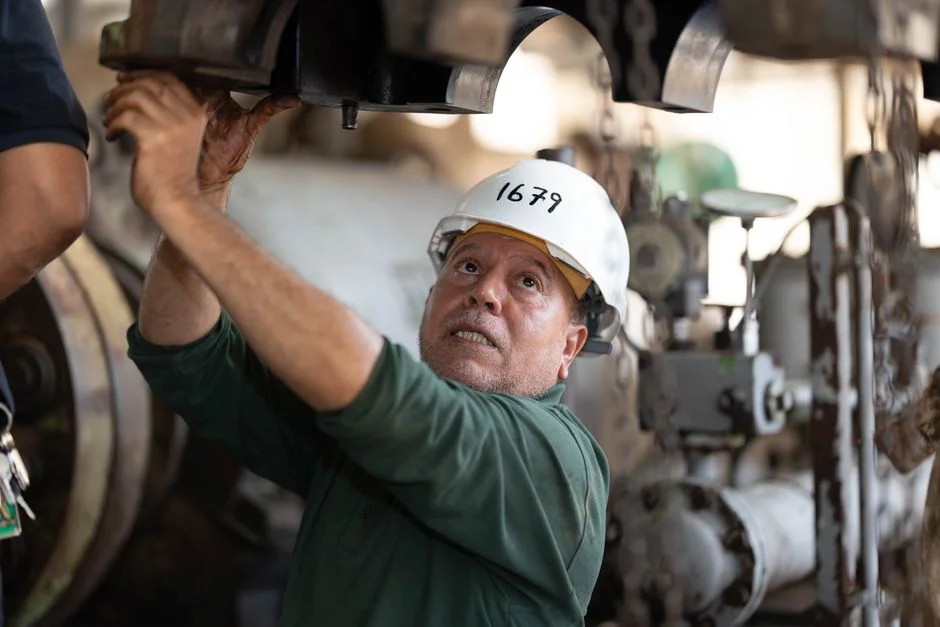
Monthly and quarterly work is performed by the maintenance technician and prevents catastrophic bearing and seal failures. Anchor every reading to a documented baseline taken at commissioning, as absolute numbers mean little without a trend.
Monthly: take vibration readings on the motor drive-end and non-drive-end bearings and on the pump bearing housing; evaluate against ISO 10816-3 severity zones for medium machines (15–75 kW motors, which bracket the 11 kW / 15 HP OWASA units) — readings consistently above 4.5 mm/s RMS at the pump bearing housing indicate Zone C/D boundary and warrant corrective action. Check bearing-housing oil level and color; top up only with the manufacturer-specified lubricant, and flag any milkiness as probable water ingress through a failing mechanical seal. Record winding temperature if the VFD reports it; a baseline temperature rise above 10 °C over 30 days typically points to soft-start ramp mis-tuning.
Quarterly: laser-align the coupled driver and pump (acceptance limit 0.05 mm offset, 0.05 mm/m parallel); measure mechanical seal face drop where the design permits external measurement; verify VFD ramp rates stay inside 3–10 seconds to prevent winding overheating during repeated starts. Pull the suction-side clean-out port and inspect the impeller for rags, plastics, and stringy material wrap — this is the single most common RAS pump failure mode in municipal service. Trend bearing-housing temperature against the OEM alarm setpoint; a rising baseline is a leading indicator of lubrication breakdown.
| Interval | Task | Acceptance Threshold |
|---|---|---|
| Monthly | Vibration analysis — pump bearing housing | ≤ 4.5 mm/s RMS (ISO 10816-3 Zone B/C boundary) |
| Monthly | Bearing housing oil level & color | Within sight glass; no milkiness or metal sheen |
| Monthly | Motor current vs. FLA | Within ±10% of commissioning baseline |
| Quarterly | Laser alignment, coupled units | ≤ 0.05 mm offset, ≤ 0.05 mm/m parallel |
| Quarterly | Mechanical seal face measurement | Within OEM "minimum face" spec; replace if at limit |
| Quarterly | Suction clean-out & impeller rag inspection | No binding; clear passage documented |
| Quarterly | VFD ramp rate verification | 3–10 s accel/decel per OEM |
Annual Overhaul and Rebuild Tasks
Annual work requires the pump to be taken out of service, necessitating a phased schedule to keep the plant online while the duty unit is serviced. The 2017 OWASA clarifier outage serves as a reminder of the consequences when no backup is available.
- Pull the pump and inspect the impeller and volute end-to-end. Measure impeller vane clearance at the wear face; abrasive wear is the failure mode that thick-walled volutes and renewable shaft sleeves are designed to absorb, and the OEM-published clearances are the only defensible limits.
- Replace the mechanical seal (or fully repack if packed), and check the shaft sleeve for grooving — sleeves scoring beyond 0.5 mm typically need rotation or replacement rather than re-installation.
- Inspect bearings for spalling, brinelling, or discoloration; rotate heavy-duty bearings if the design supports it. Heavy-duty bearings and high-strength shafts enable long service life under continuous duty (per Pumps & Systems), provided they are inspected on a rigorous interval.
- Recalibrate the VFD and confirm the remote-monitoring signals — flow, current, vibration, bearing temperature — feed SCADA. Remote monitoring is a primary preventive-maintenance enabler; a clean SCADA dashboard distinguishes a planned bearing swap from a 3 a.m. callout.
- For plants without a backup pump (the documented OWASA condition), schedule the annual overhaul on a clarifier that can be taken offline and confirm the bypass piping to the backup diesel pump is operational before the first flange is unbolted.
Spare Parts, Redundancy and the OWASA Lesson

A maintenance schedule without a spares list and working redundancy is ineffective. The OWASA record is unambiguous: "the existing RAS pumping infrastructure does not provide for a back-up pump to be utilized while an existing pump is out of service" (per the OWASA 2024-08 RFQ, citing the 2018 Hazen and Sawyer study). The 2018 study recommended new bypass piping for quick connection to a backup diesel pump on Clarifiers 2 and 3; maintenance schedules must assume that bypass is exercised quarterly.
Maintain critical rotable spares at one full set per duty pump: bearings, mechanical seal, wear rings, and one complete impeller. These parts determine whether an unplanned outage lasts four hours or four weeks. Stock consumables — packing, gaskets, lubricant — on the shelf to avoid operational downtime. Tie the spare-parts list to the OEM's published MTBF and the plant's own failure log; a CMMS that tracks both is the only credible input. For plants feeding downstream dewatering, the schedule should also align with the solids load delivered to a plate and frame filter press for sludge dewatering, as a healthy RAS/WAS train keeps cake solids in spec. Engineers planning a new clarifier train can reference the lamella clarifier for secondary clarification footprint to free hydraulic head. A wider process overview is in the municipal sewage sludge treatment process guide, and a domestic-scale variant is in the domestic sewage sludge treatment process guide.
| Spare / Consumable | Stocking Rule | Redundancy Trigger |
|---|---|---|
| Bearing set (driver + pump) | 1 set per duty pump | Replace on first spall or at 50,000 h |
| Mechanical seal | 1 per duty pump | Replace at OEM face-life limit or any drip > 60/min |
| Complete impeller | 1 per duty pump | Replace when vane clearance exceeds OEM max |
| Wear rings | 1 set per duty pump | Replace when clearance doubles OEM baseline |
| Packing, gaskets, lubricant | Min. 1 yr consumption on shelf | Reorder at 50% stock |
| Backup diesel pump & bypass | 1 per clarifier train | Exercised quarterly (per OWASA lesson) |
Frequently Asked Questions
How often should RAS pump bearings be lubricated and replaced?
Re-grease every 2,000–4,000 running hours with the manufacturer-specified grease; replace bearings at the first sign of spalling or at 50,000 hours, whichever comes first (per standard rotating-equipment practice for continuous-duty pumps).
What is the typical maintenance interval for RAS pump mechanical seals?
Plan mechanical seal replacement every 3–5 years in continuous RAS service, or immediately if the seal-drip rate exceeds 30–60 drops per minute; any milkiness in bearing oil is grounds for immediate seal inspection.
How does the OWASA case change a plant's redundancy approach?
The 2018 Hazen and Sawyer study found that a single RAS pump failure forces the associated secondary clarifier offline (per the OWASA 2024-08 RFQ), so the redundancy rule is simple: if no backup pump and bypass piping are tested quarterly, no annual overhaul should be scheduled.
What vibration threshold should trigger a RAS pump inspection?
Use ISO 10816-3: readings above 4.5 mm/s RMS at the pump bearing housing on 15–75 kW machines cross into Zone C and require corrective action; readings above 7.1 mm/s RMS indicate immediate shutdown.
Why is WAS pump maintenance scheduled separately from RAS pumps?
WAS pumps run intermittently to control sludge age and the F:M ratio, so failure typically manifests as a process upset rather than a hydraulic one; missed WAS cycles shift MLSS and are identified through timer-cycle verification rather than vibration trending.