Why Iranian Hotels and Resorts Need Purpose-Built Wastewater Systems
Iran Department of Environment (DOE) regulations establish the compliance floor for any surface-discharge project: BOD₅ ≤30 mg/L, COD ≤60 mg/L, TSS ≤40 mg/L, fecal coliform ≤200 MPN/100 mL, and pH 6.5–8.5 (per DOE effluent regulations applicable to hospitality discharges, 2026). These numbers are not aspirational; they are the line above which the operating permit is revoked. Every unit operation downstream of the headworks must be selected and sized to clear this bar continuously, including during the summer peak when occupancy in coastal and central-Iran resorts can run 3–4× the winter baseline.
Most 4–5 star resort developments on Kish, Qeshm, the Caspian coast (Ramsar, Chaloos), Isfahan, and the Alborz foothills sit outside municipal sewer networks. Tanker-truck haulage is impractical at 80–150 m³/day and is increasingly restricted by provincial environmental offices. A packaged on-site STP is therefore the default, not a fallback. Seasonal tourism loads — a 30–40% occupancy swing between November and August at mountain and island resorts — make a municipal tie-in uneconomic even where one exists nearby.
Iran's tourism pipeline is rebuilding in 2026, with the Tripadvisor Iran resort category actively listing properties across the country (source: tripadvisor.com, 2026). That brings a new wave of both new-build and renovation demand for treatment packages sized to the DOE envelope. Pool backwash (high free chlorine, suspended solids, and TDS), kitchen FOG at 80–120 mg/L from full-service restaurants, and laundry lint create a wastewater profile fundamentally different from a domestic apartment block. A generic residential STP package — typically sized for 150 L/cap·day of weak sewage — underperforms in this duty and will not hold fecal coliform below 200 MPN/100 mL during the July–August surge.
Sizing the Plant: Per-Capita Loading, BOD and Hydraulics
Resort design flow is governed by per-guest water use rather than per-resident figures: 200–250 L/guest·day is the defensible envelope for a 4–5 star property, against 150 L/cap·day for permanent domestic dwellings (per HydropureWater resort sizing methodology, 2026). The uplift reflects longer showers, laundry frequency, two meals per guest-day in the all-inclusive format, and pool backwash recycle. A 3-day composite sample taken at peak occupancy in July or August is the right basis for influent design — lab data on a slow February week will undersize the biological stage by 30–50%.
Typical resort influent parameters to design against are BOD₅ 250–350 mg/L, COD 500–700 mg/L, TSS 250–400 mg/L, FOG up to 80–120 mg/L from full kitchens, and ammonia 25–40 mg/L. These figures straddle the Iranian DOE raw-sewage envelope and are consistent with published resort wastewater characterizations from comparable Mediterranean and Caspian tourism loads. The same logic that drives a packaged MBR STP sizing guide for European city hotels applies, with the addition of a higher peaking factor.
Peaking factor for Iranian resort sites with high tourist seasonality (Kish, Qeshm, Ramsar, Mashhad pilgrimage peaks) is 2.5–3.5× the average dry-weather flow. The equalization tank should therefore hold 4–6 hours of average flow, with mechanical mixing at 4–8 W/m³ to prevent FOG cap formation and septic souring. The worked example below makes the math explicit.
Worked example: 200-room Isfahan or Kish resort
- Average flow = 200 rooms × 2.2 guests/room × 220 L/guest·day = 96,800 L/day = 96.8 m³/day
- Peak factor 3.0 → peak daily volume ≈ 290 m³/day
- Peak hourly load ≈ 290 / 24 × 1.5 (in-hour surge) ≈ 18.1 m³/h, or ~12.1 m³/h on a sustained 24-hour basis
- Biological stage sized at 100–150 m³/day nominal, rounded up to 200 m³/day for safety margin and future F&B expansion
| Design Parameter | Value | Source / Note |
|---|---|---|
| Per-guest water use | 200–250 L/guest·day | 4–5 star resort envelope, 2026 |
| Influent BOD₅ | 250–350 mg/L | Peak-season composite |
| Influent COD | 500–700 mg/L | Peak-season composite |
| Influent TSS | 250–400 mg/L | |
| Influent FOG | 80–120 mg/L | Full kitchen duty |
| Influent NH₃-N | 25–40 mg/L | — |
| Peaking factor (seasonal) | 2.5–3.5× | Kish, Ramsar, Mashhad peaks |
| Equalization retention | 4–6 h of avg flow | Mixing 4–8 W/m³ |
| 200-room avg flow | 96.8 m³/day | Worked example |
| 200-room peak flow | ~290 m³/day | PF 3.0 |
MBR vs WSZ vs SBR: Choosing the Right Packaged Architecture
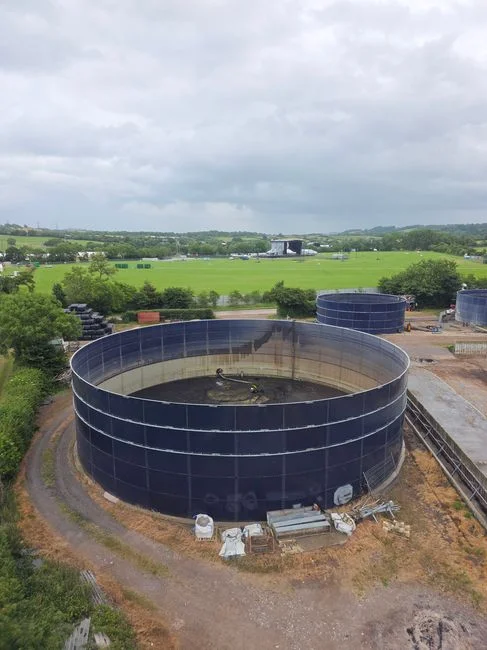
Three packaged architectures dominate the Iranian resort market: WSZ (A/O contact oxidation in a buried tank), MBR (membrane bioreactor with submerged flat-sheet modules), and SBR (sequencing batch reactor). Each maps to a different envelope of flow, reuse ambition, and operator availability, and the choice should be defended on numbers, not brand familiarity.
WSZ underground packaged plants cover 1–80 m³/h (roughly 20–1,500 m³/day) with no daily operator, buried installation, and the lowest capex in the comparison. They are the natural answer for remote eco-lodges and 4–5 star properties under 50 m³/day that only need DOE surface-discharge compliance, and the WSZ underground packaged plant format is the workhorse of Iranian rural hospitality. Effluent BOD₅/TSS are typically 20/20 mg/L — adequate for discharge, marginal for unrestricted landscape reuse.
MBR is the high-effluent, small-footprint option. Submerged PVDF flat-sheet membranes deliver a <1 μm filtrate with typical BOD₅ <5 mg/L, COD <30 mg/L, TSS <1 mg/L, and turbidity <1 NTU from a tankage volume 60% smaller than an equivalent CAS plant (per HydropureWater MBR design data, 2026). The trade-off is energy: 0.4–0.7 kWh/m³, roughly 2× a WSZ, plus membrane-replacement exposure. For a resort that wants to reuse filtrate on 5–10 ha of gardens without a separate polishing step, the integrated MBR plant is the most direct route. The same logic that drives the European packaged MBR STP sizing guide applies in Tehran, Isfahan, and Kish.
SBR is the balanced middle ground. Cycle times of 4–8 hours with discrete fill–react–settle–decant phases give 50–500 m³/day resorts built-in equalization and biological phosphorus removal without a dedicated clarifier. Effluent BOD₅/TSS sit in the 15–20 / 15–20 mg/L band, and the operator requirement (1–2 hr/day) is between WSZ (unattended) and MBR (0.5–1.0 hr/day for membrane cleaning). For a resort that wants operational flexibility across the winter low season without paying the MBR energy premium, SBR is a defensible answer.
| Criterion | WSZ (A/O contact) | MBR (flat-sheet) | SBR |
|---|---|---|---|
| Flow envelope | 20–1,500 m³/day | 10–2,000 m³/day | 50–500 m³/day |
| Effluent BOD₅ | ≤20 mg/L | <5 mg/L | 15–20 mg/L |
| Effluent TSS | ≤20 mg/L | <1 mg/L | 15–20 mg/L |
| Footprint m² per m³/day | 0.20–0.30 | 0.10–0.15 | 0.15–0.25 |
| Energy kWh/m³ | 0.2–0.4 | 0.4–0.7 | 0.3–0.5 |
| Operator attention | Unattended | 0.5–1.0 hr/day | 1–2 hr/day |
| Direct reuse for irrigation | Marginal | Yes (no polishing) | Polishing required |
| Capex USD/m³/day installed | 180–320 | 350–600 | 260–450 |
| OPEX USD/m³ treated | 0.05–0.12 | 0.10–0.18 | 0.08–0.15 |
Process Flow for a 100–150 m³/day Resort Plant
The unit-operation train for a 100–150 m³/day Iranian resort STP is a four-stage train. Each stage is selected for a specific failure mode in resort sewage, and the sizing is anchored to the worked example above.
Headworks: a rotary bar screen headworks with 3 mm bar spacing removes rags, plastic, and laundry lint before the lift station. The screen protects downstream biological stages from clogging and is sized for peak instantaneous flow (≈18 m³/h in the 200-room example), with a 2× turndown ratio for the winter low season. An upstream grit chamber (1 minute retention at peak flow) protects the membrane cassettes from abrasion.
Equalization + DAF pretreatment: a 4–6 hour equalization tank absorbs the 3× peaking factor, and a DAF pretreatment unit is engaged when kitchen flow pushes oil & grease above 50 mg/L. DAF micro-bubbles (20–50 μm) carry FOG and floating colloids to the surface for skimming; the underflow drops FOG below 20 mg/L, which the MBR can absorb without fouling. Without DAF, FOG coats the membrane surface and shortens cleaning intervals by 40–60%.
Biological stage: an MBR tank with submerged PVDF flat-sheet DF membrane modules at 0.1 μm pore size, with 32–135 m³/day throughput per 80–225 m² cassette, runs at MLSS 8,000–12,000 mg/L under continuous aeration. Aeration demand is 0.4–0.7 kWh/m³, dominated by membrane scouring at 0.3–0.5 m³ air per m² membrane area per minute. The high MLSS shrinks the tank to 60% of an equivalent CAS footprint — a decisive factor on tight Kish or Caspian-coast sites.
Polishing and disinfection: a chlorine dioxide disinfection system sized at 50–20,000 g/h provides residual disinfection and holds fecal coliform below 200 MPN/100 mL, satisfying DOE reuse criteria. For projects targeting unrestricted landscape irrigation without chemical residuals, an open-channel UV unit is the chemical-free alternative, sized at 30–40 mJ/cm² dose. Both paths meet EU Drinking Water Directive 98/83/EC microbial criteria when paired with the MBR filtrate envelope.
Sludge Handling, Reuse Options and Water-Scarcity Drivers
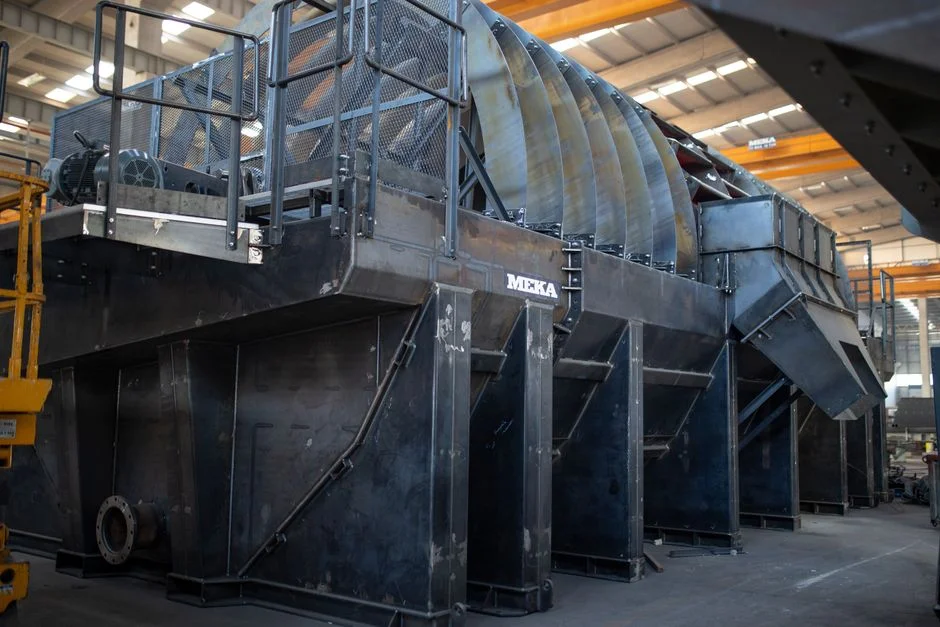
Waste activated sludge (WAS) is wasted at 0.5–1.0% of treated flow from the MBR bleed and thickened in a lamella clarifier at surface loading 20–40 m³/m²·h. The thickened sludge is then dewatered by a plate-and-frame filter press to 22–28% dry solids, with the cake going to lined landfill or, in the eco-lodge case, to on-site composting with green waste. The high-efficiency sedimentation tank upstream of the press cuts polymer consumption and improves cake release — a meaningful saving per the polymer optimization guidance for arid-region plants.
MBR filtrate reuse for landscape irrigation is permitted in Iran when fecal coliform is held below 200 MPN/100 mL, pH is in the 6.5–8.5 range, and a 1 mg/L chlorine residual is maintained (or 30–40 mJ/cm² UV dose). For a 5–10 ha resort garden, this substitution can offset 60–100 m³/day of potable irrigation water, with an open storage tank (24-hour retention) and a drip-distribution grid to prevent aerosol drift. A UV sterilizer downstream of the storage tank provides the residual-free polish preferred for resort public-area irrigation.
Iran's ongoing drought across the central plateau and the Lake Urmia basin makes reuse a permit plus, not an option. A developer who presents DOE with a packaged STP that simultaneously delivers compliance and a 60–100 m³/day potable offset typically wins faster sign-off, because the project aligns with national water-security policy. In 2026, that alignment is the single strongest non-commercial argument the EPC can make to the owner.
Operating Cost Benchmarks for an Iranian Resort STP
OPEX for an Iranian resort STP breaks into four line items: energy, chemicals, operator labor, and consumables (membranes, UV lamps). Energy is the dominant share for MBR; chemicals dominate for SBR; WSZ has the lowest total but no reuse pathway.
Energy: 0.4–0.7 kWh per m³ treated for MBR, 0.2–0.4 kWh/m³ for WSZ, 0.3–0.5 kWh/m³ for SBR. A 100 m³/day MBR therefore draws 4–7 kW continuous, while a 100 m³/day WSZ draws 2–4 kW — meaningful at 2026 industrial tariffs above 0.05 USD/kWh. Chemicals: polymer for sludge dewatering 3–6 kg active per ton dry solids, and chlorine dioxide precursor 1–2 g per m³ for residual disinfection. Labor: WSZ runs unattended, MBR needs 0.5–1.0 hr/day skilled attention for membrane cleaning and MLSS control, SBR needs 1–2 hr/day. The polymer line is the easiest to trim — see the polymer optimization guide for dose and mixing data.
| OPEX Line Item | WSZ | MBR | SBR |
|---|---|---|---|
| Energy USD/m³ | 0.01–0.03 | 0.02–0.05 | 0.02–0.04 |
| Chemicals USD/m³ | 0.01–0.02 | 0.02–0.04 | 0.02–0.04 |
| Labor USD/m³ | 0.01–0.02 | 0.02–0.04 | 0.02–0.04 |
| Membrane / consumable USD/m³ | — | 0.03–0.06 | — |
| Annual OPEX envelope USD per m³/day installed | 20–45 | 35–70 | 25–55 |
For a 200-room Iranian resort at 100 m³/day average and 290 m³/day peak, the annual OPEX envelope sits at USD 3,500–7,000 for a WSZ, USD 6,000–12,000 for an MBR with reuse, and USD 4,500–9,500 for an SBR. These are budgeting figures, not quotations; vendor proposals will vary with freight, duty, and local installation rates.
Frequently Asked Questions
What flow does a 200-room hotel generate per day in Iran?
A 200-room resort at 2.2 guests per room and 220 L/guest·day generates about 96.8 m³/day on the annual average. With a 3.0 peaking factor during the July–August tourist peak, the design flow rises to roughly 290 m³/day, which sets the biological-stage size at 100–150 m³/day nominal, rounded up to 200 m³/day for safety margin.
Does Iran allow treated wastewater to be reused for garden irrigation?
Yes. The Iran Department of Environment permits landscape irrigation reuse when the effluent holds fecal coliform below 200 MPN/100 mL, pH is in the 6.5–8.5 range, and a 1 mg/L chlorine residual (or 30–40 mJ/cm² UV dose) is maintained. MBR filtrate typically meets these limits without a separate polishing step; WSZ and SBR effluents require additional disinfection before reuse.
MBR or SBR for a 100-room eco-lodge?
For a 100-room eco-lodge under 50 m³/day with no irrigation reuse target, a WSZ underground packaged plant is the most economical answer — buried, unattended, and DOE-compliant. If landscape reuse on 3–5 ha of gardens is part of the design, an MBR earns its higher energy cost by eliminating the polishing step. SBR is the right call when winter occupancy drops below 30% and the operator wants a single, flexible biological stage that runs the same setpoints year-round.
What is the standard effluent limit for hotel discharge in Iran?
Under DOE regulations applicable to hotel and resort discharges, surface-discharge projects must meet BOD₅ ≤30 mg/L, COD ≤60 mg/L, TSS ≤40 mg/L, fecal coliform ≤200 MPN/100 mL, and pH 6.5–8.5. Reuse-bound projects add the fecal coliform and residual-disinfection criteria above. These limits are the compliance floor for every unit operation selected.
How long does an MBR membrane last in a resort?
PVDF flat-sheet MBR membranes in a well-designed resort STP carry a 5–8 year service life, with CIP (clean-in-place) cycles every 3–6 months depending on influent FOG control. The DAF unit upstream is the largest single determinant of membrane life: holding FOG below 20 mg/L on the membrane feed extends cassette life by 30–50% compared to a non-DAF influent.