Why MBR vs CAS Is a Real Decision in the Blytheville Steel Corridor
Blast-furnace contact cooling, EAF dust slurry, and coke-oven ammonia liquor all converge on the mill drainage sump in the Blytheville, AR steel corridor, and the combined stream is exactly the kind of feed that punishes a conventional activated sludge train. Variable pH (often 4.5–9.0 from batch casting and slag quench events), 50–500 mg/L total suspended solids from slag handling, 10–80 mg/L oil and grease, ammonia-nitrogen between 20 and 150 mg/L from coke contact water, and dissolved iron/manganese in the 5–40 mg/L range routinely push a clarifier-based system past its design envelope. Arkansas Department of Energy and Environment, Division of Environmental Quality (ADEQ) NPDES permits in this corridor typically enforce 30 mg/L TSS monthly average, 5 mg/L ammonia-N for facilities discharging to sensitive waters, and total metals limits tied to 40 CFR 440 (Ore Mining and Dressing) for ore-processing lines and to permit-specific limits for steel-making contact water — so the technology choice is driven by both chemistry and regulation.
The trade-off the plant engineer actually faces is this: pay roughly 20–40% more capex to install membranes now, or keep the CAS train and pay forever in clarifier surface area, polymer on the secondary, and sludge hauling. The 60% footprint reduction quoted in the HydropureWater 2026 MBR product catalog is what unlocks retrofits inside congested mill drainage footprints where adding a third clarifier is physically impossible. The comparison below is built around a 1,000 m³/day duty drawn from that same mining/steel-mill envelope, with technology selection framed against ADEQ's mining-and-metals framework. For process engineers weighing a packaged approach, the HydropureWater integrated MBR system ships in the 10–2,000 m³/day range that covers the typical contact-water train.
How a Conventional Activated Sludge Train Handles Mining Effluent
A conventional activated sludge (CAS) train for a 1,000 m³/day mining/steel-mill contact-water duty typically looks like this: equalization basin (8–24 h HRT) → lime or caustic neutralization to pH 6.5–7.5 → primary clarifier or dissolved air flotation (DAF) for oil and settleables → aeration basin operating at MLSS 2,000–4,000 mg/L and SRT 5–15 days → secondary clarifier → chlorination or UV disinfection. The MLSS ceiling and the short SRT are the two parameters that govern everything downstream.
For a typical mining/steel-mill influent in the 1,000–3,000 mg/L COD range, a well-tuned CAS secondary will deliver 10–30 mg/L effluent TSS and 30–70% TSS removal, with a sludge yield of 0.4–0.6 kg TSS per kg COD removed (per the standard Metcalf & Eddy activated-sludge mass balance for industrial wastewater). That yield figure matters: it sets the hauling bill. The DAF is the workhorse upstream of CAS in the region because it strips free oil and floated slag fines that would otherwise ride through primary settling and coat the aeration basin.
Failure modes specific to mining and EAF contact water are well documented: floating oil punching through to the secondary clarifier, heavy-metal toxicity (especially Cu, Zn, Cd >5 mg/L) shocking the biomass, and bulking sludge when F/M swings between 0.1 and 0.4 kg BOD/kg MLSS·d as batch casting starts and stops. The clarifier is the weak link — it cannot produce a consistent TSS when the upstream chemistry is unstable, and the downstream permit does not care why.
How a Submerged MBR Train Re-engineers the Same Duty
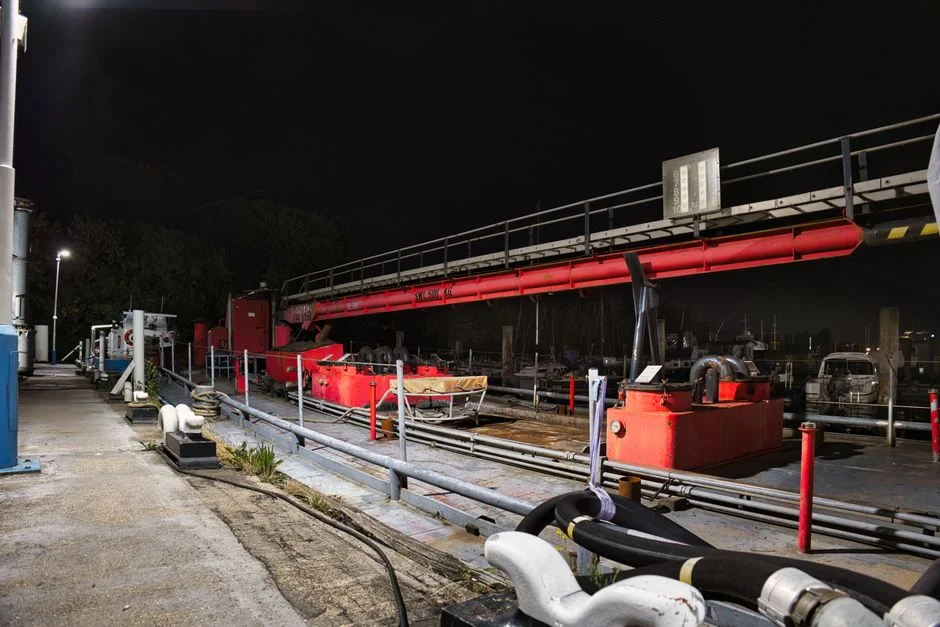
A submerged MBR train replaces the secondary clarifier and most of the downstream polishing with a membrane cassette, while pushing the biomass to concentrations a clarifier could never handle. The process: equalization → fine screening (1–3 mm rotary bar screen) → biological reactor operated at MLSS 8,000–12,000 mg/L and SRT 20–40 days → submerged PVDF membrane cassettes at 0.1 μm nominal pore size → permeate pump → chlorine dioxide or UV for residual disinfection. The 60% footprint advantage (HydropureWater field data, 2026) comes from collapsing the secondary clarifier and the sand-filter polishing step into a single tank, not from building a smaller aeration basin.
The pore size is the key performance claim. The Grasmick/Heran/Sarrafzadeh 2012 thesis on MBR activated-sludge viability quantified retention on PVDF and PES membranes with 0.04–0.2 μm cutoff, confirming that bacteria and most viruses are practically completely retained — that is why MBR permeate typically runs at sub-1 NTU turbidity and TSS is reported as <1 mg/L on a routine lab sheet. The 0.1 μm flat-sheet modules in the DF-series 0.1 μm PVDF flat-sheet MBR modules sit in that same pore-size window, so the engineering expectation is the same: near-clarifier-free permeate suitable for reuse polishing rather than discharge-only.
Two operating parameters make the MBR work on mining duty. First, SRT is decoupled from HRT — the long 20–40 day SRT retains slow-growing nitrifiers (Nitrosomonas, μmax ≈ 0.04 h⁻¹) that a 5–15 day CAS train cannot hold, which is the mechanism that controls NH3-N to <1 mg/L. Second, coarse-bubble aeration directly beneath the membrane cassettes at 0.3–0.6 Nm³/m²·h scrubs the membrane surface continuously; flat-sheet submerged configurations draw an order of magnitude less energy than external cross-flow loops, and the energy penalty versus CAS is only the air-scour delta, not a circulation pump. For a deeper treatment-train walkthrough see the 2026 MBR explainer.
Side-by-Side Parameter Comparison for a 1,000 m³/day Mining Duty
The table below compares CAS and MBR on identical 1,000 m³/day mining/steel-mill contact water (1,500–2,500 mg/L COD, 50–300 mg/L TSS, 20–80 mg/L oil & grease, 5–40 mg/L Fe+Mn, 20–80 mg/L NH3-N, pH 5.5–8.5). Numbers are drawn from the HydropureWater 2026 MBR catalog, the Grasmick thesis on MBR retention, and the standard industrial- wastewater mass balance. See the companion sibling MBR vs CAS comparison for US mining for a second regional case study.
| Parameter | CAS (existing train) | Submerged MBR | Source |
|---|---|---|---|
| MLSS, mg/L | 2,000–4,000 | 8,000–12,000 | Metcalf & Eddy; HydropureWater 2026 catalog |
| SRT, days | 5–15 | 20–40 | Standard AS design; Grasmick 2012 |
| HRT, h | 6–12 (aeration) | 4–8 (reactor) | Process design |
| Effluent TSS, mg/L | 10–30 | <1 (reported as non-detect) | Field data |
| Effluent turbidity, NTU | 5–15 | <1 | Field data |
| Effluent NH3-N, mg/L | 5–20 (seasonal) | <1–2 | Nitrifier retention at 20–40 d SRT |
| Footprint index, m² per m³/day | 0.5–0.8 | 0.2–0.3 | HydropureWater 2026 (60% reduction) |
| Sludge yield, kg TSS/kg COD | 0.4–0.6 | ~0.3 | Industrial mass balance |
| Membrane pore size | N/A (clarifier overflow) | 0.1 μm PVDF | HydropureWater DF-series |
| Polymer on secondary | Yes (2–8 mg/L) | None (no clarifier) | Process design |
| Energy intensity, kWh/m³ | 0.4–0.7 | 0.5–0.9 | Including air scour |
| O&G tolerance upstream | <30 mg/L after DAF | <50 mg/L with DAF | Operating experience |
When CAS Still Wins in Blytheville Duty
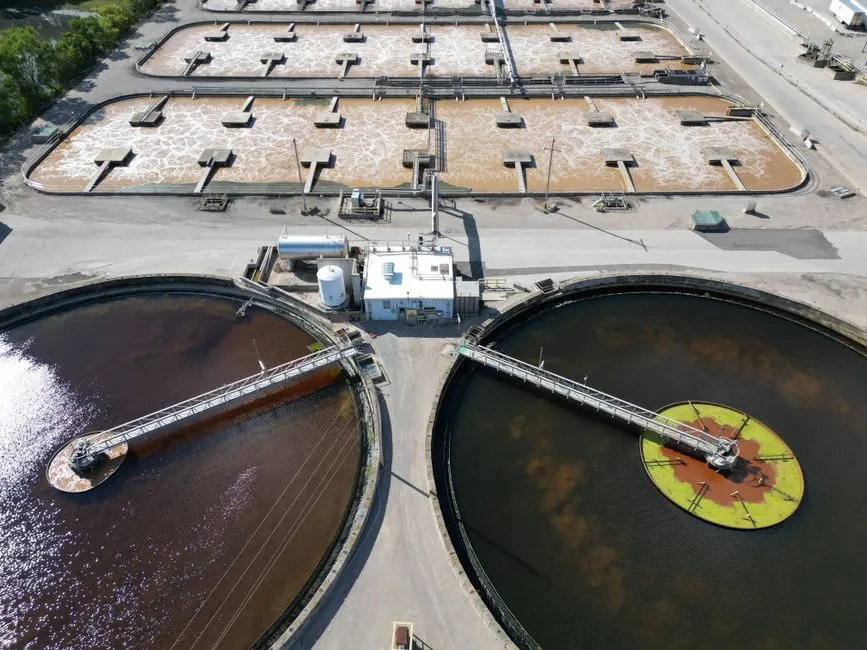
CAS is the right call in three specific situations I have seen on Mississippi County sites. First, when the existing aeration basin has 1.5–2× spare hydraulic capacity and the ADEQ permit stops at secondary standards (BOD and TSS only, with no NH3-N limit and no reuse obligation), there is no regulatory driver to upgrade to MBR. Second, when influent oil & grease is consistently <20 mg/L after the existing DAF and dissolved metals sit below toxicity thresholds (Cu <0.5 mg/L, Zn <2 mg/L, Cd <0.1 mg/L), the biomass is not at risk and a CAS train will run reliably for years. Third, when the capex ceiling is firm and the 20–40% MBR premium cannot be funded, and the site has no space constraint, the 60% footprint benefit is irrelevant — the cheaper retrofit is the right retrofit. A worked example of DAF-vs-clarifier up front of either train is in the DAF vs clarifier decision guide for mining wastewater.
5-Year Cost and Footprint Delta for a Mississippi County Retrofit
The financial case is what gets a project approved. For a 1,000 m³/day mining/steel-mill contact-water duty in the Blytheville corridor, a CAS upgrade (new aeration grid, secondary clarifier rebuild, DAF refurbishment) typically lands in the $1.2–1.8M capex range, while an MBR retrofit (reactor conversion + membrane cassette train + permeate skid) runs $1.7–2.5M. The 40–50% capex premium for MBR is consistent with the heavy-metal-bearing industrial wastewater benchmarks in Gingerich et al. (2017), which put chemical-precipitation-plus-biological treatment at $3.01/m³ and zero-liquid-discharge at $11.26/m³ — meaning biological treatment with a clarifier sits at the cheap end of the cost curve and any membrane step is justified only by an effluent-quality or reuse revenue it unlocks. Opex is where the MBR case gets interesting:
- Sludge hauling: 30–50% reduction versus CAS, because MBR sludge yield drops to ~0.3 kg TSS/kg COD at long SRT and the wasted solids are already thickened in the reactor.
- Polymer: eliminated on the secondary (no clarifier), saving 2–8 mg/L of polyacrylamide dose.
- Aeration energy: rises ~10–20% versus CAS due to the air-scour demand at 0.3–0.6 Nm³/m²·h.
- Footprint: MBR fits inside ~40% of the equivalent CAS basin footprint, which is the make-or-break metric for a congested mill-drainage retrofit.
The payback framing for finance: 3–5 years when the project unlocks reuse-water sales (mill make-up or scrubber supply), eliminates a clarifier rebuild, or avoids an ADEQ ammonia-limit upgrade triggered by a permit renewal. See the 5-year summary below:
| Line item | CAS upgrade (1,000 m³/day) | MBR retrofit (1,000 m³/day) | Delta |
|---|---|---|---|
| Capex (installed) | $1.2–1.8M | $1.7–2.5M | +40–50% |
| Footprint, m² | 500–800 | 200–300 | −60% |
| Sludge yield, kg TSS/kg COD | 0.4–0.6 | ~0.3 | −30 to −50% |
| Sludge haul cost, $/yr (typical contract) | $180–260k | $110–160k | −30 to −40% |
| Polymer on secondary, $/yr | $15–30k | $0 | −100% |
| Aeration energy, kWh/m³ | 0.4–0.7 | 0.5–0.9 | +10–20% |
| Effluent reuse revenue potential | Low (clarifier overflow) | High (sub-1 NTU permeate) | Step change |
| Indicative payback | — | 3–5 years (reuse or NH3-N trigger) | — |
Designing the Retrofit: Pretreatment, Metals Polishing and Sludge Handling
The membrane cassette is the most expensive component in the train, so everything upstream of it is designed to keep it alive. Start with a rotary bar screen at 2–3 mm aperture to strip rags, scale, and casting debris that would otherwise blind a flat-sheet module. Follow with the DAF for oil and floated solids; MBR can tolerate O&G up to about 50 mg/L with a DAF, but it cannot tolerate a slug of floating oil. Equalization with pH correction to 6.5–7.5 follows, then hydroxide or sulfide precipitation for dissolved metals (Cd, Cr, Zn) upstream of the bioreactor — precipitation at the source is far cheaper than chelating metals through the biomass.
The MBR permeate then goes to optional UF polishing or RO if the duty is reuse, and disinfection with a chlorine dioxide generator or UV sterilizer before reuse or discharge. Wasted activated sludge — already thickened to 1–2% solids in the MBR reactor — routes to a plate-and-frame filter press for dewatering to 22–28% dry solids, dropping the hauling mass by another 70–80% relative to the reactor volume. The full integrated MBR system ships with the screening, biological, and membrane stages pre-piped, which is what compresses the 3–5 year payback into a single procurement.
Frequently Asked Questions
Does an MBR retrofit help with ADEQ NPDES ammonia-nitrogen compliance in Mississippi County?
Yes. An MBR operating at 20–40 day SRT reliably retains nitrifying bacteria, delivering NH3-N under 1–2 mg/L versus the 5–20 mg/L seasonal swings typical of a CAS train on mining/steel-mill contact water. That is the difference between passing an ADEQ monthly-average ammonia limit without a polishing step and having to add a side-stream nitrification reactor.
How much footprint does an MBR actually save on a 1,000 m³/day mining retrofit?
About 60%. The HydropureWater 2026 catalog puts the MBR footprint at 0.2–0.3 m² per m³/day versus 0.5–0.8 for an equivalent CAS train, which on a 1,000 m³/day duty is roughly 200–300 m² of deck space saved — typically enough to fit the new train inside the existing aeration basin footprint and skip a greenfield expansion.
What is the real capex premium for MBR over a CAS upgrade on a 1,000 m³/day duty?
Directionally, $1.7–2.5M for MBR versus $1.2–1.8M for a CAS upgrade, a 40–50% capex premium. Anchored against the $3.01/m³ and $11.26/m³ heavy-metal treatment cost benchmarks in Gingerich et al. (2017), the premium is paid back in 3–5 years when reuse water sales, an avoided clarifier rebuild, or an ammonia-limit upgrade are factored in.
When is CAS still the correct choice for a Blytheville mining or steel-mill wastewater retrofit?
CAS wins when the existing aeration basin has 1.5–2× spare hydraulic capacity, the ADEQ permit stops at secondary BOD/TSS only (no NH3-N or reuse trigger), influent oil and grease after DAF is under 20 mg/L, dissolved metals stay below biomass-toxicity thresholds, and the 20–40% MBR capex premium cannot be funded. In that envelope, the 60% footprint benefit is irrelevant and the cheaper CAS upgrade is the right call.