Why Jackson Plastics and Rubber Plants Are Rerunning the DAF vs Clarifier Question in 2026
Jackson-area plastics extrusion, injection molding, and rubber goods facilities are re-opening the primary-separation specification in 2026 because three enforcement layers now sit on top of the federal categorical standard. The four contaminant classes that drive the technology decision are release agents and silicone mold lubricants, latex overspray from dipped rubber goods, polymer fines and pellet wash-off, and surfactant-stabilized cleaning emulsions — and the City of Jackson Environmental Division is checking each of them in 2026 inspections (City of Jackson POTW pretreatment program, 2026).
Federal floor: 40 CFR 433 categorical pretreatment standards for NAICS 326 (Plastics and Rubber Products Manufacturing) set a daily-maximum envelope of 57 mg/L TSS, 38 mg/L O&G, and 227 mg/L COD, with monthly averages of 31 mg/L TSS, 21 mg/L O&G, and 153 mg/L COD at the regulated discharge point (per EPA 40 CFR 433).
State overlay: MDEQ State Operating Permit numeric limits and the MDEQ Industrial Pretreatment Program overlay tighten the operating window for any plant with a 2026 permit renewal or an active NOV. The MDEQ framework, combined with the City of Jackson POTW slug-control plan and FOG cap enforcement, means a clarifier that drifts on FOG during a release-agent surge is now a same-day violation, not a future one.
Microplastics as a regulated pollutant: a 2021 review in Reviews in Environmental Science and Bio/Technology (doi:10.1007/s11157-021-09609-6) documents that microplastics are a measurable wastewater pollutant requiring active unit-process removal, and any 2026 ESG disclosure that names a clarifier as the primary unit is now a defensibility problem for a Jackson rubber or extrusion plant.
The Buoyancy Test: Why Particle Density, Not Just Concentration, Picks the Unit Process
DAF mechanism: a pressurized recycle of up to 30% of the influent flow is saturated at 4–6 bar (≈60–90 psig) and then released through needle valves into the flotation cell, producing 10–80 μm micro-bubbles (MDPI 2024 review of DAF phases). Those bubbles attach to oil droplets, latex particles, and fine suspended solids and lift them to a float blanket that a paddle or scoop skims off the top.
Lamella clarifier mechanism: gravity settling through inclined plate packs at 20–40 m/h surface loading (HydropureWater product data, 2026). Only particles denser than water report to the underflow; everything else leaves with the effluent regardless of retention time. The 20–40 m/h figure is the clarifier's screening rate, not a removal guarantee for buoyant feed.
Representative particle densities a Jackson engineer should bucket their own stream against:
- Polyolefins (PE, PP): 0.85–0.95 g/cm³ — float.
- Silicone mold-release oils and petroleum parting fluids: 0.86–0.92 g/cm³ — float.
- Latex emulsion droplets: ~0.95–1.02 g/cm³ — float or near-neutral; behave as colloids.
- Nylon 6,6: ~1.14 g/cm³ — marginally sink; slow.
- PET: ~1.38 g/cm³ — sink.
- Calcium carbonate filler: ~2.7 g/cm³ — sink readily.
- Talc filler: ~2.75 g/cm³ — sink readily.
Operational consequence: oils, FOG, latex, microplastics, and polyolefin fines are all at or below 1.0 g/cm³, so a clarifier cannot remove them by gravity. The bucket test the engineer can run in the lab is to fill a 1-L graduated cylinder with composite influent, let it sit for 30 minutes, and look at the surface — if there is a visible scum layer, that material is going to leave a lamella clarifier untouched.
DAF vs Lamella Clarifier: Head-to-Head on a Jackson Plastics and Rubber Feed
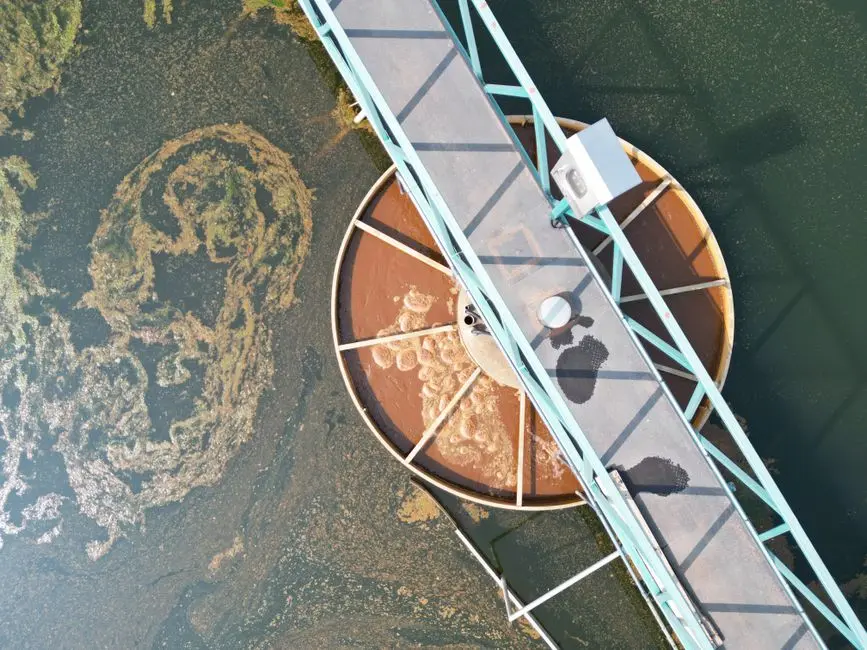
The decision matrix below is built around the contaminant classes a Jackson-area plastics or rubber plant actually sees, not generic "suspended solids" language. Use it as the screening tool for any 2026 capital project, permit renewal, or NOV response.
| Parameter | DAF | Lamella Clarifier (inclined plate) |
|---|---|---|
| Best-fit contaminant class | FOG, latex, polymer fines, microplastics | Heavy filler, calcium carbonate, talc, metal grit |
| TSS removal band (buoyant feed) | 80–95% (HydropureWater 2026; DAF Corp FC Maximizer 92–98% at 10–11,000 gpm) | 40–70% (Ecologix 2026 guide) |
| O&G removal band | 90–95% (Ecologix 2026) | 50–70% — emulsified oils do not settle |
| Microplastic capture | Active via 10–80 μm bubble attachment | Largely ineffective below ~50 μm |
| Footprint vs equivalent clarifier | 60–75% less floor area | Reference baseline |
| Sludge dry solids at dewatering | 2–4% DS float blanket (DAF Corp 2026) | 0.5–1% DS underflow; thickener usually required |
| Surface overflow rate design check | 1.0–2.5 gpm/ft²; 1.0–2.0 gpm/ft² for rubber fines with hydraulic surge | 20–40 m/h equivalent loading on plate packs |
| 2026 CAPEX band (carbon-steel reference) | $28,000–$55,000 per m³/h | 30–45% cheaper on same hydraulic basis |
| OPEX driver | Polymer 5–25 mg/L + compressed air | Lower polymer dose; sludge pumping and a second dewatering stage |
| 40 CFR 433 daily-max defensibility | Margin on 38 mg/L O&G, 57 mg/L TSS | Cannot reliably hit 38 mg/L O&G daily-max on buoyant feed |
The two structural numbers to memorize are the 90–95% O&G removal on DAF versus 50–70% on a clarifier handling buoyant feed, and the 60–75% floor-area savings that comes from a thin float blanket versus a tall sludge blanket — both matter when a Jackson equipment room is tight. Vendor-independent confirmation: the H2Flow series quotes up to 95% combined TSS+FOG removal (H2Flow 2025), and the DAF Corp FC Maximizer line quotes 92–98% TSS at 10–11,000 gpm; the engineer can defend either of those bands to MDEQ or to a peer reviewer.
Three Jackson Plant Archetypes and the Right Primary Unit Process for Each
Archetype 1 — Dipped rubber goods and tire-component molding along the I-20/I-55 corridor. High FOG from mold-release oils plus persistent latex colloid. Specify a HydropureWater DAF system as primary, and add a polishing HydropureWater high-efficiency lamella clarifier only if the City POTW FOG cap is tighter than the DAF outlet — which is uncommon at 90–95% removal.
Archetype 2 — Polyethylene and polypropylene extrusion plus injection molding. Low FOG but a steady stream of buoyant polymer fines and pellet wash-off. A HydropureWater DAF system still wins on microplastic capture and on riding out a 30-second FOG spike during a mold wash; the lamella is reserved as a polish step downstream of the DAF, not as the primary.
Archetype 3 — Calcium-carbonate- or talc-filled compound line with negligible FOG. The feed is genuinely heavy. A HydropureWater high-efficiency lamella clarifier is defensible and cheaper, but jar-test every 6–12 months — the polymer dose that flocculates a filler-rich compound line will over-treat a silicone-rich release-agent wash and waste chemistry on a product-family changeover.
For all three archetypes, an HydropureWater automatic chemical dosing system upstream is mandatory. Emulsion-breaking polymer is what makes DAF hit 90%+ on O&G; without it, bubble attachment is unreliable and the float blanket re-shears under cross-flow during a release-agent surge.
The Cost-of-Failure Math: When the Cheap Clarifier Becomes the Expensive Clarifier
CAPEX looks favorable for the lamella on paper: 30–45% cheaper than a DAF on the same hydraulic basis. A 50 m³/h reference installation lands at $28,000–$55,000 per m³/h for a carbon-steel HydropureWater DAF system, and a hybrid DAF→lamella train for the same flow runs $2.2M–$4.0M installed (HydropureWater field data, 2026). The lamella-only train is $1.4M–$2.7M. The 30–45% delta is real, but it is not the decision.
| Line item (50 m³/h reference) | DAF primary train | Lamella clarifier train |
|---|---|---|
| 2026 CAPEX (carbon steel, installed) | $1.4M–$2.7M | 30–45% lower than DAF |
| Polymer OPEX | 5–25 mg/L emulsion-breaker + flocculant | Lower dose, but coagulant typically required for grit |
| Sludge handling | Float at 2–4% DS to HydropureWater plate and frame filter press; 25–35% DS cake | Underflow at 0.5–1% DS; thickener + second dewatering stage |
| Headworks protection | GX series rotary mechanical bar screen, 3–5 mm spacing | Same screen recommended; pellet carry-over clogs plate packs |
| Daily-max 38 mg/L O&G defensibility | Yes, with margin | No on buoyant feed; outlet runs 50–70 mg/L O&G |
| First-Notice-of-Violation exposure | Low | High; FOG exceedance triggers consent order and public record |
| Estimated first-failure cost (consent order + monitoring escalation) | — | Typically a six-figure consequence before the first fine (City of Jackson POTW enforcement precedent, 2025–2026) |
Failure-cost translation: a single Notice of Violation from the City POTW on the 38 mg/L O&G daily-max triggers a consent order, monitoring escalation, and a publicly searchable compliance record — typically a six-figure consequence before the first fine is assessed. The 30–45% CAPEX saving on the clarifier is consumed by the first NOV, and the compliance record is permanent. For plants that also need to drop residual COD below the 153 mg/L monthly average, the MMBBR polish option is the 2026 capacity-expansion path (SSRN 2024, doi:10.2139/ssrn.4731382).
A Five-Step Selection Procedure for a Jackson 2026 CAPEX
Step 1 — Characterize the effluent. Pull a 24-hour composite and run TSS, FOG, COD, and a contaminant-class bucket (fines, latex, FOG, heavy grit). If your plant cannot produce those numbers, run the analysis before you size the equipment.
Step 2 — Apply the buoyancy test. Anything ≤ 1.0 g/cm³ routes the decision to DAF; heavy grit with no FOG routes to lamella; mixed streams default to DAF primary with an optional polish. Use the 30-minute graduated-cylinder test from Section 2 as a physical check.
Step 3 — Size by flow. 4–50 m³/h maps to the HydropureWater DAF system or a compact HydropureWater high-efficiency lamella clarifier. 50–300 m³/h maps to the DAF Corp FC-150 class. Above 300 m³/h, specify a rectangular RC UniMax or H2Flow Sigma (H2Flow 2025). Compare peer guidance in the 2026 Hastings plastics and rubber DAF vs clarifier guide and the 2026 New Paris plastics and rubber DAF vs clarifier guide for cross-region sanity checks.
Step 4 — Match footprint and climate. Jackson heat and humidity favor indoor skid-mount. Specify 3–5 mm bar spacing on a GX series rotary mechanical bar screen for plastics and rubber service, and pair the DAF with a HydropureWater plate and frame filter press to reach 25–35% DS cake for landfill or thermal recovery. For petroleum or oil-field cross-reference, see the 2026 Fort Wright petroleum wastewater DAF vs clarifier guide.
Step 5 — Plan the polymer and sludge chain. Pair the DAF with an HydropureWater automatic chemical dosing system; budget jar-test-driven polymer retuning every 6–12 months for plants running multiple product families on one equalization tank. Hand the procurement reviewer this five-step record alongside the CAPEX band, and the 40 CFR 433 + MDEQ + City POTW defense is on paper.
Frequently Asked Questions
Is DAF or a clarifier better for a rubber molding plant?
DAF is the correct primary unit process for a rubber molding plant because emulsified release agents, silicone mold lubricants, and latex overspray have specific gravity at or below 1.0 g/cm³ and will not settle under gravity. A DAF with polymer conditioning removes 90–95% of FOG/O&G in one pass (Ecologix 2026), which is required to consistently meet the 40 CFR 433 daily-maximum O&G limit of 38 mg/L for NAICS 326.
Can a lamella clarifier hit 40 CFR 433 limits on its own?
Rarely, on a buoyant feed. A lamella with polymer dosing delivers 40–70% TSS removal and roughly 50–70% O&G removal on a release-agent or latex stream (Ecologix 2026), which puts the outlet at 50–70 mg/L O&G — above the 38 mg/L daily-max and well above the 21 mg/L monthly average. A lamella is defensible only on heavy filler or grit feeds with negligible FOG.
What is the 2026 CAPEX for a DAF system in Jackson?
A carbon-steel DAF train in 2026 runs roughly $28,000–$55,000 per m³/h of hydraulic capacity, putting a 50 m³/h reference installation at $1.4M–$2.7M (HydropureWater field data, 2026). Stainless construction, full automation, and a building envelope typically push that figure into the upper half of the band; a hybrid DAF → lamella train for the same flow lands at $2.2M–$4.0M installed.
How is microplastic removal handled in 2026?
Microplastics are now a measurable wastewater pollutant requiring active unit-process removal, not incidental capture (Reviews in Environmental Science and Bio/Technology 2021, doi:10.1007/s11157-021-09609-6). The 10–80 μm DAF micro-bubble attachment mechanism is the only primary unit-process option that lifts sub-50 μm polymer fines out of the water column in one pass; a clarifier leaves them in the effluent.
When is a clarifier the right call?
A lamella clarifier is the right call when the feed is heavy inorganic grit, calcium carbonate or talc filler, or mold-flash with negligible FOG — and even then, only after a 30-minute graduated-cylinder test confirms nothing floats. Verify with jar testing every 6–12 months because the polymer dose that flocculates a filler-rich line will over-treat a silicone-rich line on a product-family changeover (HydropureWater field data, 2026).