
Quick Verdict: When DAF Beats a Clarifier for Fort Wright Petroleum Plants
For a Fort Wright petroleum plant in 2026, a Dissolved Air Flotation (DAF) unit is the stronger choice when the wastewater carries emulsified light oils, FOG, and fine TSS — conditions where DAF delivers 92–97% TSS removal and 3–5% float solids while occupying roughly 20–25% of the footprint of a conventional clarifier (HydropureWater field data, 2025). A conventional lamella or API clarifier wins when the stream is dominated by free, separable oil and heavy grit, because gravity settling is faster, cheaper, and needs no chemical or compressed-air systems. The short rule: route free oil to an API or lamella separator first, then send the emulsified effluent to a DAF system for polishing. Kentucky DOW categorical pretreatment under 401 KAR 5:031 typically enforces an oil & grease daily maximum of 100 mg/L (verify against the current KPDES permit) — a target DAF can hold even under slug loads, while a clarifier tends to bleed over during surge events. Self-route to the decision framework below if your influent has more than 30% emulsified oil or your flow regularly spikes above 2× average.
What Fort Wright Petroleum Wastewater Actually Looks Like
Petroleum wastewater contains a complex mix of free oil, emulsified oil, TSS, and chemical contaminants that require specific treatment technologies. A Fort Wright refinery, terminal, lubricant blender, or re-refinery sees a mixed stream of free oil (rapidly separable, >150 µm droplets), emulsified oil (droplets <20 µm stabilized by surfactants, descalers, and caustic wash water), TSS from iron sulfide and catalyst fines, phenols, sulfides, and BTEX. Temperatures commonly sit between 25 and 60 °C, pH swings from 6 to 9, and slug loads arrive every shift — desalter dumps, tank draws, and truck-offloading events routinely spike flow to 2–3× the daily average. Emulsified oil is the primary challenge for gravity separation: once droplet specific gravity approaches 1.0 and is stabilized by detergents, Stokes' law requires extended residence time, often resulting in oil leakage. The regulatory frame is 401 KAR 5:031 (KPDES petroleum refinery categorical standards) plus the facility's individual KPDES permit, with oil & grease daily-max limits typically cited at 100 mg/L and monthly-average limits near 50 mg/L — numbers the plant must defend on every DMR. Facilities in scope include refineries, crude terminals, lubricant blenders, re-refineries, and petrochemical tank farms along the Ohio River corridor. These streams do not behave like food-processing FOG, and they cannot be evaluated with generic advice pulled from non-petroleum sources.
DAF vs Clarifier: Head-to-Head on Petroleum KPIs
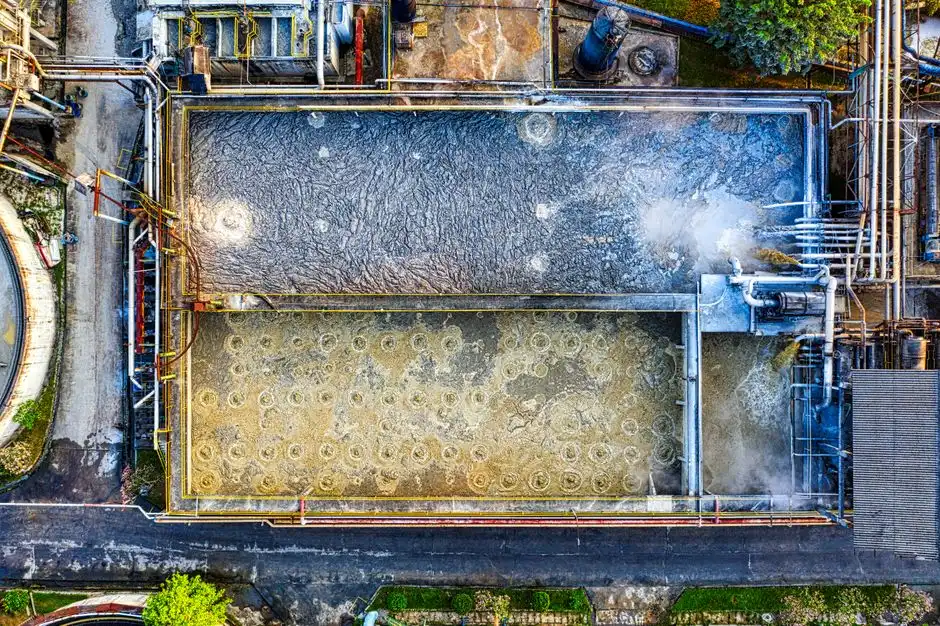
The table below provides a comparison for petroleum service, utilizing data from HydropureWater field data (2025) and the Spracell-class DAF reference set (Wang & Wang, 2022). Use it as the defensible matrix when a Kentucky DOW reviewer or a plant manager asks why one technology was selected over the other.
| Parameter | DAF | Lamella / API Clarifier |
|---|---|---|
| FOG removal | Up to 95% | 40–70% on free oil; poor on emulsified |
| Emulsified oil handling (<20 µm) | Strong — micro-bubbles lift flocculated droplets | Weak — droplets pass through |
| Free oil handling (>150 µm) | Good after API/lamella upstream | Strong — gravity wins |
| Surface loading rate | 5–15 m/h (Spracell: 4–5 GPM/ft²) | 1–3 m/h |
| Hydraulic retention time | 20–30 min (Spracell: ~3 min) | 2–4 h |
| Footprint vs clarifier | ~20–25% of clarifier | Baseline (1×) |
| Float / underflow solids | 3–5% float (Spracell: 2–3%) | 1–2% underflow |
| Energy | 0.2–0.5 kWh/m³ | <0.05 kWh/m³ (passive) |
| Chemical demand | 0.5–5 mg/L cationic/anionic polymer | Low to none |
| Effluent TSS (steady) | 20–30 mg/L (Spracell: 20 mg/L); 92–97% removal | 80–150 mg/L on emulsified streams |
| Surge tolerance (2× flow) | High — active aeration adapts | Low — overflows with oil |
| CAPEX band (50–200 m³/h) | $50,000–$500,000 (SS304/SS316) | Lower CAPEX, but larger civil works |
| OPEX driver | Energy + polymer + maintenance | Sludge hauling (1–2% solids) |
Lamella/inclined-plate clarifiers improve on conventional units by shortening the settling path, though the physics still depends on droplet specific gravity >1.0. For petroleum emulsions, that assumption fails. A HydropureWater lamella clarifier belongs upstream as a free-oil and grit workhorse; it does not replace DAF as the FOG and TSS polisher.
How a DAF System Removes Oil and FOG in Four Stages
The DAF process operates as a four-stage engineering sequence: coagulation/flocculation, air dissolution, bubble-particle attachment, and flotation/skimming (HydropureWater, 2025). In stage 1, an automatic chemical dosing skid injects a cationic or anionic polymer at 0.5–5 mg/L to bridge oil droplets and TSS into buoyant flocs, with pH held between 6.5 and 8.5 for polymer performance. In stage 2, a recycle stream of 10–30% of clarified effluent is pressurized to 4–6 bar in a saturation vessel, achieving 85–95% air-saturation efficiency. When that recycle re-enters the flotation tank at atmospheric pressure in stage 3, the dissolved air precipitates as 20–100 µm micro-bubbles that attach to the flocs. In stage 4, the loaded float is skimmed off the surface at 3–5% solids; the float is then sent to a plate-frame filter press for further dewatering to 25–35% solids, which removes 98% of total solids from the float (HydropureWater field data, 2025). This mechanism explains why DAF succeeds with emulsified oil: rather than waiting for gravity to act on near-neutral-buoyancy droplets, the system actively attaches bubbles to flocculated oil and lifts it.
The Fort Wright 2026 Decision Framework
Follow these six steps using your facility's influent data to determine the most effective equipment.
- Characterize the oil. Free oil (rapidly separable in a skim trough) → API or lamella. Emulsified oil (droplets <20 µm, surfactant-stabilized) → DAF required. Dissolved oil → DAF plus downstream polishing.
- Check temperature and pH windows. Polymer performance is rated pH 6.5–8.5; air-dissolution efficiency is rated 4–6 bar. Hot desalter blowdown above 60 °C may need a quench exchanger before the floc tank.
- Estimate flow surges. Slug loads >2× average favor DAF because active aeration and skimming absorb the spike. A passive clarifier will overflow oil during the surge and fail the DMR.
- Apply the footprint constraint. Fort Wright sites along the Ohio River are frequently land-locked. DAF at 20–25% of a clarifier's footprint is decisive when the only available pad is 200 m².
- Map the regulatory target. If the KPDES permit requires <50 mg/L O&G consistently, DAF is the only single-stage technology that holds it. If the permit allows higher O&G with API-separator pretreatment, a lamella clarifier downstream of an API unit may be defensible — and cheaper.
- Consider the hybrid train. The standard 2026 configuration for Kentucky refineries is API separator → equalization → DAF → biological (or MBR) → discharge. A screening step in front, such as a rotary mechanical bar screen, protects the air-injection nozzles and recycle pump. Pairing a MBR membrane bioreactor downstream provides a polishing step that handles residual dissolved organics and ammonia. For a tank-farm turnaround, a rotary mechanical bar screen ahead of a temporary mobile DAF is a 2026 option worth pricing.
2026 CAPEX, OPEX, and ROI for a Fort Wright Petroleum DAF
For a DAF in the 4–300 m³/h range, CAPEX typically falls between $50,000 and $500,000 in 2026, depending on material — SS304 for general service, SS316 for chloride- or sulfide-bearing petroleum streams (HydropureWater, 2025). A 100 m³/h Fort Wright refinery or terminal will land in the middle of that band, roughly $180,000–$280,000 for a fully automated SS316 unit including the recycle pump, saturation vessel, and skimmer drive. OPEX is driven by three factors: energy at 0.2–0.5 kWh/m³, polymer at 0.5–5 mg/L, and routine annual maintenance on the recycle pump, air compressor, and skimmer blades. The primary offset is disposal: DAF float reaches 3–5% solids versus 1–2% for clarifier underflow, which means 50–70% less hauled volume per unit of contaminant removed. For a 100 m³/h petroleum plant running 20 hours a day, that disposal delta saves approximately $40,000 per year in hauling and landfill fees, in addition to reduced compliance-fine risk and avoided shutdowns. The standard ROI formula — (Annual Disposal Savings + Reduced Compliance Fines − Annual OPEX) / CAPEX — returns a payback of 1.5 to 3 years for most high-FOG industrial DAF retrofits (HydropureWater, 2025). For pilot work or temporary surge capacity during a Fort Wright tank-farm turnaround, mobile trailer-mounted DAF units can be delivered and brought online in a single day, providing a defensible compliance posture without committing to a permanent installation until the influent is fully characterized.
Frequently Asked Questions
What is the Kentucky DOW oil & grease limit for petroleum refinery discharge?
Kentucky DOW enforces the petroleum refinery categorical pretreatment standards under 401 KAR 5:031, with oil & grease daily-max limits typically cited at 100 mg/L and monthly-average limits near 50 mg/L for industrial users discharging to a KPDES-permitted POTW. Always confirm the exact value against the facility's current KPDES permit, as site-specific limits can be tighter.
How much oil and TSS can a DAF actually remove on a petroleum stream?
On emulsified light-oil and FOG streams, a properly tuned DAF delivers 92–97% TSS removal and up to 95% FOG removal, with effluent TSS in the 20–30 mg/L range (HydropureWater field data, 2025; Spracell reference: 20 mg/L). This performance makes DAF the only single-stage technology that consistently holds the 100 mg/L O&G daily-max under
Frequently Asked Questions
Should a petroleum refinery in Fort Wright choose DAF or a clarifier in 2026?
For modern petroleum wastewater applications in 2026, a Dissolved Air Flotation (DAF) system is generally superior to a traditional gravity clarifier. While clarifiers rely on Stokes' Law for sedimentation, DAF units utilize micro-bubbles to float suspended solids and oil droplets, achieving removal efficiencies of 80% to 95% for emulsified oil and suspended solids, compared to the 50% to 70% typically seen with standard clarifiers in high-throughput refinery environments.
What is the Kentucky DOW oil and grease discharge limit for petroleum facilities?
Under Kentucky Division of Water (DOW) regulations and typical KPDES permit requirements for petroleum refining, the daily maximum limit for Oil and Grease (O&G) is generally set at 15 mg/L to 20 mg/L, with monthly averages often restricted to 10 mg/L. Facilities failing to meet these thresholds must implement advanced pretreatment, as standard gravity separation is rarely sufficient to achieve these low concentration levels.
How much does a DAF system cost for a 100 m³/h refinery wastewater stream?
For a 100 m³/h capacity system, a complete industrial DAF package—including the saturation pump, air compressor, flocculation tank, and scraper mechanism—typically ranges from $180,000 to $350,000. This capital expenditure varies based on materials of construction, such as 316L stainless steel versus coated carbon steel, and the level of automation required for real-time compliance monitoring.
Can a DAF remove emulsified oil that a clarifier cannot?
Yes, a DAF system is specifically engineered to remove emulsified oil droplets in the 10 to 100-micron range, which remain suspended in a standard clarifier. By employing chemical demulsifiers and coagulants upstream, the DAF system neutralizes surface charges and attaches air bubbles to the oil droplets, significantly reducing the density of the particles and forcing them to the surface for mechanical skimming.
What is the ROI of switching from a clarifier to a DAF for oily wastewater?
The Return on Investment for upgrading to a DAF system is typically achieved within 18 to 36 months. This is driven by a significant reduction in surcharges for exceeding local sewer discharge limits, decreased sludge disposal volumes—as DAF sludge is often dewatered more efficiently—and lower chemical consumption compared to the heavy polymer dosing required to force settling in an overloaded clarifier.