What Makes Tea Processing Wastewater a Membrane Problem
Black, green, and oolong factories discharge a stream that bears little resemblance to municipal sewage or generic food-industry effluent. Tea-factory influent runs COD 1,500–6,000 mg/L, BOD 800–3,000 mg/L, TSS 300–1,500 mg/L, polyphenols 80–400 mg/L, pH 4.5–6.5, and temperature 30–55 °C (HydropureWater field data, 2026). Three sub-streams dominate: withering-trough washwater high in dust and proteins from broken leaves, rolling and fermentation cleanup rich in catechins, caffeine residues, and oils, and CTC green-tea effluent loaded with fibre fines and tannins. Each peaks at a different hour of the shift, which is why seasonal flow swings of 3–5× between the March–October plucking campaign and the dormant off-season are the rule rather than the exception.
Conventional activated-sludge biology underperforms on this stream. Tea polyphenols are bacteriostatic at concentrations above roughly 150 mg/L, and the low influent pH suppresses nitrification; a contact-stabilization basin typically loses 20–30% of its design capacity within weeks of feeding raw tea liquor (HydropureWater field data, 2026). The membrane-process review published through Istanbul Technical University in Environmental Technology Reviews (Taylor & Francis, 2026) confirms that MF, UF, NF, and RO are the four applicable membrane families, with UF positioned as the workhorse for solids and colloid removal, NF as the polyphenol-concentrator, and RO reserved for reuse polishing. The same review frames fouling, energy demand, and durability as the three constraints any 2026 deployment has to engineer around (per ITU review 2026, DOI 10.1080/21622515.2026.2669860).
For a factory engineer, the takeaway is direct: if the daily flow is seasonal, the influent is tannin-loaded, and the existing biological basin is underperforming, UF is the family worth modelling first.
Why UF Sidesteps the Toxicity Problem
UF separates solids, colloids, and high-molecular-weight organics by physical size exclusion, which removes biomass kinetics from the design equation entirely. Reported COD removal on tea effluent runs 50–90%, TSS removal 95%+, and polyphenol transmission tracks the membrane's molecular weight cut-off (HydropureWater field data, 2026). Because UF does not depend on a healthy microbial consortium, the bacteriostatic effect of tea polyphenols above ~150 mg/L becomes a non-issue.
Energy demand is the second part of the argument. Hollow-fiber UF on tea effluent runs 0.4–0.8 kWh/m³, which is roughly one-third to one-quarter of the 1.5–3.0 kWh/m³ typical of brackish RO polishing (HydropureWater field data, 2026). Positioned as the lower-energy step in a DAF-UF-EQ-RO train, UF carries the load-bearing 50–90% COD reduction while RO only polishes the permeate when boiler-feed reuse is in scope. The 2026 ITU review flags fouling, energy demand, and durability as the three constraints, which on a tea line translate concretely to tannin precipitation on the membrane, pump kWh, and chlorine tolerance during CIP (per ITU review 2026).
The defensive case for UF to an internal stakeholder is therefore short: it works when biology cannot, and it costs less energy per cubic metre than the only credible polishing alternative.
The 2026 Process Flow: DAF → Equalization → UF → Optional RO
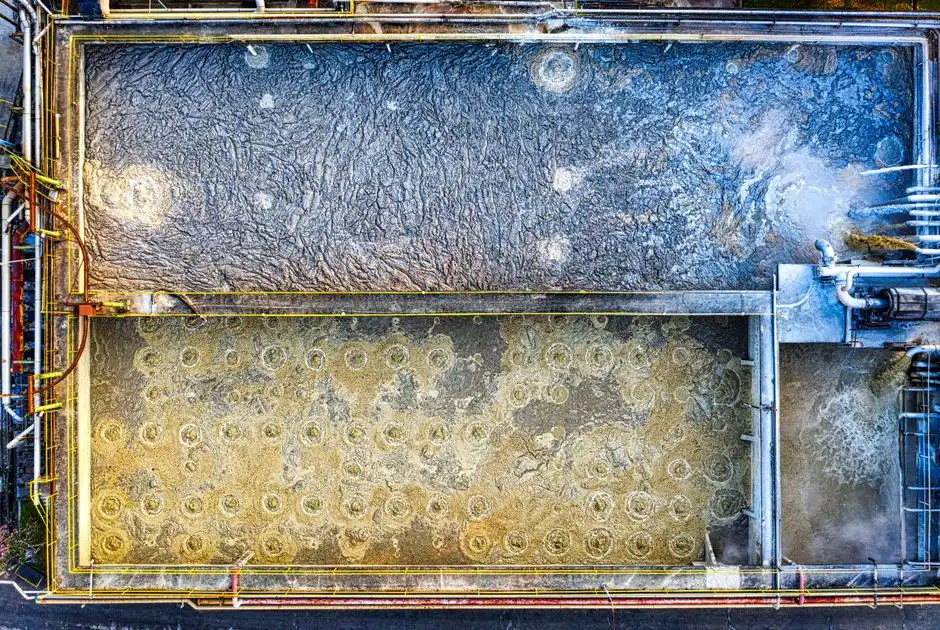
The standard 2026 train for a tea-factory UF line is rotary bar screen → DAF → equalization tank → UF → optional RO or ClO₂ polishing → discharge or reuse (HydropureWater field data, 2026). A 0.5–1.0 mm rotary bar screen headworks removes leaf fragments and stringy fibre before fine screening, then a tea-line DAF pre-filter strips 60–80% of colloidal tea dust, residual oils, and floating leaf fragments. Without DAF upstream, those colloids blind the UF within 4–8 hours of operation, pushing CIP frequency from 1–2× per week to daily and roughly doubling OPEX (HydropureWater field data, 2026).
The equalization tank is the unit most buyers forget to budget. Sized for 12–24 hours of retention, it dampens the 3–5× diurnal and seasonal flow swing before the UF sees a stable flux. A 500 m³/day peak plant needs a 250–500 m³ EQ basin with mechanical mixing and pH correction; a 2,000 m³/day integrated plant typically splits the EQ into two 1,000 m³ cells so one can be drained and cleaned while the other carries the load (HydropureWater field data, 2026). From the UF permeate, two discharge paths are common: direct sewer to meet the GB 8978-1996 secondary limits, or further RO polishing for boiler-feed reuse at ≤10 µS/cm. For sites that prefer chemical disinfection over membrane polish, a ClO₂ polishing step sized at 2–5 mg/L residual handles colour and microbial load without the membrane cost.
Equalization is not optional. Any vendor proposal that omits an EQ tank on a plucking-season line is under-sizing the hydraulic buffer and will push the UF into transients it was not designed for.
Membrane Selection: PVDF vs PES vs Ceramic
PVDF hollow-fiber is the 2026 default for tea effluent: it tolerates 0.5–1.0% NaClO during CIP, runs at a sustained flux of 40–80 L/m²·h under 0.1–0.3 MPa TMP, and survives 30–55 °C feed temperatures without hydrolysis. PES flat-sheet costs 15–25% less per m² but degrades above 500 ppm free chlorine in CIP, which a tea line routinely hits during polyphenol-fouling recovery washes (HydropureWater field data, 2026). Ceramic (Al₂O₃ or ZrO₂) is justified above 60 °C on tea-extract concentration loops, with an 8–12 year service life offsetting a 3–5× CAPEX premium over PVDF. Below 55 °C on standard tea effluent, PVDF delivers 95% of the performance at roughly one-fifth of the membrane cost.
For polyphenol-recovery duty, molecular weight cut-off is the parameter that makes or breaks the revenue line. A 50–100 kDa PVDF membrane rejects >95% of TSS and proteins while transmitting enough 300–500 Da catechin and theaflavin monomers for a downstream resin column to adsorb. Tight 10–20 kDa membranes reject the same TSS but also strip the polyphenols of interest, killing the recovery revenue before the skid is even commissioned (HydropureWater field data, 2026). Always state MWCO on the equipment datasheet and reconcile it against the resin-adsorption column specification before signing a PO.
| Parameter | PVDF hollow-fiber | PES flat-sheet | Ceramic (Al₂O₃ / ZrO₂) |
|---|---|---|---|
| Typical MWCO range | 50–100 kDa (recovery) / 10–20 kDa (tight) | 5–50 kDa | 1–100 kDa (multi-channel) |
| Sustained flux | 40–80 L/m²·h | 30–60 L/m²·h | 60–120 L/m²·h |
| Operating TMP | 0.1–0.3 MPa | 0.15–0.4 MPa | 0.2–0.5 MPa |
| Max feed temperature | 30–55 °C continuous | ≤45 °C | ≥60 °C (extract loops) |
| NaClO tolerance (CIP) | 0.5–1.0% | ≤500 ppm (degrades above) | 2–3% (alkaline peroxide) |
| Relative CAPEX | 1× (baseline) | 0.75–0.85× | 3–5× premium |
| Service life on tea effluent | 5–7 yr | 3–4 yr under tea CIP | 8–12 yr |
| Best fit | Default for 95% of tea effluent duty | Low-CIP, cold water streams (not recommended for tannin-rich effluent) | Hot tea-extract concentration, polyphenol recovery loops above 60 °C |
For a 200–2,000 m³/day line, the practical selection rule is straightforward: PVDF for the standard 30–55 °C effluent, ceramic only if the duty is extract concentration above 60 °C, and PES only if the budget is binding and the CIP regime is dialed back below 200 ppm free chlorine.
CAPEX and OPEX for a 2026 Tea-Line UF
Installed-cost bands for an ultrafiltration system for tea processing wastewater in 2026 run $80–$380 per m³/day of capacity. A 200 m³/day small estate lands at $52,000–$76,000 ($260–$380/m³/day); a 500 m³/day mid-size factory at $80,000–$190,000 ($160–$260/m³/day); a 2,000 m³/day integrated plant at $160,000–$280,000 ($80–$140/m³/day) due to skid-economy of scale (HydropureWater field data, 2026). The UF skid plus membrane modules account for roughly 54% of the total; the balance is tanks, pumps, the PLC panel, and civil works. Generic pricing pages quoting "industrial UF >$15,000" are usually sub-50 m³/day skids; a 200+ m³/day tea line is typically 5–20× that figure once tanks, pumps, and PLC panels are added (per Chunke 2026 UF pricing reference).
OPEX for a 2026 tea-line UF sits in the $0.08–$0.34/m³ treated band, with a working median around $0.19/m³ for a 500 m³/day plant running an 8-month (≈180 day) campaign (HydropureWater field data, 2026). The four line items procurement forgets to budget are energy (0.4–0.8 kWh/m³ × $0.08–$0.12/kWh, with the feed pump at 60% of load and backwash at 25%), CIP chemicals (NaOH plus citric plus NaClO — tea tannins drive higher dosing than dairy), and sludge hauling from the DAF float and UF backwash, which can rival the energy bill on a low-flow, high-solids estate.
| Capacity | Installed CAPEX (USD) | CAPEX per m³/day | OPEX ($/m³) | Median annual OPEX* | Key drivers |
|---|---|---|---|---|---|
| 200 m³/day (small estate) | $52,000–$76,000 | $260–$380 | $0.22–$0.34 | ~$8,000 | Highest $/m³/day; sludge hauling dominates |
| 500 m³/day (mid-size) | $80,000–$190,000 | $160–$260 | $0.14–$0.24 | ~$17,100 | Working median $0.19/m³; balanced energy vs CIP |
| 2,000 m³/day (integrated) | $160,000–$280,000 | $80–$140 | $0.08–$0.14 | ~$43,000 | 40–60% cost compression from skid-economy of scale |
*Annual OPEX assumes the $0.19/m³ median over a 180-day campaign at 500 m³/day and pro-rata scaling for other capacities.
For comparison, the same cost structure on a 2,000 m³/day integrated plant compresses by 40–60% versus the 200 m³/day estate, which is the single biggest argument for centralizing wastewater treatment across multiple plucking lines on a single estate.
Polyphenol Recovery: When the OPEX Math Flips
Polyphenol recovery is the line item that turns a UF system from a cost centre into a revenue-positive skid. UF permeate routed to a downstream resin-adsorption column can capture 30–60% of residual catechins and theaflavins, producing a crude polyphenol extract that wholesales for $1.2–$4/kg in the nutraceutical market (HydropureWater field data, 2026). On a 500 m³/day plant running at the working median OPEX, a 30% capture rate at 200 mg/L feed polyphenol concentration yields approximately 10 kg/day of crude extract, which translates to $4,400–$14,600/yr in additional revenue.
The mechanism matters. The MWCO selection is the single most consequential specification on the equipment datasheet, because 50–100 kDa lets the 300–500 Da catechin and theaflavin monomers pass through to the resin column while 10–20 kDa strips them and kills the revenue line. The resin column is sized for the permeate flow and the breakthrough curve of the specific polyphenol mix; the automated CIP chemical dosing skid that regenerates the resin in place is what makes the cycle economic at tea-campaign scale (HydropureWater field data, 2026). Picking the right MWCO and pairing it with a properly sized resin column compresses payback from 9–10 months to 6–8 months — a difference of three months on a $190,000 capital line that procurement will notice.
Vendor Scorecard: Five Criteria That Separate a Tea Specialist from a Reseller
Generic membrane resellers will quote a tea line the same way they quote a dairy or brewery line, which is why a weighted scorecard is the only way to filter them. The five criteria below are weighted against concrete failure modes seen in the field (HydropureWater field data, 2026).
- Tea-industry reference plants. ≥3 operating sites in China, India, Kenya, or Sri Lanka with ≥12 months runtime. Proves the vendor has solved tannin and polyphenol fouling, not just demonstrated clean-water lab flux.
- PVDF membrane OEM (not rebranded). Direct OEM relationship with torque traceability, or in-house fiber casting. Tea CIP regimes routinely exceed 1,000 ppm NaClO; off-brand fibers fail within 18 months under that exposure.
- Automated CIP with a tea recipe library. ≥5 stored recipes covering tannin burn, CaCO₃ scale, biofoul, seasonal cold-start, and post-extract. Manual CIP on a 6-day campaign loses 3–5% runtime that an automated recipe library recovers.
- PLC/SCADA with remote monitoring. 4G/Ethernet, MQTT or Modbus TCP, alarm push to phone. Tea estates in Assam, Munnar, and Nandi Hills often lack on-site automation staff, so remote visibility is operationally mandatory.
- Field engineer within 48 h in tea regions. Coverage in Yunnan and Fujian (China), Assam (India), Kericho (Kenya), and Kandy (Sri Lanka). Membrane damage during peak season costs $5,000–$8,000/day in lost recovery; response time is a hard commercial line.
Score each criterion 0–3 and reject any vendor scoring below 2 on criteria 1, 2, or 5. Those three are the ones that bite a tea line specifically; criteria 3 and 4 are table-stakes for any modern skid.
Worked ROI: 500 m³/day Tea Plant in 2026
Take a mid-size tea factory at 500 m³/day peak. CAPEX is $190,000 at the upper end of the band (HydropureWater field data, 2026). OPEX at the $0.19/m³ median over a 180-day campaign: 0.19 × 500 × 180 = $17,100/yr. If the alternative is hauling effluent off-site at $3/m³, avoided disposal is 3 × 500 × 180 = $270,000/yr, which gives a 9–10 month payback before any polyphenol revenue. Layer in polyphenol recovery at 30% capture × 200 mg/L × 500 m³/day ≈ 10 kg/day, sold at $1.2–$4/kg wholesale, that is $4,400–$14,600/yr in additional revenue that compresses payback to 6–8 months (HydropureWater field data, 2026).
The downstream sludge train matters too. A automated CIP chemical dosing skid typically pays back in 4–6 months on a tea line by reducing CIP chemical waste 20–30%, and the DAF float plus UF backwash sludge it generates feeds directly into a sludge dewatering unit sized for 8–12% dry solids cake. The membrane skid and the sludge train are one system economically; budgeting them separately is how a CAPEX number drifts 20–30% above the vendor's headline quote.
2026 Outlook and Frequently Asked Questions
The 2026 ITU membrane-process review in Environmental Technology Reviews flags nanotechnology-based high-performance membranes and integrated treatment systems as the research direction most likely to land in commercial UF skids over the next 24–36 months (per ITU review 2026, DOI 10.1080/21622515.2026.2669860). The same review points to renewable-energy-integrated membrane systems as an emerging 2026+ theme, which matters for tea estates in Yunnan, Assam, and Kericho that already co-fire biomass. Fouling, energy demand, and durability remain the three constraints any 2026 deployment has to engineer around, and they are the same three that will define the next generation of tea-line UF. For cross-validation on adjacent beverage streams, see the 2026 engineering guides for UF for coffee processing wastewater and UF for fruit processing wastewater, or the broader food processing water purification compliance reference.
What is the realistic 2026 CAPEX for a 200 m³/day tea-line UF system?
Between $52,000 and $76,000 installed, or $260–$380 per m³/day, with the UF skid and membranes accounting for roughly 54% of the total. Costs compress by 40–60% on a 2,000 m³/day integrated plant due to skid-economy of scale (HydropureWater field data, 2026).
How much polyphenol can a tea-line UF actually recover in 2026?
With a 50–100 kDa PVDF membrane and downstream resin adsorption, 30–60% of the feed polyphenols (80–400 mg/L) end up as a crude extract worth $1.2–$4/kg, generating $4,400–$14,600/yr in additional revenue on a 500 m³/day plant (HydropureWater field data, 2026).
Why pair DAF with UF on tea effluent instead of running UF alone?
A DAF upstream removes 60–80% of colloidal tea dust, oils, and floating leaf fragments. Without it, UF CIP frequency jumps from 1–2× per week to daily, roughly doubling OPEX and shortening membrane life by 30–40% (HydropureWater field data, 2026).
PVDF or ceramic membrane for a hot tea-extract concentration loop?
Use ceramic (Al₂O₃ or ZrO₂) above 60 °C, accepting the 3–5× CAPEX premium and the 8–12 year service life. Below 55 °C on standard tea effluent, PVDF hollow-fiber delivers 95% of the performance at one-fifth the membrane cost.
What is the typical payback period for a tea-line UF in 2026?
A 500 m³/day plant at $190,000 CAPEX pays back in 9–10 months versus $3/m³ off-site hauling, and that drops to 6–8 months once polyphenol recovery revenue is credited (HydropureWater field data, 2026).
Related Equipment
- spare PVDF UF membrane elements — specifications, capacity range, and technical data
Further Reading
Frequently Asked Questions
What is the 2026 CAPEX for an ultrafiltration system on tea processing wastewater?
For a standard tea processing facility with a daily discharge of 50 to 100 cubic meters, the 2026 capital expenditure typically ranges from $120,000 to $280,000 USD. This estimate includes pre-treatment skids, membrane modules, automated backwash systems, and PLC integration, but excludes site-specific civil works or specialized discharge compliance piping.
Why pair DAF with UF instead of running UF alone on tea effluent?
Dissolved Air Flotation (DAF) is essential as a pre-treatment step to remove high concentrations of suspended tea solids, lipids, and colloidal tannins that cause rapid irreversible fouling in ultrafiltration membranes. Running UF alone on raw tea effluent results in flux decline within 2 to 4 hours of operation, whereas the inclusion of DAF reduces the total suspended solids (TSS) load by 85% to 95%, extending membrane service life from months to years.
How much polyphenol can a tea-line UF actually recover in 2026?
Modern ultrafiltration systems utilizing 10–50 kDa molecular weight cut-off (MWCO) membranes can recover between 65% and 82% of total polyphenols from tea processing wastewater. The exact recovery rate depends on the tea variety and the specific processing temperature, with higher recovery efficiencies achieved by optimizing cross-flow velocity to prevent the formation of a dense concentration polarization layer on the membrane surface.
PVDF or ceramic membrane for a hot tea-extract concentration loop?
Ceramic membranes are the industry standard for hot tea-extract concentration loops, particularly when processing temperatures exceed 60°C. While PVDF membranes are cost-effective for cold-water treatment, they suffer from thermal degradation and structural deformation at high temperatures; ceramic membranes offer superior chemical resistance to harsh cleaning-in-place (CIP) cycles and can operate continuously at temperatures up to 90°C without loss of integrity.
What is the typical payback period for a tea-line UF system in 2026?
In 2026, the typical payback period for an ultrafiltration system in a tea facility is 1.8 to 2.8 years. This return on investment is driven by a combination of reduced wastewater discharge surcharges, lower sludge disposal costs, and the internal valorization of recovered polyphenols or clarified process water that can be recycled for non-product-contact cleaning operations.