Why a Freetown Data Center Cannot Use a Generic Sub-Saharan Design Brief
"Wastewater" at a Freetown data center is not one stream but three, each with its own chemistry, peak load, and Sierra Leone discharge rule. Raw intake water runs turbid with seasonal TSS spikes above 1,000 NTU and carries saline-intrusion risk in the dry season. Cooling-tower blowdown sits at TDS 1,200–6,000 mg/L, silica- and hardness-loaded, and biocide-bearing. Sanitary sewage is pathogen-bearing, organic, and low-flow at BOD₅ 200–300 mg/L. Combining any two of them destroys reuse economics, blows pathogen counts past EPA-SL limits, and forces one technology to handle two incompatible waste profiles (HydropureWater field data, 2026).
Freetown's tropical wet-bulb temperatures sit in ASHRAE TC 9.9 Class A1/A2 territory year-round, which means wet cooling is feasible and a ZLD alternative would add 25–40% CAPEX with no operating benefit. Grid instability drives sustained on-site diesel runtime, which raises raw-water demand and means blowdown reuse must tolerate intermittent heat load — design blowdown storage for at least 24 hours of peak evaporation loss. Sierra Leone FDI is sensitive to time-to-start-a-business and macroeconomic stability, so permit certainty and a pre-engineered equipment package matter more than bespoke design for a foreign developer (per the 2025 Sierra Leone FDI econometric study, Drivers of Foreign Investment Inflow in Sierra Leone). The rest of this guide is non-generic on those grounds.
Raw-Water Pretreatment: Screening, Clarification, Carbon, and RO
The raw-water train is the single largest determinant of RO membrane life on a remote Freetown site, and it has to be specified in the order it should appear on a P&ID. The defensible sequence is: GX rotary mechanical bar screen at the intake, lamella clarifier with automatic chemical dosing for coagulant and flocculant, multi-media filter (quartz sand over anthracite), activated carbon polishing, cartridge filtration, then the industrial RO system with antiscalant dosing.
The rotary bar screen runs continuously and removes rags, plastics, and fibrous debris that would otherwise foul the lamella plates. The lamella clarifier handles wet-season turbidity spikes at surface loading 20–40 m/h and cuts coagulant demand by up to 30% versus conventional clarification (per lamella clarifier product specification). The multi-media filter targets an SDI below 3 for the downstream RO and runs automated backwash on differential pressure.
The activated carbon stage is non-optional. It strips trace organic loading, residual chlorine, and — for Freetown catchments with upstream artisanal mining activity or stormwater-driven sediment loading — trace heavy metals that would otherwise shorten RO membrane life. This stage is the difference between a 3-year and a 12-month membrane change-out cycle on a remote site. The industrial RO delivers permeate at recovery up to 95% (per RO system spec), feeding cooling-tower makeup storage. The same train handles trace mercury from upstream artisanal gold mining in the parallel Bo District precedent, and that same logic applies if a Freetown catchment shows upstream disturbance (per the Baomahun data center wastewater and cooling blowdown treatment 2026 guide).
Cooling-Tower Blowdown: The Largest Treatable Stream
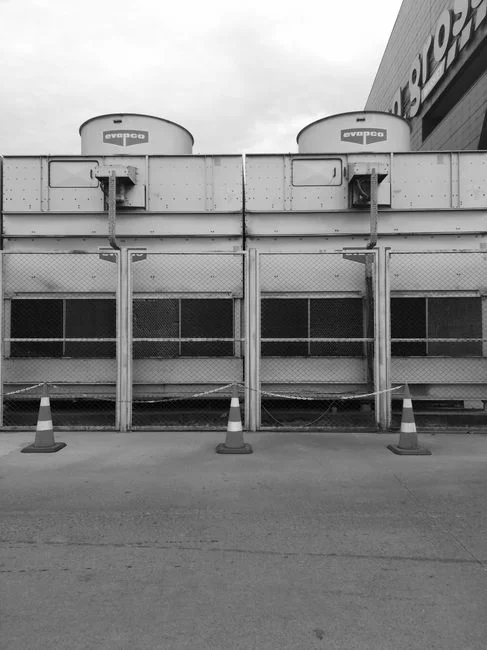
Cooling-tower blowdown is the largest single treatable stream on a tropical Freetown campus, and it is non-optional. A 5 MW IT load in 25–32 °C ambient conditions loses 150–250 m³/day to evaporation; without blowdown, hardness, silica, and TDS climb until scaling and biological fouling shut the tower down. The blowdown train has four jobs: strip hardness, polish particulates, disinfect against Legionella, and reuse what it can.
First, a twin-tank industrial water softener (KJ-WT series, 1–45 T/h) on 5–10% of tower flow strips Ca²⁺ and Mg²⁺, allowing cycles of concentration to climb from 2–3 to 4–6 without exceeding calcium carbonate or silica scale limits. This is the single largest freshwater lever on the campus. Genesis data shows a typical data center operating at 4 cycles of concentration loses 25–30% of makeup water to blowdown, and softening cuts that fraction further (per Genesis Water Technologies, 2025). Second, a lamella clarifier plus automatic chemical dosing drops TSS and silica carryover, after which the polished blowdown splits between cooling-tower makeup (typically cutting raw-water withdrawal by 30–50%) and on-site irrigation. Third, an on-site chlorine dioxide generator doses 0.5–1.0 mg/L residual; ClO₂ is preferred over chlorine because it does not form trihalomethanes and remains effective against Legionella in the 25–32 °C warm-water range that ASHRAE TC 9.9 flags as the Legionella growth optimum.
For higher-recovery reuse, the industrial RO system on blowdown operates at 50–85% recovery with permeate TDS 10–50 mg/L (per Genesis, 2025). Operating pressures sit at 150–400 psi, with antiscalant injection mandatory and RO/UF membrane elements on a 1–3 month chemical-cleaning cycle. Advanced systems using controlled salt precipitation push overall recovery to ~95% but only justify themselves at >10 MW IT load (per IDE, 2025). MVC evaporative concentration at 15–25 kWh per 1,000 US gallons produces distillate below 10 mg/L TDS at 95–98% recovery — consider only for ZLD or where discharge is fully prohibited.
| Job | Equipment | Operating Parameter | Outcome |
|---|---|---|---|
| Strip hardness | Side-stream ion-exchange softener (KJ-WT, 1–45 T/h) | 5–10% of tower flow, NaCl regeneration | Cycles of concentration 4–6 vs. 2–3 unsoftened |
| Polish particulates | Lamella clarifier + automatic chemical dosing | Surface loading 20–40 m/h; coagulant + flocculant | TTS and silica carryover reduced; 30–50% raw-water cut |
| Disinfect against Legionella | On-site ClO₂ generator | 0.5–1.0 mg/L residual; 25–32 °C operating range | No THM formation; Legionella control per ASHRAE TC 9.9 |
| High-recovery reuse | RO on blowdown (brackish configuration) | 50–85% recovery; 150–400 psi; permeate TDS 10–50 mg/L | Cooling-tower makeup reuse; antiscalant-protected |
| ZLD (optional, >10 MW) | MVC brine concentrator | 15–25 kWh/1,000 gal; distillate <10 mg/L TDS | 95–98% recovery; 25–40% CAPEX premium over reuse |
Sanitary Sewage: Buried A/O Package Plant with Press Dewatering
Sanitary load is the smallest of the three streams by volume but the most operationally sensitive, because it runs every day regardless of whether the IT load is online. At 100 L per employee per day and BOD₅ around 250 mg/L, with cafeteria and dormitory peaks layered on top, a 200-person campus generates a hydraulic load that the package plant must be sized for at 1.5× the commissioning-day headcount to absorb shift turnover and contractor surges.
Specify the WSZ underground A/O package plant in the 1–80 m³/h range, fully buried with landscaping above to suit a low-rise tropical campus. The A/O (anoxic/oxic) contact oxidation process is robust against load swings typical of a phased build-out, and the unit is fully automatic with no dedicated operator — a practical requirement in Freetown, where skilled plant operators are concentrated in the city and difficult to retain at peri-urban sites. Discharge is either land-irrigated on the campus perimeter under an EPA-SL irrigation permit, or trucked to the nearest accredited off-site facility if the site footprint is tight.
Sludge is routed to a plate-and-frame filter press for dewatering before off-site disposal. This is non-negotiable: there is no municipal sludge treatment in the Western Area, and un-dewatered septic sludge cannot be hauled on the Freetown road network at acceptable cost. The press brings the sludge cake to 25–35% dry solids, suitable for licensed off-site disposal. For future expansion that adds a laundry, cafeteria upgrade, or staff housing, an MBR integrated wastewater treatment upgrade covers the biological polishing step without redesigning the A/O plant.
Freetown 2026 CAPEX and OPEX Bands
CAPEX and OPEX for a 5 MW hyperscale or colocation campus in 2026 should be framed as a range, not a single number, because Freetown inland freight and customs carry a 25–40% logistics premium over Asian or European supply. As a 2026 engineering band, the full three-stream process train — raw-water pretreatment, cooling-tower blowdown, sanitary sewage — lands in the low single-digit USD millions for CAPEX (process equipment only, excluding site civil works and generator backup).
OPEX is dominated by RO membrane replacement on a 3-year cycle, ClO₂ precursor (sodium chlorite + HCl) on a continuous dosing basis, ion-exchange regeneration salt (NaCl) sized to site water hardness, and activated carbon change-out at 12–18 month intervals. Reuse scenarios lower OPEX through a 30–50% raw-water reduction but raise front-end CAPEX; haul-out scenarios lower front-end CAPEX but raise long-term OPEX through trucking contracts and discharge fees. For a peer African industrial reference frame under similar logistics conditions, see the Johannesburg industrial wastewater 2026 cost breakdown. Note also that September 2026 data center water reuse discharge rules are tightening across multiple jurisdictions, which raises the relative value of the on-site reuse configuration.
Permitting and Reuse-or-Haul Decision Matrix
Any new discharge to land or water requires an EPA-SL permit, and any release from a mineral-bearing catchment is also subject to Sections 90 and 91 of the Mines and Minerals Act 2009. Freetown coastal sites must additionally consider saline-intrusion risk in the dry-season raw intake — design for blend with stored rainwater or treated municipal supply if available. The decision matrix below governs how each stream is handled at the permit stage.
| Site Condition | Blowdown Disposal | Sanitary Disposal | Permit Required | Cost Posture |
|---|---|---|---|---|
| Footprint >5 ha, EPA-SL irrigation permit obtainable, non-mineral catchment | On-site irrigation (30–50% raw-water cut) | On-site irrigation under EPA-SL | EPA-SL discharge + irrigation permit | Higher CAPEX, lower long-term OPEX |
| Footprint <2 ha or catchment drains to protected water body | Truck to accredited off-site facility | Truck to accredited off-site facility | EPA-SL special discharge permit + haul contract | Lower front-end CAPEX, higher long-term OPEX |
| Mineral-bearing catchment (alluvial or upstream artisanal activity) | On-site reuse with activated carbon polishing, no surface discharge | On-site irrigation only after pathogen compliance | EPA-SL + Mines and Minerals Act 2009 §§90–91 | Mid-range CAPEX, governed by §§90–91 reporting |
| Coastal site with dry-season saline intrusion | On-site reuse; no ocean discharge of blowdown | On-site irrigation or haul-out | EPA-SL + coastal zone review | Blend design with stored rainwater adds CAPEX |
Either way, raw-water pretreatment must include the activated carbon stage and cooling-tower blowdown must be polished before any reuse or discharge — these are not optional in Freetown.
Frequently Asked Questions
What cycles of concentration should a Freetown cooling tower target in 2026?
With a side-stream industrial water softener on 5–10% of flow, a Freetown cooling tower can operate at 4–6 cycles of concentration while keeping Ca hardness below ~600 mg/L as CaCO₃ and silica below ~90 mg/L as SiO₂, in line with ASHRAE TC 9.9 guidance. Without softening, cycles of 2–3 are the practical ceiling because silica scale trips first.
Does a Freetown data center need a zero-liquid-discharge (ZLD) system?
No. Because Freetown's tropical wet-bulb temperatures sit in ASHRAE TC 9.9 Class A1/A2 territory year-round, wet cooling is feasible and a ZLD alternative would add 25–40% CAPEX with no operating benefit. A side-stream softener, lamella clarifier, and on-site chlorine dioxide generator cover the reuse case at a fraction of the cost. See the Baomahun 2026 guide for a parallel tropical West African precedent.
Which Sierra Leone permits apply to a data center discharge?
Any new discharge to land or water requires an Environmental Protection Agency–Sierra Leone (EPA-SL) permit. Mineral-bearing catchments are also governed by Sections 90 and 91 of the Mines and Minerals Act 2009, which cover contaminant releases and require additional reporting. The simplest path is on-site irrigation of treated sanitary and blowdown streams under an EPA-SL irrigation permit, with sludge hauled to a licensed off-site facility.
Why must the raw-water train include activated carbon before the RO?
Trace metals from upstream artisanal mining or stormwater-driven sediment loading adsorb onto RO membranes and reduce flux and rejection over time, shortening membrane life by 30–50% if not removed upstream. An activated carbon stage after the multi-media filter strips organics, residual chlorine, and trace metals before they reach the industrial RO system, protecting the most expensive component in the train.
Can the sanitary and blowdown streams be combined?
No. Sanitary sewage is organic, low-flow, and pathogen-bearing at BOD₅ 200–300 mg/L; cooling-tower blowdown is mineralized, warm, and biocide-bearing at TDS 1,200–6,000 mg/L. Combining them complicates reuse, blows pathogen counts past EPA-SL limits, and forces one technology to handle two incompatible waste profiles. Treat them on parallel trains, with the WSZ underground A/O package plant for sanitary and the side-stream softener-to-ClO₂ train for blowdown, and only blend at the irrigation reuse point if both streams independently meet the irrigation quality target.