
Why Charlotte Petroleum Bulk Terminals Face a 2026 Treatment Decision
Charlotte Water enforces local discharge limits on fats, oils, and grease (FOG) and total recoverable hydrocarbons (TRH) that are routinely tighter than the federal NPDES baseline, and NCDENR's 15A NCAC 02H pretreatment rules hold bulk-storage terminals to the same standard as continuous refineries once process wastewater enters the picture. For a petroleum bulk terminal, tank farm, or fuel-blending facility discharging to the Charlotte Water collection system, that means the local FOG ceiling is typically 100 mg/L monthly average / 150 mg/L daily maximum, TRH is capped in the 20–50 mg/L range depending on the discharge permit, and TSS is held under ~250 mg/L — limits that eliminate gravity-only designs from most spec sheets. The 2026 pinch is operational, not theoretical: a Notice of Violation (NOV) from Charlotte Water can trigger surcharges of $500–$5,000 per day, and a lost discharge permit at a tank farm is a same-week shutdown event. Add in 2026 stormwater requirements under NCG080000 (the state's industrial stormwater general permit) for petroleum bulk storage, and the DAF-versus-clarifier question stops being a capital-planning item and becomes a 2026 procurement decision.
How DAF and Clarifiers Actually Separate Oil and Solids
A dissolved air flotation unit works by pressurizing a recycle stream (typically 15–25% of the throughput) with air at 4–6 bar, then releasing it at atmospheric pressure inside a flotation tank. The pressure drop nucleates micro-bubbles in the 10–100 μm range; those bubbles attach to oil droplets and fine suspended solids and lift them to the surface, where a skimmer removes the float layer (per Ecologix, 2026 oil & gas application note, source S5). A clarifier does the opposite — it relies on gravity settling in a sedimentation basin, where particles denser than water drop to a sludge bed and are scraped to a hopper. Both processes use the same coagulant/flocculant chemistry, but the physical goal differs: DAF wants a strong, low-density floc that bubbles can lift, while a clarifier wants a dense, settleable floc (source S4 — WesTech, 2026).
Emulsified oil is the failure mode that defines this comparison. Once oil droplet size drops below roughly 20 μm, droplets stay in suspension indefinitely under gravity — surfactants from tank cleaning, fuel-blending surfactants, and shearing through pumps keep them stable. A conventional clarifier physically cannot capture them, which is why DAF was originally developed for refinery and oilfield service in the first place (source S5). On a feed with 200–500 mg/L emulsified FOG, expect ~95% removal in a properly sized DAF and only 50–70% in a clarifier, even with optimal polymer dosing.
The lamella clarifier variant tilts the comparison by stacking inclined plates inside the basin, multiplying the effective settling area. Surface loading rises from ~1–2 m³/m²·h in a conventional clarifier to 20–40 m³/m²·h in a lamella design (per HydropureWater product data, 2026), which is why a lamella is the standard polishing stage behind a DAF at flow rates above 20 m³/h. The lamella recovers the settleable solids the DAF releases rather than capturing, and it does so in one-fifth to one-tenth the footprint of a conventional clarifier.
DAF vs Clarifier for Petroleum Bulk Wastewater: 2026 Comparison Matrix
For Charlotte bulk terminals in 2026, dissolved air flotation is the better first choice for streams dominated by emulsified oils, FOG, and hydrocarbons — Ecologix's 2026 selection guide shows DAF removes 95% of oil and grease versus ~70% for a gravity clarifier on the same feed (source S2, 2026). Clarifiers win only on heavy suspended-solids streams with low oil content and tight CAPEX budgets, so most bulk terminals end up running a DAF as primary with a lamella clarifier polishing the effluent. If your dominant contaminant is emulsified oil, DAF wins. If it's settleable solids and you have the footprint, a conventional clarifier wins — but a lamella variant is almost always the smarter pick in 2026.
| Parameter | DAF | Conventional Clarifier | Lamella Clarifier |
|---|---|---|---|
| FOG / oil removal | ~95% | ~50–70% | ~60–75% |
| TSS removal | 85–95% | ~90% (high-solids feed) | 85–95% |
| Surface loading | 5–25 m³/m²·h | 1–2 m³/m²·h | 20–40 m³/m²·h |
| Footprint (per 50 m³/h) | ~25–35 m² (skid) | ~150–200 m² (basin) | ~25–40 m² (inclined plates) |
| CAPEX (relative) | 1.0× baseline | 0.4–0.6× baseline | 0.5–0.7× baseline |
| OPEX (relative, $/m³) | 1.0× baseline | 0.6–0.8× baseline | 0.7–0.9× baseline |
| Best-fit influent | FOG >50 mg/L, emulsified oil | TSS >500 mg/L, FOG <50 mg/L | Polishing; variable TSS/FOG |
| Shock-load tolerance | High (hydraulic + chemical) | Low (residence time dependent) | Moderate |
DAF CAPEX is dominated by the saturator, recycle pump, air compressor, and skimmer assembly. Clarifier CAPEX is dominated by civil work — a concrete or steel basin, sludge scraper, and a feed well. OPEX runs the opposite direction: DAF consumes compressed air (typically 0.5–1.5 kWh/m³ treated), polymer, and float-disposal cost; clarifiers mainly burn power on sludge pumping and basin maintenance. Ecologix puts clarifier OPEX at 20–40% below DAF on a $/m³ basis (source S2, 2026) — accurate, but the comparison is misleading if the clarifier fails the discharge limit and triggers surcharges.
Decision Framework: Which One Does Your Charlotte Terminal Actually Need?
Run this four-step decision against your own discharge monitoring reports before you talk to vendors — it takes about 15 minutes and saves a six-figure mis-spec.
- Pull your last 6 months of FOG, TRH, and TSS data. The dominant contaminant dictates the primary unit. If FOG is consistently above 50 mg/L or spikes above 200 mg/L during loading, DAF is your primary. If TSS is consistently above 500 mg/L and FOG is below 50 mg/L, a lamella clarifier is your workhorse.
- Check the loading profile. Bulk terminals see intermittent slugs during truck loading and hydrostatic testing, not the continuous stream a refinery sees. Size the DAF for peak flow (typically 1.5–2× average), not average — DAF handles shock loads far better than a clarifier because hydraulic residence time in a DAF is 20–30 minutes versus 2–4 hours in a clarifier.
- Confirm the footprint envelope. Inside a tank-farm berm or a building footprint, a lamella clarifier plus a small DAF skid is the most common 2026 hybrid at Charlotte bulk terminals. A dissolved air flotation system paired with a lamella clarifier fits in roughly 60–80 m² for a 50 m³/h peak.
- Decide whether the discharge is stormwater-only. If your NPDES permit under NCG080000 covers only stormwater (no process water, no hydrostatic-test water), a lamella clarifier alone is usually sufficient and cheapest. The moment tank-bottom draws or wash water enter the stream, you need the DAF cut.
Charlotte Case Snapshot: Hybrid DAF + Lamella at a Petroleum Bulk Terminal
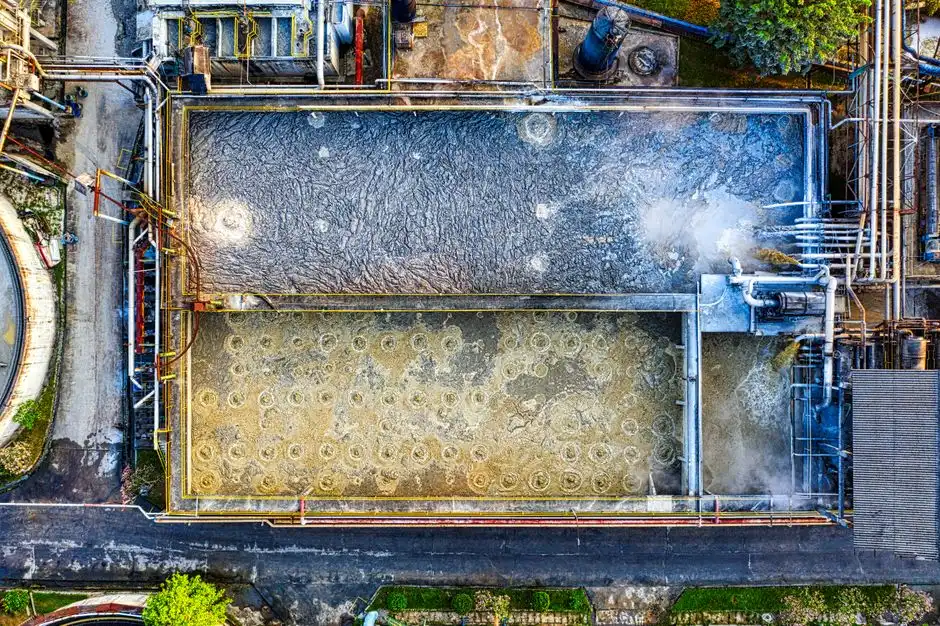
A representative Charlotte tank farm handling 40 m³/h combined stormwater and hydrostatic-test water, with FOG spiking to 300 mg/L during truck loading and TSS baseline around 400 mg/L, is a textbook 2026 hybrid-DAF application. The process train runs: rotary bar screen to capture debris and rags, equalization basin (8–12 hours retention) to dampen the loading slugs, a dissolved air flotation system sized for the 50 m³/h peak, a high-efficiency lamella clarifier polishing the DAF effluent, pH adjustment, and discharge. Pre-treatment starts with a rotary mechanical bar screen to protect the downstream equipment from rags and large solids, and an automatic chemical dosing system meters coagulant and flocculant polymer ahead of the DAF for stable float.
Expected performance on the Ecologix 2026 removal curve: FOG cut from 300 mg/L peak to under 50 mg/L (~85–95% range), TSS cut from 400 mg/L to under 30 mg/L — comfortably under typical Charlotte Water monthly-average limits. During turnarounds or peak-season slug events, a mobile DAF trailer from WesTech can be deployed within a single day (source S4, 2026) to supplement the permanent unit, which avoids over-sizing the fixed DAF for events that occur four to six times a year.
2026 CAPEX and OPEX Ranges for Charlotte Buyers
Order-of-magnitude 2026 CAPEX bands for packaged DAF units vary with flow rate, material of construction (SS304, SS316, or carbon steel with coatings), and automation level. These are not quotes — they are typical industrial price bands for budget anchoring, and final pricing depends on materials, automation, and site conditions.
| System Size | Flow Range | CAPEX (USD, 2026 band) | Dominant OPEX Drivers |
|---|---|---|---|
| Small packaged DAF | 4–25 m³/h | $80,000 – $250,000 | Air compressor kWh, polymer, float disposal |
| Mid-range DAF | 25–100 m³/h | $250,000 – $750,000 | Air compressor kWh, polymer, float disposal, sludge pumping |
| Large DAF | 100–300 m³/h | $750,000 – $2,000,000+ | Air system, polymer, float/sludge handling, automation |
| Lamella clarifier (packaged) | 20–100 m³/h | $120,000 – $400,000 | Sludge pumping, polymer, basin maintenance |
| Conventional clarifier (civil) | 20–100 m³/h | $100,000 – $350,000 | Sludge pumping, basin maintenance |
Clarifier CAPEX is typically 40–60% of a comparable DAF because there is no air-saturation system, no skimmer, and a simpler tank — consistent with Ecologix's 2026 note on DAF's higher upfront cost (source S2). OPEX drivers differ: DAF burns compressed-air energy and polymer to build a float; clarifiers burn power on sludge pumping and basin maintenance. The line item most buyers miss is float and sludge handling — a plate-and-frame filter press downstream cuts disposal volume by 60–80% and pays back inside two years at most Charlotte bulk terminals.
For a deeper read on the same decision in other U.S. port cities, see the DAF or clarifier for petroleum wastewater in Newport guide, the DAF or clarifier guide for Mobile, AL petroleum plants, or the Braintree petroleum bulk wastewater DAF vs clarifier guide.
Frequently Asked Questions
Is DAF or a clarifier better for petroleum bulk terminal wastewater?
DAF is the better primary unit because FOG and emulsified oil dominate the stream — Ecologix's 2026 selection guide shows DAF removes 95% of oil and grease versus ~70% for a gravity clarifier on the same feed (source S2). A lamella clarifier is the standard 2026 polishing stage behind the DAF, not a replacement for it, at any Charlotte bulk terminal where loading-slug events push FOG above 50 mg/L.
Can a DAF and a clarifier be used together?
Yes. A hybrid DAF + lamella clarifier is the standard 2026 configuration for variable bulk-terminal loads (Ecologix 2026 FAQ, source S2). The DAF takes the FOG cut and lifts the bulk of the floatable solids, and the lamella polishes the remaining TSS in one-fifth the footprint of a conventional clarifier.
Does a DAF need chemicals?
It can run without chemicals, but coagulant and flocculant polymer are typically dosed to improve float separation and float solids content (source S4 — WesTech, 2026). For a petroleum bulk terminal, jar testing is the only reliable way to pick the right polymer and dose rate — expect 5–25 mg/L coagulant (typically a cationic polyaluminum chloride or ferric chloride) and 1–5 mg/L flocculant polymer on a FOG-rich feed.
What is the typical footprint of a mobile DAF?
WesTech's small mobile DAF trailer measures approximately 47'-6" by 8'-6" in both shipping and operating configurations; the larger unit measures 51'-7" by 8'-6" in operation, with 3–5 feet of clearance recommended around the unit for safe access (source S4, 2026). Mobile DAFs deploy within a single day and are useful for turnarounds, peak-season slugs, or supplemental capacity.
How much does a DAF cost in 2026?
Order-of-magnitude 2026 CAPEX for a packaged DAF starts around $80,000 for a small 4–25 m³/h unit and rises past $2,000,000 for a custom SS316 refinery-grade unit above 300 m³/h. Final pricing depends on flow rate, material of construction, automation level, and site conditions. A wastewater analysis and pilot test are the only reliable way to get a binding quote — request a jar test on your actual stormwater + hydrostatic-test water mix before issuing an RFQ.