
Why Petroleum Wastewater in Newport Is a Different Problem
Petroleum wastewater in Newport, RI is governed by 40 CFR Part 435 — the U.S. EPA effluent guideline for the oil and gas extraction point source category — which sets monthly-average oil and grease limits of 14–26 mg/L and TSS limits of 30–78 mg/L depending on subcategory. Marine fuel terminals on Coasters Harbor Inlet, re-refineries in the Port of Newport, and lube-oil blenders handling slop oil all discharge under a Rhode Island Pollutant Discharge Elimination System (RIPDES) permit to Narragansett Bay, where a slug load carries both state and federal enforcement risk. The treatment train must be designed against a specific influent envelope: free oil typically >100 mg/L, emulsified oil 50–500 mg/L, TSS 200–2,000 mg/L, sulfides 5–50 mg/L, and phenols 0.5–20 mg/L (HydropureWater field data, 2026). The specific gravity of emulsified oil sits at or below 1.0, which is the physical reason gravity sedimentation underperforms on petroleum streams — light solids and neutrally buoyant oil droplets do not settle, they drift (per HydropureWater, 2025). Newport's coastal location also means any overflow, bypass, or slug discharge carries Narragansett Bay enforcement risk and Narragansett Bay Commission pretreatment scrutiny, so reliability under variable throughput matters more than at a landlocked inland site. The technology choice is driven by the contaminant matrix, not by the vendor's unit price tag.
How a DAF System Treats Petroleum Wastewater
A dissolved air flotation (DAF) system treats petroleum wastewater through a four-stage engineering sequence: coagulation/flocculation, air dissolution, bubble-particle attachment, and flotation/skimming (HydropureWater engineering reference, 2025). Coagulation destabilizes the emulsified oil and colloidal TSS using a cationic or anionic polymer dosed at 0.5–5 mg/L, with the charge selection confirmed by jar testing on the actual refinery or terminal wastewater. Air is then dissolved into a 10–30% recycle stream of clarified effluent at a saturation pressure of 4–6 bar, achieving saturation efficiency of 85–95%. When that pressurized recycle enters the flotation cell at atmospheric pressure, the dissolved air precipitates as micro-bubbles in the 20–100 μm range, which attach to flocculated oil and solids and lift them to the surface for skimming. Operating pH should be held in the 6.5–8.5 window for floc strength; outside that range, floc shears and effluent turns cloudy. Surface loading rates of 5–15 m/h mean a DAF treats the same flow in roughly 20–25% of the footprint of a comparable clarifier — a decisive factor for Newport terminals where marine-side real estate is constrained (HydropureWater, 2025). On a refinery desalter effluent or terminal bilge stream, expect 92–97% TSS removal and up to 95% FOG removal, which is the operating envelope that lets you meet 40 CFR Part 435 monthly-average oil and grease limits without polishing chemistry downstream.
How a Conventional or Lamella Clarifier Treats Petroleum Wastewater

A conventional gravity clarifier treats petroleum wastewater by sedimentation: particles denser than water settle to the bottom over a 2–4 hour retention time and are scraped to a central hopper as underflow. A lamella clarifier uses inclined plates at 55–60° to compress that footprint, achieving surface loading rates of 20–40 m/h on a much smaller plan area (HydropureWater lamella clarifier spec, 2025). Clarifier underflow typically runs 1–2% solids versus 3–5% for a DAF float, which directly drives downstream dewatering cost — a thinner underflow means more gallons hauled and higher polymer demand at the filter press (HydropureWater, 2025). For petroleum streams, the clarifier's failure mode is physical: it captures heavy grit, sand, and settleable TSS efficiently, but it cannot lift free or emulsified oil. Field experience and published case data put the realistic oil-removal ceiling at roughly 70% on a food-plant analog stream, and that number drops further when the oil is emulsified rather than free (per Ecologix commercial reference, 2025). Clarifier CAPEX is lower and the vessel is passive — no saturation tank, no recycle pump, no compressor — which fits a low-throughput marine terminal with heavy inorganic loading from ballast or stormwater, but it does not fit a refinery desalter, slop-oil, or re-refining wastewater with 50–500 mg/L emulsified oil.
DAF vs Clarifier for Newport Petroleum: Head-to-Head Comparison
Procurement choices must be tied to the specific contaminants a petroleum discharge carries and to the 40 CFR Part 435 limits the plant must meet. The table below is sized for a typical Newport terminal or small refinery in the 20–100 m³/h range.
| Parameter | DAF | Conventional / Lamella Clarifier |
|---|---|---|
| Oil & grease removal | Up to 95% (HydropureWater field data, 2025) | ~70% on free oil; near 0% on emulsified oil |
| TSS removal | 92–97% | ~90% on settleable TSS; poor on colloidal |
| Footprint (per m³/h) | 0.07–0.20 m² — 20–25% of clarifier | 0.8–1.5 m² (lamella); 2–4 h retention |
| Energy use | 0.2–0.5 kWh/m³ (HydropureWater, 2025) | 0.05–0.1 kWh/m³ (no aeration) |
| Sludge solids | 3–5% float solids | 1–2% underflow solids |
| Polymer demand | 0.5–5 mg/L | 0–2 mg/L (often none) |
| CAPEX (4–300 m³/h) | $50,000–$500,000 (HydropureWater, 2025) | $30,000–$250,000 |
| 40 CFR Part 435 fit | Meets O&G monthly avg on emulsified streams | Meets only on free-oil-only streams |
| Best fit | Refinery desalter, slop oil, bilge, re-refining | Grit, ballast, stormwater pre-treatment |
DAF is the only single-stage option that reliably meets 40 CFR Part 435 oil and grease limits on streams containing emulsified oil. A clarifier is acceptable only as a post-DAF polish step or as pre-treatment for grit-dominated streams.
The 2026 Newport Recommendation: API Separator → DAF → Clarifier Polish
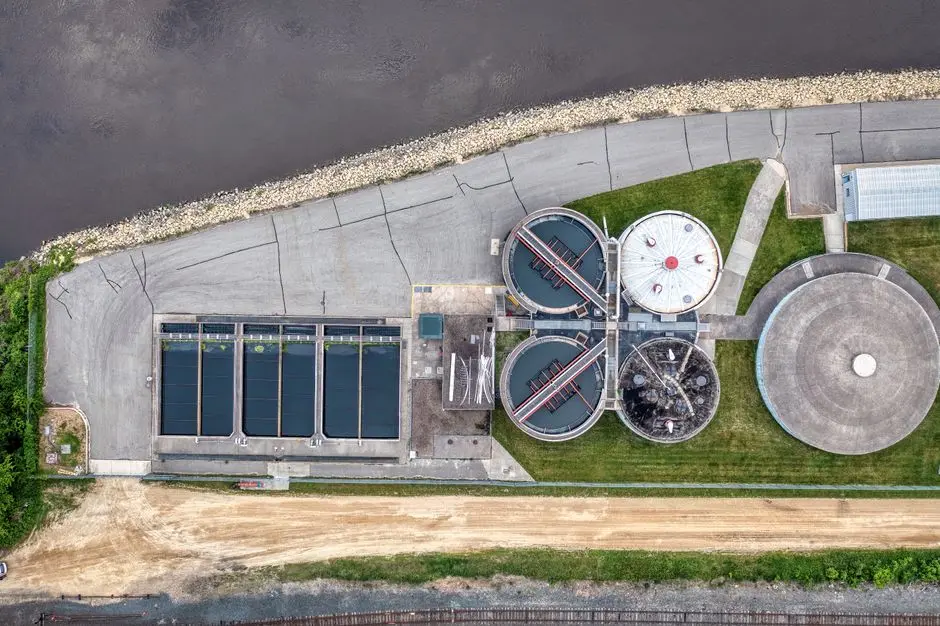
The configuration that most U.S. refineries actually run in 2026 is a three-stage train. The first stage is an API separator (or a corrugated-plate interceptor) that removes bulk free oil and settleable solids, typically knocking total oil down from >500 mg/L to 100–200 mg/L and protecting the downstream DAF from slug loads during a tank-water draw or a desalter upset. The second stage is a dissolved air flotation system sized for 4–300 m³/h, which handles the emulsified oil and fine TSS at 92–97% efficiency and produces a 3–5% float that feeds directly into dewatering. The third stage is a HydropureWater high-efficiency lamella clarifier running at 20–40 m/h surface loading, polishing residual TSS to meet the 30–78 mg/L 40 CFR Part 435 monthly-average TSS limit before RIPDES discharge. Upstream, a GX-series rotary mechanical bar screen protects the air-injection nozzles and recycle pump from rags and large debris. A HydropureWater automatic chemical dosing skid holds pH in the 6.5–8.5 window and feeds polymer at the jar-tested dose. Downstream of the DAF, a HydropureWater plate and frame filter press dewaters the float to 25–35% cake solids and reaches 98% total solids removal (HydropureWater field data, 2025). This is the train that hits 40 CFR Part 435 monthly-average oil and grease limits on a real petroleum stream.
2026 CAPEX, OPEX, and ROI for a Newport Petroleum DAF Installation
The dollar case must hold up against a clarifier quote that is 30–50% lower. The table below is built for a 50 m³/h Newport terminal or re-refinery pre-treatment train.
| Cost line | DAF (50 m³/h) | Lamella Clarifier (50 m³/h) |
|---|---|---|
| Equipment CAPEX | $150,000–$250,000 (SS316 for chloride exposure) | $80,000–$130,000 |
| Installation & civils | 20–30% of CAPEX | 25–35% of CAPEX (larger footprint) |
| Energy | 0.2–0.5 kWh/m³ × 8,760 h ≈ $8,000–$20,000/yr at $0.15/kWh | 0.05–0.1 kWh/m³ ≈ $2,500–$5,000/yr |
| Polymer chemistry | 0.5–5 mg/L × 50 m³/h ≈ $3,000–$8,000/yr | $0–$2,000/yr |
| Sludge disposal (hauled) | 50–70% less volume than clarifier | Baseline |
| Annual disposal savings vs clarifier | ~$40,000/yr (HydropureWater, 2025) | — |
| Compliance fine risk | Low (meets 40 CFR Part 435 O&G) | High on emulsified streams |
The ROI formula, from the HydropureWater 2025 engineering reference, is: (Annual Disposal Savings + Avoided Compliance Fines − Annual OPEX) / CAPEX = ROI (years). For a high-oil petroleum stream in Newport, the payback lands at 1.5–3 years once avoided RIPDES non-compliance penalties and reduced hauling tonnage are counted.
Frequently Asked Questions
Can a clarifier alone meet 40 CFR Part 435 oil and grease limits?
Rarely, and never reliably on an emulsified stream. 40 CFR Part 435 sets monthly-average oil and grease limits of 14–26 mg/L depending on subcategory, and a gravity clarifier physically cannot float oil with specific gravity ≤ 1.0. A DAF, or a DAF plus clarifier polish, is required for any stream with measurable emulsified oil.
What influent oil concentration justifies DAF over a clarifier?
Free oil above ~100 mg/L, or any measurable emulsified oil fraction, is the practical breakpoint. Below that, on a free-oil-only ballast or stormwater stream, a lamella clarifier can do the job at lower CAPEX. Above it, DAF pays back through higher removal efficiency and lower sludge volume.
How much floor space does a 50 m³/h DAF need vs a clarifier in Newport?
A DAF at 50 m³/h occupies roughly 20–25% of the footprint of a comparable clarifier because of the 5–15 m/h surface loading rate (HydropureWater, 2025). For a Newport coastal site with constrained marine-side real estate,