Why Mining Wastewater in Conway Springs Is a Solids-Separation Problem First
For a Conway Springs aggregate, salt-handling, or light-metals plant, the binding constraint on a 2026 wastewater project is not biological treatment — it is primary solids separation. Wash-water slurries from aggregate screens, brine contact streams, and equipment wash bays in light-metals operations routinely run at 1,000–5,000 mg/L TSS with intermittent heavy-metal spikes (Pb, Zn, Cu, As) tied to ore contact and acid rock drainage events. Sulfate from brine operations and variable pH from mineral contact add to the matrix. The unit operation that consistently takes TSS, total metals, and pH into the discharge window is the one that earns the capital.
DAF is an industry-accepted primary separator for this duty. DAF applications explicitly include "Mining, quarrying and aggregate production" and "Tailings water clarification" on the published DAF application list (wastewatermachinery.com). In US mining, the governing standard is 40 CFR Part 440 — effluent limit guidelines for ore mining — which sets TSS, total recoverable metals, and pH as the primary permit drivers. In Kansas, KDHE administers a general NPDES permit covering the Arkansas River basin; Conway Springs discharges fall under that pathway. The choice is therefore: which unit operation reliably meets TSS and metals limits when feed swings.
How a DAF System Actually Works on Mining Water
A DAF system separates solids by attaching fine air bubbles to flocculated particles so the mass floats rather than settles. On mining water the process runs in five steps: coagulant and flocculant dosing in an upstream mix train → floc formation in a flocculator or static mixer → pressurized air-saturated recycle (whitewater) injected at the contact zone → bubble-floc attachment that lifts particles to the surface → surface skimming of the float, with a bottom auger collecting heavy settleables (clearwaterind.com process flow).
Bubble size in modern DAF is 30–50 µm (clearwaterind.com), which is small enough to attach to the low-density, fine particles typical of mining slurries. Headline performance on industrial effluents: TSS reduction up to 97% and COD removal 60–80% (wastewatermachinery.com performance bullets). On a mining matrix with proper coagulant selection, 90–97% TSS is the working band; under-dosed chemistry drops that range sharply.
Non-negotiable design specs on a 2026 mining DAF: saturation pressure ≥ 5 bar, PLC control with effluent monitoring, SS316 wetted parts for chloride and sulfate exposure, and an air-to-solids (A/S) ratio set from on-site jar testing (wastewatermachinery.com selection table). For a Conway Springs aggregate or light-metals plant evaluating vendors, a DAF system with these specs is a defensible baseline.
How a Clarifier (Conventional or Lamella) Behaves on the Same Mining Matrix
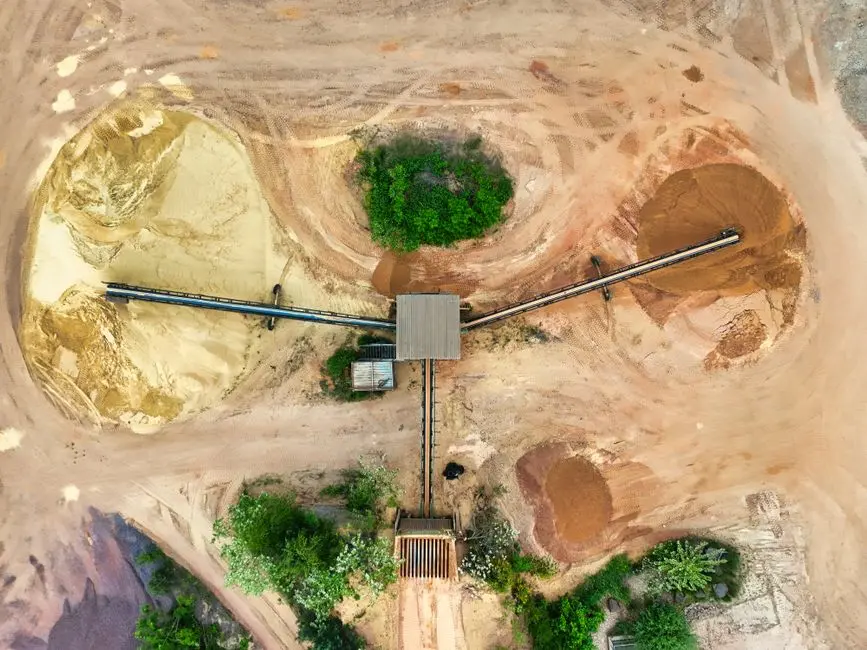
A conventional gravity clarifier is a quiescent tank where settleable solids drop to a hopper under gravity and are scraped or pumped out as underflow. It handles dense, mineral solids well but needs a large footprint and a long residence time. On mining water with fine or low-density particles — the same matrix that gives DAF trouble — the conventional clarifier struggles.
The lamella clarifier is the footprint-compressed upgrade: inclined plates multiply the effective settling area, surface loading runs 20–40 m/h (internal HydropureWater catalogue data), and chemical consumption is roughly 30% lower than a conventional unit at the same flow because of more efficient floc contact. A lamella clarifier typically occupies about one-fifth the footprint of a conventional basin at equivalent flow.
Realistic performance on mining effluents: 60–85% TSS removal, with sharp drops when feed TSS spikes or particle density falls below ~1.05 g/cm³. Clarifiers do not float oil and grease — when FOG matters, as it does in light-metals equipment wash bays, a DAF or CPI separator is added. For a primary clarifier in a Conway Springs flow train, a high-efficiency lamella clarifier is the modern equivalent of a conventional basin and a more realistic baseline for a 2026 selection.
DAF vs Clarifier for Mining: Side-by-Side Comparison
The matrix below is the screenshot a procurement lead will forward. Numbers are drawn from the research sources cited above and from engineering baselines for primary solids separation; cost bands are framed as 2026 order-of-magnitude, not fabricated precision.
| Parameter | DAF | Lamella / Conventional Clarifier |
|---|---|---|
| Separation mechanism | Buoyancy (30–50 µm bubbles attach to floc) | Gravity settling on inclined plates |
| TSS removal on mining water | 90–97% | 60–85% |
| Footprint index at same flow | ~1 (baseline) | Conventional ~5× baseline; lamella ~1× baseline |
| Flow range per unit | 3–120 m³/h (DAF-003 to DAF-120) | Lamella commonly to several hundred m³/h per basin |
| Heavy-metal removal (with coagulant) | Strong — Pb, Zn, Cu, As precipitated and floated in one vessel | Moderate — metals coagulate and settle, but fine metal hydroxides can escape |
| OPEX (energy + chemicals) | Higher energy (recycle pump, saturator); lower polymer dose per m³ | Lower energy; higher polymer consumption at equivalent clarity |
| CAPEX band (2026, OOM) | Higher unit CAPEX; compresses the train (no equalization basin) | Lower unit CAPEX; typically needs an upstream equalization basin |
| Feed-variability tolerance | Recovers in minutes after a feed spike | Sludge blanket can be lost in hours; recovery slow |
| Sludge consistency | Float 3–6% DS — easy downstream dewatering | Underflow 4–8% DS — thicker but more variable |
| Oil & grease removal | Yes — single-vessel | No — requires CPI or DAF add-on |
Stormwater ingress and batch wash water are routine at Conway Springs sites. Recovery time after a feed spike is the line that usually decides it: DAF holds its effluent within minutes of a chemistry correction; a clarifier can take hours to rebuild a sludge blanket and may discharge off-spec in between.
Decision Framework: When Conway Springs Plants Should Pick DAF, Clarifier, or Both
Translate the matrix into a rule the engineer can apply on the same day they read it:
- Rule 1 — TSS > 500 mg/L or heavy metals present: Lead with DAF for primary separation. DAF's floc-and-float path handles variable TSS and the coagulant chemistry that drops Pb, Zn, Cu in a single vessel.
- Rule 2 — Flow > 200 m³/h with dense, settleable solids and tight CAPEX: Lead with a lamella clarifier. Add DAF only as a polishing or thickening step if the effluent still fails metals.
- Rule 3 — Variable feed (stormwater events, batch wash water): DAF primary, lamella as sludge thickener. This is the most common 2026 arrangement for new mining ETPs in south-central Kansas.
- Rule 4 — Oil & grease plus TSS (equipment wash bays at a light-metals plant): DAF is the only single-vessel option that hits both.
Pairing DAF with an automatic chemical dosing skid is the 2026 standard for reliable heavy-metal precipitation; pH adjustment, coagulant, and flocculant are metered from a single PLC. Downstream, a plate and frame filter press handles the 3–6% DS float to a stackable cake for landfill or backfill. For a parallel reading on pretreatment limits at a US metals site, the 2026 NPDES pretreatment guide for mining and metals plants walks through the same compliance framing. For an adjacent industry, this DAF vs clarifier comparison for petroleum wastewater applies the same matrix on a refinery matrix.
Sizing a DAF for a Conway Springs Mining Plant: 2026 Selection Table
The table below maps design flowrate to a starting DAF model class. Pin a unit to your peak wet-weather flow, not your average — that mistake shows up in every failed mining ETP audit. The published catalogue flow band for the DAF line in the research is 3–120 m³/h (DAF-003 to DAF-120) and 4–300 m³/h across the 13 standard DAF models (HydropureWater, internal). Run on-site jar testing before locking the A/S ratio and the polymer dose; that single test is the highest-value hour in a DAF project.
| Design flow (m³/h) | Recommended DAF model class | Notes |
|---|---|---|
| 3–5 | DAF-003 to DAF-005 | Single skid; suitable for small wash-bay or pilot duty |
| 10 | DAF-010 | Common light-metals equipment-wash size; DN100 connections |
| 20–30 | DAF-020 to DAF-030 | Mid-size aggregate or salt-handling wash loop |
| 50 | DAF-050 | DN200 connections; plan a 7 m × 3.6 m footprint |
| 80–100 | DAF-080 to DAF-100 | Heavy aggregate or combined wash + metals train; DN250–DN300 |
| 100–120 | DAF-100 to DAF-120 | Upper-end single-train capacity; larger plants parallel two units |
Footprint and operating weight for each class are in the published DAF technical sheet (wastewatermachinery.com) — for example, a DAF-050 weighs 5,500 kg empty, 55,000 kg operating, and a DAF-100 weighs 9,000 kg empty, 110,000 kg operating. These are the figures the structural engineer needs at 30% design.
Compliance, Costs, and Common Mistakes to Avoid in 2026
Three rules govern a Conway Springs mining ETP in 2026: 40 CFR Part 440 sets the effluent limits for ore mining; the KDHE NPDES general permit sets Kansas-specific monitoring and reporting; and pH 6–9 is the typical discharge window for both. Most permit excursions on new mining ETPs are TSS or total recoverable metals — both are unit-operation problems at the head of the train, not polishing problems at the end.
2026 cost framing: a DAF system costs more in CAPEX than a lamella clarifier of the same flow, but it compresses the train (no upstream equalization basin, no separate oil-removal step, faster start-up). On a 5-year total-cost-of-ownership view, OPEX and footprint savings often flip the decision toward DAF. Treat published catalogue ranges as order-of-magnitude, not as a quote; a useful order-of-magnitude primer is the 2026 DAF system cost and pricing guide.
Three mistakes sink mining ETP projects. (1) Skipping jar testing and A/S ratio optimization — this is the single most common cause of underperforming DAF units. (2) Specifying carbon-steel wetted parts in chloride or sulfate mining chemistry — use SS316. (3) Sizing on average flow instead of peak wet-weather flow — the unit will pass during commissioning and fail the first big storm. For a new Conway Springs mining ETP in 2026, default to DAF primary with a lamella sludge thickener unless the influent is consistently low-TSS and low-metal.
Frequently Asked Questions
What TSS removal can a DAF realistically hit on mining wastewater?
A properly jar-tested, SS316 DAF with the right coagulant will remove 90–97% TSS on a typical mining matrix (wastewatermachinery.com performance band). Under-dosed chemistry or carbon-steel wetted parts in chloride service will knock that range down sharply.
Is a lamella clarifier ever the right primary on a Conway Springs mining plant?
Yes — when design flow exceeds 200 m³/h, solids are dense and settleable, influent is consistently low in heavy metals, and CAPEX is the binding constraint. In that case a lamella clarifier at 20–40 m/h surface loading and roughly one-fifth the footprint of a conventional basin is the defensible primary.
Do DAF and clarifier need to be paired, or can a plant pick one?
For most 2026 new mining ETPs in Kansas, pairing is the standard: DAF as primary, lamella as sludge thickener, plate and frame filter press for cake. The combination absorbs feed variability (DAF's strength) and produces a thick, consistent underflow for dewatering (lamella's strength).