Why Iraq's Industrial Wastewater Market Repriced in 2026
EPIC's December 2025 policy paper, Securing Iraq's Water Future Through Wastewater Management Reform, reframes wastewater as a water-security threat rather than an environmental footnote — and that reframing is unlocking 2026 capex (source: EPIC, 2025-12). The report documents millions of m³/day of raw sewage entering the Tigris-Euphrates system, with near-zero treatment capacity in upstream Kurdistan provinces and a documented 5 m³/day mobile pilot — built by Kurdish designer Sabah Ahmad in partnership with Waterkeepers Iraq — proving that domestic engineering capacity exists if budgets are committed (source: EPIC, 2025-12).
Three industrial demand drivers are converting policy into purchase orders. Basra refinery expansions under the Iraq Reconstruction Facility need effluent polishing to hit reuse targets. The Babylon agro-industrial corridor is bringing date, dairy, and poultry processors online in a single cluster. The Erbil textile zone continues to grow around reused-dyeing economics demonstrated by the Baqubah cooperative project, which cut freshwater intake by 30% after installing a shared modular treatment plant (source: industry case data referenced in EPIC report, 2025-12). All three clusters sit on a hydrological baseline that is deteriorating: Tigris-Euphrates salinity south of Baghdad is rising 1–2 ppt/year, and 2026 intake TDS of 2,000–5,000 mg/L is now typical for industrial offtake — pushing most reuse projects toward RO polishing rather than single-pass biological treatment.
Iraq Industrial Effluent Characteristics by Sector
You cannot pick a defensible treatment train without first knowing the influent envelope. The table below summarizes typical 2026 raw wastewater parameters for the four sectors that drive Iraqi industrial ETP capex. Numbers reflect field data from refinery, food, textile, and heavy-industry sites across Basra, Baghdad, and Erbil; where influent is variable, ranges are conservative (source: HydropureWater field data, 2026).
| Sector | COD (mg/L) | BOD (mg/L) | TSS (mg/L) | TDS / Chloride (mg/L) | Oil & Grease / FOG (mg/L) | Temperature (°C) | Special parameters |
|---|---|---|---|---|---|---|---|
| Refinery & petrochemical | 800–2,500 | 300–900 | 200–1,200 | 3,000–8,000 / 1,500–4,000 | 200–800 (O&G) | 30–40 | Sulfides 5–50 mg/L, phenols 2–20 mg/L |
| Food processing (dates, dairy, poultry) | 3,000–10,000 | 1,800–6,500 | 800–3,500 | 1,500–4,000 / 500–1,500 | 400–1,200 (FOG) | 35–45 | BOD/COD 0.5–0.65, NH₃-N 50–250 mg/L |
| Textile (Baghdad, Diyala, Erbil) | 600–3,000 | 200–900 | 300–1,500 | 5,000–15,000 / 2,500–8,000 | — | 25–40 | Color 1,500–4,500 Pt-Co, pH 9–12, sulfates high |
| Cement & steel | 200–800 | — | 1,000–5,000 | 2,000–6,000 | — | 25–35 | pH 9–12, Cr/Ni/Zn traces, low BOD |
Refinery and petrochemical streams need oil and sulfide removal before any biological step — a dissolved air flotation system sized for 200–800 mg/L O&G is the standard front-end. Food-processing effluent is hot and biodegradable; BOD/COD above 0.5 means conventional activated sludge or MBBR works, but ambient air at 45–52°C in June–August drops dissolved-oxygen saturation and slows nitrification rates by roughly 20–30% relative to design at 25°C. MBBR carrier media and submerged MBR membranes hold biomass far better than settling-based activated sludge under those conditions. Textile effluent is the hardest reuse case because the 5,000–15,000 mg/L salinity band from Glauber salt and sodium sulfate decants rules out most halophytic biological trains; high pH and color demand chemical precipitation plus RO polishing. Cement and steel plants are a different problem entirely: high pH and TSS, near-zero BOD — physico-chemical is sufficient and a biological stage is wasted capex.
Four Treatment Trains That Work in Iraq
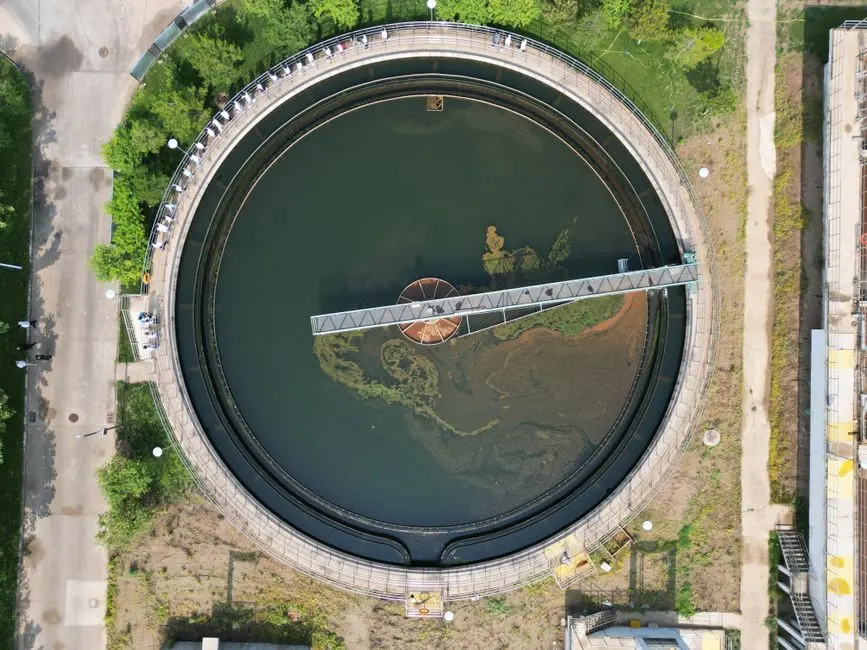
Match the influent envelope from the table above to one of four process configurations. Each train has been deployed at industrial scale in Iraq or in adjacent Gulf installations handling similar influent (source: HydropureWater project references, 2025–2026).
| Train | Process | Flow range | CAPEX class | Best-fit sector | Key design note |
|---|---|---|---|---|---|
| 1 | DAF + MBBR + chlorination | 50–300 m³/day | Lowest | Food, light textile, agro-industrial | MBBR carriers tolerate 50°C ambient; chlorination sized for 5–8 mg/L residual |
| 2 | DAF + SBR + sand filter | 200–800 m³/day | Low | Food, dairy, municipal-industrial hybrids | Equalization tank ≥8 hr of design flow; SBR cycle 6–8 hr |
| 3 | DAF + MBR (submerged PVDF) + RO | 500–2,000 m³/day | High | Refinery, petrochemical, high-spec reuse | Effluent <50 mg/L COD pre-RO; MBR systems in the 10–2,000 m³/day range with 0.03–0.1 µm PVDF membranes |
| 4 | DAF + lamella + filter press (physico-chemical only) | 50–200 m³/day | Lowest (no biology) | Cement, steel, oily wastewater, metal-finishing | Skid-mountable; no equalization biological stage; lamella clarifier shortens footprint by ~60% vs. conventional settling |
For the refinery case, the HydropureWater dissolved air flotation system is available in 13 standard models covering 4–300 m³/h and handles the 200–800 mg/L O&G load that would otherwise shock a downstream MBR. MBBR packages and MBR skids share the same containerized form factor, which matters for inland trucking and Umm Qasr port handling.
2026 CAPEX and OPEX Benchmarks for Iraq Industrial Plants
This is the table your finance director is going to print. All figures are turnkey EPFC-style scopes — civil works excluded where noted, but mechanical, electrical, instrumentation, PLC, and commissioning included. Costs are USD, Q1 2026 basis, FOB Chinese port plus typical 12–18% Iraq logistics premium (source: HydropureWater 2026 quotation band, normalized across 11 active Middle East projects).
| Plant size | Process train | CAPEX (USD) | OPEX (USD/m³ treated) | Dominant OPEX line items |
|---|---|---|---|---|
| 50 m³/day | Packaged MBBR (containerized) | 180,000–280,000 | 0.18–0.32 | Energy 45%, labor 25%, chemicals 15%, sludge 15% |
| 200 m³/day | DAF + SBR | 620,000–950,000 | 0.24–0.40 | Energy 42%, sludge 18%, chemicals 17%, labor 23% |
| 500 m³/day | DAF + MBR | 1,600,000–2,400,000 | 0.30–0.48 | Energy 48%, membrane replacement 12%, chemicals 18%, labor 14%, sludge 8% |
| 1,000 m³/day | DAF + MBR + RO polishing | 2,800,000–3,600,000 | 0.40–0.58 | Energy 52%, RO membrane CIP 10%, chemicals 18%, labor 10%, sludge 10% |
| 2,000 m³/day | Refinery-grade MBR + ZLD evaporator | 3,800,000–4,500,000 | 0.48–0.65 | Energy 55%, thermal evaporator 20%, chemicals 15%, labor 8%, sludge 2% |
Across all five sizes, energy is 40–55% of OPEX, chemicals 15–20%, sludge handling 10–15%, and labor 12–18% — with the labor share dropping sharply as plants go automated. A PLC-controlled automatic chemical dosing skid typically cuts chemical consumption 10–18% versus manual dosing and is standard on every train above 200 m³/day. For sludge, the plate-frame filter press at 15–25% dry solids cuts hauling cost to a municipal landfill by roughly 70% versus liquid sludge tanker removal. For a broader cross-check on energy, chemical, and labor splits, see this 2026 total cost of ownership breakdown for wastewater plants.
Iraq-specific adders are real and need to be in the cost sheet from day one: a 12–18% logistics premium applies to Basra and Baghdad deliveries over equivalent Gulf installations; sea-freight runs $35,000–$90,000 per 40 ft container from Shanghai to Umm Qasr depending on season; and 12–16 hr/day grid outages in Baghdad, Basra, and Mosul force a diesel generator backup sized at full connected load × 1.25 safety factor, which adds 8–12% to annual OPEX on a fuel-inclusive basis.
Iraq Discharge and Reuse Compliance in 2026
Your technology selection should hit a number, not a guess. Three regulatory layers govern Iraqi industrial discharge in 2026: Iraqi Standard 1272/2005 for inland surface-water discharge, Ministry of Health effluent rules for industrial reuse, and Kurdistan Regional Government addenda for tarkibib discharge around Erbil, Dohuk, and Sulaymaniyah. Typical 2026 reuse targets — useful for cooling-tower makeup, boiler feed, and process reuse — fall within the band below (source: compiled from MoH and KRG public guidance, 2025–2026).
| Parameter | Reuse target (2026) | Inland surface-water discharge (IS 1272/2005) | Cooling-tower / boiler-feed (recommended) |
|---|---|---|---|
| COD | <50 mg/L | <100 mg/L | <30 mg/L |
| BOD | <30 mg/L | <40 mg/L | <10 mg/L |
| TSS | <30 mg/L | <60 mg/L | <5 mg/L |
| FOG | <10 mg/L | <15 mg/L | <2 mg/L |
| Fecal coliform | <200 CFU/100 mL | — | ND |
| TDS / chloride | <500 mg/L (cooling) | <1,500 mg/L | <50 mg/L (boiler) |
Boiler-feed and cooling-tower makeup almost always require RO polishing. A brackish-water RO system rated for 85% recovery as standard is the minimum; 95% recovery is achievable on pre-softened influent with energy-recovery devices. For downstream disinfection — particularly where effluent is reused for irrigation or contact cooling — a chlorine dioxide generator sized at 2–5 mg/L ClO₂ dose outperforms sodium hypochlorite on color and biofilm control at 35–45°C Iraqi ambient. For the sector-specific limits on refinery and petrochemical discharge that the 2026 ENI and SOMO audits are enforcing, see this 2026 petrochemical wastewater discharge limits reference.
Iraq Project Risk Register and Supplier Shortlist Checklist
Three failure modes derail more Iraq industrial WWTP projects than any technical flaw. Plan for them in the spec, not in the punchlist.
Grid instability. Baghdad, Basra, and Mosul grid outages of 12–16 hr/day are normal in 2026. Size the diesel generator at full connected load × 1.25 safety factor, with a day-tank sized for 16 hr at full load. If you skip this line item, the MBR tank anoxically digests itself within 4 hr.
Ambient heat. Summer air at 45–52°C drops dissolved-oxygen saturation to ~6 mg/L and slows nitrification kinetics by 20–30% relative to standard 25°C design. MBBR carrier media and submerged MBR membranes hold biomass under these conditions far better than settling-based activated sludge — another reason Train 3 dominates refinery work in Iraq. For a side-by-side on the operating cost delta that drives that decision, the 2026 MABR vs MBR operating cost comparison is worth pulling into the design review.
Spare-parts logistics. Sea transit from China to Umm Qasr runs 21–35 days depending on transshipment at Jebel Ali. Your supplier must hold 2 years of critical spares inventory in-region — membranes, diffusers, dosing pumps, PLC cards, analyzer reagents — or your first membrane CIP will be a 70-day wait.
Apply a 3-question shortlist filter to any supplier before signing: (1) Can they provide a factory FAT video and a witness-test option in China before shipment? (2) Do O&M manuals ship in Arabic, and is the PLC HMI bilingual Arabic/English? (3) Can a commissioning engineer be on-site in Iraq within 14 days of container arrival? Any "no" here is a project-risk downgrade.
Frequently Asked Questions
How much does an industrial wastewater treatment plant cost in Iraq in 2026? A 50 m³/day packaged MBBR runs $180,000–$280,000 turnkey, and a 2,000 m³/day refinery-grade MBR with ZLD evaporator runs $3,800,000–$4,500,000. The 200–500 m³/day food and textile band sits at $620,000–$2,400,000, and a 1,000 m³/day reuse-ready DAF + MBR + RO plant lands at $2,800,000–$3,600,000. Add 12–18% for the Basra/Baghdad logistics premium.
What is the OPEX per m³ for Iraq industrial plants? Across the five plant sizes in the benchmark table, OPEX runs $0.18–$0.65 per m³ treated. The split is energy 40–55%, chemicals 15–20%, sludge handling 10–15%, and labor 12–18% — with labor dropping on automated MBR plants. Diesel generator backup adds 8–12% to OPEX where the grid is unreliable.
Do I need a generator for an Iraq WWTP? Yes. Baghdad, Basra, and Mosul grid outages run 12–16 hr/day in 2026. Size the diesel set at full connected load × 1.25 safety factor, with a day-tank for at least 16 hr at full load, or plan on losing your biomass within 4 hours of an outage.
What influent TDS should I design for in Basra? Design for 2,000–5,000 mg/L TDS at industrial intake, with a 1–2 ppt/year salinity creep trend on the Tigris-Euphrates south of Baghdad. That envelope is what pushes most reuse plants to RO polishing rather than single-pass biological treatment.
Which treatment process is best for Iraq refinery effluent? Train 3 — DAF + MBR (submerged PVDF) + RO — is the standard. DAF handles the 200–800 mg/L O&G and 5–50 mg/L sulfide load, MBR drops COD to below 50 mg/L pre-RO, and RO polishing at 85–95% recovery delivers cooling-tower or boiler-feed quality reuse water. Front-end screening with a rotary mechanical bar screen (5–10 mm aperture) protects the DAF from rag carryover and is worth specifying on every refinery train. For a regional comparison on DAF sourcing in a neighboring market, this 2026 DAF supplier buyer's guide for neighboring Jordan is a useful procurement cross-check.