What IFAS Can and Cannot Prove for Fruit Wastewater
IFAS can be a biological option for fruit processing wastewater because sugar-rich streams may be readily biodegradable: a 2012 study measured a BOD5/COD ratio of 0.66 and obtained above 90% aerobic COD removal in most reactors. However, that study did not test an IFAS basin, so its result is not an IFAS guarantee. For an engineered treatment train, place IFAS after screening, equalization, upstream solids removal and required pH or alkalinity control, with DAF as an optional pretreatment stage. Confirm fruit-specific concentrations, alkalinity, nutrients, solids, mixing, aeration and media retention through characterization and pilot testing.
IFAS—Integrated Fixed-film Activated Sludge—is a hybrid process combining suspended activated sludge with attached-growth media. The July–September 2025 IJSAT overview identifies BOD removal, nitrification and increased treatment capacity as principal applications. That definition supports IFAS for fruit processing wastewater as a candidate process; it does not establish removal efficiency, media loading, hydraulic capacity or aeration demand for this wastewater.
The strongest fruit-specific evidence is the 2012 study of concentrated fruit juice wastewater: its BOD5/COD ratio was 0.66, and aerobic reactors achieved above 90% COD removal in most cases. This supports favorable biodegradability, but the reactors were not IFAS configurations. The study also examined chemical coagulation/flocculation, so its coagulation results cannot be attributed to attached-growth media.
A Hazen and Sawyer municipal IFAS demonstration used a 35% K3 fill fraction, generally 5–15 g TSS/m², and achieved nitrification in less than 50% of the aerobic volume required by a conventional system. These are municipal demonstration findings, not fruit-processing design values. They indicate how media retention and solids inventory may be evaluated, while leaving the actual fruit-specific IFAS question unresolved.
The defensible decision is therefore conditional: IFAS belongs in the treatment train if characterization and pilot testing support it, and supplementary physical or polishing stages are added where discharge or reuse requirements demand them. The IFAS fruit juice wastewater treatment guide provides supporting context, while IFAS design guidance for another high-organic food-processing stream should be treated as adjacent rather than direct evidence.
How Fruit Processing Wastewater Changes the Treatment Train
Fruit processing wastewater must be characterized by stream and campaign, not represented by one average COD value. Washing, fruit processing, pulp carryover, sugar-rich production streams and cleaning operations can change flow, suspended solids and organic composition between campaigns, so equipment selection depends on the governing batch load and the most adverse operating envelope.
High soluble COD can favor biological treatment, yet it does not guarantee stable biological loading. Concentration and batch changes affect oxygen demand, mixing, sludge production and the balance between soluble substrate and settleable solids. A design based only on annual averages can leave the equalization and biological stages undersized during concentrated juice losses or pulp carryover.
The scale of industrial co-digestion is illustrated by a 2026 Springer full-scale Italian example: the plant received 500–3,500 m³/day of fruit juice processing wastewater, representing roughly 50% of the municipal plant’s daily flow. This was co-digestion with primary sludge, not a standalone IFAS demonstration, and the flow contribution is not a universal design ratio. It does establish that fruit juice wastewater can materially affect a biological plant at full scale.
| Information required | Why it changes the design | Engineering use |
|---|---|---|
| COD and BOD5 | Defines biodegradability, organic loading and batch variability | Mass load, oxygen demand and pilot conditions |
| Flow and campaign profile | Shows hydraulic shock and peak biological demand | Equalization, transfer and basin hydraulics |
| TSS, pulp and colloids | Indicates solids loading and separation demand | Screening, solids removal and clarification |
| pH and alkalinity | Identifies acid and buffer risk | Chemical dosing and biological stability controls |
| Nutrients and trace elements | Shows whether biological growth may become imbalanced | Nutrient and trace-element supplementation review |
| Oils and greases, temperature and final-use criteria | Captures inhibitory or project-specific constraints | Pilot conditions, permit basis and polishing selection |
Campaign-based sampling is therefore necessary. Composite samples should be supplemented with targeted samples of washing, pulp carryover, juice-loss events and cleaning discharges. Equipment such as a mechanical bar screen for upstream solids protection and automatic chemical dosing for pH and alkalinity control should be selected only after that source-specific data are available.
Place IFAS After the Loads That Can Break It
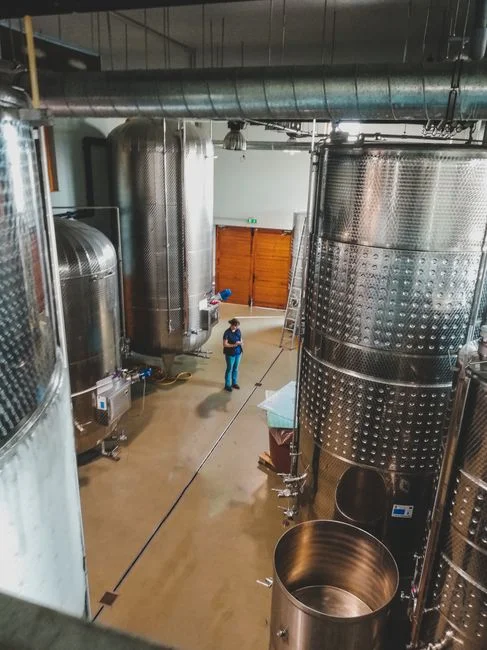
The defensible sequence is screening and equalization, pH or alkalinity adjustment where required, upstream solids separation, IFAS biological treatment, secondary clarification, and polishing or disinfection required by the discharge or reuse specification. This order keeps excessive solids, hydraulic shocks and chemical imbalance out of the biological stage where practical.
DAF is an optional upstream unit, not part of the IFAS basin. DAF pretreatment for fruit processing wastewater may be justified where site data show that pulp, colloids or other floatable solids require separation before biological treatment. Its selection should follow solids characterization and trial data, not the assumption that every fruit-processing stream needs flotation.
The 2012 fruit juice study reported 94.4% turbidity removal and 99.6% COD removal under ferric-chloride conditions. These were study-specific coagulation/flocculation results. They are neither IFAS performance nor a plant guarantee, and they cannot be combined with the aerobic removal result to imply a complete treatment train.
The 2026 Springer co-digestion research identifies high C:N ratio, low buffering capacity, nutrient imbalance and lack of trace elements as conditions that can accelerate acidification and VFA accumulation. Those risks justify testing alkalinity response and VFA behavior, not prescribing a generic chemical dose. The secondary sedimentation tank for solids separation should be assessed as part of the biological train because attached biomass does not remove the need for effective solids capture.
- Protect the system with screening and equalization.
- Establish pH and alkalinity control where characterization shows it is required.
- Remove upstream solids, using DAF only where the wastewater and pilot results justify it.
- Run the IFAS biological stage under representative batch loads.
- Separate biological solids in secondary clarification.
- Apply polishing or disinfection to meet the final-use specification.
Pilot acceptance should therefore be based on hydraulic loading, biomass inventory, sludge rheology and effluent or reuse tests. Generic biological removal claims cannot substitute for evidence that attached-growth biomass, solids separation and downstream polishing work together under the plant’s actual waste stream.
Size the Biological Stage from Plant Data
Fruit-specific kinetic data can structure a pilot, but they do not directly size a commercial IFAS basin. The 2012 aerobic study fitted K(s) of 6–20 g COD/L, v(max) of 2.0–5.1 g COD/g VSS/day, K(i) of 0.10–0.50 g COD/L, maximum removal rates of 0.11–0.26 g COD/g VSS/day and S* of 0.77–3.16 g COD/L. These values came from fruit juice wastewater fitted to aerobic reactors, not an IFAS configuration.
| Evidence | Reported value | Permitted use | Prohibited transfer |
|---|---|---|---|
| 2012 concentrated fruit juice wastewater study | K(s) 6–20 g COD/L; v(max) 2.0–5.1 g COD/g VSS/day; K(i) 0.10–0.50 g COD/L; maximum removal rate 0.11–0.26 g COD/g VSS/day; S* 0.77–3.16 g COD/L | Frame pilot conditions and kinetic testing | Direct commercial IFAS sizing without plant-specific verification |
| Hazen and Sawyer municipal IFAS demonstration | 35% K3 fill fraction; generally 5–15 g TSS/m² | Reference for media-retention and solids-inventory design | Fruit-processing media quantity or loading criterion |
| 2012 aerobic reactors | Above 90% COD removal in most cases | Evidence of favorable biodegradability | IFAS removal guarantee or hydraulic capacity |
Before sizing, verify the plant’s concentration range, temperature, possible inhibition and treatment objective against the 2012 kinetics. Concentration is not the only control: a pilot must reproduce batch variability, pH and alkalinity response, nutrient conditions, mixing, aeration transfer, biomass attachment and detachment, solids separation, VFA behavior, sludge rheology and final effluent quality.
The municipal 35% fill fraction and 5–15 g TSS/m² findings show how media inventory may be documented in an IFAS demonstration, but they do not answer how much fruit-processing media is required. Media selection must be supported by pilot observations of biomass distribution, shear, retention-screen loading and solids separation. Comparable IFAS comparison with poultry wastewater treatment and engineering guidance for another food-processing wastewater can help structure the questions, not replace fruit-specific evidence.
A sound sizing basis is therefore a site mass balance, representative pilot response, identified worst-case batch, verified oxygen transfer and mixing, and a solids inventory that remains manageable through secondary clarification and sludge handling. The above-90% COD result should inform the biodegradability hypothesis, not substitute for design.
Choose IFAS, MBR or a Combined Treatment Train
IFAS is appropriate when the objective is biological COD removal or nitrification in a hybrid suspended- and attached-growth basin, provided the wastewater characterization supports pilot validation. MBR becomes more relevant when the final-use requirement justifies combined activated sludge and submerged PVDF membrane filtration. These are different procurement decisions, not interchangeable equipment labels.
| Decision | IFAS | MBR | Combined or alternative train |
|---|---|---|---|
| Biological objective | COD removal or nitrification with attached and suspended biomass | Activated sludge combined with membrane separation | IFAS or biological pretreatment followed by membrane polishing |
| Solids pretreatment | Requires upstream protection and effective downstream clarification | Still requires appropriate upstream solids management | DAF, clarification or other separation selected from site data |
| Polishing need | Depends on the discharge or reuse specification | Selected when membrane-quality separation is required | UF or another polishing step where solids or colloids remain |
| Retrofit constraint | Evaluate basin geometry, media retention, aeration and mixing | Evaluate membrane module access, piping and controls | Assess available footprint, intercepts and utilities |
| Sludge and operating burden | Assess attached-growth solids inventory and sludge rheology | Assess membrane cleaning, replacement and sludge handling | Compare dewatering demand and downstream disposal routes |
The HydropureWater catalog lists MBR capacities from 10–2,000 m³/day, filtration below 1 μm and a claimed 60% smaller footprint than conventional systems for suitable industrial applications. These are manufacturer claims, not independent evidence for fruit juice wastewater. Likewise, the listed ultrafiltration capacity of 2,000–40,000 L/h, 0.03 μm PVDF membranes and automatic backwash and air scour describe catalog configuration rather than demonstrated fruit-processing results.
Accordingly, MBR polishing for reuse-quality effluent should be evaluated against the required final quality and whole-life obligations, while ultrafiltration for solids and colloid separation remains a candidate polishing technology. The correct selection follows from biological objective, pretreatment, polishing needs, retrofit constraints, sludge handling and acceptance testing—not from a generic technology ranking.
Move from Pilot to Performance Guarantee
A performance guarantee should state a defined influent envelope and final-use criteria, not promise generic above-90% COD removal. That result came from aerobic reactors in the 2012 fruit juice study, which did not test IFAS; it cannot support an IFAS contractual guarantee without a project-specific validation program.
Request the pilot protocol, source-specific data, media selection basis, aeration and mixing calculations, retention-screen design, control narrative, solids inventory, sludge handling plan and startup support. The operating envelope should identify permitted flow, COD, BOD5, TSS, pH, alkalinity, nutrients, temperature, oils and greases and batch-loading conditions.
Define the equipment boundary before comparing bids. It should state whether screening, equalization, DAF, chemical dosing, IFAS media and basins, secondary clarification, polishing, disinfection, controls, sludge dewatering and commissioning are included. A plate and frame filter press for sludge dewatering may form part of that boundary, but media, downstream polishing and sludge treatment should not be separated from performance responsibility.
The 2026 Italian example shows that fruit juice wastewater can materially change the loading on a biological plant, but its flow contribution is not a universal ratio. Before plant performance is accepted, verify controls for batch feeds, pH, alkalinity, nutrients, dissolved oxygen, mixing and media fill condition. A pilot result becomes contractual evidence only when the influent envelope, operating controls and acceptance tests are reproduced or bounded in the agreement.
Frequently Asked Questions
Can IFAS meet the discharge permit for fruit processing wastewater?
IFAS may support biological treatment, but permit compliance depends on characterization, the complete treatment train, pilot results and the site-specific permit requirement. Check the required COD, BOD5, TSS, nutrient and reuse criteria against measured performance before selecting the biological stage.
Is IFAS cheaper than MBR for a fruit juice plant?
The supplied research contains no cost comparison for these technologies. Request a site-specific comparison of capital cost, aeration, media, solids handling, polishing, footprint, energy, membrane or media replacement and sludge disposal; no budget conclusion should be drawn from generic technology rankings.
How much IFAS media should a fruit processing plant use?
The 35% K3 fill fraction and 5–15 g TSS/m² came from a municipal demonstration and cannot be transferred directly to fruit juice wastewater. Establish media quantity through fruit-specific pilot data covering batch loading, biomass attachment and detachment, mixing and solids separation.
What pretreatment is required before IFAS?
Provide screening and equalization, upstream solids removal and pH or alkalinity adjustment where characterization requires it. Evaluate DAF when solids or colloidal separation data justify flotation; it is an upstream pretreatment, not part of the IFAS basin.