What treatment does a Thiruvananthapuram data center actually need?
A data center in Thiruvananthapuram generally needs two treatment decisions: control and reuse of cooling tower blowdown, and treatment of other facility wastewater before reuse or lawful discharge. Blowdown is concentrated, saline water containing treatment chemicals and potentially metals, so it normally requires filtration or UF before RO when reclaimed for cooling make-up. The appropriate train depends on source-water chemistry, blowdown flow, required recovery, cooling cycles of concentration and the receiving authority's limits. UF removes suspended solids and microbes; RO removes 95–99% of dissolved solids but normally achieves 50–85% recovery on blowdown because scaling limits operation.
Start by segregating streams rather than sending every drain to one unit. Cooling tower blowdown, domestic sewage, kitchen wastewater, process wastewater, RO reject, generator oily wastewater, laboratory drains and fire-water flows have different contaminants and destinations. Cooling tower blowdown is a controlled purge used to control dissolved-solids concentration, corrosion, scaling and biological growth; Commercial Water Lab describes it as concentrated water rather than clean water.
IDE-TECH gives a screening reference of up to 2 million litres of daily water demand for a 100-megawatt facility. That is not a Thiruvananthapuram design input: actual flow, IT load, cooling configuration, operating hours and make-up-water quality must be measured or modelled before equipment sizing. The project must resolve four decisions: reuse versus discharge, treatment train, residual-concentrate route, and monitoring and control strategy.
For local framing, the [comparison guide for data center cooling blowdown treatment](/blog/13612-what-wastewater-and-cooling-blowdown-treatment-does-a-data-center-in-4.html) provides another jurisdiction-specific reference, while the [Cape Town high-recovery cooling blowdown engineering guide](/blog/7058-cape-town-data-center-cooling-blowdown-treatment-2026-engineering-guide.html) shows why recovery decisions must be tied to site conditions rather than imported as universal limits.
Map every source and destination before selecting equipment
A defensible facility water balance must account for every stream entering and leaving the cooling and wastewater systems. The same volume can have several destinations, so the balance should distinguish fresh make-up, evaporation, drift, blowdown, cooling-tower drain, condensate, RO permeate, RO concentrate and each separately generated wastewater stream.
Obtain a complete analysis of the make-up source and representative testing of the blowdown. The testing scope should cover TDS, conductivity, hardness, calcium, magnesium, alkalinity, silica, sulfate, chloride, sodium, suspended solids, temperature, residual biocides, corrosion inhibitors, scale inhibitors and site-relevant metals. Direct liquid or immersion cooling must be identified separately because Commercial Water Lab notes that its coolant may contain refrigerants or PFAS compounds and requires specialized handling.
Each stream then needs an assigned destination: cooling make-up, domestic reuse, process reuse, permitted discharge or specialist disposal. Record the actual receiving authority and its contact; do not assume that a municipal sewer connection is available or that environmental discharge and sewer discharge follow the same consent pathway. The current requirements must be confirmed for the proposed Thiruvananthapuram location. Overseas permit limits should not be transferred to India.
| Facility stream | Assessment before equipment selection | Potential destination to verify |
|---|---|---|
| Cooling tower blowdown | Full chemistry, treatment-chemical inventory, cycles of concentration | Cooling make-up or permitted discharge |
| Domestic sewage | Domestic-use quality and local reuse requirements | Domestic reuse or approved collection route |
| Kitchen wastewater | Grease, solids and cleaning chemicals | Specialist pretreatment or approved disposal |
| Process wastewater | Stream-specific contaminants and batch variability | Process reuse, discharge or specialist disposal |
| RO reject | Source train, salinity, scaling chemistry and flow | Further concentration or permitted discharge |
| Generator oily wastewater | Oil, sediment and coalescing requirements | Specialist treatment |
| Laboratory drains | Acid, base, metals and reagent inventory | Neutralization or specialist disposal |
| Fire-water flows | Discharge frequency and retained-water chemistry | Confirmed discharge route |
| Direct liquid or immersion coolant | Refrigerants, PFAS and product-specific controls | Specialist handling or recovery |
Automatic controls such as an automatic chemical-dosing system can later implement the approved conditioning philosophy, but should not precede water-balance work. Physical removal devices also remain stream-specific: the mechanical bar screen is relevant only where a screened solids stream has been identified.
Characterize cooling blowdown and define the reuse target
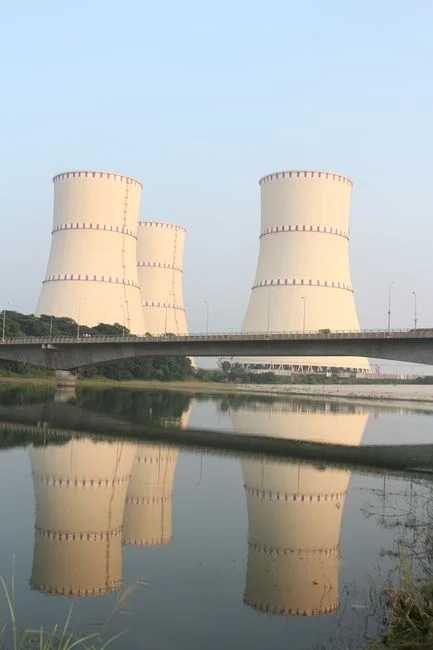
Cooling tower cycles of concentration determine how strongly dissolved constituents accumulate in circulating water and therefore how much treatment the blowdown requires. Genesis Water Technologies reports blowdown TDS of 1,200–6,000 mg/L, suspended solids of 10–50 mg/L, and TDS commonly four to eight times makeup-water TDS. These are vendor-reported research benchmarks, not Thiruvananthapuram permit limits or guaranteed site values.
Genesis states that a tower at four cycles loses approximately 25–30% of makeup water to blowdown. Increasing cycles of concentration reduces that purge but concentrates hardness, alkalinity, silica and treatment chemicals. The design question is therefore not simply “Can the blowdown be reused?” but “At what recovery, quality and blend ratio can it re-enter the cooling system without damaging equipment or changing the cooling chemistry?”
Genesis separately gives 500–1,500 mg/L TDS and 10–25 mg/L suspended solids as cooling-system reference targets. They should be used as research references for comparison, not automatically imposed as Indian consent conditions or local design criteria. A direct cooling make-up reuse target generally requires more complete dissolved-solids control than lower-grade washdown or process reuse, while a discharge-only train must follow the issued consent conditions.
| Design question | Information needed | Decision consequence |
|---|---|---|
| How concentrated is the blowdown? | Representative TDS, conductivity, silica, hardness and alkalinity testing | Sets membrane and scaling-control requirements |
| What cycles of concentration are required? | Cooling-system operating strategy and make-up chemistry | Determines purge volume and reuse value |
| Where will permeate be used? | Cooling, process or washdown specification | Sets the required water-quality objective |
| What happens to concentrate? | Mass balance, receiving route and solids-handling options | Determines whether recovery is technically deliverable |
Reuse does not remove the residual concentrate. Brine volume, dissolved solids, scaling precipitates and disposal route must remain visible in the facility water balance. Equipment for industrial water softening or multimedia pretreatment should be selected only after the blowdown analysis and reuse target establish which chemistry each barrier must control.
Choose a treatment train that matches the end use
UF, NF and RO solve different problems and should be combined only after the limiting contaminants are identified. UF is primarily a solids, colloid and biological barrier; NF selectively removes hardness and sulfate; RO is required when the cooling make-up target demands low dissolved solids or the discharge consent restricts total salinity.
Genesis reports that UF removes suspended solids, bacteria, viruses and high-molecular-weight organics, with typical recovery of 90–95% and operating pressure of 10–30 psi. This makes a UF system for cooling blowdown pretreatment relevant where particles or biofilm could foul downstream equipment. UF does not, by itself, remove dissolved salts.
For low-TDS cooling make-up, Genesis reports 95–99% dissolved-solids removal, 10–50 mg/L permeate TDS and 50–85% blowdown-RO recovery. An industrial RO system for cooling make-up water recovery therefore addresses the dissolved-salinity problem, but the selected industrial RO system for cooling make-up water recovery must be engineered around silica, hardness and concentrate management.
NF is selective rather than a general demineralizer. Genesis reports typical recovery of 70–85%, operating pressure of 75–150 psi, and permeate TDS around 30–50% of feed-water concentration. It is appropriate where hardness and sulfate—not total TDS—control reuse or discharge performance. A site with high silica may require RO despite its higher pressure and lower recovery.
IDE-TECH identifies silica, calcium carbonate and calcium sulfate as key cooling-blowdown scaling compounds and reports conventional brackish-water RO often limited to 75–80% recovery. It also reports an industrial desalter operating at around 95% recovery and reducing silica in the permeate to about 1 mg/L. That is a vendor-reported, feed- and design-specific proof of concept, not a Thiruvananthapuram performance guarantee.
| Option | Primary function | Research benchmarks | Main design limitation |
|---|---|---|---|
| UF | Suspended solids, colloids and biological material | 90–95% typical recovery; 10–30 psi | Does not remove dissolved salts |
| NF | Selective hardness and sulfate removal | 70–85% typical recovery; 75–150 psi; permeate TDS around 30–50% of feed | Not a complete low-TDS barrier |
| RO | Dissolved-solids removal | 95–99% removal; 10–50 mg/L permeate TDS; 50–85% blowdown recovery | Scaling and osmotic-pressure limits |
| RO plus MVC | Additional recovery from RO concentrate | MVC 95–98% recovery from concentrate; 85–95% overall for the reported configuration | Thermal-energy and brine-management requirements |
| ZLD | Near-complete liquid recovery with solid residue | 95–99% overall recovery; solid waste below 1% of original blowdown volume | Highest capital and operating-cost burden |
High-recovery membrane-plus-precipitation, MVC and brine concentration should therefore be escalation options, not automatic additions. They become relevant when conventional RO recovery cannot satisfy the reuse or discharge objective, or when residual-liquid restrictions justify further concentration.
Build a resilient Thiruvananthapuram treatment process

A practical treatment sequence begins with equalization and segregation, followed by screening or solids removal, side-stream filtration and, where required, UF pretreatment. Chemical conditioning and pH adjustment precede NF or RO separation; treated water then passes through storage, controlled make-up blending and residual-brine management.
Genesis states that membrane feed should be filtered below 10–15 microns and chemically conditioned to prevent scaling. The final pretreatment specification must still be confirmed against the selected membrane and the actual blowdown chemistry. Equipment selection should also consider how the RO and UF membrane elements will be changed, cleaned and tested without compromising cooling continuity.
Define the operating controls before procurement. Relevant indicators include conductivity, TDS, differential pressure, permeate flow, recovery ratio, pH, silica and hardness trends. Automatic control should operate against site-specific limits derived from the cooling chemistry and consent conditions, with operator sampling covering chemistry and treatment-chemical residuals. An water-treatment valve and media package can be specified only after that philosophy is approved.
Chemical conditioning should address the accumulation of biocides, corrosion inhibitors, scale inhibitors and dispersants identified by Genesis. Dose rates cannot be set from the general literature; they require source-water analysis, material compatibility and equipment-specific testing. Redundancy, bypass and storage requirements should likewise follow validated flow, availability and cooling-service criteria rather than an assumed equipment count.
For mission-critical cooling, the reliability review should cover temporary loss of permeate, tank capacity, membrane cleaning, chemical delivery failure, power interruption and the safe operating response to invalid reuse-water quality. The RO and UF membrane elements and treatment valving must therefore be treated as parts of one maintainable system, not isolated consumables.
Plan discharge, reuse economics and implementation
The business case can rest on freshwater reduction, avoided discharge cost, compliance assurance or operational resilience, but each has a different evidence requirement. Water savings alone may not justify the added energy and maintenance of a high-recovery train. The residual-concentrate route must be included in the same comparison as the reuse benefit.
Genesis reports that direct-disposal fees in some water-stressed foreign markets exceed $5–15 per thousand gallons. This is a vendor-reported foreign-market observation, not a Thiruvananthapuram tariff, and it must not be entered into an Indian financial model without local confirmation.
| Cost or decision input | Information to request | Why it matters |
|---|---|---|
| Make-up water | Current local supplier tariff and projected contract terms | Establishes the value of avoided freshwater |
| Disposal | Written route-specific tariff or consent condition | Distinguishes sewer from environmental discharge |
| Chemicals | Dosing philosophy, consumption and compatible supply costs | Tests whether recovery conflicts with cooling treatment |
| Energy | Expected load and local tariff | Separates RO, MVC and ZLD economics |
| Lifecycle | Membrane replacement, cleaning, spares and labour | Prevents capital-only comparison |
| Residual brine | Receiving route, hauling, treatment or solids disposal | Prevents an unpriced concentrate liability |
Procurement should proceed through a defined sequence: complete the facility water balance; perform bench or pilot testing; develop the detailed process design; confirm the receiving authority and consent conditions; select equipment; commission; train operators; and verify performance. Acceptance tests should be tied to agreed permeate quality, recovery, availability and residual-stream objectives. No numerical acceptance threshold should be invented without the final consent and supplier guarantees.
The [water-scarcity data center treatment guide](/blog/13624-what-wastewater-and-cooling-blowdown-treatment-does-a-data-center-in-5.html) offers a comparison case for climate-driven decisions, while the [data center treatment workflow](/blog/13605-what-wastewater-and-cooling-blowdown-treatment-does-a-data-center-in-3.html) can support implementation-stage review. Neither replaces site-specific Indian data.
Frequently Asked Questions
Which treatment technology is best for cooling tower blowdown in a Thiruvananthapuram data center?
Select the train from the limiting contaminant and end use, not from a generic technology list. Genesis reports 90–95% typical UF recovery for solids and biological control, 70–85% NF recovery where hardness and sulfate dominate, and 50–85% blowdown-RO recovery where low-TDS permeate is required. The final choice requires local makeup-water and blowdown analyses, the required cooling cycles of concentration and the confirmed residual route.
How should treatment capacity be sized for the facility?
Size from the validated facility water balance, including measured or modelled makeup, evaporation, drift, blowdown, drainage and wastewater flows. IDE-TECH’s 100-megawatt example of up to 2 million litres of daily demand is a screening reference only. Equipment flow, storage, redundancy and availability must follow the actual cooling configuration and facility operating criteria.
What does the wastewater and cooling-blowdown treatment cost?
The supplied research contains no Thiruvananthapuram equipment quotation or local tariff, so a defensible price cannot be stated. Request separate quotations for make-up water, sewer or environmental disposal, chemicals, energy, membrane replacement, cleaning and residual-brine handling. Include the recovery target and residual-stream route in every request so vendors quote comparable operating cases. The foreign $5–15 per thousand-gallon disposal observation is not an Indian price.
How should a supplier be selected to reduce compliance and performance risk?
Evaluate suppliers against project-specific criteria: demonstrated experience with the proposed feed chemistry, guaranteed permeate quality and recovery, total lifecycle cost, residual-brine solution, equipment redundancy, membrane availability and commissioning support. Require evidence from comparable water chemistry and operating conditions, and make final acceptance conditional on the consent conditions and performance testing.
Which Indian authority or compliance route applies to a Thiruvananthapuram data center?
Confirm the route with the actual receiving authority for the proposed site and the applicable local requirements. Direct environmental discharge, discharge to a municipal sewer, internal reuse and specialist disposal require different approvals and may involve different authorities. The project must record the responsible authority, consent conditions, monitoring requirements and permitted receiving point; foreign regulatory frameworks should not be treated as local law.
Related Equipment
- industrial RO system for cooling make-up water recovery — specifications, capacity range, and technical data