
The Valencia Trap: Why the Top Search Result Is for the Wrong Continent
Treating cooling blowdown in Valencia, Venezuela involves raw blowdown total dissolved solids (TDS) concentrations of 1,200–6,000 mg/L driven by a tropical feed baseline, whereas a facility in Valencia, Spain receives municipal or desalinated makeup typically ranging from 400–800 mg/L TDS (Genesis Water Technologies 2026). Engineering managers researching treatment requirements for a European facility risk copying specifications designed for South American conditions. The published technical literature for Venezuelan sites reflects tropical humidity, Lake Valencia surface water intakes, and high airborne dust loads that demand specialized pretreatments (HydropureWater 2026). Applying those assumptions to a Spanish project results in substantial capital overspend on oversized high-pressure membrane skids and thermal evaporators.
Valencia, Spain experiences a Mediterranean climate (Csa) characterized by hot, dry summers (30–35°C) and mild winters. Makeup water supplied by the local utility—Empresa Metropolitana de Aguas de Valencia (EMAV)—blends surface water from the Júcar and Turia rivers, local groundwater, and desalinated water from seawater plants in Sagunto and Valencia. Discharging industrial wastewater in Spain is governed by EU Water Framework Directive 2000/60/EC, Spanish Royal Decree 849/1986, and basin-specific discharge permits issued by the Confederación Hidrográfica del Júcar (CHJ). Relying on Venezuelan environmental ministry parameters will lead to immediate compliance failures under Spanish law. Facilities operating in high-humidity tropical climates require fundamentally different operational strategies, as detailed in our analysis of data center blowdown treatment in a tropical climate.
Valencia, Spain Water Profile: What You Know and What You Must Test
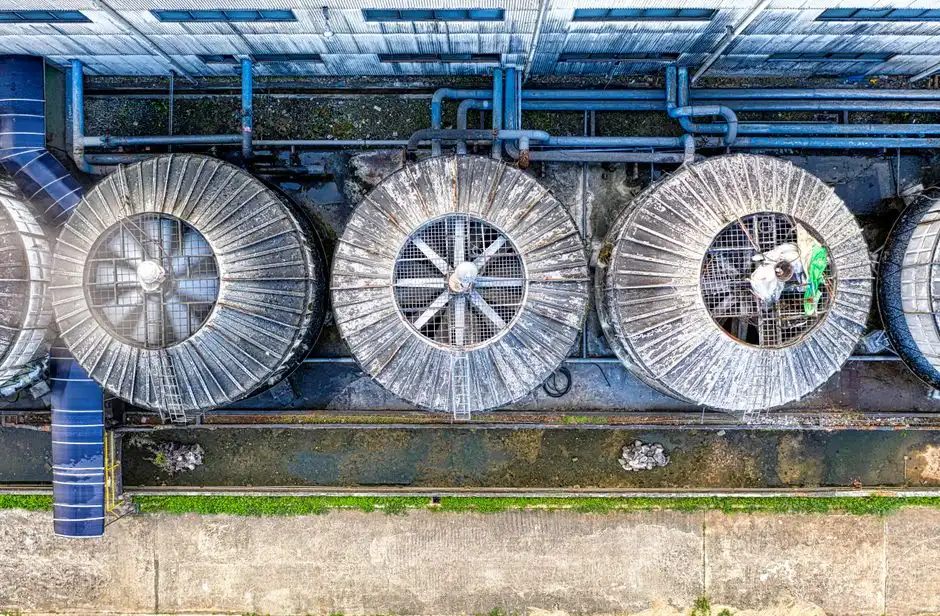
At a baseline operating target of 4 cycles of concentration (COC), approximately 25–30% of cooling tower makeup water is purged as blowdown, generating 2.5 to 3 million gallons of wastewater monthly for a facility consuming 10 million gallons per month (Genesis Water Technologies 2026). In the Mediterranean climate of Valencia, high evaporative demand during summer peak operations accelerates mineral concentration in open recirculating cooling towers. Municipal makeup water provided by EMAV typically contains 400–800 mg/L TDS, 150–300 mg/L CaCO₃ total hardness, and 10–30 mg/L silica. Without treatment, circulating cooling water reaches scaling limits rapidly, forcing frequent blowdown events to protect heat exchangers.
Before issuing requests for proposals (RFQs) or freezing process flow diagrams, engineering teams must conduct comprehensive laboratory analyses of site-specific feed water over a 12-month period to account for seasonal variations. Key analytical parameters required by membrane equipment manufacturers include feed TDS, calcium and magnesium hardness, silica concentrations, total alkalinity, pH, chloride, sulfate, total suspended solids (TSS), total organic carbon (TOC), and biocide residual profiles (Genesis Water Technologies 2026).
| Parameter | EMAV Municipal Feed Baseline | Cooling Tower Blowdown (4 COC) | Analytical & Sizing Impact |
|---|---|---|---|
| Total Dissolved Solids (TDS) | 400–800 mg/L | 1,600–3,200 mg/L | Determines RO pump pressure class and membrane rejection performance. |
| Total Hardness (as CaCO₃) | 150–300 mg/L | 600–1,200 mg/L | Sets antiscalant chemistry type and maximum recovery limit before chemical precipitation. |
| Reactive Silica (SiO₂) | 10–30 mg/L | 40–120 mg/L | Defines solubility limits to prevent irreversible silica fouling on RO elements. |
| Total Suspended Solids (TSS) | <5 mg/L | 10–50 mg/L | Mandates mechanical pretreatment to protect ultrafiltration modules from abrasion. |
Spanish & EU Regulatory Limits That Drive Treatment Selection
Industrial wastewater discharges within the Júcar river basin must comply with Spanish Royal Decree 849/1986 and EU Water Framework Directive 2000/60/EC, which typically restrict total dissolved solids below 1,500–2,000 mg/L, total suspended solids below 100 mg/L, and free chlorine or bromine residuals below 0.5 mg/L (Genesis Water Technologies 2026). Discharge permits issued by the Confederación Hidrográfica del Júcar enforce stringent limits to protect regional aquifers and surface waters from salinization. When blowdown TDS exceeds 1,500 mg/L, untreated discharge into local water bodies or storm drains is illegal.
Facilities discharging into municipal sewer systems managed by EMAV must verify local acceptance thresholds and fee structures. Sewer utilities apply heavy surcharges for high-TDS effluent to cover downstream infrastructure maintenance. To prevent membrane degradation and maintain regulatory compliance, cooling tower chemical programs must utilize low-phosphate, low-toxicity scale inhibitors and non-oxidizing biocides that can pass through membrane arrays without creating toxic discharge residuals (Genesis Water Technologies 2026).
| Regulated Discharge Parameter | Typical CHJ / Spanish Permit Limit | Raw Blowdown Level (4–5 COC) | Required Engineering Control |
|---|---|---|---|
| Total Dissolved Solids (TDS) | <1,500–2,000 mg/L | 1,600–4,000 mg/L | Reverse osmosis desalination or municipal surcharge agreement. |
| Total Suspended Solids (TSS) | <100 mg/L | 10–50 mg/L | Side-stream media filtration and PVDF ultrafiltration. |
| Free Active Chlorine / Bromine | <0.5 mg/L | 0.5–2.0 mg/L | Chemical bisulfite dosing or activated carbon dechlorination. |
| Chemical Oxygen Demand (COD) | <125–250 mg/L | 50–150 mg/L | Biological control and low-organic chemical treatment selection. |
| Zinc (from corrosion inhibitors) | <1.0–2.0 mg/L | 1.0–5.0 mg/L | Transition to zinc-free cooling water treatment chemistries. |
Three End-States: Decision Framework for Valencia, Spain
Reverse osmosis recovery systems processing cooling blowdown generate permeate with total dissolved solids of 10–50 mg/L at an operating cost of $1.50–$3.00 per thousand gallons, offsetting direct municipal freshwater purchases and indirect power grid water consumption (Genesis Water Technologies 2026; Open Engineering 2026). Selecting the correct end-state for a Valencia data hall requires balancing municipal water supply costs against capital expenditure and local environmental discharge constraints.
Evaluating project economics requires comparing local municipal freshwater tariffs against wastewater surcharge structures. In regions with elevated water costs or strict permit enforcement, implementing high-recovery membrane systems provides rapid capital payback while mitigating supply security risks. Similar economic evaluation principles apply to facilities in other water-stressed environments, as documented in our high-altitude, water-scarce data center blowdown guide and our Thai regulatory compliance and ZLD decision framework.
| End-State Architecture | Primary Operating Conditions | System Configuration | Cost & Economic Metrics |
|---|---|---|---|
| End-State A: Direct Discharge | Freshwater <$1/m³, permit allows TDS >2,000 mg/L without fee. | Side-stream mechanical filtration + chemical dechlorination. | CAPEX: $50k–$200k OPEX: Minimal (Genesis Water Technologies 2026) |
| End-State B: RO Recovery & Reuse | Baseline for Valencia. Municipal water $2–3/m³, TDS cap <1,500 mg/L. | Filtration → UF → Industrial RO (50–85% recovery). | CAPEX: $250k–$500k (50k GPD) OPEX: $1.50–$3.00/kgal (Genesis Water Technologies 2026) |
| End-State C: Zero Liquid Discharge | Surface discharge prohibited by CHJ or raw water >$5/m³. | RO + Mechanical Vapor Compression + Crystallizer (95–99% recovery). | CAPEX: $3M–$8M OPEX: $5–$15/kgal (Genesis Water Technologies 2026) |
Process Flow: From Blowdown to Reuse-Quality Makeup
Deploying a multi-stage process flow featuring side-stream filtration, PVDF ultrafiltration, and reverse osmosis allows data center cooling loops to achieve 50–85% overall blowdown recovery while rejecting 95–99% of dissolved salts (Genesis Water Technologies 2026). The treatment train converts variable-quality cooling tower purge water into high-purity makeup water that reduces overall facility water consumption.
- Equalization Tank: Sized for a 2–4 hour hydraulic retention time (HRT) to equalize temperature variations and damp hydraulic or TDS spikes caused by automated cooling tower blowdown cycles.
- Side-Stream Mechanical Filtration: A dedicated side-stream multi-media filtration skid processes 1–5% of total recirculating cooling water flow to capture airborne dust and particulate matter, removing particles down to 10–25 µm (Genesis Water Technologies 2026).
- Chemical Conditioning: A PLC-controlled antiscalant and biocide dosing skid injects specialized membrane-compatible scale inhibitors and non-oxidizing biocides to prevent calcium carbonate and silica precipitation on downstream surfaces.
- Ultrafiltration (UF) Pretreatment: A PVDF ultrafiltration system for RO pretreatment utilizing hollow-fiber membranes (0.01–0.1 µm) operates at 10–30 psi to achieve 90–95% water recovery while removing suspended solids, turbidity, and biological fragments (Genesis Water Technologies 2026).
- Reverse Osmosis (RO) Desalination: An industrial reverse osmosis system for blowdown recovery operating at 150–400 psi removes 95–99% of dissolved inorganic salts, producing high-purity permeate (10–50 mg/L TDS) that returns directly to the cooling tower basin (Genesis Water Technologies 2026).
- Concentrate Management: RO concentrate (15–50% of blowdown volume) is discharged to the municipal sewer under a CHJ permit or directed to a mechanical vapor compression (MVC) evaporator operating at 15–25 kWh/kgal to achieve 95–98% recovery (Genesis Water Technologies 2026).
Equipment Sizing & 2026 Cost Ranges for a Mid-Size Valencia Data Hall
For a mid-size 5 to 15 MW data hall generating 50 to 150 GPM of cooling blowdown, an installed 50,000 GPD reverse osmosis system requires $250,000 to $500,000 in capital expenditure (Genesis Water Technologies 2026). Capital investment scales with treatment capacity and the structural metallurgy selected to resist chloride-induced stress corrosion.
Operating costs for reverse osmosis processing run $1.50 to $3.00 per thousand gallons treated, incorporating electrical consumption, chemical dosing, routine cartridge filter replacements, and periodic membrane replacements (Genesis Water Technologies 2026). Sizing calculations must include a complete RO and UF membrane element package engineered to withstand continuous operating pressures. Life cycle assessment research demonstrates that systems installed in 2026 will experience declining operational global warming potential over their service life through 2050 as the regional power grid decarbonizes, preserving long-term water savings without permanent carbon penalties (Open Engineering 2026).
| Equipment Unit Operation | Target Sizing Scope (5–15 MW Hall) | Installed CAPEX (2026 USD) | OPEX & Utility Requirements |
|---|---|---|---|
| Side-Stream Filtration Skid | 50–750 GPM circulation flow rate | $50,000–$200,000 | Low OPEX; periodic backwash water disposal (Genesis Water Technologies 2026) |
| PVDF Ultrafiltration System | 50–150 GPM feed capacity | Included in RO pretreatment package | 10–30 psi power demand; chemical cleaning every 1–3 months (Genesis Water Technologies 2026) |
| Industrial Reverse Osmosis Skid | 50,000 GPD permeate capacity | $250,000–$500,000 | $1.50–$3.00 / 1,000 gallons treated (Genesis Water Technologies 2026) |
| Mechanical Vapor Compression (MVC) | 10,000–30,000 GPD distillate | $1,000,000–$3,000,000 | 15–25 kWh / 1,000 gallons distillate (Genesis Water Technologies 2026) |
| Complete ZLD System (RO+MVC+Crys) | 50,000 GPD overall capacity | $3,000,000–$8,000,000 | $5.00–$15.00 / 1,000 gallons treated (Genesis Water Technologies 2026) |
Procurement Checklist: Spain-Specific Verification Before Purchase Order
Procurement teams must verify that PVDF ultrafiltration membranes tolerate feed temperatures up to 35°C and variable pH ranges before finalizing equipment purchase orders for Mediterranean installations (Genesis Water Technologies 2026). Failure to account for summer water temperatures degrades membrane structural integrity and shortens element life.
- Pressure Vessel Certification: Confirm that RO pressure vessels carry European Pressure Equipment Directive (PED) certification and are rated for continuous operation at 150–400 psi (Genesis Water Technologies 2026).
- Chemical Compatibility: Require written confirmation from chemical vendors that antiscalants are phosphonate-free and compatible with both downstream RO membranes and CHJ outfall limits.
- Control System Integration: Ensure the treatment skid PLC supports industrial communications protocols (Modbus TCP, OPC UA, or ProfiNet) for integration with the facility Building Management System (BMS).
- Single-Source Warranty: Obtain a unified warranty covering the ultrafiltration pretreatment skid, industrial reverse osmosis unit, and membrane elements to eliminate cross-vendor liability gaps.
- Regulatory Permitting Verification: Secure formal confirmation from the Confederación Hidrográfica del Júcar regarding exact discharge thresholds for TDS, heavy metals, and biocide residuals at the specific outfall point.
- Tariff Structure Validation: Validate current EMAV municipal water tariffs and wastewater discharge surcharge formulas to confirm project payback calculations.
Frequently Asked Questions
What is the typical capital expenditure for a 50,000 GPD cooling blowdown reverse osmosis system in Spain in 2026?
An installed 50,000 GPD reverse osmosis system for cooling blowdown recovery typically ranges between $250,000 and $500,000 USD (Genesis Water Technologies 2026). Procurement leads specifying equipment for Spain should budget an additional 10% to 15% to account for European Pressure Equipment Directive (PED) vessel certification, CE electrical compliance, and local site integration requirements.
What regulatory permits and supplier specifications are required before discharging cooling blowdown concentrate to the municipal sewer in Valencia?
Discharging concentrate requires written authorization from the Confederación Hidrográfica del Júcar (CHJ) and an industrial discharge agreement with municipal utility EMAV. Buyers must request certified chemical analysis of their RO concentrate stream verifying TDS stays below local permit caps (typically 1,500–2,000 mg/L) or request EMAV's fee formula for high-TDS surcharges before sizing treatment skids (Genesis Water Technologies 2026).
Under what conditions is Zero Liquid Discharge (ZLD) mandatory for a data center operating in Valencia, Spain?
Zero Liquid Discharge is required only when a facility operates within a CHJ environmentally protected zone that strictly prohibits industrial liquid outfalls, or when raw municipal water costs exceed approximately $5.00 per cubic meter (Genesis Water Technologies 2026). For most urban and industrial sites in Valencia, an RO recovery system with controlled sewer discharge provides the optimal balance of compliance and capital efficiency.
What specific cooling-tower treatment chemistry is compatible with downstream membrane recovery systems?
Cooling loops designed for downstream membrane recovery must use non-oxidizing, low-toxicity biocides such as DBNPA or isothiazolin blends alongside phosphonate-free antiscalants (Genesis Water Technologies 2026). Operators must avoid zinc-based corrosion inhibitors if local discharge permits cap heavy metal concentrations below 1.0–2.0 mg/L.