
Why Valencia, Venezuela Changes the Data-Center Water Math
A data center sited near Valencia, Venezuela cannot be designed against a temperate-region freshwater baseline. The warm tropical climate drives evaporative cooling duty hard, while feed water drawn from the Lake Valencia basin and intermittent municipal supply is mineral-rich and seasonally stressed, which forces cooling-tower cycles of concentration (COC) down and pushes blowdown volume, total dissolved solids (TDS), and scaling risk up.
Cooling towers account for 20–30% of water demand at power-plant-scale cooling loads (Open Engineering, 2026, citing Stillwell & Webber 2014), making the cooling loop the dominant water sink in a Valencia facility. A "closed-loop" or hybrid wet/dry marketing label does not make a data hall water-free: even with reclaimed feed, water is consumed every day through evaporation and blowdown (S4, La Plata Community Group 2026). Valencia's feed-water quality and climate force a higher-spec blowdown train than a temperate-region baseline, with membrane pretreatment sized for high-TDS, silica-bearing feed rather than clean municipal water.
What Cooling-Tower Blowdown Actually Contains in This Region
Cycles of concentration is the ratio of dissolved solids in the circulating water to dissolved solids in the makeup water; pushing COC up reduces blowdown volume but intensifies scaling and corrosion chemistry (Genesis Water Technologies, 2026). At 4 COC, roughly 25–30% of makeup water is lost to blowdown, which for a facility on 10 million gallons per month is 2.5–3 million gallons discharged and sets the size class of any recovery system (Genesis Water Technologies, 2026). In a Valencia feed-water envelope, blowdown TDS typically lands 4–8× higher than makeup, in the 1,200–6,000 mg/L range, with concentrated calcium, magnesium, silica, and alkalinity creating scaling risk on heat exchangers and downstream membranes (Genesis Water Technologies, 2026). Suspended solids from corrosion products, biofilm fragments, and airborne dust typically measure 10–50 mg/L, so any reuse train needs solids removal ahead of membranes, and biological content plus treatment-chemistry residuals (biocides, scale inhibitors, dispersants) carry over. Reuse trains prefer low-phosphate, low-toxicity cooling chemistry compatible with downstream reverse osmosis (Genesis Water Technologies, 2026). Valencia-specific confirmation should be requested from the local utility or from a Lake Valencia basin sampling program, since generic TDS values do not capture the basin's seasonal conductivity swings.
| Parameter | Typical range in blowdown (Valencia envelope) | Design implication |
|---|---|---|
| Total dissolved solids (TDS) | 1,200–6,000 mg/L (4–8× makeup) | Drives RO concentrate osmotic pressure and antiscalant dose |
| Hardness ions (Ca, Mg) and silica | Concentrated proportional to COC | Sets scaling control and RO recovery limit |
| Suspended solids | 10–50 mg/L | Requires <10–15 µm filtration upstream of UF/RO |
| Treatment-chemistry residuals | Biocides, scale inhibitors, dispersants | Low-phosphate, low-toxicity chemistry preferred for reuse |
| Biological content | Planktonic bacteria, biofilm fragments, algae | UF acts as RO pretreatment barrier |
The Valencia-Ready Treatment Train: Filtration, UF, RO, and When to Add MVC or ZLD
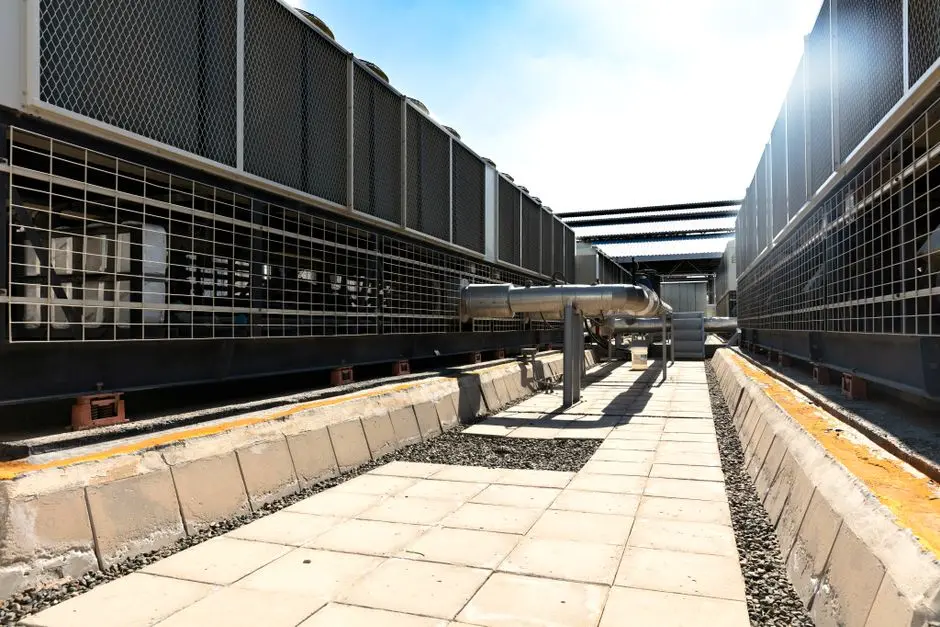
The defensible Valencia process flow is raw blowdown → equalization → side-stream or self-cleaning mechanical filtration (1–5% of circulation flow, ~10–25 µm) → antiscalant dosing → ultrafiltration (0.01–0.1 µm, 10–30 psi, 90–95% recovery) → reverse osmosis (150–400 psi, 95–99% salt rejection) → permeate to cooling-tower makeup, with concentrate routed to discharge or to mechanical vapor compression (MVC) or ZLD (Genesis Water Technologies, 2026). These systems require specific hardware to handle the region's unique water profile. A multi-media filter for blowdown side-stream filtration sits ahead of membranes, followed by a PVDF ultrafiltration system as RO pretreatment, an industrial reverse osmosis system for blowdown recovery, and a PLC-controlled antiscalant and biocide dosing skid to keep scaling under control on silica-bearing Valencia feed. Ultrafiltration is the workhorse pretreatment for RO: it removes suspended solids, bacteria, and high-molecular-weight organics while letting dissolved salts pass, with chemical cleaning every 1–3 months and backwash with permeate (Genesis Water Technologies, 2026). Reverse osmosis is the recovery engine: 50–85% recovery on blowdown, permeate TDS 10–50 mg/L suitable for direct return to the cooling tower, with antiscalant injection and clean-in-place (CIP) cycles sized for high-TDS, silica-bearing feed (Genesis Water Technologies, 2026). Where discharge permits cap TDS below 1,500 mg/L or where the project must demonstrate water positivity, RO concentrate goes to a mechanical vapor compression unit (95–98% recovery, distillate TDS below 10 mg/L, 15–25 kWh per 1,000 US gallons) (Genesis Water Technologies, 2026). Full ZLD — RO plus MVC plus crystallizer — reaches 95–99% overall recovery with solid salt cake below 1% of original blowdown volume, at $3–8M capital and $5–15 per thousand gallons operating cost; reserve ZLD for sites where discharge is prohibited or freshwater cost is extreme (Genesis Water Technologies, 2026). Open Engineering's 2026 LCA adds a longer view: a reuse train's GWP is roughly double the freshwater case today, with treatment energy as ~80% of the difference, but a cooling system commissioned today and operated through 2050 will spend the majority of its service life under a decarbonized grid where the GWP penalty of reuse is largely eliminated while the freshwater savings remain (Open Engineering, 2026).
| Stage | Function | Operating range | Valencia-specific note |
|---|---|---|---|
| Side-stream / self-cleaning mechanical filter | Solids removal ahead of membranes | 10–25 µm; 1–5% of circulation flow | Critical in warm, dusty tropical intake air |
| Antiscalant and biocide dosing | Scale and biological control | PLC-controlled, low-phosphate chemistry | Chemistry must be RO-compatible |
| Ultrafiltration (UF) | RO pretreatment barrier | 0.01–0.1 µm; 10–30 psi; 90–95% recovery | PVDF membrane tolerates warm, low-pH feed |
| Reverse osmosis (RO) | Dissolved solids removal and recovery | 150–400 psi; 95–99% rejection; 50–85% recovery | Permeate 10–50 mg/L TDS to cooling tower |
| Mechanical vapor compression (MVC) | Concentrate volume reduction | 95–98% recovery; <10 mg/L distillate; 15–25 kWh/kgal | Use where TDS limit <1,500 mg/L applies |
| ZLD crystallizer (optional) | Solid salt cake disposal | 95–99% overall recovery; <1% liquid waste | Only when discharge is fully prohibited |
Reuse, Discharge, or ZLD: A Valencia-Specific Decision Framework
The three end-states — cooling-tower makeup reuse (60–85% recovery), compliant discharge to municipal sewer, and ZLD — should be evaluated against the 2026 cost reality of $5–15 per thousand gallons in direct discharge fees in water-stressed regions (Genesis Water Technologies, 2026). The decision rule of thumb from that body of work: if freshwater is cheap and discharge is unconstrained, do minimum pretreatment; if discharge TDS limits below 1,500 mg/L apply, add RO; if discharge is prohibited or scarcity is acute, specify ZLD (Genesis Water Technologies, 2026). For a Valencia site adjacent to a stressed municipal supply and the Lake Valencia basin, the breakeven usually sits at RO-with-controlled-discharge because reuse offsets freshwater pumping, treatment, and the indirect water penalty of ~0.93 L/m³, which Open Engineering (2026) calculates as less than 0.1% of the direct displacement benefit. Pair the decision with a long-term carbon view: a system commissioned today and operated through 2050 will spend most of its life under lower-carbon grid conditions, so the GWP penalty of reuse largely disappears while water savings remain (Open Engineering, 2026). Make the framework auditable: capture feed TDS, target cycles of concentration, local TDS discharge limit, and freshwater cost per thousand gallons as design inputs before selecting the train, since each of those four numbers can flip the result between reuse, controlled discharge, and ZLD.
| Condition | Recommended end-state | Reasoning |
|---|---|---|
| Cheap freshwater, unconstrained discharge | Minimum pretreatment, discharge | Lowest CAPEX; reuse offers little payback |
| TDS discharge limit <1,500 mg/L | RO + controlled discharge | RO permeate 10–50 mg/L easily meets cap |
| Stressed municipal supply, intermittent availability | RO with cooling-tower reuse (60–85% recovery) | Offsets freshwater pumping and treatment cost |
| Discharge prohibited or freshwater cost extreme | Full ZLD | 95–99% recovery; solid cake <1% of blowdown volume |
Equipment Selection and Operating-Cost Benchmarks for a 50,000 GPD-Class Site
For a mid-size data hall, side-stream mechanical filtration typically runs $50,000–$200,000 installed, with low operating cost beyond solids disposal and routine maintenance (Genesis Water Technologies, 2026). Reverse osmosis at 50,000 GPD on blowdown typically runs $250,000–$500,000 installed, with operating cost of $1.50–$3.00 per thousand gallons treated including energy, chemicals, membrane replacement, and maintenance (Genesis Water Technologies, 2026). An MVC evaporator sized at 10,000–30,000 GPD typically runs $1–3M capital with 15–25 kWh per 1,000 US gallons of distillate, and a full ZLD system at this scale typically runs $3–8M capital and $5–15 per thousand gallons operating cost, reaching 95–99% overall recovery with solid salt cake below 1% of original blowdown volume (Genesis Water Technologies, 2026). On the procurement checklist: confirm the UF membrane material is PVDF for warm, low-pH tropical feed, confirm the pressure-vessel pressure class for 150–400 psi RO operation, confirm the antiscalant is compatible with the local cooling chemistry and the discharge permit, and confirm PLC/SCADA integration with the building management system using an RO and UF membrane and element package specified as a single source, alongside the industrial reverse osmosis system for blowdown recovery and the PVDF ultrafiltration system as RO pretreatment. Local TDS limits, freshwater tariff, and any basin-specific discharge rules should be confirmed with the competent Venezuelan authority before the train is frozen, since these inputs change the result of the decision framework above.
Frequently Asked Questions
What CAPEX should a 50,000 GPD blowdown reverse osmosis system carry in 2026?
For a 50,000 GPD RO unit treating cooling-tower blowdown, installed capital typically falls in the $250,000–$500,000 range, with operating cost around $1.50–$3.00 per thousand gallons treated including energy, chemicals, membrane replacement, and maintenance (Genesis Water Technologies, 2026). Buyers should request a
Frequently Asked Questions
What wastewater and cooling blowdown treatment does a data center in Valencia, Venezuela need?
Data centers in Valencia must manage high-mineral-content cooling tower blowdown, typically requiring a treatment train consisting of chemical softening or anti-scalant dosing, followed by membrane filtration to manage Total Dissolved Solids (TDS). Given the local water hardness and potential for silica scaling, treatment must ensure compliance with environmental regulations regarding heavy metal concentrations and pH balance before discharge into the municipal sewer or local water bodies.
How much does a 50,000 GPD reverse osmosis system for cooling-tower blowdown cost in 2026?
In 2026, a high-recovery 50,000 GPD industrial reverse osmosis system designed for cooling tower blowdown typically ranges from $180,000 to $260,000 USD. This price includes pre-filtration, high-pressure pumps, membrane skids, and automated controls, though final costs fluctuate based on the required metallurgy for corrosion resistance and the specific salinity profile of the Valencia municipal water supply.
When is zero liquid discharge justified over RO-plus-discharge for a data center in a water-stressed region?
Zero Liquid Discharge (ZLD) is justified when local water scarcity mandates a recovery rate exceeding 95% or when discharge permits are unavailable due to strict environmental protection zones. If the cost of raw water extraction or municipal water supply exceeds $5.00 per cubic meter, the operational savings from recycling treated effluent via evaporation and crystallization often provide a return on investment within 5 to 7 years in water-stressed industrial hubs.
How do you size a side-stream filtration unit for a tropical-climate cooling tower?
Side-stream filtration systems for tropical data centers should be sized to process 5% to 10% of the total recirculating cooling water flow rate per hour. In the high-humidity environment of Valencia, where biological growth and airborne particulate loading are elevated, multi-media or disc filtration systems must be designed for a flux rate of 10-15 gpm/ft² to ensure effective removal of suspended solids before they reach the heat exchangers.
Which discharge parameters (TDS, TSS, biocide residual) should be confirmed with the local authority before specifying a blowdown treatment train in Venezuela?
Before finalizing specifications, operators must confirm limits for Total Dissolved Solids (TDS), which generally should remain below 2,000 mg/L for municipal discharge; Total Suspended Solids (TSS), typically capped at 100 mg/L; and biocide residuals, specifically free chlorine or bromine, which must be dechlorinated to levels below 0.5 mg/L. Additionally, chemical oxygen demand (COD) and specific heavy metal limits (such as zinc from corrosion inhibitors) must be verified against current Venezuelan environmental ministry standards for industrial effluent.