DAF or Clarifier for Farmville Pharmaceutical Wastewater: The 2026 Decision
For pharmaceutical preparations wastewater in Farmville, choose DAF when rapid removal of emulsified oils, fine solids, biomass, or CIP/GMP surfactants must precede biological or membrane treatment; choose a gravity sedimentation clarifier when the stream contains predominantly heavy, readily settleable solids and presents low solvent-vapor risk. Pharmaceutical effluent can switch between solvent-rich, biomass-laden, and surfactant-loaded conditions within one shift, so generic performance curves cannot establish the choice. SIGMADAF reports approximately 90% suspended-solids removal, at least 95% oils-and-greases removal, and 20–50% COD reduction, but actual pharmaceutical performance requires jar testing. Solvent-bearing service calls for nitrogen-induced gas flotation and VOC capture; neither DAF nor gravity clarification replaces downstream treatment for dissolved APIs, salts, residual solvents, and antibiotic activity.
| Decision condition | Preferred equipment | Reason |
|---|---|---|
| Emulsified oil, fine solids, biomass carryover, or CIP/GMP surfactant | DAF | Provides a compact solids-removal step before MBR or RO/EDI. |
| Heavy, readily settleable solids with stable flow and low surfactant or solvent loading | Gravity sedimentation clarifier | Provides simpler hydraulics and fewer powered subsystems. |
| Measured solvent vapors create an ignition concern | Nitrogen-induced gas flotation | Uses nitrogen rather than air in the saturator. |
| Dissolved APIs, salts, residual solvents, or antibiotic activity remain | Neither device is sufficient alone | Continue with MBR, RO/EDI, or advanced oxidation as appropriate. |
The final selection requires sampling across API synthesis, fermentation, formulation, and washdown operations before equipment sizing. An industrial DAF system should therefore be evaluated as a variable-duty front-end buffer, not as a universal pharmaceutical clarifier. Farmville design should also verify the applicable permit, sewer pretreatment requirements, and site safety conditions; the supplied research does not establish a local discharge limit.
How Pharmaceutical Wastewater Differs From a Generic Industrial Stream
Pharmaceutical wastewater can change between solvent-rich, biomass-laden, and surfactant-loaded conditions within a single shift, which makes batch-to-batch characterization more important than a generic “industrial wastewater” classification. The supplied 2026 pharmaceutical DAF research identifies BOD and COD from API intermediates and fermentation residues, suspended-biomass carryover, residual solvent traces, antibiotic residues, and CIP or GMP washdown surfactants as conditions to confirm through site sampling. It also states that these conditions are not quantified in supplier literature and must be measured on the actual plant stream.
DAF removes suspended and emulsified material by attaching micro-bubbles to conditioned particles until buoyancy overcomes gravity. That mechanism is relevant to API mother liquor treatment when light solids, oils, or biomass would otherwise carry into biological treatment or membranes. A gravity sedimentation clarifier instead separates heavier material by settling. It is most attractive where solids are genuinely heavy and settleable rather than buoyant, emulsified, or dependent on fragile floc.
Surfactants change that judgment because CIP and GMP washdown chemistry can destabilize normal floc formation. Chemical conditioning must be tested against the actual formulation-suite and washdown streams rather than selected from catalog data. For API and fermentation batches, residual-solvent and antibiotic testing also determines whether clarification is sufficient or whether additional downstream controls are needed.
The practical distinction is not simply “fine solids versus coarse solids.” DAF is usually the stronger candidate when low-density material or emulsions must be removed in a compact footprint. Gravity clarification becomes credible when the solids are heavy, the composition is stable, and there is no material solvent-vapor ignition concern. See the related comparison of DAF versus clarifier selection for solvent-bearing wastewater for the broader separation logic.
DAF Performance, Components, and Operating Limits
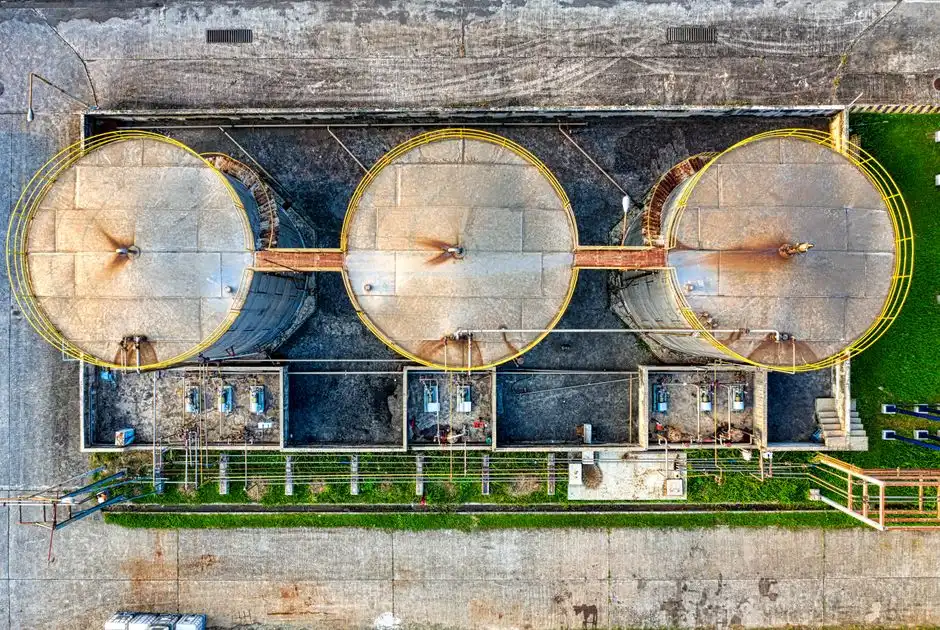
DAF performance is conditional on gas generation, chemical conditioning, hydraulic design, and the characteristics of the wastewater being treated. SIGMADAF reports approximately 90% suspended-solids removal, at least 95% oils-and-greases removal, and 20–50% COD reduction depending on effluent type, coagulant, and system design. Those values are generic supplier benchmarks, not guarantees for a Farmville pharmaceutical stream.
The mechanical sequence begins with a recycle pump and saturator, followed by a pressure-reduction valve, micro-bubble release, bubble–floc attachment, flotation, and surface skimming. Air is the usual saturator gas, but nitrogen-induced gas flotation is appropriate where solvent vapors create an ignition concern. The gas decision must be based on monitoring the actual stream rather than the plant’s general solvent inventory.
| Parameter or component | Evidence available for bid evaluation |
|---|---|
| Suspended-solids removal | Approximately 90%, reported by SIGMADAF; verify by site jar testing. |
| Oils-and-greases removal | At least 95%, reported by SIGMADAF; not a pharmaceutical guarantee. |
| COD reduction | 20–50% reported by SIGMADAF; 11.1–77.7% measured by Bogacki et al. (2017) across five cosmetic effluent samples. |
| Bubble size | SIGMADAF specifies 50–100 µm; Clearwater Industries/SigmaDAF USA specifies 30–50 µm. Require the bidder to identify the bubble-generation method. |
| Recycle flow | Generally 10–40% of total flow, with a broader 10–50% range in the supplied 2026 DAF technology source. |
| Saturation | Common saturation is 4–6 bar with 70–100 mg/L dissolved air under those conditions, according to the 2026 DAF technology source. |
| Float sludge | Typically 3–4% dry matter, reported by SIGMADAF; confirm handling and disposal for the actual formulation. |
Bogacki et al. (2017) measured 11.1–77.7% COD removal on the same laboratory DAF hardware with different coagulant programs. The highest observed result was 77.7% for Sample 5 at a coagulant dose of 0.5 ml/L and sludge volume of 30 ml/L. That study used cosmetic effluent, so it is a formulation-suite proxy rather than direct evidence for API mother liquor. The same paper calculated 133 mg/L of air introduced into a 1 L laboratory DAF at 6 bar saturation under an assumed 100% mass-transfer efficiency; this is a sanity check, not a design value.
Bids should also separate the tank, recycle pumping, saturator, skimmer, controls, and an automatic chemical dosing system. Float-sludge dewatering may require a plate and frame filter press, subject to the actual sludge rheology and disposal route.
Clarifier Strengths, Constraints, and Best-Fit Applications
A conventional gravity sedimentation clarifier is most attractive when wastewater contains heavy, readily settleable solids and has a stable, low-emulsion profile. It uses gravity separation rather than pressurized recycle, so it generally has fewer powered subsystems than DAF. The commercial comparison source states that clarifiers generally have lower operating costs, while DAF may be more cost-effective for specific oily contaminants.
That operating-cost distinction does not make the clarifier automatically suitable for pharmaceutical preparations wastewater. A stable solids profile is needed; light floc, emulsified material, and biomass can carry over and increase downstream biological or membrane loading. Low surfactant loading is equally important because surfactants can interfere with settling and conditioning chemistry.
The same comparison source gives an illustrative food-processing case in which DAF achieved 95% oil-and-grease removal versus 70% for a clarifier on the same stream. That is not pharmaceutical performance data and should not be transferred into a Farmville bid without testing the actual wastewater. For a heavily sedimented stream with limited emulsified contamination, a gravity sedimentation clarifier can offer the simpler hydraulic solution. For solvent-bearing or surfactant-loaded duties, the high-efficiency sedimentation tank proposal needs specific justification for solids settleability, footprint, and downstream carryover.
The clarifier remains a front-end separation device, not proof of pharmaceutical effluent compliance. Dissolved APIs, salts, residual solvents, and antibiotic activity are outside the principal function of either gravity separation or DAF.
Safety, Footprint, Operating Cost, and Downstream Integration
Solvent-vapor monitoring can determine whether a DAF may use air or must use nitrogen in the saturator. The 2026 pharmaceutical DAF research identifies nitrogen-induced gas flotation as the option that avoids ignition risk when solvent vapors are present. It also warns that volatile compounds stripped during flotation must be captured and treated if gaseous-emission limits are exceeded, making VOC capture part of the equipment scope rather than an optional accessory.
| Comparison point | DAF | Gravity sedimentation clarifier |
|---|---|---|
| Primary separation | Micro-bubbles attach to conditioned particles, which float and are skimmed. | Heavier particles settle and are removed as sludge. |
| Best-fit solids | Emulsified oils, fine solids, biomass carryover, and surfactant-conditioned floc. | Heavy, readily settleable solids. |
| Nitrogen service | Required where measured solvent vapors make an air-saturated system unsuitable. | No equivalent DAF saturator-gas decision; solvent vapor still requires separate review. |
| VOC capture | May require an off-gas treatment train. | Not normally inherent in the gravity process. |
| Footprint | Usually smaller for comparable loading because it separates low-density floc by flotation. | Generally requires more settling area and depth. |
| Mechanical complexity | Requires recycle pumping, pressurization, gas supply, and controlled skimming. | Generally has fewer powered subsystems. |
| Chemical conditioning | Normally required; adds chemical cost and sludge. | May be less intensive for suitable solids, but site chemistry still governs. |
| Downstream role | Protects MBR and RO/EDI from suspended and emulsified material. | Provides bulk settling before downstream treatment. |
DAF adds chemical, power, and maintenance costs; the commercial comparison reports generally lower clarifier operating costs. The trade-off is performance and footprint: DAF can remove material that would remain buoyant or emulsified in a gravity basin. The commercial comparison also provides a DAF-versus-clarifier decision framework that supports site analysis rather than catalogue selection.
A typical pharmaceutical treatment train begins with fine screening, flow equalization, DAF with chemical dosing, biological treatment—most often a submerged MBR—and RO or RO/EDI. Mechanical screens such as a rotary mechanical bar screen protect downstream equipment from gross solids. For biological design, see the MBR design and sizing guide; for polishing, review the MBR-integrated treatment system and industrial reverse-osmosis system.
Downstream membrane protection is the defensible benefit of DAF, not complete contaminant removal. Dissolved APIs, salts, residual solvents below their solubility cutoff, and antibiotic activity still require MBR, RO/EDI, or advanced oxidation. A plant considering water reuse must size that final train from measured water chemistry, not from DAF removal percentages.
A Site-Data and Jar-Test Workflow for the 2026 Purchase
The defensible equipment selection starts with sampling the actual production streams, then narrows the alternatives through controlled testing. Do not size either device from generic suspended-solids or COD curves. The following sequence gives Farmville procurement and engineering teams a common basis for evaluating bidders.
- Sample API synthesis, fermentation, formulation, and CIP or GMP washdown flows across representative batches and operating conditions.
- Request batch-to-batch variability, BOD, COD, suspended biomass, residual solvent, antibiotic activity, surfactant behavior, flow profile, and temperature data.
- Run jar tests on the actual streams and compare coagulant and flocculant programs, including float or settle behavior and chemical consumption.
- Measure solvent-vapor risk and require bidders to state whether the proposed gas is air or nitrogen, including any required VOC-capture train.
- Compare itemized equipment scope, controls, guarantees, and downstream interface requirements against the same wastewater basis.
| Bid item to compare | Evidence the buyer should require |
|---|---|
| Flow and loading basis | Measured batch flow range, suspended-solids profile, and contaminant concentrations from site sampling. |
| Separation performance | Site-specific jar-test results and clearly defined test endpoints, not generic supplier removal percentages. |
| Chemical conditioning | Program, dose range, mixing method, storage requirements, and consumption assumptions. |
| Gas and safety scope | Air or nitrogen basis, solvent-vapor assessment, ventilation, detection, and VOC treatment if required. |
| Mechanical scope | Tank, saturator, recycle pump, skimmer, automatic dosing, controls, sludge handling, and required accessories. |
| Commercial schedule | Itemized equipment and service pricing, exclusions, installation inputs, delivery terms, and warranty conditions. |
SIGMADAF covers throughput from 3 m³/h to more than 1,000 m³/h, but the supplied research contains no quotation. Ask each bidder for itemized pricing rather than deriving cost from a generic capacity band. Also require the industrial DAF system proposal to distinguish guaranteed site performance from catalog values.
Do not base procurement on the cited future-dated DAF technology page or unverified general performance claims. Verify design values against current permits, site influent testing, and the final equipment proposal. This is especially important for API mother liquor treatment, where the supplied 2026 DAF configuration for API mother liquor emphasizes that clarification is only one part of the treatment train.
Frequently Asked Questions
How should a Farmville pharmaceutical plant size a DAF or gravity clarifier?
Use site sampling plus jar testing, not a generic suspended-solids or COD curve. Sample API synthesis, fermentation, formulation, and CIP/GMP washdown streams, then test the chemical program, separation behavior, and expected downstream load on the actual wastewater.
How do nitrogen DAF and VOC capture affect the budget?
They can add equipment and operating scope beyond a standard air-saturated DAF. Require bidders to itemize nitrogen supply, gas-pressure equipment, controls, ventilation or detection, and VOC treatment. No quotation is available in the supplied research, so do not use a generic capacity range as a price estimate.
Which supplier scope should be checked before selecting equipment?
Compare bidders against the same measured wastewater basis and require explicit coverage of the tank, saturator, recycle pump, skimmer, automatic chemical dosing, controls, sludge handling, gas selection, and VOC capture. Also request the performance test method, acceptance criteria, installation inputs, delivery terms, and exclusions.
Does either device establish pharmaceutical discharge compliance?
No. DAF and gravity clarification protect downstream treatment; neither independently demonstrates permit compliance. Current Farmville discharge requirements must be checked against the complete treatment train, including measured residual APIs, salts, solvents, antibiotic activity, solids carryover, and applicable sewer pretreatment conditions.