What Treatment Does an Eskişehir Data Center Actually Need?
No Eskişehir treatment plant should be selected until its discharge route and liquid streams are known. The site generally needs separate pathways for cooling-tower blowdown, domestic sewage, chiller or generator flushes, glycol-bearing streams and emergency discharges. Cooling blowdown is usually the largest industrial stream and carries concentrated dissolved solids, chlorides, suspended matter and treatment-chemical residues, so it commonly requires equalization, clarification, filtration and, where reuse is permitted, UF followed by RO. Domestic sewage should receive biological treatment before blending, while glycol and spill streams should remain segregated. The correct design depends on the selected discharge route, measured water chemistry, cooling cycles of concentration, reuse targets and current Eskişehir approvals; final limits and pretreatment criteria must be confirmed locally.
ASCE’s March/April 2024 article, “Engineers often need a lot of water to keep data centers cool,” identifies domestic wastewater and cooling effluent as the two principal wastewater types and notes that cooling effluent is normally the larger share. The Eskişehir P&ID should therefore develop a liquid-stream register before it develops the treatment train. That register must include cooling-tower blowdown, chiller and generator flushes, domestic sewage, glycol loops, battery-spill containment, fire-water events and emergency dumps. Each stream needs an owner, normal flow range, chemistry, destination and abnormal-response procedure.
Domestic sewage requires biological treatment. Glycol and battery-spill streams should remain segregated and follow an approved disposal pathway; sending them through the industrial RO train risks membrane damage and can invalidate the waste-management basis. Cooling blowdown is the normal candidate for clarification, filtration and membrane treatment. A packaged MBR treatment system can address domestic sewage, while a DAF system for cooling-blowdown solids removal addresses the variable solids load.
| Design decision | Question to resolve first | Effect on treatment |
|---|---|---|
| Discharge route | Municipal sewer, organized industrial zone pretreatment, receiving-water discharge or reuse? | Determines the applicable acceptance requirements and whether RO is necessary. |
| Treatment objective | Cooling makeup reuse, permitted discharge or higher-recovery zero liquid discharge? | Sets permeate quality, recovery, reject management and operating complexity. |
| Source-water chemistry | What are the measured TDS, silica, hardness, alkalinity, chlorides, suspended solids and chemical residuals? | Controls clarification, softening, antiscalant, UF and RO design. |
Confirm current requirements in writing with the relevant municipality, sewer authority, organized industrial zone operator and environmental authority before freezing the Eskişehir P&ID. Permit thresholds are revision-controlled and site-specific; limits written for Antalya, Istanbul or another municipality should not be transferred to Eskişehir.
Build the Eskişehir Water Balance Before Sizing Equipment
Equipment sizing should begin with a metered Eskişehir data center water balance, not with a vendor’s nominal flow rate. The water balance must reconcile makeup, evaporation, blowdown, domestic sewage, process water, temporary uses and emergency discharges. Genesis Water Tech’s 2026 cooling-blowdown guide gives the governing relationship as B = E/(CoC − 1), where E is evaporative loss, B is blowdown and CoC is cycles of concentration. This is the calculation to reconcile against meter data before sizing equalization, UF, RO or the reject system.
Genesis Water Tech (2026) reports that blowdown equals 25% of makeup at 4 CoC and 20% at 6 CoC. Moving from 4 to 6 CoC therefore reduces blowdown by five percentage points, not by 50%. That volume saving must be weighed against scaling, corrosion and biological-growth risk. A higher CoC can reduce the liquid flow requiring treatment while making the remaining blowdown harder to treat.
ASCE’s March/April 2024 article cites an illustrative 20–30% design range for cooling effluent in a southeastern U.S. data-center project. That is a design precedent, not an Eskişehir operating factor. The project’s flowmeter must establish the local discharge rate. Genesis Water Tech (2026) also reports that measured blowdown can exceed theoretical calculations by 15–30% because of unmeasured losses and emergency dumps.
For a preliminary Eskişehir balance, record makeup and blowdown continuously, estimate evaporation, and monitor conductivity, pH and suspended solids monthly. Reconcile the mass balance during representative operating periods rather than sizing equalization around a single peak day. Temporary water from construction, fire-system tests or equipment flushing should remain a separate design event where practical.
| Water-balance item | Measurement or basis | Use in equipment sizing |
|---|---|---|
| Makeup water | Metered flow plus source-water analysis | Establishes total withdrawal, chemical demand and baseline reuse potential. |
| Evaporation | Calculated from B = E/(CoC − 1) and reconciled with site data | Identifies the consumptive portion that cannot be recovered as liquid. |
| Blowdown | Continuous flow measurement, checked against conductivity | Sets clarification, filtration, UF/RO and equalization duty. |
| Domestic and process water | Submetering and operating schedule | Prevents sewage or process discharges from being hidden in the blowdown balance. |
| Emergency and temporary flows | Event log, tank volume and discharge procedure | Defines containment, peak equalization and contaminated-hold capacity. |
The regional data-center blowdown treatment guide provides a useful structure for this reconciliation, but the Eskişehir water balance must use local meter records. A defensible design also preserves redundancy: a projected blowdown total is insufficient if the equalization system cannot contain a failed meter, an uncontrolled dump or an off-spec cooling event.
Characterize the Wastewater Before Selecting the Process

The analytes that determine the Eskişehir process train are the analytes that control scaling, corrosion, fouling and membrane compatibility. ASCE’s March/April 2024 guidance calls for seasonal sampling and analysis of pH, conductivity, TDS, chlorides, silicon, hardness, alkalinity and microbial counts. A single grab sample is not a design basis for a continuously operating cooling system because source-water chemistry, CoC and chemical dosing can change through the year.
HydropureWater’s 2026 Antalya guide reports 1,200–6,000 mg/L TDS as an industry benchmark for cooling-tower blowdown. This is not a measured Eskişehir value and must not be entered into the site water balance as such. It is useful only for preliminary sensitivity testing. The local blowdown chemistry must be measured across representative operating conditions, including the expected CoC range and the effect of the cooling chemical inventory.
Silica, calcium, magnesium, alkalinity and chlorides define much of the scaling and corrosion envelope. Treatment-chemical residuals matter as well because they influence reuse-water quality, membrane compatibility and the biological control strategy. ASCE (March/April 2024) also warns that reclaimed water can cause more corrosion, scaling and microbiological growth than potable water. A reuse train must therefore address the chemistry of the recycled water, not simply demonstrate that the RO permeate is cleaner than the feed.
Before purchasing, request the following from the site team and the relevant water supplier:
- Local source-water and blowdown analyses across operating and seasonal conditions.
- The complete cooling chemical inventory, including biocide, corrosion inhibitor and antiscalant products.
- The intended and maximum cycles of concentration, blowdown temperature and expected conductivity range.
- The proposed reuse destination and required cooling makeup-water quality.
- Discharge-route criteria, including any organized industrial zone pretreatment rules.
| Parameter | What it controls | Design response |
|---|---|---|
| TDS and conductivity | RO osmotic pressure, reject volume and blend calculations | Set recovery targets, blending and concentrate management. |
| Calcium, magnesium and alkalinity | Scale formation and precipitation risk | Consider softening, antiscalant and controlled recovery. |
| Silica | Concentrate scaling and RO recovery ceiling | Test worst-case concentration and consider high-recovery alternatives if needed. |
| Chlorides and corrosion indicators | Cooling-system corrosion and material selection | Set chemical control, materials and reuse-water specification. |
| Suspended solids and microbial counts | Clarifier, filter and membrane fouling | Determine clarification, media filtration and disinfection requirements. |
| Treatment-chemical residuals | Compatibility with membranes and downstream biological systems | Confirm products and dosage limits before selecting equipment. |
Where hardness or silica is the controlling constraint, request a project-specific water-softening assessment and obtain the correct valves, controls and replacement media only after the chemistry is defined. That avoids specifying equipment around Antalya or Istanbul water assumptions.
Match the Treatment Train to the Discharge Route
The Eskişehir discharge route is the first branch in the process decision tree, because it determines the required effluent quality and the fate of the RO reject. A permitted municipal-sewer connection, an organized industrial zone pretreatment system, direct receiving-water discharge and internal reuse are not equivalent routes. The design should proceed in this order: confirm the route, characterize each stream, select the treatment objective, then size the equipment.
For cooling-tower makeup reuse, the Antalya guide gives a baseline of side-stream filtration, UF and industrial RO. It reports UF recovery of 90–95%, RO recovery of 50–85% and dissolved-solids rejection of 95–99% (HydropureWater, 2026). These are benchmark values, not guaranteed Eskişehir performance. A project-specific design must use a hollow-fiber UF pretreatment system and an industrial RO system for cooling-tower makeup reuse only after the feed chemistry, flow envelope and recovery target are fixed.
For municipal or industrial-zone discharge, request the current written acceptance criteria and sewer permit. Do not import generic limits into the Eskişehir P&ID. The pretreatment package may then be limited to equalization, clarification and filtration, or it may need a higher-grade process depending on the authority’s limits and the chemistry of the actual discharge.
For direct receiving-water discharge or a high-recovery requirement, HydropureWater’s 2026 Antalya guide recommends partial zero liquid discharge—RO followed by mechanical vapour compression (MVC) on the concentrate—at 85–95% overall recovery before full ZLD. The same guide gives MVC energy demand of 15–25 kWh per 1,000 US gallons of distillate. For Eskişehir, this makes electricity tariff, thermal management and reject handling critical commercial inputs rather than footnote assumptions.
Domestic sewage should be handled in a packaged biological unit. A underground integrated sewage treatment system can be evaluated for this duty before any blending with industrial effluent. Raw sewage introduced to the industrial pretreatment train would add organic and ammonia loads that the blowdown unit was not designed to manage.
| Selected route | Indicative treatment sequence | Key unresolved issue |
|---|---|---|
| Cooling-tower makeup reuse | Equalization → clarification → multi-media filtration → UF → RO → controlled blending | Reuse quality, recovery and concentrate destination. |
| Municipal sewer or industrial-zone pretreatment | Equalization → required solids removal → filtration → authority-defined controls | Current connection and pretreatment acceptance criteria. |
| Receiving-water discharge | Treatment train selected against confirmed direct-discharge requirements | Applicable permit, temperature and receiving-water constraints. |
| High recovery | RO → MVC on concentrate → residual management | Energy cost, availability and solids-disposal route. |
| Domestic sewage | Packaged biological treatment before any permitted blending | Peak load, reuse or sewer destination and permit conditions. |
The Turkish data-center blowdown treatment guide illustrates the broader route logic, but Istanbul sewer criteria are not substitutes for Eskişehir requirements. Freeze the route only after the responsible authority confirms it in writing.
Clarify Solids, Filter and Protect the High-Recovery Equipment
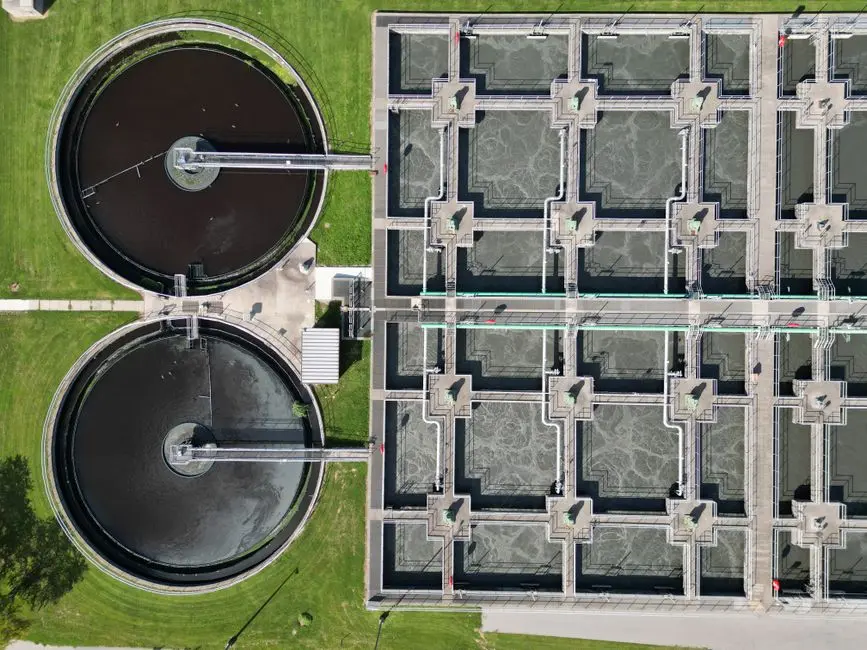
Clarification technology should be selected from the measured solids load and operating envelope, not from the generic “data-center wastewater” label. A DAF unit is a variable-solids removal option. HydropureWater’s 2026 Istanbul guide specifies a DAF range of 4–300 m³/h for cooling-blowdown duties involving suspended solids, FOG, oil and grease and colloidal matter. Where footprint is the controlling constraint, the same guide gives lamella clarification at 20–40 m³/m²·h surface loading, with sludge recirculation and flocculation.
Multi-media filtration should precede UF where the analysis shows enough suspended solids to compromise membrane performance. HydropureWater’s 2026 technical guide specifies a UF range of 2,000–40,000 L/h with 0.03 μm PVDF membranes, automatic backwash and air scour. Those are equipment benchmarks, not the required Eskişehir flow. A multi-media filtration stage can be selected to reduce the measured solids load presented to the UF system.
Chemical compatibility is part of the equipment specification, not a later operator preference. Antiscalant, corrosion-control and biocide products must be checked against membrane chemistry and the actual cooling inventory. The Antalya guide also provides a sizing check for side-stream filtration, but the Eskişehir circulation rate must be verified before that value is applied. The chemical dosing system should ultimately be sized from the treated flow, required dose range and containment provisions shown in the P&ID.
Every solids-removal step creates sludge. That sludge needs its own mass balance, dewatering method and disposal route. HydropureWater’s 2026 guide includes a plate-and-frame filter press for the sludge workstream. A high-efficiency sedimentation tank may also be relevant where lamella or gravity clarification is being evaluated. The liquid train should not be presented as if the generated solids disappear.
| Stage | Design role | Purchase input |
|---|---|---|
| DAF or lamella clarification | Remove variable suspended solids and floatable contaminants | Measured flow and solids profile, plus required footprint or loading. |
| Multi-media filtration | Reduce residual suspended solids before UF | Filtrate target, flow envelope and backwash-waste route. |
| UF | Provide a low-suspended-solids feed for RO | Recovery, feed chemistry, cleaning method and redundancy. |
| RO | Produce controlled-quality reuse water | Permeate target, recovery, silica and scaling envelope. |
| Sludge treatment | Separate and dewater process solids | Solids generation rate, residual moisture target and disposal site. |
Compare the 2026 Investment and Vendor Options
Equipment cost should be compared on the same design basis: measured feed chemistry, recovery, reject route, redundancy and operating labor. HydropureWater’s 2026 Antalya guide cites $250,000–$500,000 for a 50,000 GPD RO installation and $1.50–$3.00 per 1,000 gallons of operating cost. These figures are planning benchmarks from another Turkish city, not an Eskişehir quotation or allowance. They should prompt the buyer to request a project-specific price, not be copied into a capital estimate.
Genesis Water Tech’s 2026 guide provides a separate sensitivity example: a 15 MW facility with $200,000 CAPEX, 60% blowdown recovery and a 6.7-year simple payback on water savings alone. The guide states that including omitted benefits can improve payback to 3–5 years. Neither case establishes Eskişehir economics; the site calculation must use its utility rates, discharge charges, electricity tariff, recovered-water value and maintenance assumptions.
Three configurations merit direct comparison. A modular UF-plus-RO package maximizes freshwater reduction and reuse but introduces membrane, chemical and reject-management obligations. Clarification plus filtration supports permitted discharge with lower process complexity where the authority accepts that treatment. Partial ZLD increases recovery but adds MVC energy demand, thermal rejection and more demanding maintenance. The Turkish data-center blowdown treatment guide provides additional regional context, while the Eskişehir commercial case must use local costs and permits.
| Package | CAPEX and operating profile | Freshwater and reject risk |
|---|---|---|
| Clarification, filtration and permitted discharge | Lower treatment complexity; authority requirements determine added controls | Freshwater savings depend on site reuse opportunities; reject remains a permitted-discharge obligation. |
| UF plus RO reuse | Higher equipment, chemical and membrane requirements | Reduces liquid discharge through reuse; RO reject requires a defined destination. |
| RO with MVC concentrate treatment | Adds high-energy equipment, thermal management and maintenance | Higher recovery, but brine and solid-waste management remain critical. |
Screen vendors on documented Eskişehir or equivalent high-salinity projects, membrane sizing against the measured envelope, chemical compatibility, PLC controls, redundancy, local service capability, FAT scope and delivery schedule. Request OPEX at the project’s TDS, silica, hardness and CoC conditions. Where MVC is included, obtain a firm delivery date and contractual schedule because the skid can sit on the project critical path.
Approve the Design with Testing and Operating Controls
Design approval should require documentary proof of the discharge route, actual-water characterization and performance testing against the real feed envelope. The permit package should identify the receiving authority and state the current sewer, organized industrial zone or receiving-water criteria in writing. If the site is in an organized industrial zone, confirm whether additional pretreatment rules apply. A generic Turkish limit or another municipality’s acceptance threshold is not an adequate approval basis.
Require seasonal source-water and blowdown data before final equipment selection. HydropureWater’s 2026 Antalya guide recommends a silica-spike test on the actual RO skid during factory acceptance testing rather than relying only on clean-water performance. The FAT should also prove control sequencing, alarms, chemical-dosing response, recovery measurement and reject handling under the agreed operating conditions.
The chemical programme should be written around measured chemistry and verified membrane compatibility. Ask the supplier to identify the antiscalant and biocide inputs, expected consumption, cleaning chemicals, dosing limits and consequences of an overdose or loss of dosing. Use the specified RO and UF membrane elements and the specified treatment valves and filter media only against approved drawings and datasheets.
Commissioning should compare theoretical blowdown with metered discharge, then verify flow, conductivity, pH, differential pressure, turbidity or suspended solids and reject flow. Hydraulic and process acceptance should cover the reuse-water specification, permit conditions, guaranteed recovery, equipment availability, redundancy and operator training—not nominal throughput alone. For further regional comparison, the Mediterranean data-center water-treatment guide can help structure operator handover and monitoring, but it does not replace Eskişehir approval.
Frequently Asked Questions
Which treatment train should an Eskişehir data center select for cooling blowdown?
For cooling-tower makeup reuse, use the sequence equalization, clarification, multi-media filtration, UF and RO, with the RO reject routed to a confirmed discharge or concentration pathway. Use only the unit processes required by the measured chemistry and recovery target. For permitted discharge, ask the sewer authority or organized industrial zone operator for the current pretreatment criteria before fixing the train.
What wastewater characterization is needed before issuing an equipment specification?
Request seasonal source-water and blowdown analyses covering pH, conductivity, TDS, chlorides, silica, hardness, alkalinity, suspended solids and microbial counts. Add the cooling chemical inventory, temperature, CoC range, flow record and proposed reuse-water quality. A single grab sample cannot establish membrane scaling, corrosion or biological-fouling risk.
How much should an Eskişehir treatment package cost?
Request a quotation based on the measured flow and chemistry, selected recovery, reject route, controls, redundancy and FAT scope. HydropureWater’s 2026 Antalya guide gives $250,000–$500,000 for a 50,000 GPD RO installation and $1.50–$3.00 per 1,000 gallons of OPEX, but these are benchmarks—not Eskişehir prices. The buyer should also request a 10-year comparison using local freshwater, discharge and electricity tariffs.
Which supplier and delivery terms should be checked before award?
Screen references for comparable data-center or high-salinity duty, confirm membrane sizing against the measured TDS and silica envelope, and review Eskişehir regulatory experience, controls, redundancy and local service support. Make FAT, operator training, commissioning support, spare parts and delivery milestones contractual. If the package includes MVC, require a firm delivery date because it may be the critical-path item.
Related Equipment
- DAF system for cooling-blowdown solids removal — specifications, capacity range, and technical data
- industrial RO system for cooling-tower makeup reuse — specifications, capacity range, and technical data