Why Antalya changes the design: Mediterranean water stress and the 2026 regulatory climate
Antalya sits inside a Mediterranean basin where freshwater supply is already contested between tourism, agriculture, and a growing hyperscale pipeline. IDE Tech (2026) puts the demand at up to ~2 million liters per day for a 100 MW facility, which means a single Antalya build can rival a small municipality's daily consumption. Across the industry, IDE frames data-center water demand as accelerating into 2026 and beyond because AI workload density is rising faster than regional water systems were sized for. Tourism-season municipal peaks — June through September in Antalya — add a procurement-side risk that the operator cannot hedge with volumetric contracts alone.
Turkey's discharge framework sits under the Environment Law (Çevre Kanunu) and the Water Pollution Control Regulation, with the Su Kirliliği Kontrol Yönetmeliği (SKKY) setting parameter limits for direct discharge to receiving bodies. Where the site is inside an organized industrial zone, the Antalya OSB pretreatment regime also applies, and ASAT (Antalya Water and Wastewater Administration) controls municipal sewer acceptance criteria for indirect discharge. The engineer should confirm current parameter limits directly with ASAT and the OSB operator before locking the design basis — the article intentionally does not list numeric limits because those are revision-controlled and site-specific. For a broader reference on data-center wastewater engineering outside Turkey, the global data-center wastewater engineering guide covers the same control logic without the SKKY overlay.
The full wastewater register at a typical Antalya data center
A defensible 2026 design starts by enumerating every liquid stream the treatment plant will see, not just the cooling tower blowdown. Genesis Water Tech (2026) puts blowdown at roughly 25–30% of makeup water lost at 4 cycles of concentration, which makes it the largest stream by volume but never the only one. Valicor (2026) groups the rest into scheduled-service and emergency-response liquids that the operator must have a documented pathway for, on or off site.
| Stream | Typical character | Design handling |
|---|---|---|
| Cooling tower blowdown | Brackish, scaling-prone, 1,200–6,000 mg/L TDS (Genesis, 2026) | Side-stream filtration → UF → RO for makeup reuse; brine co-managed with RO reject |
| Humidifier bleed | Similar dissolved-solids chemistry to blowdown | Combined upstream of RO in a common blend tank |
| RO reject from makeup plant | High-TDS sidestream, scaling-prone | Routed to the same brine train as blowdown concentrate |
| Generator jacket cooling / chiller flush | Periodic lower-volume flow, pH/TSS handling | Equalization + TSS reduction before sewer |
| Glycol loops / battery-spill containment | Small, regulated hazardous volumes (Valicor, 2026) | Segregated storage; contract disposal, not blend with industrial train |
| Equipment washdown | Low-TSS, intermittent | Settle/filter then reuse for landscape or washdown |
| Onsite domestic sewage | ~50–150 L/person/day for 24/7 operations crew | Packaged MBBR or MBR step before blending with industrial streams |
The first four rows feed one treatment train. Glycol and battery-spill streams stay segregated because sending them through RO destroys membranes and almost always violates the disposal pathway. Domestic sewage needs a packaged biological step (MBBR or MBR) because blending raw sewage with the industrial train overloads the RO pretreatment on ammonia and organics. Integrating this register early is the difference between a single procurement package and a re-worked P&ID six months into commissioning.
Blowdown and ancillary wastewater: target parameters for Antalya
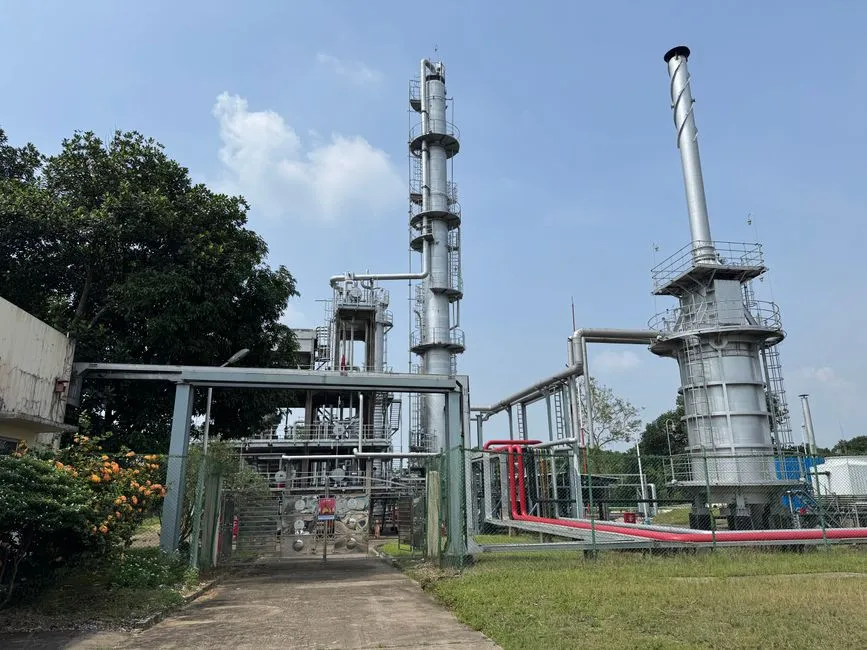
Cooling tower blowdown is a brackish stream: TDS typically 1,200–6,000 mg/L — 4 to 8× the makeup value — with suspended solids in the 10–50 mg/L band and elevated silica, calcium, magnesium, and treatment-chemical residuals (Genesis, 2026). Antalya municipal and groundwater makeup commonly falls in the 300–800 mg/L TDS range, so 4 cycles of concentration push blowdown into the upper half of the Genesis bracket. The reuse specification for cooling-tower makeup is a target TDS of 500–1,500 mg/L and suspended solids of 10–25 mg/L, which sets the RO permeate blending requirement.
| Parameter | Typical blowdown range | Cooling-tower reuse target | Design implication |
|---|---|---|---|
| TDS | 1,200–6,000 mg/L (Genesis, 2026) | 500–1,500 mg/L (Genesis, 2026) | RO permeate blended with raw makeup to hit target |
| Suspended solids | 10–50 mg/L (Genesis, 2026) | 10–25 mg/L (Genesis, 2026) | UF or self-cleaning side-stream filter upstream of RO |
| Silica | Concentrated; site-specific | Low to avoid tower scaling | Drives RO recovery ceiling; may force MVC or chemistry-aware train |
| Calcium / magnesium / alkalinity | Elevated with cycles of concentration | Softened for tower makeup | Antiscalant program sized to Langelier saturation index |
| Treatment chemicals (biocide, inhibitor) | Accumulates with cycles | Compatibility with membrane chemistry | Charactize before designing RO pretreatment; consider tablet-based program |
Antalya groundwater with high silica is the specific reason both Genesis and IDE flag silica management as the constraint, not just TDS. Without that characterization, the engineer risks designing a BWRO that scales at 70% recovery when the site actually needs a 95% recovery configuration.
Treatment train options: from UF+RO to full ZLD
Baseline train: hollow-fiber UF system as pretreatment (0.01–0.1 μm pore, 10–30 psi, 90–95% recovery), followed by an industrial RO unit at 150–400 psi and 50–85% blowdown recovery with 95–99% dissolved-solids rejection. Genesis cites a 50,000 GPD RO installation at $250,000–$500,000 and OPEX of $1.50–3.00/kgal, including energy, chemicals, membrane replacement, and maintenance. Side-stream filtration sized to 1–5% of circulation flow, with a multi-media filter ahead of the UF, drops blowdown suspended solids into the range the RO can accept.
| Train configuration | Indicative operating envelope | CAPEX (Genesis, 2026) | OPEX (Genesis, 2026) | Best fit |
|---|---|---|---|---|
| UF + RO | RO 50–85% recovery; permeate 10–50 mg/L TDS | $250,000–$500,000 for 50,000 GPD RO | $1.50–3.00/kgal | Baseline cooling-tower makeup reuse |
| UF + NF + RO | NF 70–85% recovery at 75–150 psi; partial softening | NF lower cost than full RO at high hardness | Lower energy than RO | Hardness-limited, not TDS-limited |
| UF + RO + MVC | MVC 95–98% recovery, distillate <10 mg/L TDS, 15–25 kWh/1,000 US gal | $1–3M for 10,000–30,000 GPD MVC | Energy-driven; tariff-dependent | Silica- or scaling-limited RO concentrate |
| Full ZLD (RO + MVC + crystallizer) | 95–99% overall recovery; <1% solid waste | $3–8M | $5–15/kgal | Discharge prohibited or freshwater cost exceeds ZLD OPEX |
When silica blocks a conventional BWRO at 75–80% recovery, the engineering move is up the recovery ladder — NF for hardness-limited cases, MVC for silica- or scaling-limited cases, full ZLD only when both reuse targets and discharge economics force it. IDE Tech's MAXH₂O logic takes a different route: it precipitates sparingly soluble salts in a fluidized-bed reactor so the remaining brine is NaCl-dominated, then runs the RO in a dynamic, high-velocity flush mode that keeps the membrane within the induction phase of crystallization. The result is stable operation well beyond 75–80% single-stage recovery without the complexity of multi-stage RO and interstage boosting.
Chemical conditioning is not optional. Antiscalant and biocide dosing skids sized to the Antalya characterization protect the RO membrane and prevent biofouling in the concentrate loop. The forward-osmosis variant covered in the forward osmosis engineering guide is an alternative when osmotic pressure limits are pushing conventional RO past its operating envelope.
Antalya-specific compliance, discharge, and reuse pathway
The first design checkpoint is the discharge route, not the equipment list. If the site is inside an Antalya OSB, the OSB pretreatment regime applies in addition to SKKY; if the site discharges to municipal sewer, ASAT's acceptance criteria control indirect discharge. SKKY parameter limits apply to direct discharge to receiving bodies — confirm the current revision with the regulator rather than rely on a generic value embedded in a vendor proposal. Reuse for cooling-tower makeup, landscape irrigation, and equipment washdown is the most defensible 2026 pathway because it avoids the SKKY direct-discharge envelope entirely; potable reuse is not in scope for these sources.
Where discharge is restricted or uneconomic, partial ZLD — RO followed by MVC on the concentrate — achieves 85–95% overall recovery (Genesis, 2026) and is the realistic step before committing to full ZLD. For a comparable site in a Mediterranean climate, the Al Ain effluent treatment plant buyer guide covers the parallel arid-climate discharge logic and ZLD cost stack.
CAPEX, OPEX, and ROI logic for an Antalya build
Use Genesis's equipment cost ranges as the starting point and overlay Antalya-specific freshwater and discharge costs from the operator's utility bills. Genesis cites RO OPEX of $1.50–3.00/kgal — energy, chemicals, membrane replacement, and maintenance — and discharge fees in water-stressed regions of $5–15/kgal, but the Antalya-specific figure must be confirmed from the ASAT tariff and the OSB pretreatment agreement. MVC adds 15–25 kWh per 1,000 US gallons of distillate (Genesis, 2026), so the Antalya electricity tariff is a meaningful OPEX line and should be requested from the utility before final design. For a comparable hyperscale benchmark, one Texas facility recovered 2.5 million gallons per month of blowdown and cut municipal draw by 35% (Genesis, 2026) — useful as a scale reference, not a Turkey-specific number.
The ROI logic stacks three line items: avoided freshwater purchase at Antalya's commercial potable rate, avoided discharge fees, and avoided seasonal scarcity premium during the tourism peak. The freshwater line is usually largest for a 24/7 site, and the discharge-fee line is the most variable across Mediterranean utilities. A West-African comparison for low-infrastructure contexts is in the West-African data-center blowdown guide.
Frequently Asked Questions
What is the minimum viable treatment train for a small Antalya data center with low blowdown flow?
For a lower-flow site, the baseline train is side-stream filtration (1–5% of circulation flow) feeding UF pretreatment at 10–30 psi and 90–95% recovery, then RO at 50–85% recovery for cooling-tower makeup reuse (Genesis, 2026). NF and MVC are not justified at small scale unless the local discharge limit forces higher recovery. Confirm ASAT sewer acceptance criteria first — if ASAT will accept the UF permeate blend without further treatment, a packaged UF + RO train sized to peak blowdown is the right starting point.
When does the spend justify ZLD instead of RO + discharge?
ZLD becomes defensible when the avoided freshwater cost plus avoided discharge fees exceed the ZLD OPEX of $5–15/kgal (Genesis, 2026) over the design horizon. The math is site-specific: request the Antalya potable commercial rate, the ASAT or OSB discharge tariff, and the electricity tariff, then run a 10-year OPEX comparison against partial ZLD at 85–95% recovery. If the answer is "marginal," stay with RO + MVC on concentrate until the freshwater or discharge line moves.
Which Turkey-specific compliance items must be confirmed before procurement?
Confirm three things in writing: the applicable discharge route (ASAT municipal sewer versus Antalya OSB pretreatment regime), the current SKKY parameter limits for any direct discharge to a receiving body, and whether the OSB operator has site-specific pretreatment rules that override SKKY defaults. None of these are uniform across Turkey, and the 2026 revisions should be checked directly with the regulator and the OSB administration before the P&ID is frozen.
How should a buyer screen suppliers for an Antalya 2026 build?
Screen on three artifacts: a reference list of data-center or high-salinity reuse installs in the last 24 months, factory acceptance test (FAT) procedures that include a silica-spike run on the actual RO skid (not just clean-water performance), and a written antiscalant program sized to the Antalya feed characterization. Ask the vendor for OPEX at the project's specific TDS, silica, and cycles-of-concentration envelope rather than accepting a generic kgal figure. Lead time on MVC skids is the usual critical-path item — request a delivery date with liquidated-damages terms, not a budget estimate.
Related Equipment
- industrial RO unit — specifications, capacity range, and technical data