Separate the data center’s wastewater streams before selecting equipment
A data center in Dnipro should separate sanitary wastewater from cooling-tower blowdown because the blowdown stream is mineralized, chemically dosed, and normally the larger treatment load. At 4 cycles of concentration, blowdown equals roughly 25–30% of makeup water and may contain 1,200–6,000 mg/L TDS, hardness, silica, suspended solids, metals, and treatment chemicals. A practical 2026 concept is equalization and pH/temperature control, filtration, clarification when justified, UF, then RO, with cooling-tower makeup reuse as the preferred recovery route. Final design must use seasonal Dnipro source-water testing, actual cooling chemistry, a permitted discharge route, and a confirmed concentrate destination; regional hydrological pressure makes water accounting and contingency planning essential.
Cooling-tower blowdown is the intentional removal of circulating water to prevent dissolved solids, treatment chemicals, and corrosion products from accumulating to damaging concentrations. Evaporation removes relatively pure water; most salts and nonvolatile chemicals remain in the loop. The discharge rate therefore depends on makeup flow, evaporation, operating cycles of concentration, and control decisions—not simply on the data center’s IT load.
Sanitary wastewater from offices, kitchens, toilets, and welfare areas is a different stream. The Kyiv engineering guide characterizes it as comparatively small and suitable for a distinct pathway, while identifying blowdown as the primary industrial treatment load. A municipal sewer connection or local biological treatment may therefore suit sanitary flow, but it does not establish a route for concentrated cooling water. The regional data-center blowdown treatment guide provides a useful comparison framework.
At 4 cycles of concentration, blowdown is approximately 25–30% of makeup water. Genesis Water Tech, in 2025, states that 10 million gallons of monthly makeup demand produces 2.5–3 million gallons of blowdown. Before sizing equipment, prepare an hourly and daily balance covering makeup, evaporation, blowdown, emergency dumps, sanitary discharge, reuse, and planned bypass. A similar stream-balance approach is used for the Zaria data-center treatment concept, but Dnipro values must come from local measurements.
| Water stream | Primary engineering duty | Sizing and routing question |
|---|---|---|
| Cooling-tower blowdown | Control dissolved solids, suspended solids, metals, and residual chemicals | What are the peak, average, emergency, and seasonal flows, and can the stream be reused or discharged? |
| Sanitary wastewater | Manage organic solids, nutrients, oil and grease, and pathogens | Is there a permitted municipal connection, or must local biological treatment be provided? |
| RO concentrate | Manage the residual stream after partial recovery | Where is it discharged, further concentrated, or crystallized under a confirmed authorization? |
Characterize the two streams that determine treatment performance
Blowdown treatment must be designed around the complete cooling-water chemical inventory, not a generic “TDS” value, because the dissolved-solids fraction includes compounds that affect scaling, membrane compatibility, biological treatment, and aquatic toxicity.
Genesis Water Tech, in 2025, reports blowdown TDS of 1,200–6,000 mg/L. The stream may also contain hardness, silica, suspended solids, corrosion inhibitors, scale preventers, biocides, and metals such as copper and zinc. The consequences are specific: hardness and silica constrain RO recovery, suspended solids can foul membranes, biocides may affect biological treatment, and metals can determine whether precipitation or clarification is necessary. The same source warns against treating a single “typical” analysis as a design basis because seasonal source-water chemistry changes the blowdown profile.
Collect cooling-blowdown and source-water samples across operating and seasonal conditions. The analytical package should include temperature, pH, conductivity or TDS, hardness, alkalinity, silica, suspended solids, oil and grease, residual chlorine, biocide residuals, copper, and zinc. Add the complete site cooling-chemical inventory so the laboratory can identify active and recently decommissioned products. Where loops are exposed to freezing or auxiliary heat exchangers can introduce contaminants, check glycol and heat-exchanger carryover; a review of treatment valves and filter media can help align materials with the confirmed chemical program.
| Parameter or input | Why it affects the design | Required basis |
|---|---|---|
| pH, alkalinity, hardness, silica | Control scaling, chemical dosing, and RO recovery | Seasonal source and blowdown analyses with minima and maxima |
| TDS or conductivity | Sets concentration cycles, salt loading, and blend controls | Operating log plus representative laboratory results |
| TSS, oil and grease, colloids | Determines filtration and possible DAF or clarification | Worst-case combined samples, including emergency events |
| Residual chlorine, biocides, glycol | Protects membranes and downstream biological processes | Complete chemical inventory and product concentration records |
| Copper and zinc | May require precipitation, clarification, or specialized control | Cooling-loop metal monitoring and blowdown analysis |
For sanitary wastewater, obtain flow, COD, BOD, TSS, oil and grease, nutrients, and pH. Confirm whether a separate municipal connection is legally and hydraulically available. Do not combine a low-volume sanitary stream with blowdown merely to simplify piping: doing so obscures the sanitary treatment duty and can expose the biological receiving process to cooling biocides, heat, or metals.
Account for Dnipro source-water and ecological constraints
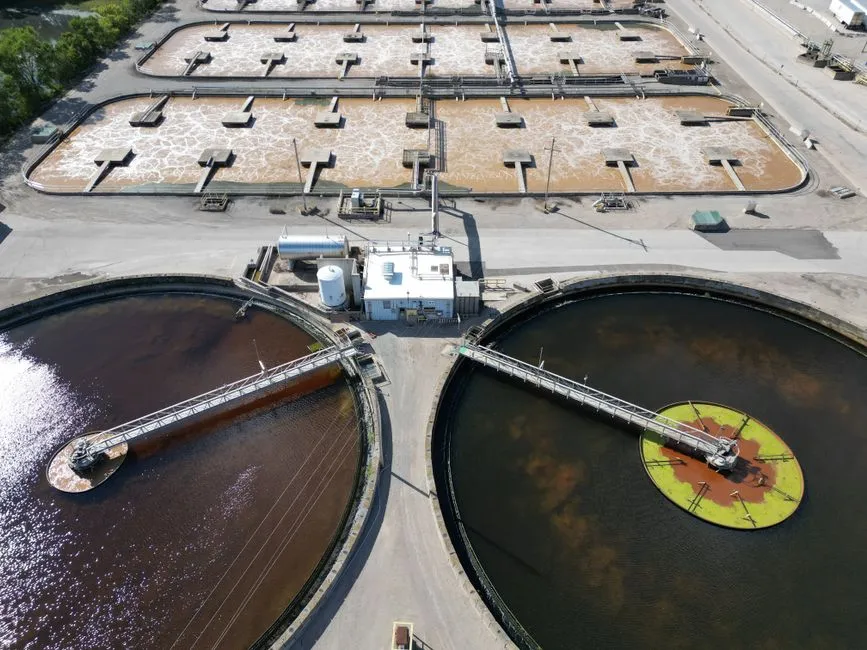
The loss of Kakhovka reservoir regulation changed the lower-Dnipro water balance, so a data-center treatment design cannot assume stable river flow or dilution capacity.
Applied Water Science, in 2026, explains that Kakhovka served industrial users, irrigation, drinking-water supply, fisheries, water transport, and energy cooling before the dam was destroyed on June 6, 2023. The paper reports that ecological functioning in the lower Dnipro may require flows of 1,000 m³/s or more, while the daily natural-flow minimum can decrease by 200–300 m³/s during an extremely low-flow period. These are regional hydrological figures, not a data-center design flow.
The same 2026 study projects a moderate 18–24% decrease in Dnipro river flow under various scenarios, except from January to March, when a slight increase of up to 7% is possible. For summer water-use scenarios without the reservoir, the reported flow requirement ranges from 649 to 1,100 m³/s, depending on the scenario. The engineering implication is conditional: freshwater availability and receiving-water dilution can vary, but neither confirms that a discharge permit will be granted or that dilution can substitute for treatment.
Translate this regional context into project actions. Obtain seasonal source-water data, model freshwater demand and reuse under low-flow conditions, evaluate storage or an alternative source, and maintain treatment capacity for emergency dumps and high-concentration operating periods. The 2026 wastewater requirements analysis provides a broader frame for separating source-water constraints from equipment performance.
For the data center, the practical resilience test is whether the permitted discharge route remains available when the Dnipro is low. If it does not, the project needs a valid reuse route, storage, standby treatment, or a controlled reduction in freshwater demand. A river-discharge contingency without a confirmed authority decision is not a design basis.
Build a pretreatment train that protects downstream equipment
Each pretreatment step should have a defined contaminant-removal or equipment-protection duty; a data-center label does not justify every unit in a generic treatment train.
- Equalize the blowdown and trim pH and temperature. Equalization stabilizes flow, while pH control limits corrosion and chemical demand. The supplied Kyiv design basis uses pH 6.0–9.0 and a discharge temperature of no more than approximately 65°C at the relevant discharge stage. The cooling duty remains site-specific.
- Filter suspended solids. The published data-center sizing basis is 1–5% of circulation flow with 10–25 µm filtration. A side-stream or multimedia filter provides the initial solids barrier; capacity should be checked against both circulation demand and actual pretreatment flow.
- Condition the feed chemically. A PLC-controlled dosing skid should provide pH adjustment and antiscalant, plus coagulation only where analysis supports it. Chemical compatibility must cover the complete cooling program and all piping and membranes downstream.
- Add clarification only for identified duties. DAF is justified by high suspended solids, oil and grease, colloids, or metal-bearing precipitate. The supplied DAF basis covers 4–300 m³/h across 13 models. A lamella clarifier is an alternative where inclined-plate solids separation is justified; the published surface-loading range is 20–40 m³/m²·h.
- Use UF when the RO membrane design requires a controlled solids and colloids barrier. The supplied basis includes 0.03 µm PVDF membranes, automatic backwash and air scour, 2,000–40,000 L/h flow, and acceptance of up to 300 ppm turbidity. A hollow-fiber UF system for RO pretreatment should be selected against seasonal feed turbidity and cleaning chemistry.
Available equipment examples include multimedia filtration, DAF pretreatment for contaminated blowdown, and a PLC-controlled chemical dosing system. These are configuration options, not a mandatory sequence.
| Stage | Trigger | Published design basis |
|---|---|---|
| Equalization and pH/temperature trim | Variable blowdown flow, heat, or aggressive pH | pH 6.0–9.0; no more than approximately 65°C at the relevant discharge stage |
| Side-stream or multimedia filtration | Suspended-solids control required | 1–5% of circulation flow; 10–25 µm filtration |
| DAF | TSS, oil and grease, colloids, or precipitated metals | 4–300 m³/h across 13 models |
| Lamella clarifier | Inclined-plate solids separation justified | 20–40 m³/m²·h surface loading |
| UF | Controlled barrier required before RO | 0.03 µm PVDF; automatic backwash and air scour; 2,000–40,000 L/h; up to 300 ppm turbidity |
Do not make DAF mandatory solely because the site is a data center. If wastewater analysis shows low oil and grease, modest suspended solids, and no metal-bearing precipitation, filtration may be sufficient. Conversely, if emergency heat rejection or auxiliary equipment can introduce oil, glycol, or metal-bearing solids, those inflows belong in the peak hydraulic and contaminant design cases.
Use reverse osmosis for controlled reuse and concentrate reduction

RO is a controlled-reuse and dissolved-solids-removal step, not an automatic requirement; its justification depends on permit limits, freshwater economics, source-water chemistry, staffing, and concentrate handling.
The supplied industrial RO performance envelope is 95–99% rejection, 10–50 mg/L permeate TDS, 50–85% recovery, and 150–400 psi operating pressure. The industrial RO water-purification system should be sized around the seasonal feed envelope and anticipated cleaning regime—not the optimistic permeate output. Membrane selection and maintenance depend on the actual feed chemistry, so the RO and UF membrane elements should be checked against those conditions.
Where reuse is accepted, use conductivity-based automatic control to maintain cycles of concentration and a controlled blowdown rate. Permeate blending can reduce the amount sent to RO, but the blend must remain compatible with the cooling loop and any water-quality requirements. HydropureWater’s industrial RO systems provide automated PLC control and recovery rates up to 95%; the project recovery must nevertheless be reconciled with membrane-feed chemistry and the site water balance.
Recovery changes the size of the residual stream but does not remove it. Partial recovery reduces concentrate volume, yet the remaining concentrate still requires a lawful discharge route, further concentration, or crystallization. The concentrate destination is therefore the final decision gate—not a detail to resolve after the RO skid is ordered.
| RO design question | Decision required before purchase |
|---|---|
| What feed flow and chemistry govern the membrane? | Use seasonal maxima and the worst credible cleaning case, not only average blowdown. |
| What permeate quality is needed? | Match the reuse target and any permitted blending rule to the source chemistry. |
| What recovery is sustainable? | Balance freshwater savings against scaling, fouling, cleaning, and membrane replacement. |
| Where does concentrate go? | Confirm a permitted receiver or complete the thermal-concentration and solids-handling design. |
Choose between reuse, sewer discharge and zero liquid discharge
The final commercial choice is the end-of-pipe route: recover the water, discharge it under a valid authorization, or eliminate the liquid discharge through thermal concentration.
Cooling-tower makeup reuse generally offers the strongest direct water value because the water is already conditioned for the cooling loop. Sewer discharge is a discharge pathway, not reuse: it requires pretreatment against the actual Dnipro permit and confirmation that the receiving utility has hydraulic and pollutant capacity. Full zero liquid discharge (ZLD) adds RO, mechanical vapor compression (MVC), and a crystallizer; it should be compared with the consequences of leaving a permitted discharge unavailable.
The supplied full-ZLD figures are precise but generic: 95–98% MVC recovery, distillate below 10 mg/L TDS, 15–25 kWh per 1,000 US gallons, 85–95% combined RO and MVC recovery, and solid waste below 1% of original blowdown volume. These figures do not establish a Dnipro energy price, permit condition, or crystallizer route.
Use the financial benchmarks cautiously. Genesis Water Tech, in 2025, lists a 50,000 GPD RO skid at $250,000–$500,000 CAPEX and $1.50–$3.00 per 1,000 gallons OPEX. It lists full ZLD at $3–8 million CAPEX and $5–15 per 1,000 gallons OPEX. These are general vendor benchmarks, not Dnipro quotations, and exclude site-specific civil work, taxes, financing, concentrate disposal, and local utility charges. The wastewater automation CAPEX and OPEX guide and 2026 wastewater treatment cost per cubic meter provide planning context, not a substitute for a site-specific offer.
| Route | Principal benefit | Decision gate |
|---|---|---|
| Cooling-tower makeup reuse | Reduces freshwater demand and may avoid unnecessary discharge | Permeate quality, cooling-loop compatibility, and concentrate destination |
| Treatment followed by sewer discharge | Uses an existing conveyance route where capacity and authorization exist | Binding Dnipro permit, receiving-utility capacity, and pretreatment limits |
| Full ZLD | Eliminates liquid discharge when the concentrate must be converted to solids | Residual stream, energy availability, crystallizer solids handling, and staff capability |
Do not apply Kyiv-specific sewer tariffs, reporting cadence, or temperature claims to Dnipro. Obtain the binding Dnipro sewer conditions, current Ukrainian environmental requirements, special water-use conditions, and the responsible authority before selecting the route. For ZLD, use RO plus MVC only where RO concentrate still requires thermal treatment, and add a crystallizer where solids disposal is necessary.
Convert the concept into a procurement and commissioning plan
Equipment should be ordered only after the source-water, discharge, reuse, and concentrate decisions are documented.
- Complete a site survey and an 8–12-week representative monitoring campaign before final process selection. Require flow, temperature, pH, TDS, hardness, alkalinity, silica, TSS, metals, biocide, and oil-and-grease results.
- Issue supplier performance requirements against the full seasonal feed envelope. Require guarantees for permeate flow, recovery, cleaning frequency, chemical compatibility, and concentrate quantity.
- Confirm the discharge authorization, special water-use conditions, monitoring frequency, reporting authority, and any sewer pretreatment agreement before freezing the design.
- Compare redundancy, bypass isolation, leak containment, membrane-cleaning access, spare parts, power requirements, and control-system integration. Equipment selection should reflect operating staff and wartime continuity constraints, not only installed price.
- Commission in sequence: flushing, media conditioning, membrane loading, permeate and concentrate sampling, automatic-control verification, and operator training. A sedimentation-tank implementation and the required treatment valves and filter media should be checked against the accepted process design.
| Procurement package | Minimum information to request |
|---|---|
| Design-basis report | Measured flow balance, seasonal chemistry, source-water uncertainty, and sanitary-stream routing |
| Equipment guarantee | Seasonal feed envelope, permeate flow, recovery, cleaning regime, chemical compatibility, and concentrate output |
| Compliance package | Permit route, applicable limits, monitoring, reporting, receiving capacity, and responsible authority |
| Commissioning plan | Factory tests, flushing, sampling, control verification, training, and spares |
Frequently Asked Questions
What equipment does a data center in Dnipro need for cooling blowdown?
The evidence-based train is equalization with pH and temperature trim, filtration, clarification when analysis justifies it, UF, and RO for controlled reuse or polishing. MVC and crystallization are optional only when the RO concentrate requires a final liquid-free route. The 2026 data-center wastewater guide provides an adjacent regional framework, but Dnipro chemistry and permits must govern the final selection.
How much does cooling blowdown treatment cost?
No responsible Dnipro price can be stated without measured peak and average flows, seasonal chemistry, reuse targets, and the concentrate route. For preliminary comparison only, the supplied 2025 vendor benchmarks list $250,000–$500,000 CAPEX and $1.50–$3.00 per 1,000 gallons OPEX for a 50,000 GPD RO skid, versus $3–8 million CAPEX and $5–15 per 1,000 gallons OPEX for full ZLD. Request a binding offer with the flow basis, equipment boundary, utilities, chemical consumption, membrane replacement, concentrate disposal, civil works, and local taxes stated separately.
How should a Dnipro data center size a blowdown treatment skid?
Build the skid around measured peak blowdown, average blowdown, emergency dumps, equalization residence time, and the selected recovery route. Makeup flow, evaporation, operating cycles of concentration, bypasses, and reuse determine the resulting duty; at 4 cycles of concentration, the supplied 2025 source places blowdown at roughly 25–30% of makeup. Do not order from the annual average alone, because a short emergency dump can determine equalization and peak-treatment requirements.
Should a Dnipro data center buy a modular skid or a custom plant?
A modular skid is appropriate when the seasonal feed envelope, treatment objective, utility connections, and operator capability fit a defined package. A custom train is justified when blowdown chemistry varies materially, several reuse destinations have different quality requirements, the permit requires staged polishing, or the concentrate route changes the operating envelope. In either case, ask suppliers to demonstrate performance at the measured seasonal minima and maxima, not only at nominal design flow.
What compliance information should be obtained before ordering equipment?
Obtain the current Dnipro discharge route, binding permit or applicable rules, discharge limits, monitoring and reporting duties, special water-use conditions, sewer pretreatment agreement, receiving-system capacity, and confirmation of the responsible authority. Require the supplier to identify where every stream will go. If the answer is not documented, the equipment order should remain on hold because neither reuse nor discharge can be demonstrated from equipment data alone.