Why Hospital Wastewater COD Is Harder Than Municipal Sewage
Hospital effluent is not diluted domestic sewage with extra pathogens. A 19,712-hospital Chinese survey reports per-hospital generation of roughly 65 m³/day with COD in the 120–500 mg/L band and TSS at 150–160 mg/L, but that national average hides far more aggressive peaks documented in regional hospital sampling: average COD of 613 mg/L across European hospitals, 591 mg/L in Asia, and 1,074 mg/L in South America, with individual measurements of 2,480 mg/L in Brazil, 2,464 mg/L in Spain, and 1,142 mg/L in India (S3, 2020-11). The same review also documents Indian hospital BOD averaging 153 mg/L with a 92.8–270 mg/L range (S3, 2020-11). That is a 20-fold spread on the same parameter at facilities of comparable bed count.
The operational consequence is that a single site can swing from roughly 100 mg/L to over 2,000 mg/L COD in a day, driven by ward turnover, surgery schedules, laundry discharge, and pharmacy activity. Designing to the 120–500 mg/L band alone leaves no safety margin against the documented highs, and designing to the peaks over-sizes a plant that will run empty most nights. The non-biodegradable fraction is the second problem. The same S3 review reports that lorazepam, oxazepam, carbamazepine, clozapine, sulpiride, and quetiapine resisted degradation in activated-sludge systems even when bulk COD was reduced (S3, 2020-11), so the residual COD leaving a conventional biological train is not just "old sewage" — it is a defined list of psychoactive and antiepileptic compounds that pass through municipal treatment. Any plant claiming hospital compliance must address both the load swing and the pharmaceutical fraction.
| Region / Site | Hospital wastewater COD (mg/L) | Source / Scope |
|---|---|---|
| China, 19,712-hospital national survey | 120–500 (range) | S3, 2020-11 (review dataset) |
| Europe (review average) | 613 | S3, 2020-11 |
| Asia (review average) | 591 | S3, 2020-11 |
| South America (review average) | 1,074 | S3, 2020-11 |
| Brazil, peak site | 2,480 | S3, 2020-11 |
| Spain, peak site | 2,464 | S3, 2020-11 |
| India, peak site | 1,142 | S3, 2020-11 |
How Hospital Wastewater COD Removal Actually Works
Three mechanisms carry the load in 2026 hospital designs, and they stack rather than substitute. Biological oxidation handles the biodegradable bulk. A pilot MBBR followed by ozone and chlorine disinfection (10–20 mg/L Cl₂) on a 600 m³ aeration tank reported approximately 100% TSS removal, 93% COD removal, and 91% TN removal (S3, 2020-11). That is the workhorse layer; without it, no polishing step is economical. The MBBR alone cannot remove diclofenac, trimethoprim, or hydrochlorothiazide — the same study recorded 30%, 21%, and 11% removal for those compounds respectively (S3, 2020-11) — so a downstream mechanism is mandatory where pharmaceutical residues are regulated.
Electrochemical oxidation and coagulation remove COD by direct anodic oxidation plus coagulant precipitation in a single cell. The mechanism evidence comes from a 2 L Al/Fe electrocoagulation cell operating on petroleum refinery influent at 710 mg/L COD, which reached 99.5% COD removal at 10.5 V, 50 minutes, pH 7, 0.5 g/L NaCl supporting electrolyte, with energy consumption of 12 kWh/m³ and TSS of 73 mg/L (S1). That result is not a hospital guarantee, because petroleum and hospital matrices differ, but the mechanism — anode-driven oxidation plus Al³⁺/Fe³⁺ floc — is the same one a hospital electrocoagulation cell would use, and it is the cleanest reference for sizing voltage and residence time.
Advanced oxidative polishing is the third layer, and the strongest hospital-specific data point is the Hubei electron-beam demonstration. Hydroxyl radicals generated in the irradiated water were the dominant mechanism for COD removal, fecal E. coli inactivation, and virus reduction (S4, 2022-08). Operated at 15 mA beam current and 10 m³/h capacity, the unit held effluent COD at 13–27 mg/L steady and dropped fecal E. coli from ≥2.4×10⁶ MPN/L to below 20 MPN/L (S4, 2022-08). The mechanism is what matters: electron beam and ozone both produce ·OH, but the beam produces it without the bromate or aldehyde by-products of chlorination, which is why S4 frames it as a polishing step rather than a primary biological replacement.
Process Options Compared on Real Performance Data
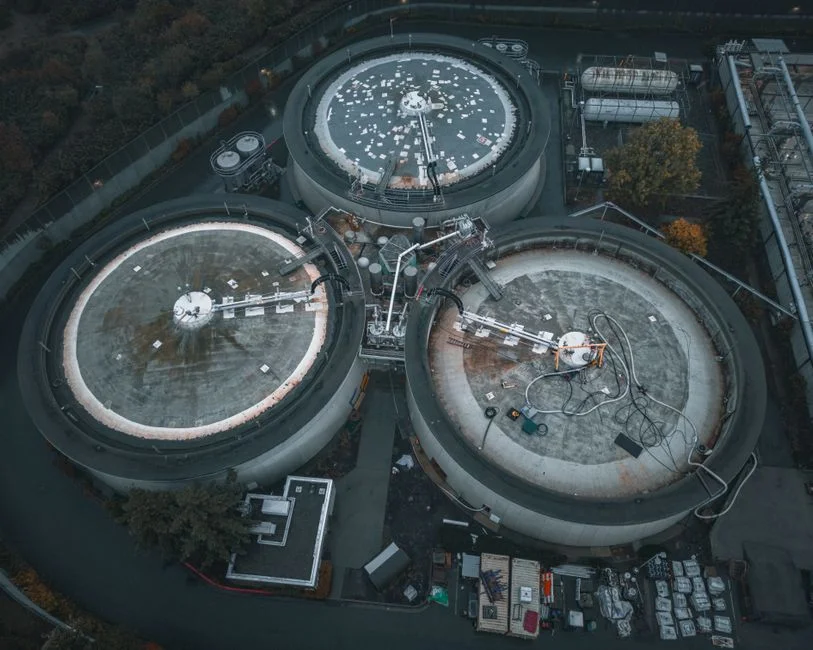
The five process families a hospital engineer will actually evaluate in 2026 are submerged MBR, MBBR + ozone, constructed wetlands, electrocoagulation, and MBBR + electron beam. Each has measured hospital-specific performance in the cited literature, and each has a different penalty in footprint, energy, or land.
Submerged MBR is the most documented option. One Chinese pilot reported more than 98% COD removal, 99% ammonia removal, and 82% TN removal; another reached more than 95% COD and ammonia removal at 31.3 h HRT; a third hit 82% COD and 90% BOD at full scale (S3, 2020-11). On the polishing side, MBR effluent treated with ozone at 1.08 gO₃/gDOC achieved 99% PhAC removal but only 51% X-ray contrast media; replacing ozone with PAC at 23 mg/L pushed contrast media to 62%, while UV at 2,400 J/m² reached 66% contrast media but dropped PhAC removal to 93% (S3, 2020-11). The trade is real: ozone maximises PhAC kill, PAC and UV do better on contrast agents.
MBBR + ozone on a 600 m³ aeration tank is the mid-cost biological baseline at 93% COD, 91% TN, and 100% TSS with 10–20 mg/L chlorine disinfection (S3, 2020-11). Constructed wetlands — 140 m² horizontal subsurface flow plus 120 m² vertical subsurface flow in Nepal — reported 97% TSS, 94% COD, 97% BOD, and 80% ammonia (S3, 2020-11), but that footprint and the climate dependency rule it out for most 50–500-bed urban retrofits. Electrochemical oxidation's 99.5% COD result at 12 kWh/m³ (S1) is mechanism evidence; a hospital electrocoagulation cell would carry the same anode-cathode penalty at similar energy. MBBR + electron beam is the only sequence with both a measured biological step and a measured polishing step on the same site: MBBR effluent at 40–87 mg/L COD drops to a steady 13–27 mg/L after the beam at 4 kGy, simultaneously meeting China's GB18466-2005 medical discharge standard and cutting fecal E. coli from ≥2.4×10⁶ MPN/L to under 20 MPN/L (S4, 2022-08).
| Process train | COD removal | Other reported metrics | Energy / footprint note | Reference |
|---|---|---|---|---|
| Submerged MBR (China pilot) | >98% | 99% ammonia, 82% TN | 31.3 h HRT demonstrated | S3, 2020-11 |
| MBR + ozone (1.08 gO₃/gDOC) | ≥95% bulk COD | 99% PhAC, 51% X-ray contrast media | Ozone dose driven by DOC | S3, 2020-11 |
| MBR + PAC (23 mg/L) | ≥95% bulk COD | 62% X-ray contrast media | PAC swap for contrast agents | S3, 2020-11 |
| MBR + UV (2,400 J/m²) | ≥95% bulk COD | 93% PhAC, 66% X-ray contrast media | Chemical-free polish | S3, 2020-11 |
| MBBR + ozone + chlorine (600 m³ tank) | 93% | 100% TSS, 91% TN | 10–20 mg/L Cl₂ residual | S3, 2020-11 |
| Constructed wetlands (140+120 m², Nepal) | 94% | 97% TSS, 97% BOD, 80% ammonia | Land-intensive, climate-limited | S3, 2020-11 |
| Electrochemical cell (Al/Fe, petroleum reference) | 99.5% | 12 kWh/m³ at 710 mg/L COD | Mechanism reference, not hospital | S1, 2023 |
| MBBR + electron beam (Hubei demo) | Steady effluent 13–27 mg/L | Fecal E. coli from ≥2.4×10⁶ to <20 MPN/L | 15 mA, 10 m³/h, 4 kGy | S4, 2022-08 |
Choosing a Process Train for 2026 Discharge and Reuse Targets
Pick the train from the discharge limit, not the other way round. If the binding limit is China's GB18466-2005 or an equivalent medical-institution standard that calls for COD under roughly 60–100 mg/L with tight pathogen counts, the demonstrated sequence is MBBR followed by electron beam: the Hubei unit held effluent COD steady at 13–27 mg/L and fecal E. coli under 50 MPN/L at 4 kGy (S4, 2022-08). Where an electron-beam rig is not in the procurement scope, the documented workhorse is a submerged MBR at greater than 95–98% COD removal (S3, 2020-11), and HydropureWater's integrated MBR membrane bioreactor with submerged PVDF modules is the equipment path that delivers the same MBR envelope with a smaller plant footprint than conventional activated sludge.
For a 50–500-bed European site under the EU Urban Waste Water Directive 91/271/EEC with a constrained footprint, the lowest-area path is a packaged MBR rather than a CAS line; the MBR route also tightens the suspended-solids envelope and protects downstream disinfection from TSS breakthrough. Where pathogen and pharmaceutical residuals dominate the risk profile — oncology wards, infectious-disease hospitals, COVID-era design specifications — the documented polish options are ozone at roughly 1.08 gO₃/gDOC, PAC at 23 mg/L, or UV at 2,400 J/m² (S3, 2020-11), with on-site chlorine dioxide generation for residual control. If the influent swings to the documented 2,480 mg/L peaks (S3, 2020-11), a HydropureWater DAF system or lamella clarifier ahead of the bioreactor absorbs the shock and protects the MBR membranes from organic overloading.
Cross-regional design teams can compare their compliance baseline against the Seville hospital wastewater engineering guide for EU-locale execution and the Cartagena hospital wastewater engineering guide for a Mediterranean spec example. The choice between packaged MBR and MBBR + AOP should be defended on three numbers: required effluent COD, available footprint, and the kWh/m³ the site is willing to carry — and those three should be on the design basis sheet before any equipment brand is named.
Equipment Specification Checklist for 2026 Procurement

Turn the chosen process into an RFQ. Headworks first: a HydropureWater rotary mechanical bar screen running continuously to strip rags, cotton, and fibrous debris that would blind downstream screens and foul MBR modules. Next, equalization and primary clarification: a HydropureWater DAF system sized to the documented peak load (up to 2,480 mg/L COD, S3, 2020-11) to cut TSS, oil and grease, and colloidal COD before the biological step.
Biological step: a HydropureWater integrated MBR membrane bioreactor with submerged PVDF flat-sheet modules at 0.1 µm pore size, sized against the peak COD so the membranes never see shock load. Polishing and disinfection: an ozone skid or a HydropureWater chlorine dioxide generator for residual control where chemical oxidation is preferred, plus a HydropureWater UV sterilizer as a chemical-free barrier against chlorine-resistant organisms and as a documented step for X-ray contrast media removal (S3, 2020-11). For a packaged single-skid delivery aimed at clinics and small hospitals, the HydropureWater medical wastewater treatment system bundles those stages and targets EU UWWTD 91/271/EEC and EPA-equivalent discharge. Sludge handling: a plate-and-frame filter press sized to the MBR waste-activated-sludge yield. Footprint context for the MBR line is captured in the MBR vs CAS footprint guide, which translates the same MBR envelope into area savings a hospital layout team can plot.
Frequently Asked Questions
What is a defensible 2026 cost benchmark for a hospital wastewater COD removal system?
The supplied research does not include a quoted price for any hospital wastewater treatment system, so a defensible budget cannot be assembled from the evidence at hand. The actionable input a buyer must request from each shortlisted vendor is a priced bill of equipment covering headworks, equalization, the MBR or MBBR biological step, the polishing unit (ozone, ClO₂, or UV), and sludge dewatering, with separate line items for the kWh/m³ each stage will draw. Vendors should also be asked for a documented reference plant at comparable bed count with measured influent and effluent COD, because the S3 dataset shows hospital COD varying by a factor of 20 between sites, and a price built on a 200 mg/L assumption will not hold for a site that runs at 1,500 mg/L peaks.
How do I choose a hospital wastewater equipment supplier in 2026?
Use the documented process envelopes as the shortlisting filter, not brand reputation. The supplier must be able to deliver a submerged MBR with PVDF flat-sheet modules at 0.1 µm that meets the >95–98% COD removal documented in S3 (2020-11), plus a documented polishing option — ozone at ~1.08 gO₃/gDOC, PAC at 23 mg/L, or UV at 2,400 J/m² — with measured PhAC and X-ray contrast media numbers, not generic catalogue curves. Ask for two reference sites at comparable bed count, the in-house scope for on-site ClO₂ generation if that is the chosen residual strategy, and the lead time for a complete MBR skid including the membrane modules, because membrane delivery is usually the schedule-critical item.
Which COD removal process has the smallest footprint for a 50–500-bed hospital?
A packaged submerged MBR has the smallest documented footprint among the hospital-specific options, because it combines biological oxidation and solid-liquid separation in a single tank with PVDF flat-sheet modules and cuts the clarifier footprint out of the layout. The biological-only MBBR + ozone route is the next step up in area. Constructed wetlands at 260 m² of subsurface flow per site (S3, 2020-11) are the largest by an order of magnitude and are only practical where land is unconstrained and the climate supports year-round vegetation.
What compliance evidence should a hospital COD removal RFQ require?
Require influent and effluent COD measured against the binding discharge standard: GB18466-2005 for China, EU UWWTD 91/271/EEC parameters for European sites, and the local EPA-equivalent elsewhere, with parallel fecal E. coli and PhAC data where the brief includes oncology or infectious-disease wards. The Hubei electron-beam demonstration provides the most complete hospital-specific compliance set in the cited literature — COD at 13–27 mg/L and fecal E. coli under 50 MPN/L at 4 kGy (S4, 2022-08) — and is a defensible reference target for a polish step; an MBR-only design should be benchmarked against the >95–98% COD removal and 99% ammonia removal reported in S3 (2020-11).
Related Equipment
- HydropureWater integrated MBR membrane bioreactor — specifications, capacity range, and technical data
- HydropureWater medical wastewater treatment system — specifications, capacity range, and technical data
- HydropureWater chlorine dioxide generator — specifications, capacity range, and technical data
- HydropureWater DAF system — specifications, capacity range, and technical data
- HydropureWater rotary mechanical bar screen — specifications, capacity range, and technical data
- HydropureWater UV sterilizer — specifications, capacity range, and technical data