Why a Kowloon Data Center's Water Story Is Different from Phoenix or Northern Virginia
Kowloon sites are built into a city of about 1,500 buildings per square kilometre, so the design choices that work on a greenfield in Arizona do not transfer. In May 2025, the Water Supplies Department, the Electrical and Mechanical Services Department, and the Building Technology Research Institute of the HKSAR government agreed to support the use of recycled water for cooling in the AWS Hong Kong facility, the first such deployment in the city, as reported by Data Centre Magazine on 2026-05-11. That single coordination point — a tertiary municipal reclamation plant feeding a hyperscale cooling loop with reverse osmosis (RO) and advanced polishing — is the regulatory interface a Kowloon operator should plan to engage early, not at commissioning.
Cooling loads are high because high ambient temperatures combine with the high rack densities typical of urban colocation builds, and the same land constraint that drives vertical construction also rules out large evaporation ponds or long brine-haul routes. Any treatment train must therefore be compact, modular, and capable of running on a constrained footprint with limited redundancy space, which is why the Hong Kong system relies on a layered treatment model rather than an open cooling pond or spray field. The three HKSAR bodies named above should be on the design team's stakeholder map from day one, because they are the same bodies that will review the recycled-water acceptance criteria the rest of the article depends on.
The Three Water Streams You Actually Have to Treat
A Kowloon data center manages three discrete water streams, and the rest of the article is organised around them. Stream 1 is the inbound make-up: in the AWS Hong Kong case it is tertiary-treated effluent from a government water reclamation plant, with further treatment including reverse osmosis before it enters cooling infrastructure, as documented in the 2026-05-11 Data Centre Magazine report.
Stream 2 is the recirculating cooling loop itself, where chemistry is held between cycles of concentration (COC) of roughly 4 and 6 using biocides, scale inhibitors, and corrosion inhibitors, with cooling-tower effluent typically at 30–40 °C and accumulating copper, zinc, and treatment chemicals as it recirculates. Stream 3 is the cooling-tower blowdown: at 4 cycles of concentration a tower loses about 25–30% of make-up water to blowdown, and blowdown TDS is typically 1,200–6,000 mg/L, roughly 4–8 times the make-up value, according to Genesis Water Technologies.
Hong Kong cooling-tower water typically contains elevated scaling minerals (calcium, magnesium, silica, alkalinity), accumulated treatment chemicals, suspended solids of about 10–50 mg/L, and biological content that must be addressed in any recovery system. The three-stream framing is also how the regulatory conversation is structured: the make-up side asks whether reclaimed water is acceptable, the loop side asks whether chemistry stays within equipment tolerance, and the blowdown side asks whether the residual can be reused, discharged, or concentrated to dryness.
Treating Reclaimed Water to Cooling-Tower Specification
The technical approach demonstrated in Hong Kong relies on tertiary-treated effluent from a government reclamation plant, with reverse osmosis and advanced treatment applied before the water enters the cooling loop, per the 2026-05-11 Data Centre Magazine article quoting Gunalan Kaniasan, Water Infrastructure Manager for Asia Pacific at AWS. Treatment objectives are set by the cooling system's tolerances for scaling, corrosion, and biological control, not by drinking-water standards, so the design target is equipment-protection thresholds, not potable criteria.
That distinction matters for the P&ID: the make-up train is sized to hold a stable inlet to the cooling loop, not to deliver a uniform permeate to a public tap. Materials compatibility, monitoring instrumentation, and contingency for source-water quality fluctuations must be designed in, because the cooling system is the load that cannot tolerate variability. The supply side therefore starts with a multi-media filter to drop suspended load ahead of the membranes, followed by an industrial RO system sized for the specific reclaimed-water TDS profile, with antiscalant and pH trim sized to the local water.
Upstream watershed work is part of the system: AWS is advancing two constructed wetland projects in partnership with GreenCity Guangzhou, expected to return more than 40 million litres of clean water annually, with construction scheduled for completion by 2026, as reported by Data Centre Magazine on 2026-05-11. For a Kowloon engineer, the practical takeaway is that the supply contract is not a single pipe but a quality envelope, and the front-of-plant equipment has to be specified to that envelope before the cooling skid is selected.
Designing the Cooling Loop and Managing Blowdown Volume
Cycles of concentration is the central operating lever: blowdown B = E ÷ (COC − 1) where E is evaporative loss, so increasing COC from 4 toward 6 directly reduces blowdown volume and therefore the required capacity of any downstream treatment train, per Ecologix Environmental Systems. That single equation is the link between the cooling-water chemistry programme and the blowdown treatment train sizing, and it is the reason the chemistry choice has to be made before the membrane system is quoted.
Side-stream filtration is the next layer: it cascades improvements through the whole system, drops blowdown suspended solids to manageable levels for downstream membranes, and supports higher cycles of concentration without excessive fouling. Implementation involves installing filtration capacity equivalent to 1–5% of total circulation flow, with capital costs in the $50,000–200,000 range for typical data center installations, per Genesis Water Technologies.
Treatment chemistry should be selected for compatibility with the recovery system: low-phosphate, non-chromate programmes with controlled-dissolution delivery minimise interference with membrane treatment and discharge compliance, and they should be metered through an automatic chemical dosing system sized to the loop volume and the COC target. Blowdown temperature (cooling-tower effluent typically 30–40 °C) and accumulated metals such as copper and zinc must be tracked, as they affect both reuse suitability and discharge permit compliance. In other words, pushing COC from 4 to 6 is a chemistry decision, a metallurgy decision, and a downstream-cost decision all at once.
Blowdown Treatment Train: Side-Stream Filtration, UF, RO, and Beyond
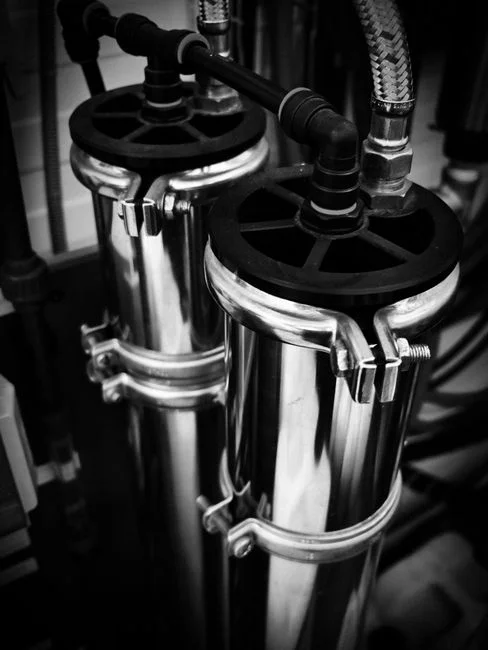
The blowdown treatment train is where the article's three streams re-converge. Side-stream filtration is the first step on the blowdown line: it drops suspended solids to levels manageable for downstream membranes, supports higher cycles of concentration without excessive fouling, and is sized at 1–5% of circulation flow per Genesis Water Technologies.
Ultrafiltration (UF) is the standard pretreatment for RO on blowdown. UF membranes with 0.01–0.1 micron pores operate at 10–30 psi, achieve 90–95% recovery, and require chemical cleaning only every 1–3 months. A UF pretreatment skid sized to the blowdown flow keeps silt density index (SDI) on the RO feed inside the membrane maker's envelope, which is the single most important variable for RO uptime on blowdown duty.
Reverse osmosis is the workhorse: 95–99% dissolved-solids removal, permeate TDS of 10–50 mg/L suitable for direct return to the cooling tower, and 50–85% recovery on blowdown feed. A 50,000 GPD RO skid treating blowdown is typically $250,000–500,000 installed with $1.50–3.00 per thousand gallons operating cost, per Genesis Water Technologies. Nanofiltration (NF) is the lower-pressure alternative — 75–150 psi and 70–85% recovery — when hardness and sulfate are the limiting parameters and full demineralisation is not required.
Membrane concentrate handling decides whether zero liquid discharge (ZLD) is on the table. Mechanical vapor compression (MVC) plus a crystallizer can reach 95–99% overall water recovery, but at $3–8 million capital and $5–15 per thousand gallons operating cost for a hyperscale installation, per Genesis Water Technologies. The table below summarises the membrane options an engineer would lift into a design basis.
| Technology | Pore / Cutoff | Operating pressure | Recovery on blowdown | Indicative capital cost (50,000 GPD class) | Indicative OPEX |
|---|---|---|---|---|---|
| Side-stream filtration | 10–25 µm | Gravity / low pressure | n/a (continuous side stream) | $50,000–200,000 | Solids disposal only |
| Ultrafiltration (UF) | 0.01–0.1 µm | 10–30 psi | 90–95% | Sized with RO train | Cleaning every 1–3 months |
| Reverse osmosis (RO) | Tight membrane | 150–400 psi | 50–85% | $250,000–500,000 | $1.50–3.00 per 1,000 gal |
| Nanofiltration (NF) | Loose RO | 75–150 psi | 70–85% | Lower than RO | Lower than RO |
| ZLD (MVC + crystallizer) | Thermal | n/a | 95–99% overall | $3–8 million | $5–15 per 1,000 gal |
Membrane selection should be driven by the blowdown water-quality objective, not by vendor preference. RO and UF membrane elements need to be specified against the actual SDI, temperature, and silica profile of the blowdown once COC has been fixed, and the antiscalant programme has to be matched to the chosen membrane, not selected later. The same membrane specification will also flow back into the make-up train, so a single chemistry envelope covers the front and the back of the plant.
Reuse vs Discharge vs Zero Liquid Discharge: The Decision Framework
Cooling-tower make-up reuse is the highest-value option, typically achieving 60–85% recovery and directly reducing both fresh-water intake and discharge volume, per Genesis Water Technologies. Where reuse is not feasible, discharge compliance is the fallback: in water-stressed regions direct discharge fees can exceed $5–15 per thousand gallons, and some jurisdictions cap TDS below 1,500 mg/L, which most blowdown exceeds without treatment. Zero liquid discharge is technically achievable (95–99% recovery) and is justified only where both reuse demand and discharge permits are restricted; expect $3–8 million capital and $5–15 per thousand gallons operating cost for a hyperscale installation, per Genesis Water Technologies.
Onsite treatment becomes mandatory when one of three conditions is met, per Ecologix Environmental Systems: (1) discharge exceeds local TDS or temperature limits, (2) the site commits to high-recovery recycling or ZLD, or (3) the local municipal treatment plant cannot accept the daily blowdown volume. In Kowloon, where the receiving water is the Victoria Harbour water control zone, the first condition is the one most likely to drive a mandatory onsite train.
The decision should be made on three numbers: the cost of the RO/NF train that reclaims 50–85% of blowdown for reuse, the avoided discharge fee at $5–15 per 1,000 gallons, and the incremental cost of stepping from 85% recovery to 95–99% via ZLD. If the avoided discharge fee is high and reuse demand is high, RO/NF pays back. If discharge is restricted altogether, ZLD is forced regardless of cost. If neither, direct discharge with permit compliance is the baseline.
Hong Kong Compliance and Siting Checklist for Kowloon

Engage the Water Supplies Department, the Electrical and Mechanical Services Department, and the Building Technology Research Institute early — these are the three HKSAR bodies that formally agreed in May 2025 to support recycled-water cooling in Hong Kong, per Data Centre Magazine on 2026-05-11. The earlier they are brought into the design, the easier the recycled-water acceptance criteria are to write into the design basis instead of retrofitting them at commissioning.
Confirm reclaimed-water source quality, supply volume, and pressure profile from the nominated government water reclamation plant before sizing the make-up RO and storage tanks. Define the cooling system's chemistry envelope — target cycles of concentration, biocide family, scale- and corrosion-inhibitor selection — before specifying blowdown treatment, because the chemistry drives the RO antiscalant programme and the discharge permit analysis. Plan for monitoring: real-time conductivity, pH, free biocide, and ORP on the loop, plus turbidity and SDI on the RO feed, so the team can prove compliance to HKSAR rather than just measure it.
Sizing inputs to lock down before detailed design include the nominated reclamation plant's average and peak effluent quality, the daily blowdown volume, the target COC, the receiving-water discharge limits, and the HKSAR-accepted analytical methods for the compliance report. Consumables and spare parts — membranes, chemicals, instrumentation — should be specified to local stockholding, and the supplier list should include water treatment parts, valves and media that are serviceable in Hong Kong on a realistic lead time, not on a factory-direct shipment from overseas.
Frequently Asked Questions
What does a 50,000 GPD blowdown RO skid realistically cost for a Kowloon data center?
A 50,000 GPD RO skid treating cooling-tower blowdown is typically $250,000–500,000 installed, with operating cost of $1.50–3.00 per thousand gallons treated, per Genesis Water Technologies. Request a quote that includes the UF pretreatment skid, the high-pressure pump, the energy recovery device (if any), the antiscalant skid, and the first three years of membrane replacements, because each of these is usually a separate line item that can shift the installed cost by 15–25%.
What should a Kowloon buyer look for when selecting a water-treatment supplier?
Look for documented experience coordinating with the Water Supplies Department, the Electrical and Mechanical Services Department, and the Building Technology Research Institute, since the May 2025 HKSAR agreement for the AWS Hong Kong project shows that this three-body interface is the actual regulator for recycled-water cooling in the city, per Data Centre Magazine on 2026-05-11. Also confirm local service coverage, membrane logistics (lead time for replacement elements landed in Hong Kong), and after-sales support that can attend site within an agreed response window.
When does a Kowloon data center actually need zero liquid discharge instead of RO reuse?
ZLD — defined as 95–99% overall water recovery via RO plus MVC plus a crystallizer — is justified only where both reuse demand is fully used up and discharge is restricted. The indicative cost is $3–8 million capital and $5–15 per thousand gallons operating cost for a hyperscale installation, per Genesis Water Technologies. In most Kowloon cases, an RO train at 50–85% recovery feeding the cooling-tower make-up is sufficient, and ZLD is reserved for sites where the receiving water control zone prohibits discharge of the residual.
How much blowdown will a typical Kowloon cooling loop actually generate?
At 4 cycles of concentration a cooling tower loses approximately 25–30% of its make-up water to blowdown, and pushing to 6 cycles of concentration reduces blowdown volume by roughly one third for the same evaporative duty. Blowdown TDS at these COC values is typically 1,200–6,000 mg/L, about 4–8 times the make-up TDS, per Genesis Water Technologies. The blowdown volume is the figure that sizes the UF, RO, and concentrate-handling equipment downstream.