Why a Fortaleza Data Center Cannot Reuse a São Paulo or Brasília Template
Fortaleza sits inside a regulatory stack that no inland Brazilian metro shares. The Ceará water-rights clock is run by COGERH, which allocates basin withdrawals across the Metropolitan, Cocó, and Pacajus systems; the discharge-permit clock is run by SEMACE, which issues the estadual licença separately from the federal outorga; and the industrial-tariff clock is run by ARCE, the state regulator that sets CAGECE industrial rates and reviews them against scarcity declarations issued by the Secretariat of Water Resources (SRH/CE) under the SAGRE/CEARÁHÍDRICOS banner. A procurement lead who treats these as a single permit conversation will miss the sequencing window and end up with equipment delivered before the outorga is granted, the same trap documented in the São Paulo 2026 engineering guide for the ANA + CETESB stack.
The coastal-discharge context adds a third variable absent from São Paulo or Brasília: any SEMACE licença for surface or marine outfall will be reviewed against CONAMA 430 chemistry caps and a biological-quality overlay covering coliforms, residual Cl/Br, and temperature. A Fortaleza campus discharging to the Pacajus/Eusébio corridor or directly to coastal waters cannot lean on a São Paulo-style interceptor discharge because the receiving body and the permit scrutiny are not the same. Ceará's recurring scarcity declarations shorten the window where a deferred reuse train is permissible: front-end engineering must raise the reuse question against the water-rights calendar, not the equipment delivery calendar, or the COGERH allocation will be granted on a baseline that no longer fits when scarcity is declared mid-year.
Two Effluent Streams, Two Permits: Blowdown and Sanitary Wastewater
A Fortaleza campus produces two chemically distinct effluent streams that converge at the discharge point but require separate treatment trains under the 2026 SEMACE permit framework. Stream 1 is cooling-tower blowdown, the bleed that holds cycles of concentration (COC) at 4–6 to prevent scale; blowdown volume is governed by the relationship Blowdown = Makeup / (COC − 1), running 0.3–0.8% of makeup volume. At a 40 MW site with PUE 1.4 and an adiabatic/economizer hybrid loop, blowdown flow is roughly 60–240 m³/day. For upper-bound sizing, the 100 MW reference of up to 2 million L/day sets the hyperscale ceiling (IDE, 2026 framing). Stream 2 is sanitary wastewater from staff, cafeteria, and restrooms: 50–100 L/person/day, BOD 150–300 mg/L, TSS 150–250 mg/L, NH₃-N 20–40 mg/L, governed by CAGECE interceptor and CONAMA 430 sanitary caps unless reused on site (HydropureWater 2026 São Paulo field envelope, applicable as a baseline for Brazilian sanitary envelopes).
The two streams must be engineered as parallel trains from day one because SEMACE's biocide-toxicity caps on blowdown are decoupled from the BOD/TSS caps on sanitary discharge. A single combined treatment train fails the biocide cap in 2026, the same structural failure documented for CETESB in the São Paulo 2026 engineering guide. Pushing COC from 4 to 6 cuts blowdown volume and water demand but intensifies scaling, which is why RO polishing only works after softening.
| Parameter | Stream 1 — Cooling tower blowdown (4–6 COC) | Stream 2 — Sanitary wastewater |
|---|---|---|
| Flow envelope | 0.3–0.8% of makeup; 60–240 m³/day at 40 MW, PUE 1.4 | 50–100 L/person/day |
| TDS | 1,500–2,500 mg/L | — |
| Total hardness as CaCO₃ | 400–800 mg/L | — |
| Free Cl/Br residual | 5–50 mg/L | — |
| TSS | 5–30 mg/L | 150–250 mg/L |
| BOD | — | 150–300 mg/L |
| NH₃-N | — | 20–40 mg/L |
| Permit driver | SEMACE biocide toxicity + CONAMA 430 | CAGECE interceptor + CONAMA 430 sanitary |
| Source | HydropureWater 2026 São Paulo field data (baseline) | HydropureWater 2026 São Paulo field envelope (baseline) |
The Five-Unit Blowdown Train: Equalize, Dechlor, Clarify, Soften, Polish
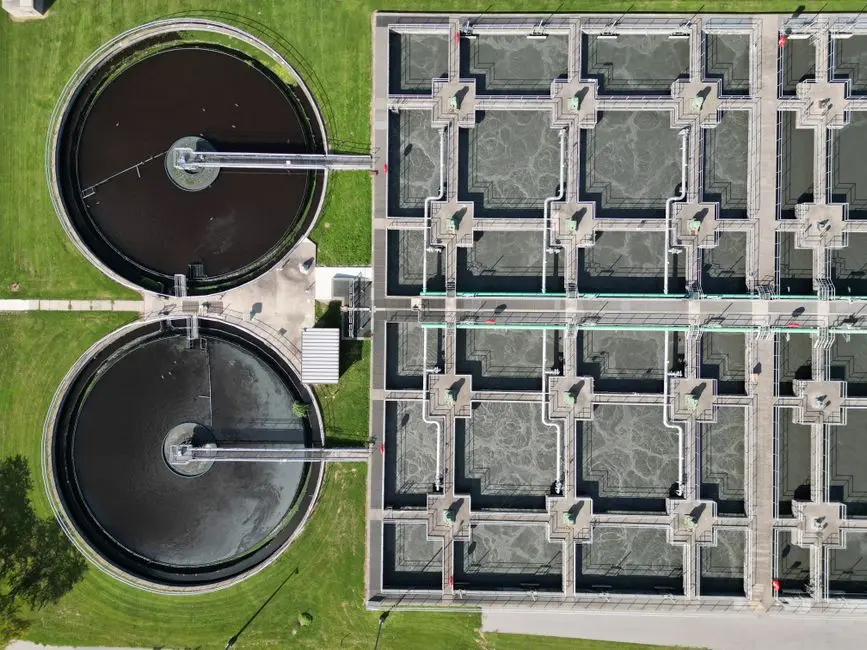
The Fortaleza blowdown train is five unit operations designed to hit either CONAMA 430 discharge or cooling-makeup reuse without changing the upstream sequence. Step 1 is equalization, a 24–48 h hold-and-decay tank sized to blowdown volume, with sodium bisulfite dosing to drop free Cl/Br residual to ≤0.5 mg/L at the point of discharge to meet CONAMA 430 biocide-toxicity caps (HydropureWater 2026 São Paulo guide, applicable as a baseline permit envelope). Step 2 is the DAF clarification unit, deployed only when inlet TSS exceeds 20 mg/L or oils/greases are present; the catalogue envelope of 4–300 m³/h covers colocation to mid-size hyperscale flow rates, and pairing it with the JY integrated purifier or lamella clarifier cuts chemical consumption by up to 30% versus conventional trains.
Step 3 is lime-soda softening using a lime-soda softening skid in the 1–45 T/h envelope for twin-tank continuous operation, pulling Ca²⁺, Mg²⁺, and silica below the scaling threshold so the downstream RO can run at 75–95% recovery without antiscalant overdose. Step 4 is an industrial RO polishing unit at 50,000 GPD, $250,000–$500,000 installed, OPEX $1.50–$3.00/kgal, with multi-media plus 5 µm cartridge pretreatment and permeate TDS of 10–50 mg/L suitable for cooling-tower makeup (Genesis Water Tech 2026). Step 5 is a ClO₂ generator on the reuse loop, 50 g/h to 20,000 g/h on-site generation, EPA/EU/WHO compliant, controlling biofilm in the polished-water storage tank without forming trihalomethanes. Where the basin TDS crosses 1,500 mg/L during scarcity, the same train upgrades to ZLD by adding MVC (15–25 kWh/kgal distillate, 95–98% recovery) and a forced-circulation crystallizer, with CAPEX $3–8M and OPEX $5–15/kgal at 95–99% overall recovery (Genesis Water Tech 2026).
| Step | Unit operation | Key parameter |
|---|---|---|
| 1 | Equalization + bisulfite dechlorination | 24–48 h hold, ≤0.5 mg/L free Cl |
| 2 | DAF clarification unit | 4–300 m³/h, TSS >20 mg/L trigger |
| 3 | Lime-soda softening skid | 1–45 T/h, twin-tank continuous |
| 4 | Industrial RO polishing unit | 50,000 GPD, 75–95% recovery, $250–500k |
| 5 | ClO₂ generator on the reuse loop | 50 g/h – 20,000 g/h, EPA/EU/WHO |
Sanitary Train: WSZ Packaged STP vs Submerged MBR by Reuse Intent
Below roughly 80 m³/day of sanitary flow with no reuse intent, a WSZ packaged sanitary STP in the 1–80 m³/h envelope handles the load fully buried, with no on-site operator and a single annual sludge pump-out, fitting the colocation tier and small metros. For a 40–80 MW site that wants to reuse treated sewage for cooling-tower makeup, irrigation, or toilet flush, specify a submerged MBR sanitary plant with PVDF membranes at <1 µm pore size, 60% smaller footprint than CAS, effluent BOD <5 mg/L, TSS <1 mg/L, meeting reuse targets without tertiary polishing. The replaceable DF-series flat-sheet membrane modules cover 10–2,000 m³/day campus WWTPs and clean in place with standard CIP chemistry, which matters when SEMACE audits the membrane integrity log.
Sludge handling is sized to the train: a plate-and-frame filter press at 1–500 m² filtration area handles MBR waste-activated sludge volume for hyperscale sites; for colocation sites, the WSZ unit drains to a sludge holding tank and is pumped out annually. The decision point is reuse intent: if the sanitary stream is going to a CAGECE interceptor, the WSZ passes; if it is going back into the cooling loop, the MBR is the only path that meets the reuse TDS/BOD envelope without a tertiary polishing stage bolted on.
| Criterion | WSZ packaged sanitary STP | Submerged MBR sanitary plant |
|---|---|---|
| Flow envelope | 1–80 m³/h | 10–2,000 m³/day (via DF-series modules) |
| Effluent BOD | Meets CONAMA 430 sewer cap | <5 mg/L (reuse-grade) |
| Effluent TSS | Meets CONAMA 430 sewer cap | <1 mg/L (reuse-grade) |
| Operator | None on-site | Membrane integrity log required |
| Sludge handling | Annual pump-out, or plate-and-frame filter press for larger loads | Plate-and-frame filter press sized to WAS |
| Decision driver | Interceptor discharge, no reuse | Cooling makeup, irrigation, or toilet flush reuse |
Tiered Sizing: Colocation, Mid-Size, and Hyperscale Fortaleza Campuses
Three tiers, each tied to COC and reuse targets rather than a fixed process flow, let a procurement manager pick a scope by campus size and water-stewardship ambition instead of forcing a one-size-fits-all tender. Tier 1 (colocation, <5 MW) is a WSZ packaged sanitary plant with blowdown discharged to CAGECE interceptor under SEMACE; no RO, no softening, and a DAF clarification unit only if oils or TSS exceed 20 mg/L. Tier 2 (mid-size, 5–30 MW) layers WSZ or MBR sanitary plus DAF, lime-soda softening skid, and side-stream RO on blowdown, with a ClO₂ generator on the reuse loop, pushing COC to 6–8 to cut blowdown volume. Tier 3 (hyperscale, 30+ MW) is the full MBR sanitary, full pretreatment-RO train on blowdown, optional ZLD when basin TDS exceeds 1,500 mg/L, and reclaimed-CAGECE-effluent makeup enabled through a CAGECE concession.
The JY integrated water purification system and the high-efficiency sedimentation tank (lamella clarifier) fit Tier 2 and Tier 3 polishing loops, cutting chemical consumption by up to 30% versus conventional trains and reducing footprint in the mechanical room, which is the constraint on most Fortaleza metro sites.
| Tier | Load | Sanitary train | Blowdown train | COC target |
|---|---|---|---|---|
| Tier 1 (colocation) | <5 MW | WSZ packaged sanitary plant | CAGECE discharge; DAF clarification unit if TSS >20 mg/L | 4–5 |
| Tier 2 (mid-size) | 5–30 MW | WSZ or MBR | DAF + softener + side-stream RO + ClO₂ | 6–8 |
| Tier 3 (hyperscale) | 30+ MW | Full MBR | Full pretreatment-RO, optional ZLD above 1,500 mg/L TDS | 7–10 with RO |
2026 Payback Math: CAGECE Tariff, Discharge Fees, and the RO Crossover
RO water reuse CAPEX pays back in under 3 years when municipal potable tariffs exceed roughly R$15/m³, a threshold already crossed in industrial allocations in multiple Brazilian metros (HydropureWater 2026 São Paulo reference). A 50,000 GPD RO on blowdown installs for $250,000–$500,000 with OPEX of $1.50–$3.00/kgal (Genesis Water Tech 2026). The discharge-fee offset of $5–15 per thousand gallons in water-stressed regions is a regional benchmark from Genesis Water Tech (2026), not a Fortaleza-specific rate; for a 2026 RFQ the buyer must request the current SEMACE fee schedule before stacking this line, because the exact Ceará figure was not located in the available research.
MVC + crystallizer ZLD is defensible only when basin TDS exceeds 1,500 mg/L or discharge is effectively prohibited; budget $3–8M CAPEX with $5–15/kgal OPEX at 95–99% overall recovery (Genesis Water Tech 2026). Without side-stream RO, target 4–6 COC to keep blowdown TDS manageable for discharge under CONAMA 430 and the SEMACE coastal overlay; with side-stream RO and lime-soda softening skid, push to 7–10 COC and recover more than 75% of blowdown as reuse water (HydropureWater 2026 São Paulo baseline, methodology applicable to Fortaleza). Chemical dosing across the train is handled by an automatic chemical dosing system sized to the peak blowdown flow, and the RO/UF membrane elements come from the RO/UF membrane elements range.
| Reuse path | CAPEX anchor | OPEX anchor | Defensibility trigger |
|---|---|---|---|
| Side-stream RO on blowdown (50,000 GPD) | $250,000–$500,000 | $1.50–$3.00/kgal | Industrial tariff >R$15/m³ |
| Full ZLD (RO + MVC + crystallizer) | $3–8M | $5–15/kgal | Basin TDS >1,500 mg/L or discharge prohibited |
| Discharge-fee offset (water-stressed regions) | — | $5–15/kgal (Genesis Water Tech 2026, regional benchmark; Fortaleza-specific SEMACE fee to be confirmed) | Stack against CAPEX in RFQ |
| COC without side-stream RO | Low | Standard discharge under CONAMA 430 + SEMACE | Default Tier 1 |
Frequently Asked Questions
What cycles of concentration should a Fortaleza data center target if it does not install side-stream RO on blowdown?
Target 4–6 COC to keep blowdown TDS manageable for discharge under CONAMA 430 and the SEMACE coastal overlay; pushing beyond 6 without softening and RO only intensifies scaling on heat exchangers and raises the SEMACE biocide-toxicity risk.
When is MVC + crystallizer ZLD defensible in Fortaleza, and what is the budget anchor?
ZLD is defensible only when COGERH basin TDS exceeds 1,500 mg/L or discharge is effectively prohibited during a SAGRE/CEARÁHÍDRICOS scarcity declaration; budget $3–8M CAPEX with $5–15/kgal OPEX at 95–99% overall recovery, and align the trigger with the COGERH scarcity calendar rather than the equipment delivery calendar (Genesis Water Tech 2026).
In what order should COGERH, SEMACE, and CAGECE permits be sequenced for a Fortaleza campus in 2026?
COGERH basin allocation (outorga federal/estadual de uso de água) must be raised first to lock the makeup volume; SEMACE licença estadual follows with the discharge envelope; CAGECE interceptor connection or industrial-tariff review by ARCE is the last clock, because CAGECE will not sign the industrial user permit without an active SEMACE licença in hand.
What is the CAPEX order of magnitude for a 50,000 GPD RO on cooling blowdown, and what supplier inputs should a buyer request before signing?
Installed CAPEX runs $250,000–$500,000 with OPEX of $1.50–$3.00/kgal (Genesis Water Tech 2026), but a buyer should request the current SEMACE fee schedule, the ARCE-reviewed CAGECE industrial tariff binding for the campus, and the COGERH scarcity-probability clause for the relevant basin before signing, because the exact Ceará tariff and discharge-fee figures were not located in the available research and must be confirmed with the local regulator rather than estimated.