Why the Pretreatment Equation for Dubuque Is Federal Floor Plus Local Cap
Federal 40 CFR Part 433 sets the categorical PSES/PSNS numbers for the Metal Finishing point source category, and the Dubuque Water & Resource Recovery Center enforces local limits developed under 40 CFR 403.5 that are always at least as stringent. The plant must meet whichever is stricter on each parameter, which is why the design envelope is built from the POTW table, not the federal table alone.
Part 433 covers forming, finishing, forging, foundry, metal spraying, and machining wash operations that are co-located with plating or anodizing lines. A stamping shop that ships only dry parts to a separate finisher is generally outside the category; a facility that runs its own zinc, nickel, or chromic acid tank is inside it (hydropurewater.com, 2026). PSES applies to existing sources and PSNS to new sources, with PSNS tighter because it applies to facilities constructed after the rule's promulgation date; in practice most POTW pretreatment programs enforce PSNS-equivalent local limits on all industrial users as a conservative baseline.
Local limits add the pollutants the categorical rule underweights: copper, nickel, zinc, lead, and silver caps, plus oil & grease, TSS, and pH. The 2026 Dubuque daily-max numbers in use are Cu <3.38 mg/L, Ni <3.98 mg/L, and Zn <2.61 mg/L, with monthly averages of Cu 2.07, Ni 2.38, and Zn 1.48 mg/L (hydropurewater.com, 2026). The table below pairs these local numbers with the federal framework so the controlling value is visible at a glance.
| Parameter | 40 CFR Part 433 PSNS Daily Max (mg/L) | Dubuque WRRC Daily Max (mg/L) | Dubuque WRRC Monthly Avg (mg/L) | Controlling Limit |
|---|---|---|---|---|
| Copper (Cu) | 3.38 | 3.38 | 2.07 | Local monthly avg (2.07) |
| Nickel (Ni) | 3.98 | 3.98 | 2.38 | Local monthly avg (2.38) |
| Zinc (Zn) | 2.61 | 2.61 | 1.48 | Local monthly avg (1.48) |
| Total Chromium | 2.77 | Site-specific | Site-specific | Whichever is stricter |
| Lead (Pb) | 0.69 | Site-specific | Site-specific | Whichever is stricter |
| Cadmium (Cd) | 0.69 | Site-specific | Site-specific | Whichever is stricter |
| Silver (Ag) | 0.43 | Site-specific | Site-specific | Whichever is stricter |
| Oil & Grease / TSS / pH | Not in Part 433 | Local caps apply | — | Local limit |
The same compliance logic applies to fabricated metals plants near Pleasant Prairie, WI on sewer pretreatment compliance, where the local POTW table is again the binding envelope. Treat the monthly-average column as the design floor for equalization and chemistry capacity; treat the daily-max column as the operating ceiling for any single grab sample.
What a Dubuque Fabricated Metals Floor Actually Discharges
Four contaminant families dominate every fabricated metals floor regardless of the specific process mix, and each one drives a different unit operation downstream.
- Emulsified oils from stamping, machining, and drawing compounds, typically 50-500 mg/L on a mixed floor drain.
- Dissolved heavy metals (Zn, Ni, Cu, Cr, Pb, Cd) from plating rinsewater and acid pickling, with total dissolved metals running 5-200 mg/L.
- Hexavalent chromium from chromic acid anodizing, hard chrome, and conversion coating, which can spike Cr(VI) past 50 mg/L on a rinse dump and drop pH below 2.
- Total suspended solids from grinding swarf, casting sand, and hydroxide floc carryover, with TSS at 100-1,000 mg/L.
HydropureWater field data from 2026 shows pH swinging between 2 and 12 across batch dumps, which is the single most common reason an undersized equalization basin sends a slug through the chemistry train (hydropurewater.com, 2026). A stamping cell may hold pH at 7 with low metals; a hard chrome line will spike Cr(VI) past 50 mg/L and drop pH below 2 on a rinse dump.
Dubuque job-shop specifics tighten the picture. Emulsified oils run 50-500 mg/L, chelated metals 10-50 mg/L, and colloidal particles sit below 10 microns, which means a standard clarifier typically lets more than 60% of these solids pass into the effluent without active coagulation and flocculation (hydropurewater.com, 2026). Daily volumes land between 5,000 and 50,000 GPD delivered in 10-50 GPM batch pulses, so flow variability is the primary operational hurdle, not average load.
Cyanide appears wherever alkaline cyanide plating (Zn, Cu, Cd, Ag) is still in use, and it must be destroyed before metals precipitation or it will resolubilize the precipitates downstream (hydropurewater.com, 2026). Treat cyanide as the parameter that can quietly undo an otherwise well-designed precipitation stage if it is left for the separator to handle.
Equalization Is the Unit Operation That Makes the Chemistry Work
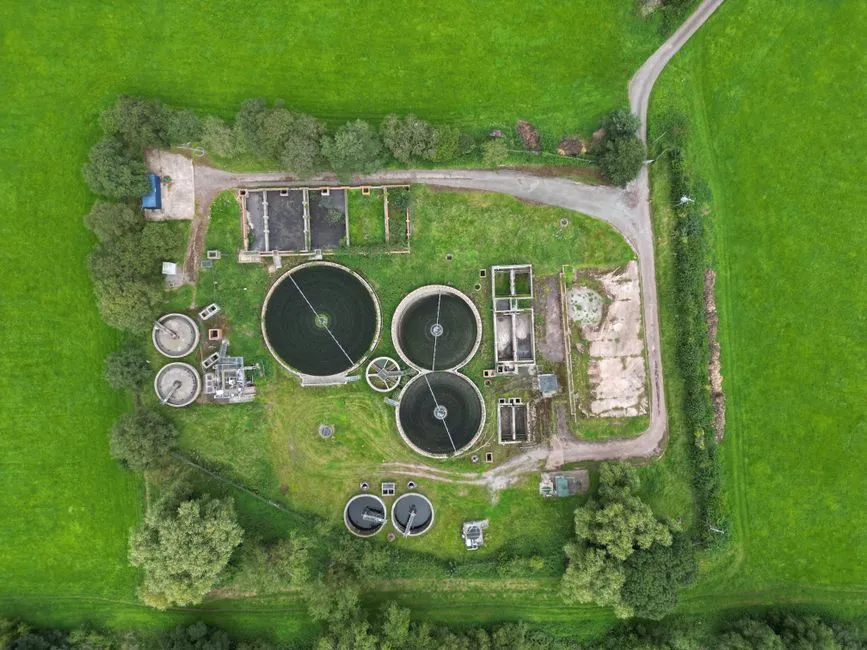
Plating and pickling shops run batch dumps, not steady flow, so equalization is not optional; it is the unit operation that makes the chemistry downstream work at all.
A 4-hour composite that misses a Friday afternoon dump will undersize the equalization basin, and the field rule is to sample a full week of composite flow before specifying equipment (hydropurewater.com, 2026). Sizing off an instantaneous flow or a single shift underestimates both the hydraulic surge and the chemical slug; both errors are then paid for in PLC alarms, off-spec effluent, and premature sludge handling.
The Dubuque sewer use ordinance requires a formal slug load control plan because batch discharges from plating or machining lines can cause hydraulic or chemical shocks, and equalization tanks are a mandatory precursor to any primary treatment system (hydropurewater.com, 2026). Failure to equalize pH, which frequently swings between 2 and 11 in metal finishing, leads to non-compliance regardless of whether the primary separator is a DAF or a clarifier.
Target equalization outlet at pH smoothed into the 6-9 range and a flow coefficient of variation below 0.5, which lets the downstream reactors run at design point instead of chasing swings. Without that smoothing, the pH trim skid, the chrome reduction stage, and the precipitation stage all fight each other for the same pump capacity on the same upset.
The Pretreatment Train, Unit by Unit, with Setpoints and Failure Modes
The standard sequence a fabricated metals plant uses to hit PSNS-equivalent POTW limits is screening, pH trim, hex chrome reduction, cyanide destruction, hydroxide precipitation, separation, and pH trim/final polish, with each step carrying a defined purpose and a defined failure mode if it is skipped (hydropurewater.com, 2026).
- Screening. A rotary mechanical bar screen for headworks protection upstream of the equalization basin keeps rags, wipes, and tramp metal out of the sludge train. This is the single most common cause of premature filter-press cloth failure, so it is the cheapest unit operation in the train to install and the most expensive to omit.
- pH trim and chemical dosing. Feedforward flow-paced control on a PLC-controlled automatic chemical dosing skid for chrome reduction, cyanide oxidation, and pH trim, using NaOH or H2SO4. Each pump needs a calibration column and a stroke-count totalizer; without those, the operator is dosing blind and the effluent proves it.
- Hexavalent chrome reduction. Sodium metabisulfite (or ferrous sulfate) at pH 2-3 with ORP controlled around 250-300 mV, converting Cr(VI) to Cr(III). The trivalent form then precipitates as Cr(OH)3 in the pH 8.5-9.5 stage, where hex chrome hydroxide would otherwise stay soluble through precipitation.
- Cyanide destruction. NaOCl alkaline chlorination must run before metals precipitation, because residual cyanide resolubilizes the metal hydroxides downstream. Skip this step on a cyanide-bearing line and the precipitation stage will discharge chelated metals no matter how clean the chemistry looks on paper.
- Hydroxide precipitation. pH 8.5-9.5 raises dissolved metals as Cr(OH)3, Ni(OH)2, Cu(OH)2, and Zn(OH)2. The four chemicals on the skid are NaOH/H2SO4, sodium metabisulfite, NaOCl, and anionic/cationic polymer.
- Separation. Dissolved air flotation or lamella clarification. DAF uses 200-micron-range microbubbles to lift floc with specific gravity as low as 0.5-1.5, while a lamella clarifier relies on Stokes' Law and needs particle specific gravity above 2.0 for reliable settling (hydropurewater.com, 2026).
- pH trim and final polish. Most fabricated metals plants hit sewer limits with this train and never need a polishing step. The cases that do are a tightened POTW local limit, a reuse specification, or a future rule such as the 2026 EPA PFAS rulemaking scoped to chrome finishing facilities.
Skid-mounting the chemical dosing package cuts field install time, forces the integrator to bench-test interlocks before shipment, and gives the operator one panel to lock out instead of five loose pumps.
DAF vs Lamella Clarifier for a Dubuque Floor Drain
DAF is favored for variable, low-density streams; lamella is favored for heavy, settleable solids at high steady flow. Pick the separator after the influent profile is in hand, not before.
DAF sizing is governed by three knobs: hydraulic surface loading of 4-20 m/h depending on model and floc density, air-to-solids ratio of 0.005-0.060 with 0.02 a typical design point, and recycle rate of 10-30% of forward flow (hydropurewater.com, 2026). Pushing A/S higher produces a drier float but costs blower power and can shatter fragile floc; pushing recycle rate higher improves TSS removal but dilutes the chemistry and inflates equalization demand.
The Dubuque climate adjustment matters. A 15% derating factor is recommended; standard hydraulic loading is 1.5-2.5 m3/m2h, but Dubuque designs should target 1.7 m3/m2h to keep performance consistent through the 5-10°C winter window (hydropurewater.com, 2026). PJOES 2026 (vol. 214082) reports that DAF at pH 4.5 paired with polymer dosing can reduce sulfate from 1,753 mg/L to below 500 mg/L, a relevant data point for plants with high-volume acid pickling lines (hydropurewater.com, 2026). DAF reaches steady state in under 30 minutes, which matches the 10-50 GPM batch pulses typical of Dubuque job shops, while gravity clarifiers need long lead times to build a sludge blanket.
Lamella clarifier economics: OPEX typically $0.05-0.08 per kgal on heavy, settleable solids at flows above 500 GPM. This advantage disappears when FOG exceeds 50 mg/L or chelated metals exceed 10 mg/L, because a secondary oil-water separator or advanced chemical precipitation is then required, nullifying the cost advantage (hydropurewater.com, 2026). For a deeper walkthrough of the same DAF sizing knobs, the DAF oil water separator design criteria for 2026 covers the oilier end of the spectrum and the micro bubble flotation design criteria for 2026 covers finer microbubble sizing for tight floc.
| Criterion | DAF | Lamella Clarifier |
|---|---|---|
| Effective particle SG range | 0.5-1.5 (float) | >2.0 (settle) |
| Microbubble size | ~200 µm | N/A |
| Hydraulic loading (Dubuque) | 1.7 m3/m2h (15% derate) | Higher; not temperature-limited |
| Time to steady state | < 30 minutes | Long (blanket build-up) |
| OPEX on heavy settleable solids at >500 GPM | Higher | $0.05-$0.08 per kgal |
| OPEX on FOG > 50 mg/L or chelated > 10 mg/L | Single unit meets limits | Requires secondary separator or advanced chemistry |
| Polymer demand | 15-25 mg/L, PLC-adjusted | Lower on dense solids |
| Sludge concentration | Higher (drives hauling OPEX down) | Lower (drives hauling OPEX up) |
Operational rule of thumb: if FOG is below 50 mg/L and the solids are dense, a lamella clarifier for heavy, settleable solids streams is the lower-OPEX pick. Once FOG or chelated metals cross those thresholds, an industrial DAF system for fabricated metals wastewater is the only single-unit primary treatment that consistently meets discharge limits.
Sludge Handling, Interlocks, and Operator Visibility
A passing DMR report is the product of the solids side as much as the chemistry side, so the sludge train and the PLC interlock list deserve the same engineering effort as the reactors.
Floated metal-hydroxide sludge typically runs 2-5% dry solids out of the DAF and dewaters to 25-35% with a plate and frame filter press for metal-hydroxide sludge. A belt press is cheaper and continuous but caps around 22% dry solids on metal hydroxide, so if the hauler is paying by wet ton, plate and frame pays back (hydropurewater.com, 2026). Dubuque Metro Landfill sludge-haul cost runs $0.12-$0.18 per gallon, which makes the higher solids concentration from DAF skimmers a real driver of long-term OPEX (hydropurewater.com, 2026).
PLC alarm and shutdown interlocks on pH excursion, ORP out of range, and high TSS should automatically divert flow back to the equalization basin header, so a chemistry upset becomes a recirculated batch rather than a discharge violation. Skid-mounting the chemical dosing package cuts field install time, forces the integrator to bench-test interlocks before shipment, and gives the operator one panel to lock out instead of five loose pumps.
Before committing capital expenditure, a 30-day on-site pilot study is recommended to validate chemical dosing ratios and hydraulic loading rates specific to the facility's unique blend of process chemicals (hydropurewater.com, 2026). Pilot data also sets the alarm setpoints the PLC will run against, so the interlocks protect effluent quality instead of just satisfying an inspector.
Designing for the 2026 EPA PFAS Rulemaking Without Paying for It Twice

EPA has a live PFAS rulemaking scoped to chrome finishing facilities as of 2026, with no current numerical PFAS limit for chrome finishers, per the EPA Metal Finishing Effluent Guidelines page. The 2026 design move is to lay out the pretreatment train so an anion exchange or GAC polish skid can be bolted on later, not to install polish now and pay to operate it ahead of any actual limit (hydropurewater.com, 2026).
If the plant also wants to reuse rinsewater, a submerged PVDF MBR membrane bioreactor system delivers under-1-micrometer filtration and stable effluent that can go to cooling tower makeup. For sub-ppm TDS or specific metal caps like Ni below 0.1 mg/L, an RO system is required, and the upstream multi-media filter must hold SDI15 below 3 or the RO membranes fail early (hydropurewater.com, 2026). For the PFAS question, anion exchange or granular activated carbon is the proven polish step for the long-chain PFAS species tied to chrome plating.
Closed-loop zero liquid discharge is rarely economic for a fabricated metals plant unless water scarcity or a specific reuse-economics case supports the capital (hydropurewater.com, 2026). The right framing for 2026 is a future-proof train: design the hydraulic and footprint envelope for a polish skid, leave the utility stubs in place, and defer the spend until the rule lands or a reuse contract underwrites the membrane system.
2026 CAPEX, OPEX, and Iowa Tax Position for a Dubuque Plant
A turnkey 200 GPM DAF installation in the Dubuque region typically runs $250,000 to $450,000, with variance driven by 304 vs 316 stainless steel, automation level, and chemical dosing complexity (hydropurewater.com, 2026). Winterization, including insulated piping, heat tracing, and a heated enclosure for outdoor installations, adds 15% to 25% to the base equipment cost; for a 200 GPM DAF that aligns with the $25,000-$40,000 winterization premium called out for Dubuque outdoor installations (hydropurewater.com, 2026).
Acid-pickling chloride exposure requires 316SS, which adds roughly 35% to the vessel cost versus 304SS (hydropurewater.com, 2026). The 2026 Dubuque industrial electric rate is $0.068/kWh, which makes DAF saturation pump power manageable. The larger variable is sludge hauling at $0.12-$0.18 per gallon to the Dubuque Metro Landfill, which is why DAF solids concentration matters more than pump kWh on a 5-year OPEX view (hydropurewater.com, 2026).
Iowa Code section 423.3(47) provides a sales and use tax exemption for industrial machinery and equipment directly and primarily used in manufacturing, with a strict 'direct use' interpretation; the exemption can apply to wastewater treatment systems if treatment is an integrated part of the production line or required for the facility to operate. Confirm qualification with a tax professional or the Iowa Department of Revenue before bidding the project as tax-exempt (hydropurewater.com, 2026). The same compliance and budgeting logic that drives Dubuque applies to fabricated metals plants near Pleasant Prairie, WI on sewer pretreatment compliance, where local POTW tables again set the design envelope.
Frequently Asked Questions
Which standard actually governs my discharge, 40 CFR Part 433 or the Dubuque local limits?
Both govern, and the stricter value on each parameter controls. 40 CFR Part 433 sets PSES and PSNS numbers for the Metal Finishing category; the Dubuque Water & Resource Recovery Center enforces local limits developed under 40 CFR 403.5 that are always at least as stringent. The 2026 Dubuque daily-max numbers in use are Cu <3.38, Ni <3.98, and Zn <2.61 mg/L, with monthly averages of Cu 2.07, Ni 2.38, and Zn 1.48 mg/L. Design to whichever column is tighter on a parameter-by-parameter basis, and run a one-week composite characterization before specifying equipment so the equalization basin matches the actual batch envelope (hydropurewater.com, 2026).
What CAPEX and budget range should I plan for a 200 GPM system in Dubuque?
A turnkey 200 GPM DAF installation in the Dubuque region typically runs $250,000 to $450,000, with the variance driven by 304 vs 316 stainless steel, automation level, and chemical dosing complexity. Winterization (insulated piping, heat tracing, heated enclosure) adds 15% to 25% to the base equipment cost, which for a 200 GPM DAF aligns with the $25,000-$40,000 winterization premium called out for Dubuque outdoor installations (hydropurewater.com, 2026). Before committing to capital expenditure, run a 30-day on-site pilot study and request a vendor proposal that itemizes metallurgy, automation, winterization, and sludge handling as separate line items so the budget can be defended internally.
Should I pick DAF or a lamella clarifier for my specific influent profile?
Match the separator to the contaminant mix, not the flow number. DAF is the right pick when FOG exceeds 50 mg/L, chelated metals exceed 10 mg/L, or the stream carries sub-10-micron colloids, because DAF lifts floc with specific gravity as low as 0.5-1.5 while a lamella clarifier needs particle SG above 2.0 for reliable settling (hydropurewater.com, 2026). A lamella clarifier becomes the lower-OPEX pick at flows above 500 GPM with heavy, settleable solids and FOG below 50 mg/L, where OPEX typically runs $0.05-$0.08 per kgal. Request a side-by-side proposal from each vendor that lists surface loading at the Dubuque 1.7 m3/m2h winter design point, polymer demand, and expected sludge concentration.
Should I install PFAS polish now or design the train for a future bolt-on?
Design for a future bolt-on, not for a polish skid today. EPA has a live PFAS rulemaking scoped to chrome finishing facilities as of 2026, with no current numerical PFAS limit for chrome finishers, per the EPA Metal Finishing Effluent Guidelines page (hydropurewater.com, 2026). The 2026 move is to lay out hydraulic capacity, footprint, and utility stubs for an anion exchange or GAC polish skid so it can be added when the numerical limit lands, rather than paying to operate a polish stage ahead of any actual limit. Revisit the decision whenever EPA publishes a chrome-finishing-specific PFAS number, and re-bid the polish skid against the now-defined target species.
Related Equipment
- industrial DAF system for fabricated metals wastewater — specifications, capacity range, and technical data
- PLC-controlled chemical dosing skid for chrome reduction, cyanide oxidation, and pH trim — specifications, capacity range, and technical data
- plate and frame filter press for metal-hydroxide sludge — specifications, capacity range, and technical data
- rotary mechanical bar screen for headworks protection — specifications, capacity range, and technical data
- lamella clarifier for heavy, settleable solids streams — specifications, capacity range, and technical data