What Anodizing Wastewater Sludge Actually Is
Anodizing wastewater sludge is the gelatinous, 1–4% dry-solids underflow produced when sulfuric acid anodizing rinse flow is neutralized to pH 8–9 and dissolved aluminum is precipitated as aluminum hydroxide — typically alongside co-precipitated calcium sulfate when lime is the reagent. The feed is a mix of free sulfuric acid dragged out of the bath (anodizing electrolytes run 5–18% H2SO4), dissolved aluminum from the anodizing reaction itself (the Al2O3 you grow is partially chemical-dissolved into the rinse), and alloy- or process-dependent contaminants: copper from 2xxx-series alloys, nickel acetate from sealing tanks, iron and silicon from caustic etch and de-smut (nitric or proprietary acid) steps, plus dye organics if color anodizing is in the line (finishing.com, 2002).
Raising pH with NaOH or lime converts dissolved Al3+ to amorphous Al(OH)3, which flocculates as a low-density, water-laden gel. Most plants run a two-stage pH adjustment: stage 1 to pH 4–5 handles the bulk acid load cheaply, and stage 2 trims to 8.0–8.5 for complete metal precipitation. When lime (Ca(OH)2) is the reagent, sulfate co-precipitates as gypsum (CaSO4·2H2O), which reports to the cake and dilutes the Al(OH)3 fraction. That co-precipitate also defines a hard ceiling: lime treatment cannot push effluent sulfate below roughly 2,400 ppm SO4 because of CaSO4 solubility — which is why many municipal discharge permits on this stream cluster near 1,700 ppm SO4 rather than below it (finishing.com, 2002). The clarifier underflow, at 1–4% dry solids, is the central design number for every downstream dewatering decision. Understanding how your chosen thickener affects underflow density and the subsequent press cycle is essential for system sizing — see the comparison of DAF vs clarifier for fabricated metals wastewater.
The Chemistry That Decides Equipment Choice
Aluminum hydroxide floc is amorphous, with a specific surface area on the order of 200–400 m2/g, and it holds 6–10 g of bound water per gram of dry solids — that bound water is the entire dewatering problem and the reason cake solids plateau in the 25–35% range even on a high-pressure press. The pH window is narrow: aluminum is fully soluble below pH ~4, starts precipitating around pH 5, hits minimum solubility (most complete precipitation) at pH 6.5–7.5, and re-dissolves above pH ~9 as sodium aluminate. The pH 8–9 target that most shops hit is a tight operating band; over-shooting wastes caustic and re-dissolves the metal you just dropped out of solution.
Polymer selection is straightforward in principle but easy to get wrong in practice. Anionic polyacrylamide at 2–10 mg/L is the workhorse flocculant; cationic polymers can re-stabilize the negatively charged hydroxide colloid and should be avoided. The pH and dosing system that holds the band needs to be reliable — an automatic pH adjustment and polymer dosing skid with redundant probes is the difference between a 30% cake and a press full of soup after a pH excursion. Lime treatment pulls sulfate out of solution as gypsum, which is good for compliance but bad for cake purity: a gypsum-diluted cake at <60% Al(OH)3 on a dry basis is essentially landfill-bound, while a NaOH-precipitated cake can run >85% Al(OH)3 and is the only realistic candidate for resale as a water-treatment coagulant. The trade-off is chemical cost: NaOH runs roughly 2–3× the per-pound cost of lime for the same neutralization work, which is why most shops accept the gypsum dilution. For sealing lines that introduce nickel acetate, the nickel reports to the sludge and is the contaminant that most often disqualifies cake from reuse.
Process Flow: Equalization to Filter Press
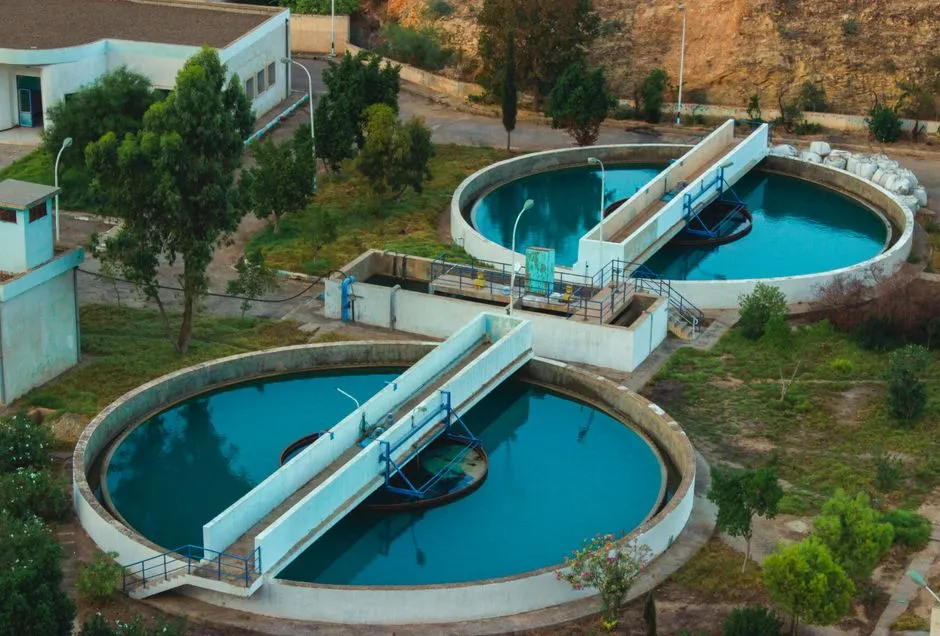
The canonical anodizing wastewater train consists of equalization → two-stage pH adjustment → flocculation → clarifier or lamella thickener → sludge thickener → filter press → cake handling, with filtrate and clarified supernatant returned to equalization or polished for reuse. Equalization homogenizes pH, flow, and metal load from intermittent rinse dumps; 8–24 hours of residence is typical for 2,000–10,000 gal/day shops (metchem.com, 2024). Two-stage pH adjustment with agitated reactors saves reagent because stage 2 effluent — already near the target pH — recirculates to the stage 1 inlet, reducing the acid load that stage 1 must neutralize from scratch.
Flocculation follows pH trim: 15–30 minutes of slow mixing at a velocity gradient G ≈ 50–75 s-1 builds dense floc without shearing it. The clarifier or lamella clarifier thickener upstream of the press produces 1–4% underflow and a supernatant that can be discharged after multimedia filtration or sent to RO for rinse-water reuse. A sludge thickener between the clarifier and the press drops underflow to 3–5% — that step alone cuts press cycle time and cake moisture because the press isn't pumping free water. The filter press is the workhorse: it produces cake at 25–35% solids for off-site disposal or recovery, with 95–98% solids recovery on a properly operated unit. Filtrate returns to equalization; supernatant polishing through sand, carbon, and RO routinely lets plants recycle 60–80% of water back to rinses — meaningful for water-scarce sites and for any shop with high incoming-water surcharges.
Sludge Dewatering Equipment Compared
Four dewatering devices realistically handle aluminum hydroxide sludge: plate-and-frame filter press, belt filter press, decanter centrifuge, and the emerging volute/screw press. The plate-and-frame is the reference unit because it produces the highest cake solids (25–35%), the highest solids recovery (95–98%), and the lowest energy demand (1–3 kWh/m3 filtrate). The trade-off is batch operation and labor for cake discharge unless you specify an automatic plate-shifting press with cloth washing. Belt presses are continuous and lower capex, but cap at 18–22% cake, run higher polymer demand, and are sensitive to feed solids variability — they suit shops with a steady clarifier underflow and a steady disposal route. Decanter centrifuges deliver 20–28% cake, are fully enclosed (a real plus for housekeeping and any odor-sensitive site), and run 10–25 kWh/m3 — high opex but very low labor. Volute/screw presses are a newer option that targets fine hydroxide sludges specifically, producing 22–28% cake with low wash-water and polymer demand on a footprint between belt and centrifuge.
| Parameter | Plate-and-frame press | Belt filter press | Decanter centrifuge | Volute / screw press |
|---|---|---|---|---|
| Typical cake solids | 25–35% | 18–22% | 20–28% | 22–28% |
| Solids recovery | 95–98% | 90–95% | 92–96% | 92–96% |
| Feed solids range | 2–5% | 2–4% | 1–4% | 1–4% |
| Polymer demand | 2–6 mg/L | 5–15 mg/L | 3–8 mg/L | 3–6 mg/L |
| Energy use | 1–3 kWh/m³ filtrate | 2–5 kWh/m³ | 10–25 kWh/m³ | 3–6 kWh/m³ |
| Operation | Batch (auto available) | Continuous | Continuous | Continuous |
| Capex tier (relative) | Medium-high | Low-medium | High | Medium |
| Best-fit flow | 1–80 m³/d | 5–50 m³/d | 10–200 m³/d | 3–40 m³/d |
Decision logic for the engineer: at <5 m³/d, a batch plate press or even a geotextile dewatering bag on a concrete pad is enough; at 5–20 m³/d, an automatic plate press or volute press hits the right labor/footprint balance; above 20 m³/d, an automatic plate press or centrifuge sized to available labor is the standard. The plate-and-frame filter press for anodizing sludge remains the default because cake solids drive disposal cost, and disposal cost is what the project pays back against. For shops already running a belt press, belt filter press maintenance and operating routines that keep the belt tracking and the polymer dose tuned will recover several points of cake solids.
Cake Handling, Disposal, and Recovery Options
The default end-of-line for anodizing sludge is landfill as non-hazardous waste in most US states — though the waste is "categorically" regulated because the source is a plating or anodizing shop, regardless of the toxicity of the actual discharge (finishing.com, 2002). Cake at >25% solids passes the paint-filter test and is normally acceptable at municipal solid waste landfills; below 20% solids, the cake is effectively a liquid and triggers more expensive handling. Stabilization before hauling is rarely needed at the solids levels a properly operated plate press delivers.
Aluminum hydroxide recovery is a real, documented market: clean NaOH-precipitated cake can be sold to municipal drinking-water plants as a partial substitute for alum (aluminum sulfate) coagulant, but it requires consistent purity — >80% Al(OH)3 on a dry basis, low heavy metals, and tight control of nickel and copper from upstream processes. A gypsum-heavy lime cake at <60% Al(OH)3 on a dry basis has no coagulation value and goes to landfill. Landfill economics in 2026 typically run $50–$120 per wet ton tipping plus hauling, for a total disposal cost of $150–$300 per wet ton across most of North America (HydropureWater field data, 2026); at 10 m³/d feed, that disposal line item pays back a $40,000–$80,000 filter press in 1–3 years. Spare parts and replacement media for the press itself — cloths, plates, pumps — are budgeted through the filter press parts and media inventory channel. A clear framework helps guide these decisions: if cake is <60% Al(OH)3 dry basis or carries regulated metals, send it to a landfill; if it meets the >80% Al(OH)3 threshold, has low heavy metals, and a nearby market exists, sell it as a coagulant.
Frequently Asked Questions
What pH should anodizing wastewater be neutralized to before sludge dewatering?
Target pH 8.0–8.5 for the clarifier feed. Aluminum is fully soluble below pH 4, hits minimum solubility at pH 6.5–7.5, and re-dissolves above pH 9 as aluminate — so the 8–9 band is the safe window. Over-shooting to pH 9.5+ wastes caustic and re-dissolves the metal you just precipitated.
How dry is the cake from a plate-and-frame press versus a belt press?
A plate-and-frame press routinely produces 25–35% dry solids cake, while a belt filter press on the same aluminum hydroxide feed caps at 18–22%. That 7–15-point gap roughly halves the wet tonnage hauled to landfill and is the single biggest lever on disposal cost for most anodizing shops.
Can lime treatment remove sulfate below 1,000 ppm in anodizing wastewater?
Not reliably. Lime precipitation bottoms out near 2,400 ppm SO4 because of CaSO