Why Bengaluru data centers cannot keep treating water as an afterthought in 2026
Bengaluru's data center build-out is colliding with a hard hydrological ceiling. The city's domestic and industrial supply runs primarily from the Cauvery system via the Krishnarajasagara (KRS) reservoir complex, and allocations to Karnataka have been trimmed in recent deficit years, pushing large users toward Bangalore Water Supply and Sewerage Board (BWSSB) tanker procurement at ₹80–120/kL once Cauvery volumes are rationed. The Government of India stated in 2026 that freshwater draw for hyperscale facilities must remain negligible, a clear signal that Consent to Operate (CTO) conditions from the Karnataka State Pollution Control Board (KSPCB) will tighten for new builds (Business Standard, 2026-01). A 100 MW facility can require up to 2 million L/day (IDE-Tech, 2026), and a 1 MW traditional air-cooled hall has been benchmarked at 26 million L/year of evaporative loss in published case work (Oxford, 2024). Four Bengaluru-specific streams therefore need dedicated hand-offs in the water balance: cooling tower blowdown (CTBD), softener regeneration brine from the makeup softening train, diesel generator (DG) and heat-exchanger cooling bleed, and humidification RO reject. Treating only CTBD leaves 20–30% of the on-site water liability unmanaged, and is the gap that most generic guides miss. For consent and ESG defensibility, all four must enter a single mass-balance model early in Front-End Engineering Design (FEED), a discipline covered in the parallel India-specific consent and compliance guide.
Cooling tower blowdown chemistry: what Bengaluru operators actually see in the lab report
CTBD is a brackish concentrate, not a dilute wastewater. Published industry data places CTBD total dissolved solids (TDS) at 1,200–6,000 mg/L, typically 4–8× the makeup water concentration, with 10–50 mg/L of suspended solids (Genesis Water Tech, 2026). A Bengaluru site fed by BWSSB Cauvery water and operating at 4–6 cycles of concentration will routinely show 80–180 mg/L silica, 400–900 mg/L calcium hardness, and 200–400 mg/L alkalinity, plus phosphate, bio-dispersant, and azole residuals from the legacy cooling chemistry program. Those figures matter because they define the recovery ceiling of the downstream membrane train. Conventional brackish water reverse osmosis (BWRO) plateaus at 75–80% recovery on CTBD before silica and calcium sulfate scaling take the system offline (IDE-Tech, 2026); designing above that ceiling without salt precipitation or staged concentrate management is the single most common reason Indian CTBD plants underperform their nameplate recovery. Legacy chromate, zinc, and high-phosphate programs must also be screened out at the makeup softener, since these species are flagged in KSPCB discharge consents and will poison downstream membrane life if bled through. Designing the industrial RO system for cooling tower blowdown recovery against a confirmed feed profile, rather than textbook values, is the cheapest risk reduction available at FEED stage.
| Parameter | BWSSB Cauvery makeup (typical) | Bengaluru CTBD at 5 CoC | Design implication |
|---|---|---|---|
| TDS (mg/L) | 250–450 | 1,200–2,500 | Sets RO feed osmotic pressure; dictates interstage boosting |
| Calcium hardness (mg/L as CaCO₃) | 80–140 | 400–900 | Antiscalant dose; CaSO₄ scaling limit at 75–80% recovery |
| Silica (mg/L as SiO₂) | 15–25 | 80–180 | Hard ceiling on BWRO recovery; drives concentrate management |
| Alkalinity (mg/L as CaCO₃) | 80–150 | 200–400 | LSI control and acid dosing demand |
| Suspended solids (mg/L) | <5 | 10–50 | Side-stream filter rating; UF pre-RO protection |
| Phosphate / bio-dispersant (mg/L) | Trace | 2–10 | Membrane biofouling risk; non-phosphate program preferred |
The 2026 process train Bengaluru data centers are standardizing on
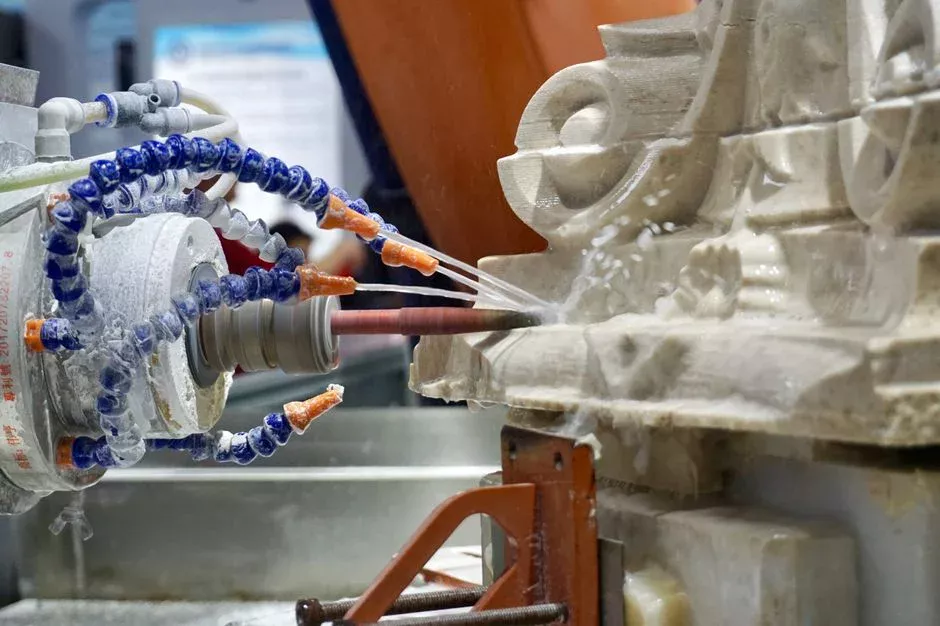
The reference design now stabilizing across new Bengaluru campuses is a five-stage train: side-stream filtration, automatic antiscalant and biocide dosing, ultrafiltration, antiscalant-dosed RO, and permeate polishing. The first three stages condition the CTBD so that RO membranes can be run at 65–75% local recovery without crossing silica or calcium sulfate scaling thresholds. Permeate is polished to <50 mg/L TDS, well inside the cooling-tower makeup envelope, and is blended with freshwater or rainwater to control cycles of concentration (CoC). For a 30 MW facility, expect CTBD flow of 30–60 m³/day; for a 100 MW campus, 100–200 m³/day. Concentrate from the RO stage is the design pivot: it is either routed to a fluidized-bed salt precipitator, where silica, calcium carbonate, and other sparingly soluble salts are intentionally precipitated onto seed material to drop overall fouling potential (IDE MAXH₂O logic), or to a Mechanical Vapor Compression (MVC) evaporator for partial zero liquid discharge (ZLD). Either path lets the system push to 90–95% overall recovery; the IDE field case reports 95% recovery with permeate silica near 1 mg/L (IDE-Tech, 2026). The cooling-water chemistry program must change in lockstep: tablet-based, non-phosphate treatment protects the membranes from fouling and removes the legacy phosphate residuals that complicate KSPCB discharge sampling. Specifying a UF pretreatment skid ahead of the RO membranes, an automatic antiscalant and biocide dosing system, and a stocked shelf of spares for RO membrane replacement cycles is now the default procurement pattern at Indian hyperscalers.
Three trains, one site: matching the design to KSPCB, BIS, and the hyperscaler's PUE/WUE target
One site rarely fits one train. Most Bengaluru projects now evaluate three options against KSPCB consent conditions, CPCB effluent limits, BIS IS 10500 reuse criteria, and the hyperscaler's Water Usage Effectiveness (WUE) target, typically <1.0 L/kWh IT. Train A is reuse-only: UF plus RO at 60–85% recovery, permeate to cooling tower, concentrate to a KSPCB-compliant sewer discharge. It is the lowest CAPEX path but exposes the operator to a 1,500 mg/L discharge TDS cap that water-stressed jurisdictions are increasingly enforcing (Genesis Water Tech, 2026). Train B is reuse plus partial ZLD: UF, RO, then MVC on the concentrate, lifting overall recovery to 95% and cutting concentrate volume by 80–90%. It is the design most campuses near BWSSB catchments are converging on because it absorbs a Consent to Operate that refuses high-TDS discharge. Train C is full ZLD: UF, RO, brine concentrator, crystallizer, with 95–99% overall recovery and a solid salt-cake waste stream for TSDF disposal. CAPEX rises sharply, but Train C is the only configuration that delivers zero liquid discharge and removes sewer capacity from the project's critical path. Where humidification RO reject blends back into the makeup stream, BIS IS 10500 limits for any worker-contact or potable-side reuse must be met even though the cooling-tower loop itself does not require potable-grade water. The decision is rarely a clean pick; the table below sets the three side by side.
| Criterion | Train A: Reuse only (UF + RO) | Train B: Reuse + partial ZLD (UF + RO + MVC) | Train C: Full ZLD (UF + RO + BC + Crystallizer) |
|---|---|---|---|
| Overall recovery | 60–85% | ~95% | 95–99% |
| CAPEX at 50 m³/day (India) | ₹1.8–2.8 Cr | ₹4–6 Cr | ₹25–55 Cr |
| OPEX (₹/kL treated) | ₹25–40 | ₹60–90 | ₹150–250 |
| Discharge stream | Liquid, KSPCB sewer | Concentrate 5–10% of feed | Solid salt cake only |
| Applicable standards | KSPCB CTO; CPCB TDS | KSPCB CTO; CPCB TDS; IS 10500 for humidification | KSPCB ZLD order; TSDF waste rules |
| Best fit | Sites with sewer capacity and lower WUE ambition | Water-stressed BWSSB catchments, mid-tier WUE | Hyperscaler ZLD mandates, no-discharge sites |
| Reference platform | RO skid (compact) | RO + MVC, requires evaporator room | Full thermal train; 18–24 month imported lead time |
An integrated packaged water purification skid covers Train A configurations; Train B and C require thermal equipment sizing and civil work that a packaged skid alone cannot absorb.
India-priced CAPEX, OPEX, and ROI for a Bengaluru CTBD recovery plant
Engineering choices collapse into money once the consent pathway is fixed. CAPEX bands at 50 m³/day capacity in India run ₹1.8–2.8 Cr for Train A, ₹4–6 Cr for Train B, and ₹25–55 Cr for Train C; the Train C range cross-checks against published ZLD benchmarks of $3–8M (Genesis Water Tech, 2026), and Train A against a $250K–500K benchmark for a 50,000 GPD RO system. OPEX is dominated by MVC energy at 15–25 kWh per 1,000 US gallons of distillate, which at Bengaluru industrial tariffs translates to roughly ₹60–90/kL for Train B and ₹150–250/kL for Train C, against ₹25–40/kL for Train A. Payback falls into a 3–5 year window whenever BWSSB tanker water at ₹80–120/kL is being displaced and consent-to-discharge savings are realized; hyperscaler WUE-linked incentives compress this further. Hidden costs are where Indian projects routinely overrun: buried-tank civil work at ₹15–25 Cr depending on foundation condition, KSPCB consent and Environmental Impact Assessment fees, and an 18–24 month lead time for imported MVC skids that must be ordered before the building is weather-tight. The cost logic that supports Train B and Train C in Bengaluru is rarely the membrane savings alone; it is the avoided tanker volume and the secured Consent to Operate. Procurement teams comparing global case studies in parallel, such as the parallel Hong Kong hyperscaler case, the Accra case study on tropical cooling water reuse, and the Athens data center water reuse guide, will see the same pattern: thermal equipment is the differentiator, not the membrane.
Commissioning and compliance checklist for the first 12 months of operation
Months 0–3 cover the foundation: baseline CTBD characterization across at least two operating CoC bands, the KSPCB Consent to Operate application package, a pilot trailer run for antiscalant selection against the actual Bengaluru feed, and integration of the 1,100 mm/year rainwater harvesting potential into the makeup water balance so that stormwater is not double-counted as a separate consent stream. Months 3–9 are mechanical: train commissioning, RO membrane break-in under controlled recovery ramp, biocide compatibility testing against the chosen cooling chemistry, and SCADA integration with the Building Management System (BMS) so that WUE is reported in real time rather than reconstructed monthly. Months 9–12 close the compliance loop with third-party stack and effluent monitoring, an IS 10500 cross-check on any reused water that touches humidification or worker-contact systems, quarterly sludge and salt-cake characterization (a TSDF acceptance requirement), and finalization of the O&M contract with membrane-replacement cycles locked in. CPCB's Real Time Monitoring framework and the KSPCB-specific data center consent conditions released during 2025–2026 set the documentation baseline; missing a single quarterly report is enough to trigger show-cause on the CTO. Keeping spares for valves and filter media on-site at handover is the lowest-cost insurance against a permit-condition finding during the first KSPCB audit.
Frequently Asked Questions
What wastewater streams does a Bengaluru data center actually need to treat?
Four streams: cooling tower blowdown (CTBD) at 1,200–6,000 mg/L TDS, softener regeneration brine from the makeup softener, diesel generator and heat-exchanger cooling bleed, and humidification RO reject. Each needs a different hand-off: CTBD enters the UF/RO train, brine is routed to MVC or crystallizer, DG bleed settles and reuses as make-up, and humidification reject blends into the RO concentrate or evaporates. Treating only CTBD leaves 20–30% of the on-site water liability unmanaged.
What recovery rate can a Bengaluru CTBD RO system realistically hit?
Conventional brackish water RO plateaus at 75–80% recovery on Bengaluru CTBD because silica at 80–180 mg/L and calcium sulfate reach scaling thresholds above that point. By routing concentrate to a fluidized-bed salt precipitator or a Mechanical Vapor Compression (MVC) evaporator, overall system recovery rises to 90–95%, with published cases reporting permeate silica near 1 mg/L at 95% recovery. Train designs that promise 85%+ recovery on RO alone, without concentrate management, will not hold membrane life on Bengaluru feed.
How much does a CTBD recovery plant cost in India at hyperscale?
At 50 m³/day capacity, Train A (reuse-only UF + RO) costs ₹1.8–2.8 Cr in CAPEX and ₹25–40/kL in OPEX; Train B (UF + RO + MVC, partial ZLD) costs ₹4–6 Cr and ₹60–90/kL; Train C (full ZLD with crystallizer) costs ₹25–55 Cr and ₹150–250/kL, dominated by MVC energy at 15–25 kWh per 1,000 US gallons of distillate. Payback runs 3–5 years once BWSSB tanker water at ₹80–120/kL is displaced and KSPCB consent-to-discharge savings are realized.
Which Indian standards apply to reused water from a data center?
KSPCB Consent to Operate conditions govern discharge to sewer; CPCB effluent limits set the TDS, pH, and residual-chemical caps; BIS IS 10500 applies to any reused water that contacts humidification loops, worker amenities, or potable-side blending; and the hyperscaler's own Water Usage Effectiveness (WUE) target, typically <1.0 L/kWh IT, sets the internal benchmark. KSPCB's 2025–2026 data center consent orders add real-time monitoring and quarterly third-party stack sampling as standard conditions.