Why Vancouver Hotels Are a Specific MBR Use Case
A packaged membrane bioreactor sized for a Vancouver hotel is not the same specification as one for a comparable property in Phoenix, Dubai, or even Toronto. Three local drivers force the design off the shelf: a combined sanitary-storm sewer network that pushes wet-weather inflow and infiltration (I&I) into the building connection, Metro Vancouver's regional push toward non-potable water reuse under the Liquid Waste Resource Management Plan, and a tourism pattern that swings the hydraulic and organic load between a summer high and a winter shoulder-season trough. Combined sanitary-storm systems in Metro Vancouver routinely deliver 3-5x dry-weather flow to a building's discharge manhole during a sustained winter rain event (Metro Vancouver, 2025-04); any on-site treatment plant must be able to either absorb that surge or bypass it safely back to the municipal sewer without discharging out of compliance. A 200-bed, 250 m³/d five-star hotel installation in Canada — documented by imemflo — provides the working anchor that the rest of this guide scales to. Operators reading a generic Canadian cold-climate packaged ETP guide will recognize that the same temperature derating logic applies on the West Coast as on the Atlantic. Tourism-season loading peaks at 90%+ occupancy in July and August and drops to 40-60% in January and February, which means the membrane train has to buffer a 2:1 to 2.5:1 hydraulic swing without operator intervention — a constraint most off-the-shelf packaged plants do not address out of the box.
Step 1: Build a Defensible Flow and Load Profile
Before any membrane selection, the engineer of record needs a written basis of design that Metro Vancouver and the building's plumbing consultant can both sign. Start with the dry-weather flow envelope: 200-300 L per guest-night for room occupancy and 50 L per employee-shift for back-of-house (laundry, kitchen prep, housekeeping) discharges, which is the standard hotel sewage envelope reported in industry references. Apply a diurnal peaking factor of 1.5-2.0 to capture the morning housekeeping wave (07:00-10:00) and the evening banquet and shower peak (19:00-23:00). A 200-key hotel at 85% average occupancy lands on approximately 70 m³/d average dry-weather flow and a design flow of roughly 250 m³/d once the peaking factor is applied — matching the imemflo 200-bed, 250 m³/d reference installation. For the organic load, characterize the influent as: BOD 250-400 mg/L, COD 500-800 mg/L, TSS 200-300 mg/L, and fats, oils and grease (FOG) 50-100 mg/L, with the higher FOG figure reserved for properties that run a full-service banquet kitchen. Document peak-week and shoulder-week envelopes separately; a single "average" value will under-design the membrane zone in summer and over-design the blower room in winter. The basis-of-design memo should also state the assumed I&I contribution from the building's laterals — typically 10-15% of average dry-weather flow in well-maintained Metro Vancouver buildings, and 20-30% in older downtown properties where the inspection chamber shows signs of groundwater infiltration.
Step 2: Lock the Compliance Envelope First
Designing a packaged MBR around a generic 90-95% removal claim — the figure commonly cited in manufacturer literature — leaves the engineer with no defensible discharge target. Anchor the design to a written compliance envelope instead, and the membrane train can be sized to meet it directly. Metro Vancouver Sewer Use Bylaw No. 299 sets the default corridor at BOD ≤300 mg/L and TSS ≤350 mg/L for sanitary discharges, with site-specific limits tightened to BOD ≤15-25 mg/L, TSS ≤15-25 mg/L, and NH3-N ≤10-12 mg/L for buildings discharging to sensitive receiving waters such as lower False Creek or English Bay. Properties pursuing non-potable reuse under the BC Municipal Wastewater Regulation (MWR) must additionally meet the reuse envelope of BOD ≤10 mg/L, TSS ≤5 mg/L, NH3-N ≤5 mg/L, and fecal coliform ≤200 CFU/100 mL (or non-detect for unrestricted toilet-flush reuse). Specify the membrane train against the reuse-grade envelope from day one — the additional capital cost of a flat-sheet PVDF train over a conventional activated-sludge package is small, and it eliminates the risk of a permit refusal if the owner decides to pursue reuse credits twelve months after opening. Packaged MBRs consistently deliver 90-95% BOD and TSS removal (per imemflo field data), so a properly sized train beats the bylaw corridor by a factor of 5-10x on BOD and 10-20x on TSS. The following table crosswalks the typical discharge target against the bylaw ceiling for each parameter.
| Parameter | Metro Vancouver Bylaw 299 (default) | Site-specific limit (sensitive receiver) | MBR design point (reuse-grade) |
|---|---|---|---|
| BOD₅ | ≤ 300 mg/L | ≤ 15-25 mg/L | ≤ 10 mg/L |
| TSS | ≤ 350 mg/L | ≤ 15-25 mg/L | ≤ 5 mg/L |
| COD | Not specified | ≤ 100 mg/L | ≤ 50 mg/L |
| NH3-N | ≤ 50 mg/L (seasonal) | ≤ 10-12 mg/L | ≤ 5 mg/L |
| Fecal coliform | Not specified | ≤ 200 CFU/100 mL | ≤ 200 CFU/100 mL (toilet flush) |
| FOG | ≤ 100 mg/L (typical) | ≤ 50 mg/L | ≤ 10 mg/L (post-DAF) |
For sites that need to defend a comparable specification to a UK or European municipal client, the same parameter logic is documented in this packaged municipal STP engineering specs reference.
Step 3: Pick the Membrane Geometry for Cold-Climate Duty
The hollow-fiber versus flat-sheet debate does not have a universal winner — it has a Vancouver-specific answer. Submerged hollow-fiber modules (Mitsubishi, Suez, Dow, DuPont per imemflo) pack more membrane area per cubic metre and have a lower first-cost, but they bundle under sustained mixed-liquor solids loading, are sensitive to hair and lint fouling from housekeeping discharge, and require pressurized permeate pumps with air-integrity testing. Flat-sheet PVDF modules (Toray, Smith & Loveless per imemflo) trade roughly 10-20% aeration efficiency for a geometry that does not bundle and is not damaged by routine backwash. Flat-sheet modules in cold-climate packaged MBRs are typically cleaned in place (CIP) only once every six months on average, without taking the system offline — the operating interval published in the Smith & Loveless QUBE specification. For a Vancouver hotel with constrained staging space, the packaging benchmark is a 40-ft shipping-container cube delivered pre-plumbed, pre-wired, and factory-tested; multiple units can be tied in parallel if flow grows. Specify 0.03-0.1 µm PVDF pore size for hospital-adjacent hygiene and reuse-grade clarity, and require the membrane cassette to be removable by a two-person crew through the side-access hatch without draining the membrane tank. The table below summarizes the cold-climate trade-offs that drive the geometry choice for a Metro Vancouver hotel.
| Criterion | Submerged hollow-fiber | Submerged flat-sheet PVDF |
|---|---|---|
| Packing density (m²/m³) | High (300-500) | Moderate (120-200) |
| Fouling tolerance to hair/lint | Lower (requires fine screening) | Higher (open channel) |
| CIP interval (typical) | 1-3 months | ~6 months (per S&L QUBE spec) |
| Aeration demand (relative) | Baseline | +10-20% |
| Cold mixed-liquor performance (4-9 °C) | Acceptable with derating | Acceptable, more predictable |
| Membrane replacement interval | 5-8 years | 8-12 years |
| Permeate pump required | Yes | No (gravity / siphon) |
Where a project requires either an integrated packaged MBR system or a standalone PVDF flat-sheet MBR membrane module to be evaluated against the table above, request the vendor's cold-water flux curve at 8 °C rather than the headline 25 °C rating — the difference is typically 15-25% in specific flux.
Step 4: Engineer the Climate and Structural Package
This is the section where generic MBR specifications fall apart for a Vancouver project. The biological stage of any MBR derates with temperature: at 10 °C mixed-liquor temperature, nitrification is roughly baseline; at 8 °C, biological activity drops 1-2% per degree, so a winter mixed-liquor of 4-6 °C inside an uninsulated membrane tank will leave the system 4-12% short of its design nitrification capacity. The fix is not to add a heater — it is to control the heat balance. The blower room of a packaged MBR generates 3-5 kW of waste heat per 100 m³/d of design flow, and that heat alone, captured and ducted to the membrane tank, is enough to hold mixed liquor above 8 °C in a Vancouver winter if the tank is insulated. Specify an enclosed, insulated membrane tank with heat-traced pipework between the bioreactor and the membrane zone, a thermostat-controlled low-velocity mixing circulator in the cold months, and an enclosure heater on the blower room sized to keep the room above 5 °C at -10 °C ambient. On the structural side, the BC Building Code places Metro Vancouver in a high-seismic zone (Vs30 site class C-D, design spectral acceleration Sa(0.2) ≈ 0.6-0.8 g per the 2024 BCBC update), with a ground snow load of 1.5-3.0 kPa depending on the specific census subdivision; specify seismic restraints and a roof snow-load rating on the enclosure accordingly. Coastal Vancouver also demands C5-M corrosion protection on the enclosure, fasteners, and internal pipework to handle salt-laden marine air. Upstream of the membrane zone, a 3 mm automatic fine screen — the specification published in the S&L QUBE documentation — protects the flat-sheet cassettes from fibrous debris discharged by housekeeping and the on-premises laundry.
Step 5: Match the O&M and Operator Model to BC Reality
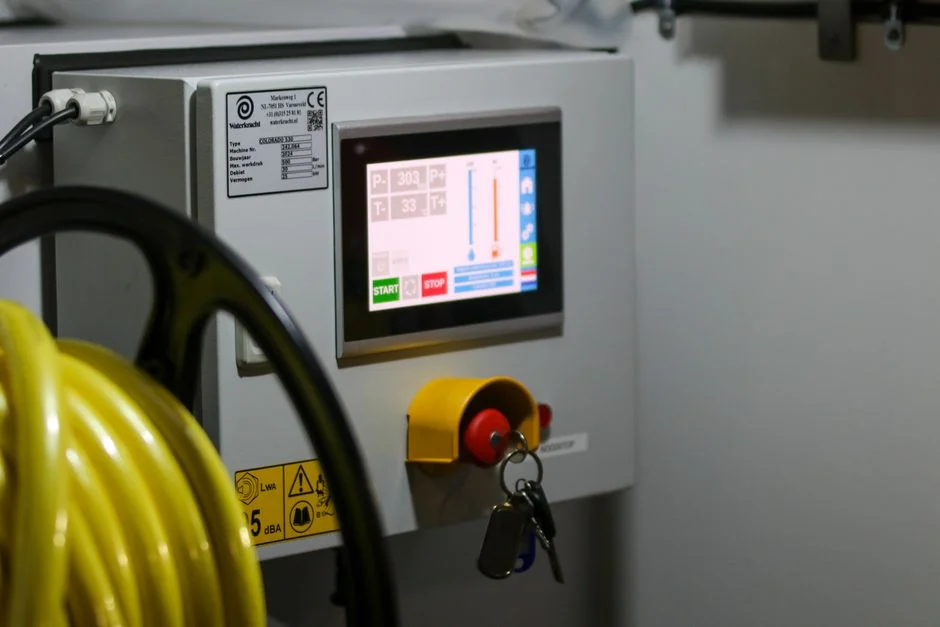
A hotel does not have a Class II wastewater operator on payroll, and the design has to respect that. Under the BC Municipal Wastewater Regulation, a packaged MBR below the small-system flow threshold can be operated with weekly site checks rather than continuous on-site attendance, provided the system has remote telemetry, automatic chemical CIP dosing, and a membrane integrity log that can be reviewed by the contract operator. Specify a PLC + HMI package (the configuration in the S&L QUBE documentation) with Modbus TCP or BACnet IP uplink to the building management system, so that high-level alarms — membrane transmembrane pressure, tank level, blower fault — route to the duty engineer's pager and to the contract operator's dashboard. Plan for sludge: MBRs produce a concentrated waste activated sludge at roughly 0.5-1.0% dry solids, and a small sludge dewatering filter press on a concrete pad outside the container is the lowest-labor disposal route for a 250 m³/d plant. Where non-potable reuse is pursued, polish the MBR permeate through a UV polishing sterilizer (or a chlorine dioxide generator, where the local health authority prefers chemical residual) sized for the reuse loop — typically toilet flush and landscape irrigation, with the option of laundry reuse if the linen contractor will accept it. For sites where the packaged MBR is buried rather than containerized — often the case in tight downtown Vancouver footprints — the equivalent configuration is the underground packaged sewage plant arrangement, with the same PLC and remote-telemetry envelope applied to the buried tank.
Frequently Asked Questions
How do I size a packaged MBR for a Vancouver hotel?
Use 200-300 L per guest-night plus 50 L per employee-shift, apply a 1.5-2.0 diurnal peaking factor, and confirm with the imemflo benchmark of roughly 250 m³/d for a 200-key property at 85% average occupancy. Add a 10-30% allowance for I&I depending on the age of the building laterals.
Does a packaged MBR meet Metro Vancouver Sewer Use Bylaw No. 299?
Yes — an MBR train designed to deliver BOD ≤10 mg/L and TSS ≤5 mg/L meets the bylaw's default corridor with a 5-10x margin and also satisfies the BC Municipal Wastewater Regulation envelope for non-potable reuse. Site-specific limits for sensitive receiving waters (lower False Creek, English Bay) and reuse permits may require additional polishing.
Flat-sheet or hollow-fiber membranes for a Vancouver hotel?
Both work. Flat-sheet PVDF is more fouling-tolerant in cold mixed liquor, requires CIP only every ~6 months on average (per S&L QUBE data), and does not need a pressurized permeate pump; hollow-fiber packs more area per cubic metre and has a lower first-cost but is more sensitive to hair and lint fouling.
Does a packaged MBR need a full-time operator in BC?
No. Under the BC Municipal Wastewater Regulation, small packaged MBRs can be operated with weekly site checks provided the system has remote telemetry, automatic CIP, and an annual membrane integrity audit. Contract operation is the standard model for hotel-scale plants in Metro Vancouver.
How does the cost of a packaged MBR compare to a conventional SBR or ASP plant?
At hotel scale (≤300 m³/d), the all-in CAPEX of a packaged MBR is broadly comparable to a conventional SBR or activated-sludge plant once land cost, the eliminated secondary clarifier, and the eliminated tertiary sand filter are factored in. The OPEX is dominated by blower energy (typically 0.8-1.5 kWh/m³) and membrane replacement (every 8-12 years).
Related Equipment
- underground packaged sewage plant — specifications, capacity range, and technical data