Why Calgary data centers need a different water playbook in 2026
Calgary sits at the centre of Canada's data center buildout: Alberta accounts for 92% of announced national capacity but only ~10% of facilities currently operating, with 213 projects totalling more than 22 GW planned against 1.6 GW in service as of June 2026 (York University Schulich School, via CBC, 2026-07). That imbalance matters because the engineering defaults imported from Phoenix, Loudoun County, or the Texas Hill Country do not survive contact with Alberta's climate, regulators, or rate structure.
Three Calgary-specific realities shape the water design. First, the climate: Calgary's mean daily winter temperature is cold enough to make closed-loop liquid cooling the natural fit, but July–August highs still require hybrid loop sizing for hyperscale halls (per CBC reporting on the Meta Sturgeon design, 2026-07). Second, the regulator: discharge is governed by Alberta Environment and Protected Areas (EPA) under the Environmental Protection and Enhancement Act (EPEA), not US EPA — so a Texas- or Virginia-style Effluent Limitations Guideline package has to be re-anchored to the Alberta Code of Practice for Steam-Electric Power Generation and the City of Calgary's Industrial Wastewater Bylaw. Third, the heat-island effect: University of Cambridge researchers found that land surface temperature around AI data centers rises by an average of 2 °C post-commissioning, detectable up to 10 km away — a community-relations variable that increasingly shows up in Calgary-area public hearings. For a deeper Calgary framing, see the Calgary effluent treatment plant buyer's guide.
What a Calgary data center's wastewater and cooling blowdown actually look like
A hyperscale hall in 2026 produces five distinct water streams, and each one needs a different handling rule.
The IT cooling loop runs a 75% water / 25% propylene glycol blend, with fluid entering the server rack at 45 °C and leaving at 55 °C per Nvidia's latest GPU envelopes (CBC, 2026-07). Losses here are to drift and minor leakage, not evaporation, so absolute volumes are small but the glycol fraction means discharge or disposal must be tracked separately.
Cooling tower blowdown (CTBD) is the dominant industrial wastewater stream in any hybrid data center. As cycles of concentration rise, dissolved silica, calcium carbonate, and calcium sulfate concentrate in the recirculating water; conventional brackish water RO (BWRO) hits a 75–80% recovery ceiling on this stream before scaling becomes unmanageable (IDE, 2026).
Chiller make-up, humidification supply, and maintenance/QA streams are individually small but are normally blended with CTBD into a single treatment train to keep operations simple. Sanitary wastewater from the data center building — typically under 50 m³/day for a 100 MW site — goes to the City of Calgary sanitary system under the plumbing code, not the industrial train. Finally, the co-located natural gas power plant brings its own cooling demand: cooling accounts for 20–30% of water demand at power plants (Open Engineering Inc LCA, 2026), and that stream either feeds or parallels the data center treatment train depending on the EPEA application.
Closed-loop cooling vs evaporative cooling: the baseline decision
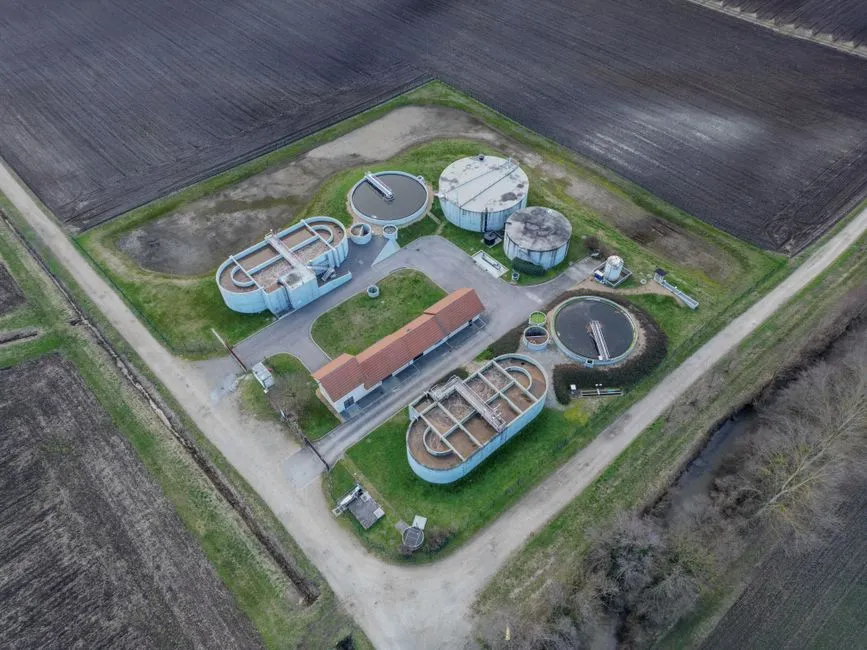
The choice of cooling architecture determines whether blowdown is even a major stream, so it has to be locked before the treatment train is selected.
Closed-loop liquid cooling is the 2026 default for new Alberta builds. Marina Freire-Gormaly at York University called it "the right answer" for Canadian climates, because the cold ambient air supplies the natural ΔT that the loop needs to reject heat (CBC, 2026-07). Nvidia-class chips accepting 45 °C inlet coolant further reduces chiller load, which lets Calgary sites raise chilled-water set points and drop both energy and water intensity per MW of IT load.
Evaporative cooling is being deprioritized in Alberta for environmental reasons. A 100 MW evaporative facility can draw up to 2 million litres of water per day — roughly the daily use of thousands of households (IDE, 2026) — and that volume is hard to defend in a province that markets itself on responsible resource development. Even so, a hybrid (closed-loop for the IT hall, adiabatic or evaporative trim for whole-hall heat rejection) is still common in Alberta because it keeps the summer peak manageable. It is precisely that hybrid which generates a meaningful CTBD stream that must be treated before discharge or reuse.
Treatment train for Calgary cooling tower blowdown (2026 default)
The defensible 2026 train for a Calgary data center is a five-step chain, sized to the City of Calgary's industrial customer requirements and Alberta EPA approval conditions. The parameter table below shows the operating envelope at each step.
| Step | Unit process | Key parameter / target | Notes for Calgary context |
|---|---|---|---|
| 1 | Intake screening — rotary mechanical bar screen | 6 mm aperture typical; rag and debris removal | Protects downstream UF/RO, especially where CTBD is blended with adjacent power-plant wastewater |
| 2 | Multi-media filtration | SDI < 3 on filtrate; feed turbidity up to ~50 NTU | Anthracite/sand/garnet beds sized for Calgary's moderately hard make-up |
| 3 | Side-stream softening (lime/soda or ion exchange) via an industrial water softener | Ca²⁺ reduced by 60–80%; LSI < 0 in RO feed | Pushes cycles of concentration from ~4 (once-through) to 6–8 without silica scale |
| 4 | Industrial RO system | 80–90% recovery; permeate silica < 1 mg/L; concentrate silica < 150 mg/L | Anti-scalant tuned for Calgary's calcium/sulfate profile; concentrate to ZLD or approved discharge |
| 5 | Optional brine polishing (evaporator-crystallizer) | Overall recovery > 95%; solid salt/scale pellet waste | Only where the site is zero-discharge mandated; energy intensive |
| Post | Permeate polishing — UV or chlorine dioxide | Target HPC < 10 CFU/100 mL; residual < 0.1 mg/L | Blends back to cooling tower make-up; closes the water loop |
The concentrate stream from Step 4 is the decision point: under a standard EPEA approval, a small RO reject is discharged to the sanitary sewer under the City of Calgary's Industrial Wastewater Bylaw; on a zero-discharge site, that same reject is sent to the evaporator-crystallizer in Step 5. Permeate is polished and recycled as cooling-tower make-up, which is what actually closes the loop and lets the operator push cycles of concentration into the 6–8 range without scaling.
Comparison: UF+RO vs softening+RO vs full ZLD for a Calgary data center
Three trains are credible for a Calgary-scale 50–150 MW site. Each maps to a different discharge assumption and reuse target.
| Train | Indicative recovery | Cycles of concentration | Relative CAPEX | Best-fit Calgary condition |
|---|---|---|---|---|
| UF + RO only (UF system + industrial RO system) | ~75–80% | 4–5 | 1.0× (baseline) | Site has reliable municipal discharge and reuse target < 80% |
| Side-stream softening + RO | 85–90% | 6–8 | ~1.2–1.4× | Calgary 2026 sweet spot; aligns with City industrial reuse rates and EPEA-monitored discharge |
| Softening + RO + evaporator-crystallizer (full ZLD) | > 95% | 8+ | ~2–3× | Zero-discharge-mandated sites or operators chasing > 90% reuse |
Two non-cost factors close the decision. First, energy: the Open Engineering Inc LCA (2026) shows the UF+RO reuse scenario uses over 5× the energy of a freshwater baseline, with treatment energy accounting for roughly 80% of the GWP gap. Alberta's grid is currently heavily natural-gas fired, so that penalty is felt in absolute terms until the grid decarbonizes — a sensitivity the LCA confirms matters less after 2035. Second, chemistry: high-recovery systems (the 95% / 1 mg/L permeate silica datapoint from IDE) need controlled salt precipitation as a design principle, not just a higher-pressure pump. That shifts the engineering choice from "buy a bigger RO" to "buy a brine-desalting loop with the right chemistry controls," with permeate disinfection handled by a chlorine dioxide generator for biological control.
Decision rule of thumb: if Bow/Elbow watershed discharge is unrestricted and the reuse target is under 80%, specify UF+RO. If the target is 80–90% and discharge is monitored under an EPEA approval, specify softening+RO. If the regulator or community is requiring zero discharge, specify full ZLD and budget the thermal energy separately.
Alberta-specific compliance and discharge rules for 2026
Alberta Environment and Protected Areas issues the Approval to Operate under the Environmental Protection and Enhancement Act (EPEA). CTBD and the adjacent power-plant wastewater are regulated as industrial wastewater — there is no "data center effluent" category in the Alberta framework, so the design has to be filed under the closest fit, which is typically an industrial wastewater approval referencing the Alberta Code of Practice for Steam-Electric Power Generation (and its 2024 amendments). That Code sets the expectations for cooling-water chemistry, blowdown handling, and thermal discharge; for a hyperscaler with a co-located natural gas plant, it is the closest analog to a US Effluent Limitations Guideline.
Any flow to the sanitary sewer is gated by the City of Calgary's Industrial Wastewater Bylaw, which controls total dissolved solids, temperature, pH, and metals — copper from server cooling hardware is a typical gating parameter, not an afterthought. Alberta is deregulated on electricity self-generation, which is why hyperscalers are pairing their halls with natural gas plants, but the EPEA application still has to address the power plant's water footprint in the same approval package. Reclaimed municipal wastewater is a permissible cooling make-up source — Stillwell & Webber (2014) projected up to 300 MGD of substitution potential at Texas power plants — and is increasingly part of Calgary's industrial water strategy; for an Alberta analog, see the parallel process framing in the Edmonton process-compliance guide.
CAPEX and OPEX envelope for a 50–150 MW Calgary data center
For a 50 MW Calgary site with a softening+RO train at 85% recovery, plan for CAPEX in the CAD 1.2–2.5M range and OPEX in the CAD 0.08–0.15 per litre treated band (engineering estimate for 2026 Alberta; vendor bids will vary). Each 1,000 m³/day of CTBD treated at 85% recovery displaces roughly 850 m³/day of fresh City of Calgary industrial water — at current industrial rates, that is a meaningful OPEX offset that typically pays back within 3–5 years.
Full ZLD upgrades add 2–3× the CAPEX of a softening+RO train and roughly CAD 0.20–0.40 per litre of OPEX from thermal energy; that is a separate business case the CFO will want before signing. Treatment energy typically adds 2–5% to facility PUE depending on the train, and a decarbonized Alberta grid (currently heavily natural-gas fired) would cut the GWP penalty materially — which is why the Open Engineering sensitivity analysis argues that a cooling system commissioned in 2026 will spend the majority of its service life under grid conditions where the GWP penalty of reuse is negligible. For trend context and broader 2026 cost benchmarks, see the industrial water reuse trends 2026 review, and for a non-Alberta analog, the data center blowdown treatment in La Paz guide shows how a different climate pushes different unit-process choices.
Frequently Asked Questions
What is the 2026 default treatment train for cooling tower blowdown at a Calgary data center?
Intake screening, multi-media filtration to SDI < 3, side-stream softening to LSI < 0, then reverse osmosis at 85–90% recovery with permeate silica under 1 mg/L. Permeate is polished and recycled as cooling-tower make-up; concentrate is discharged under EPEA or sent to a brine-polishing step.
Which Alberta regulator approves a data center's wastewater discharge?
Alberta Environment and Protected Areas issues the Approval to Operate under the Environmental Protection and Enhancement Act (EPEA). The Alberta Code of Practice for Steam-Electric Power Generation (2024 amendments) sets the cooling-water and blowdown expectations, and any flow to the sanitary sewer is gated by the City of Calgary's Industrial Wastewater Bylaw.
How much does a Calgary 50 MW data center water treatment train cost in 2026?
For a softening+RO train at 85% recovery, plan for CAD 1.2–2.5M CAPEX and CAD 0.08–0.15 per litre treated in OPEX. Full ZLD adds 2–3× the CAPEX and CAD 0.20–0.40 per litre of OPEX, dominated by thermal energy for the evaporator-crystallizer.
When does a Calgary hyperscaler need to specify full ZLD instead of softening+RO?
Only when the site is zero-discharge mandated by the EPEA approval or when the operator is targeting above 90% reuse. For a monitored discharge to the Bow or Elbow watershed with an 80–90% reuse target, softening+RO is the defensible 2026 default.
Which single design decision most changes the CAPEX/OPEX of a Calgary CTBD reuse train?
Whether RO concentrate is sent to the sanitary sewer under the City bylaw or to an evaporator-crystallizer. Choosing sewer-discharge keeps the train at softening+RO; choosing ZLD roughly doubles CAPEX and triples the OPEX per litre — so the EPEA discharge decision is the variable to lock before equipment selection.