Why Saltsburg-Area Fabricated Metals Plants Live Under Two Limits, Not One
Federal categorical limits and local POTW limits are stacked, not interchangeable, and a pretreatment skid designed only to the federal column is a permit risk. The controlling federal rule for a fabricated-metals shop discharging to a sewer is 40 CFR Part 433, the Metal Finishing categorical standard, which regulates eight pollutants — cadmium, total chromium, copper, lead, nickel, silver, zinc, and total cyanide — plus total toxic organics (TTO) (per 40 CFR Part 433, Table 1). The shop is pulled inside the rule when any of the following processes sits on the same floor drain as the rest of the plant: electroplating, electroless plating, anodizing, chromating or other conversion coating, chemical etching and milling, or printed circuit board manufacture (per 40 CFR Part 433 §433.10 and the IWRC summary, 2024-04). A stamping cell that ships only dry parts to a separate finisher is generally outside the category; a facility that runs its own zinc, nickel, or chromic acid tank is inside it.
On top of the federal column sits 40 CFR 403.5 "local limits," which the control authority (the POTW, or the state on the POTW's behalf) sets at least as stringent as the categorical rule (40 CFR 403.5(b)). In Western PA, that POTW is typically Saltsburg Municipal or Indiana County Sanitation Authority depending on where the shop taps a sewer, and the local table routinely adds copper, nickel, zinc, lead, and silver caps the federal rule underweights, plus oil & grease (often 100 mg/L daily max), TSS (often 300 mg/L daily max), and a pH band of 6.0–9.0 standard units. The design envelope has to be built from whichever number is tighter on each parameter — which is why the federal table alone is never the spec. A shop that ignores the local column will be handed a compliance schedule the first time the POTW pulls a 24-hour composite.
The third layer most operators miss is the PSES-versus-PSNS split. Pretreatment Standards for Existing Sources apply to plants operating before August 1982; Pretreatment Standards for New Sources apply to anything built after. PSNS is the tighter column and most local pretreatment programs enforce PSNS-equivalent numbers on everyone as a conservative baseline, so a 2026 new skid should design to the PSNS column from day one (per the IWRC summary, 2024-04). For a useful side-by-side of the unit operations the train is built from — the stainless tanks, lamella plates, and bar screens — see the DAF vs clarifier comparison for fabricated metals plants.
The Four Contaminant Families a Saltsburg Fab Floor Actually Generates
A mixed fab floor drain carries four contaminant families that respond to four different chemistries, and the fastest way to fail a discharge permit is to feed all of them into one reaction stage. The first family is free and emulsified oils from stamping, machining, and drawing compounds, typically 50–500 mg/L at the head of the train (HydropureWater field data, 2026). The second is dissolved heavy metals — zinc, nickel, copper, chromium, lead, and cadmium — from plating rinsewater and acid pickling, 5–200 mg/L at the head of the train and pH-swinging between 2 and 12 across batch dumps (HydropureWater field data, 2026). A hard-chrome line spike pushes Cr(VI) above 50 mg/L and drops pH below 2 on a single rinse dump, and the equalization basin has to absorb that without passing the upset downstream.
The third family is hexavalent chromium from chromic acid anodizing, hard chrome plating, and conversion coating. Cr(VI) is the regulated species and it does not precipitate as a hydroxide at any pH; it has to be reduced to Cr(III) first, then dropped as Cr(OH)₃ in the pH 8.5–9.5 stage. The fourth family is total suspended solids — grinding swarf, casting sand, and hydroxide floc carryover from an over-worked clarifier — typically 100–1,000 mg/L at the head of the train (HydropureWater field data, 2026). A fifth contaminant, cyanide, appears wherever alkaline cyanide plating of zinc, copper, cadmium, or silver is still in use; it must be oxidized before metals precipitation, because the reverse order resolubilizes the metal precipitates and dumps them straight into the discharge.
The reason the treatment train has eight unit operations instead of one is that each contaminant family needs its own unit operation to be removed, and the order of those operations is fixed by the chemistry. Oils need physical separation or chemical break before pH swings downstream, hex chrome needs reduction before metals precipitation, cyanide needs oxidation before metals precipitation, and dissolved metals need pH-driven hydroxide precipitation to drop out. Trying to collapse any of these into a single stage produces an effluent that fails on at least one parameter and usually on three.
40 CFR Part 433 PSES and PSNS Numbers the Skid Must Hit

The table below reproduces the Part 433 daily-maximum and monthly-average maximum limits a fabricator must hit at the sampling point, with the tighter PSNS cadmium values shown in parentheses. These are the federal floor; the local POTW's column is what the skid actually has to clear.
| Pollutant | PSES — Single Day Max (mg/L) | PSES — Monthly Avg Max (mg/L) | PSNS — Single Day Max (mg/L) | PSNS — Monthly Avg Max (mg/L) |
|---|---|---|---|---|
| Total Cadmium | 0.69 | 0.26 | 0.11 | 0.07 |
| Total Chromium | 2.77 | 1.71 | 2.77 | 1.71 |
| Total Copper | 3.38 | 2.07 | 3.38 | 2.07 |
| Total Lead | 0.69 | 0.43 | 0.69 | 0.43 |
| Total Nickel | 3.98 | 2.38 | 3.98 | 2.38 |
| Total Silver | 0.43 | 0.24 | 0.43 | 0.24 |
| Total Zinc | 2.61 | 1.48 | 2.61 | 1.48 |
| Total Cyanide | 1.20 | 0.65 | 1.20 | 0.65 |
| Total Toxic Organics (TTO) | 2.13 | — | 2.13 | — |
PSNS is the column to design to for a 2026 new skid: it is tighter on cadmium (0.11/0.07 mg/L vs. 0.69/0.26) and equivalent on the other metals and cyanide (per 40 CFR Part 433, Table 1, 2024-04). Cadmium is the only pollutant where the new-source column is materially tighter, but it is the one a new shop most often under-designs for. pH, oil & grease, and TSS are not on the federal table — those caps are set by the local POTW and are almost always the parameters a poorly designed skid actually fails on. Compliance reporting runs semi-annually in June and December, and all wastewater records have to be kept on site for at least three years (per 40 CFR 403.12 and the IWRC summary, 2024-04).
The Engineered Treatment Train, Step by Step
The sequence below is the order the chemistry forces, and each step has a defined outlet spec and a defined failure mode if it is skipped. Sizing everything from the federal column alone is the most common engineering mistake; size from the local POTW's tighter number on each parameter instead.
| Step | Unit Operation | Typical Inlet Spec | Target Outlet Spec | Key Sizing Knob |
|---|---|---|---|---|
| 1 | Rotary bar screen | Raw floor drain, 100–1,000 mg/L TSS | Rags, wipes, tramp metal removed | Bar spacing 3–6 mm |
| 2 | Flow equalization basin | Batch pH 2–12, flow CV > 1.0 | pH 6–9, flow CV < 0.5 | Min. 4-hr composite; size on a full week |
| 3 | DAF or lamella oil/grease removal | Oils 50–500 mg/L, TSS 100–1,000 mg/L | Oils < 50 mg/L, TSS < 100 mg/L | Surface loading 4–20 m/h, A/S 0.02 typical, recycle 10–30% |
| 4 | Hexavalent chrome reduction | Cr(VI) up to 50+ mg/L, pH 2–3 | Cr(VI) < 0.1 mg/L | ORP 250–300 mV, sodium metabisulfite dose |
| 5 | Cyanide oxidation (alkaline chlorination) | Free CN up to 20 mg/L, pH > 10 | Free CN < 0.1 mg/L | NaOCl dose, ORP > 600 mV, 30-min retention |
| 6 | Hydroxide metals precipitation | Dissolved metals 5–200 mg/L, pH 7–9 | Dissolved metals at PSNS column | pH 8.5–9.5, polymer floc aid |
| 7 | Final DAF or lamella polish | Carryover floc, TSS 50–150 mg/L | TSS at local POTW cap, turbidity < 30 NTU | Same A/S and surface-loading range as Step 3 |
| 8 | PLC chemical dosing skid + pH trim | pH 8.5–9.5, residual floc | pH 6.0–9.0 at discharge | Flow-paced feedforward + pH/ORP feedback |
Step 1 — a rotary bar screen ahead of the equalization basin — is the single most common cause of premature press-cloth failure when it is skipped, because rags, wipes, and tramp metal ride straight into the sludge train. Step 2 must be sized on a full week of composite sampling, not a 4-hour composite, because a short composite that misses the Friday afternoon hard-chrome dump will undersize the equalization basin and the chemistry downstream will never catch up (HydropureWater field data, 2026). Step 3 is a DAF system for oil and TSS removal governed by three knobs: hydraulic surface loading (4–20 m/h), air-to-solids ratio (A/S, 0.005–0.060 with 0.02 typical), and recycle rate (10–30% of forward flow). Step 4 reduces Cr(VI) to Cr(III) with sodium metabisulfite or ferrous sulfate at pH 2–3 and ORP 250–300 mV; Step 5 oxidizes free cyanide with NaOCl at pH > 10 and ORP > 600 mV, and must come before Step 6 or it resolubilizes the metal precipitates. Step 6 drops the dissolved metals as hydroxides at pH 8.5–9.5. Step 7 polishes, and Step 8 is a skid-mounted PLC chemical dosing system with calibration columns and stroke-count totalizers on every pump, so the operator is not dosing blind.
When a Polish Step Is Actually Worth the Capital
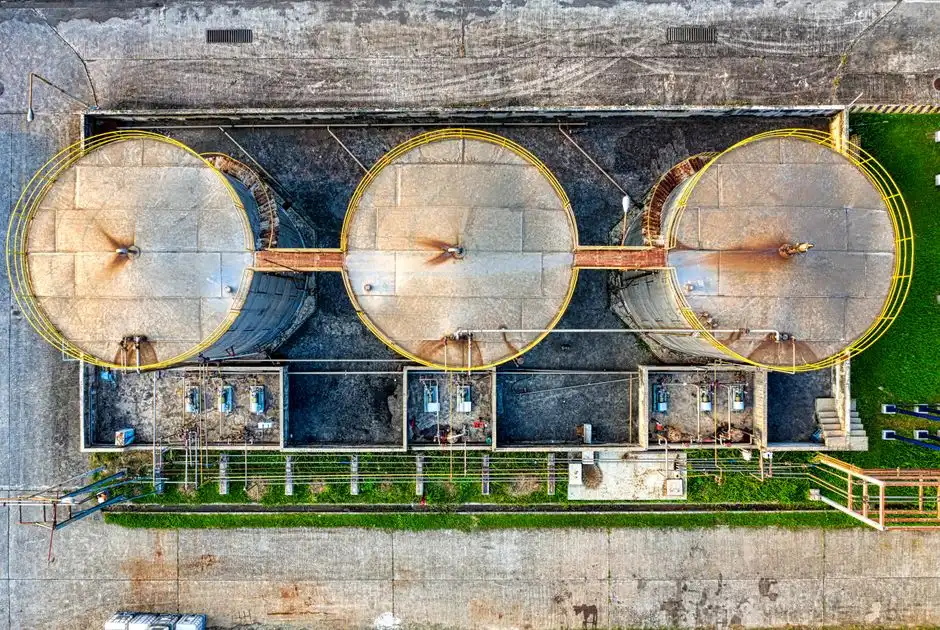
Most fabricated-metals plants hit sewer limits with the eight-step train above and never need polishing, but the cases that do are predictable. Trigger one: the POTW tightens local limits below PSNS. A submerged PVDF MBR integrated wastewater treatment system delivers <1 μm filtration and stable effluent for BOD/COD tightening or cooling-tower makeup. Trigger two: the plant wants to reuse rinsewater and needs RO-quality feed. A reverse osmosis (RO) system is required, and the upstream multi-media filter must hold SDI15 below 3 or the RO membranes fail early (HydropureWater field data, 2026).
Trigger three: the EPA 2026 PFAS rulemaking scoped to chrome finishing (per the EPA Metal Finishing Effluent Guidelines page, 2026) lands a numerical limit. Anion exchange or GAC is the proven polish step for the long-chain PFAS species tied to chrome plating; the right 2026 move is to design the train so a polish skid can be bolted on later, not to install it now and pay to operate it ahead of any actual limit. Closed-loop zero liquid discharge is rarely economic for a fabricated-metals plant unless water scarcity or a specific reuse-economics case supports the capital.
Sludge Economics: Plate-and-Frame vs Belt Press on Metal Hydroxide
DAF float sludge typically runs 2–5% dry solids out of the DAF (HydropureWater field data, 2026). The press choice is a haul-cost decision: a plate-and-frame filter press for metal-hydroxide cake dewateres to 25–35% dry solids, while a belt press caps around 22% on metal hydroxide. If the hauler bills by wet ton, plate-and-frame pays back on disposal cost alone; if the hauler is not penalizing water, belt press wins on footprint, capital, and continuous operation. Pair either press with a high-efficiency lamella sedimentation tank upstream to thicken the float before it hits the press and cut cycle time. A useful reference for the oily side of the same decision is DAF sizing for oily fab-floor wastewater; for sub-ppm metal polishing that may be needed if a local limit tightens past PSNS, see resin adsorption for sub-ppm metal polishing.
Frequently Asked Questions
Which 40 CFR Part 433 limits does a fabricated-metals plant near Saltsburg, PA have to meet?
40 CFR Part 433 regulates eight metals (Cd, Cr, Cu, Pb, Ni, Ag, Zn), total cyanide, and total toxic organics; for a 2026 new skid, the PSNS column applies (e.g., Cd 0.11/0.07 mg/L daily max/monthly avg), and pH, oil & grease, and TSS are set by the local POTW (per 40 CFR Part 433, Table 1, 2024-04).
What is the standard sequence a treatment train needs to remove hexavalent chromium before discharge?
Hexavalent chrome is reduced to trivalent chrome with sodium metabisulfite (or ferrous sulfate) at pH 2–3 and ORP 250–300 mV, then precipitated as Cr(OH)₃ in the pH 8.5–9.5 hydroxide stage; Cr(VI) will not precipitate at any pH, so reduction must come first.
Do I need a PFAS polish step today to comply with the 2026 EPA rulemaking on chrome finishing?
No — there is no current numerical PFAS limit for chrome finishers under the 2026 EPA rulemaking (per epa.gov/eg/metal-finishing-effluent-guidelines), but the train should be laid out so an anion-exchange or GAC polish skid can be bolted on later, rather than installed and operated ahead of any actual limit.
What is the typical operating pH band for the hydroxide precipitation step on a mixed fab floor drain?
pH 8.5–9.5 is the standard design band, where Cr(OH)₃ and the other metal hydroxides reach their minimum solubility; below 8.5 the metals start resolubilizing, above 9.5 the chemistry becomes unstable and the floc carries over (HydropureWater field data, 2026).