
Why Crosby Chemical Plants Are Asking DAF-vs-Clarifier Again in 2026
Crosby sits inside the Houston Ship Channel / TCEQ industrial corridor, where the local regulatory framework makes the 2026 spec cycle different from a generic DAF-vs-clarifier decision. Organic chemicals, plastics, and synthetic fibers (OCPSF) facilities here discharge under 40 CFR 414 categorical effluent guidelines plus individual TCEQ TPDES permits. A Crosby plant must meet the stricter of the two, and in 2026 TCEQ enforcement is tightening around FOG, TSS, and priority pollutants—pushing operators to add or upgrade primary solids-removal ahead of biological treatment rather than rely on the secondary step to absorb excursions. The two dominant primary clarification options on 2026 CAPEX lists are dissolved air flotation (DAF) and the lamella clarifier. For a side-by-side at a comparable Gulf-Coast site, see the Morristown chemicals DAF-vs-clarifier guide.
How DAF and Clarifiers Actually Work in a Chemical Plant
A DAF unit saturates a recycle stream with air at 4-6 bar, then releases it through needle valves into the flotation tank at near-atmospheric pressure. Micro-bubbles in the 10-80 micron range attach to oil droplets, FOG globules, and fine suspended solids, lifting them to the surface as a float layer that a skimmer scrapes into a sludge trough. The system requires an air compressor, a saturated-water recycle pump (typically 20-50% of forward flow), and a small amount of coagulant or flocculant to condition the colloids (per Ecologix, 2026 update; WesTech mobile DAF documentation, 2025).
A lamella clarifier relies on gravity to separate solids. Wastewater flows upward between inclined plates spaced at 50-80 mm; heavier settleable solids drop onto the plate surfaces and slide to the hopper, while clarified water overflows the top weirs. A lamella pack multiplies the effective settling area inside a small footprint; no air system or recycle pump is required, and energy draw is limited to the feed pump and periodic sludge pumping. On Crosby streams, the practical difference is that DAF tolerates emulsified oil and rapid influent swings, while a clarifier tolerates high-temperature streams and heavy inorganic TSS but breaks down when oil is emulsified. The DAF system is a typical 4-300 m³/h packaged unit that integrates saturator, recycle, and skimmer in a single skid.
Crosby 2026 Decision Matrix: DAF vs Clarifier for Chemicals Wastewater
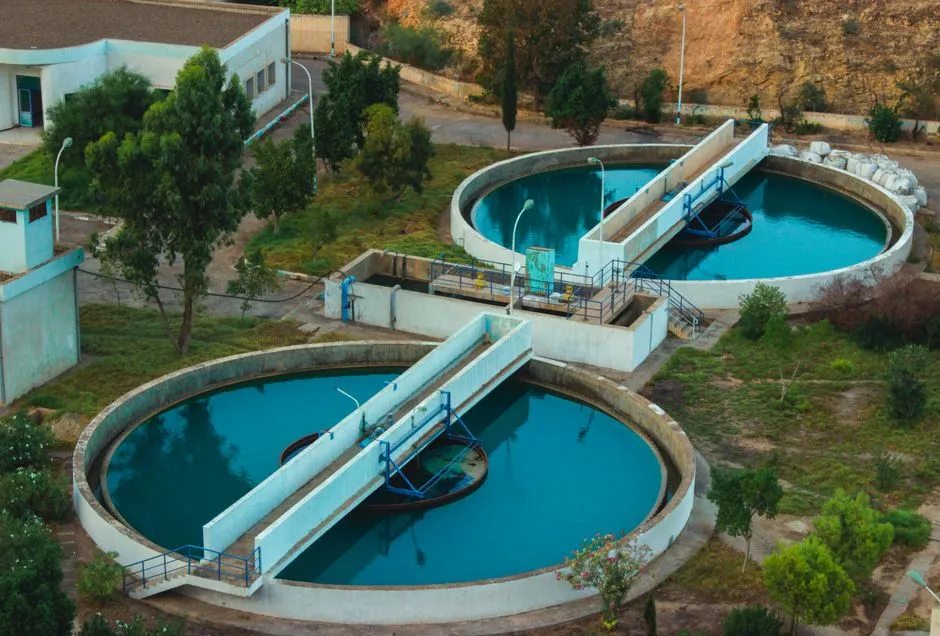
Process engineers should score the influent stream before evaluating equipment. Below is the matrix a Crosby process engineer should run before talking to procurement. FOG-heavy or emulsified streams point to DAF; heavy, settleable, low-oil streams point to a lamella clarifier; variable streams usually need a hybrid approach.
| Decision axis | Favors DAF | Favors Lamella Clarifier |
|---|---|---|
| FOG / oil content | High or emulsified — 95% removal (per Ecologix 2026 case data) | Low and free — ~70% on the same oily stream |
| TSS character | Fine, colloidal, light | Heavy, settleable, inorganic |
| Influent variability | Rapid swings, batch washdowns | Steady, well-equalized |
| Footprint available | Compact — 13 standard models covering 4-300 m³/h (per HydropureWater DAF catalog) | Lamella 20-40 m/h surface loading cuts tank volume vs. conventional clarifier (per HydropureWater catalog) |
| Energy budget | Higher — air compressor + recycle pump load | Lower — feed pump and sludge pump only |
| Target effluent oil/grease | Tight (< 10-15 mg/L range typical for OCPSF) | Moderate |
| Target effluent TSS | Good on fines, modest on heavy TSS alone | ~90% reduction on heavy sediment loads (per Ecologix 2026 mining case) |
| CAPEX tolerance | Higher CAPEX (per Ecologix 2026) | Lower CAPEX |
| OPEX tolerance | Higher OPEX (air, chemicals, maintenance) — see the 2026 DAF OPEX breakdown | Lower OPEX; lamella cuts chemical consumption up to 30% (per HydropureWater catalog) |
| Temperature tolerance | Limited at high temperature; saturator performance drops | Handles hot process streams well |
For Crosby flow bands in the 30-200 m³/h range—typical of an OCPSF specialty-chemical line—the HydropureWater lamella clarifier and the DAF can both be sized to the same duty, making the matrix above the deciding factor.
Anchoring the Choice to 40 CFR 414 and TCEQ TPDES
40 CFR 414 sets categorical pretreatment and direct-discharge effluent limits for OCPSF subcategories, including the production of bulk organic chemicals, plastics, resins, synthetic fibers, and certain specialty organics. The limits are pollutant-specific (BOD, TSS, oil and grease, pH, and a priority-pollutant table) and apply as daily maximums and monthly averages. TCEQ TPDES permits then layer site-specific limits on top, addressing local stream quality, Houston Ship Channel dissolved-oxygen concerns, and any whole-effluent-toxicity (WET) requirements (per 40 CFR 414 categorical structure; TCEQ TPDES chemical-manufacturing permits, 2025-2026). A Crosby plant must meet the stricter of the two.
The primary unit should be specified against the limiting pollutant rather than the average. If oil and grease is the binding parameter, a DAF's ~95% removal (per Ecologix 2026) makes the compliance math far easier than a clarifier's ~70% on the same stream. If TSS is binding and oil is low, a lamella clarifier is the lower-cost path and still cuts chemical consumption up to 30% (per HydropureWater catalog). Specifying the wrong primary unit pushes higher loadings into the biological step—typically an MBR or activated-sludge basin—which is both more expensive to operate and more sensitive to upsets. The 2026 self-monitoring framework and DMR cadence is detailed in the 2026 wastewater self-monitoring compliance guide.
| Compliance parameter | Where it shows up | Primary unit that buys the most margin |
|---|---|---|
| Oil & grease (40 CFR 414 subcategory limit) | Direct discharge and pretreatment | DAF — ~95% vs ~70% on identical oily stream (per Ecologix 2026) |
| TSS (TPDES site-specific) | Direct discharge | Lamella clarifier — ~90% on heavy settleable solids (per Ecologix 2026 mining case) |
| Priority pollutants (40 CFR 414 Table 1) | Direct discharge | Hybrid train with chemical conditioning — drives both oil and TSS down before biotreatment |
| Whole effluent toxicity (TPDES) | Houston Ship Channel watershed | DAF-first train reduces loading to biotreatment and WET pass probability |
Hybrid DAF + Clarifier Trains for Variable Chemical Effluent
Real Crosby plants rarely handle a single, consistent stream. A typical OCPSF facility alternates between oily washdowns and process discharges high in settleable TSS, and equalization only smooths out so much variability. Ecologix (2026) confirms that hybrid DAF-plus-clarifier systems combine FOG removal with sedimentation for these complex streams. The standard configuration is equalization → coagulant/flocculant dosing → DAF (oil and FOG polish) → lamella clarifier (TSS polish) → biological step, with a HydropureWater automatic chemical dosing system ahead of each solid-liquid split. The CAPEX and footprint are higher than either unit alone, but OPEX risk drops because a single excursion on either parameter is far cheaper to prevent than to defend before the TCEQ.
For turnarounds, peak-load events, or upsets, a mobile DAF can be deployed as temporary pre-treatment while the main train is serviced. WesTech mobile units arrive on a 47'-6" or 51'-7" trailer, require only a level pad, power, and piping, and can be online in a single day (per WesTech mobile DAF documentation, 2025). This offers a low-CAPEX way to trial a DAF-first configuration before committing to a permanent installation.
2026 Cost, Footprint, and ROI Snapshot for Crosby Plants
DAF carries higher upfront and operational costs than a clarifier due to the air compressor, recycle pump, saturator, and skimmer (per Ecologix 2026). A clarifier has lower OPEX but a larger tank footprint—except when it is a lamella, where 20-40 m/h surface loading shrinks the tank size compared to a conventional clarifier at the same flow (per HydropureWater catalog). Energy-wise, an air-saturated DAF recycle pump typically adds 0.5-1.5 kWh per m³ of forward flow depending on recycle ratio and saturator efficiency; a lamella clarifier only runs the feed pump and intermittent sludge pump. The ROI argument is risk-based: a single TCEQ permit excursion on FOG or TSS—including a WET failure triggered by oil sheeting in the outfall—can dwarf years of OPEX savings from under-spec'ing the primary unit. For line-item OPEX, the 2026 DAF OPEX breakdown walks through power, polymer, maintenance, and labor.
| 2026 cost / footprint lever | DAF | Lamella Clarifier |
|---|---|---|
| CAPEX class | Higher (per Ecologix 2026) | Lower (per Ecologix 2026) |
| OPEX class | Higher — air, recycle, polymer | Lower; chemical use up to -30% (per HydropureWater catalog) |
| Footprint at same flow | Compact; DAF covers 4-300 m³/h in 13 models (per HydropureWater catalog) | 20-40 m/h surface loading, smaller than conventional clarifier (per HydropureWater catalog) |
| Energy draw | Compressor + recycle pump + skimmer | Feed pump + sludge pump only |
| Enforcement-risk ROI | High — protects FOG and emulsion excursions | High — protects TSS excursions on heavy settleable loads |
| Trial option | Mobile DAF on 47'-6" or 51'-7" trailer, single-day deployment (per WesTech 2025) | Pilot lamella skid or rental unit |
Frequently Asked Questions
Which is better for a Crosby chemical plant with high FOG, DAF or clarifier?
DAF is the preferred choice for high FOG. On the same oily stream, a DAF typically reaches ~95% oil and grease removal versus ~70% for a clarifier (per Ecologix 2026). When oil and grease is the binding limit under 40 CFR 414 and TCEQ TPDES, that gap is the difference between a defensible compliance position and a permit excursion.
Can DAF and a clarifier be used together?
Yes. Hybrid trains are standard for variable chemical effluent. Ecologix (2026) confirms that DAF-plus-clarifier systems combine oil removal with sedimentation. A typical Crosby configuration is equalization → DAF → lamella clarifier → biological step, with coagulant/flocculant dosing ahead of each unit.
Frequently Asked Questions
Should a Crosby chemical plant choose DAF or a clarifier in 2026?
The choice between Dissolved Air Flotation (DAF) and a clarifier in 2026 depends primarily on the density of the suspended solids and the specific chemical constituents of the wastewater. DAF is superior for removing low-density contaminants, oils, greases, and particles with specific gravities near or below 1.0, typically achieving 80% to 95% removal of suspended solids. Clarifiers are more effective for heavier, inorganic solids with specific gravities significantly greater than 1.0 that settle rapidly under gravity, often requiring less energy but larger physical footprints.
For Crosby chemical facilities dealing with complex petrochemical emulsions or fluctuating organic loads, DAF is increasingly preferred for its smaller footprint and faster process kinetics. However, if the wastewater stream contains heavy metal precipitates or dense catalyst fines, a conventional primary clarifier remains the standard for initial bulk separation before downstream polishing.
Can DAF and a clarifier be used together for chemical wastewater?
Yes, utilizing both technologies in a sequential treatment train is a highly effective strategy for complex chemical wastewater streams. A common configuration involves using a primary clarifier to remove heavy, settleable solids, followed by a DAF unit to remove buoyant oils, fats, and fine suspended particles that remain in the supernatant.
This dual-stage approach reduces the organic loading on secondary biological treatment systems and ensures compliance with strict discharge limits. By removing dense solids first, the DAF unit operates with higher efficiency, preventing the fouling of air saturation nozzles and reducing the chemical coagulant dosage required for flotation.
What flow range does a DAF system cover for an industrial chemical plant?
Industrial DAF systems are highly scalable and typically cover flow ranges from as low as 50 gallons per minute (GPM) for specialized batch processing to over 3,000 GPM for continuous, high-volume chemical plant operations. The effective hydraulic loading rate for a standard DAF unit generally ranges between 2.0 and 4.0 gallons per minute per square foot of surface area.
For larger Crosby-based facilities, modular DAF designs allow for parallel installation, where multiple units handle flows exceeding 5,000 GPM. Selecting the correct size requires evaluating the rise rate of the specific chemical contaminants, as higher flow rates may necessitate higher recycle ratios to maintain the required bubble density for effective flotation.
How do 40 CFR 414 limits affect the DAF vs clarifier choice?
The 40 CFR 414 Organic Chemicals, Plastics, and Synthetic Fibers (OCPSF) effluent guidelines establish stringent limitations on pollutants such as Total Suspended Solids (TSS), Chemical Oxygen Demand (COD), and specific priority pollutants. Because DAF units are more effective at removing emulsified oils and grease—which often contribute significantly to COD and TSS—they are often essential for meeting these federal discharge limits in facilities where heavy settling alone is insufficient.
If the chemical wastewater contains significant concentrations of dissolved or colloidal organics regulated under 40 CFR 414, a clarifier may fail to reach the necessary effluent quality without excessive chemical dosing. In such cases, DAF provides the necessary removal efficiency to ensure that the facility remains within the daily maximum and monthly average concentration limits mandated by the EPA.
Is a mobile DAF unit a viable option for a Crosby chemicals facility?
A mobile DAF unit is a highly viable option for Crosby chemical facilities, particularly for temporary treatment needs, pilot testing, or emergency response during plant maintenance. These skid-mounted systems can be deployed rapidly to handle fluctuating waste streams or to manage seasonal spikes in wastewater volume without the capital expenditure of a permanent concrete structure.
Mobile units are capable of processing flows up to 500-800 GPM depending on the unit size and wastewater characteristics. They are frequently used to demonstrate compliance with local discharge permits or to treat contaminated stormwater runoff, providing a flexible, plug-and-play solution that integrates easily with existing industrial piping and electrical infrastructure.