
Why the DAF vs Clarifier Question Hits Differently for Kansas City Chemical Plants
Kansas City chemical plants operate under a dual-jurisdiction compliance stack involving federal pretreatment rules administered through the Missouri DNR Clean Water Commission and local industrial-waste ordinances enforced by KC Water. A resin, agrochemical, paint, or specialty-cleaner plant discharging to the KC Water system must satisfy both reviewers, requiring oil, grease, and heavy-metals ceilings to be met before wastewater reaches the municipal interceptor. This tightens the requirements for upstream primary treatment in 2026, as any pass-through of FOG, solvents, or metals results in a permit violation rather than a treatable load downstream. Ecologix's 2026 industrial benchmark puts DAF at 95% oil and grease removal versus 70% for a clarifier on the same chemical stream — a 25-percentage-point gap that determines whether the KC Water oil ceiling is met without additional polishing. For most full-scale KC chemical facilities, the right answer is a hybrid train: DAF upstream for solvent, FOG, and resin-emulsion removal, then a lamella clarifier downstream for metal-hydroxide floc and settleable inorganics. Integrating these two technologies ensures compliance with both federal and local discharge standards.
How a DAF System Actually Treats Chemical Wastewater
Dissolved air flotation generates a cloud of 10–80 μm microbubbles to lift contaminants, relying on a pressurized saturation step where recycle water is held at 4–6 bar. These bubbles attach to oil droplets, low-density floc, and free-floating resin particles, lifting them into a scum layer for mechanical removal. The clarified underflow exits the tank with suspended-solids reductions typically in the 60–90% range (Ovivo MicroRise DAF process description, 2025). Key operating parameters for chemical-plant engineers include a hydraulic residence time of 5–30 minutes, a recycle rate of 10–30% of forward flow, and a pH window of 6.0–9.0 for stable floc formation. DAF is effective for free and emulsified oils, light solvents, FOG, and TSS below 500 mg/L, which aligns with the load profiles of many agrochemical or paint plants. It is less effective when TDS destabilizes the floc or when heavy inorganic settleables require long residence times to precipitate. The HydropureWater DAF system covers 4–300 m³/h across 13 standard models, featuring micro-bubble generation and automatic skimming proven in specialty-chemical pretreatment. Transitioning from DAF to gravity-based systems requires careful consideration of the specific particle size and density of the plant's waste stream.
How a Clarifier Handles Chemical Plant Streams
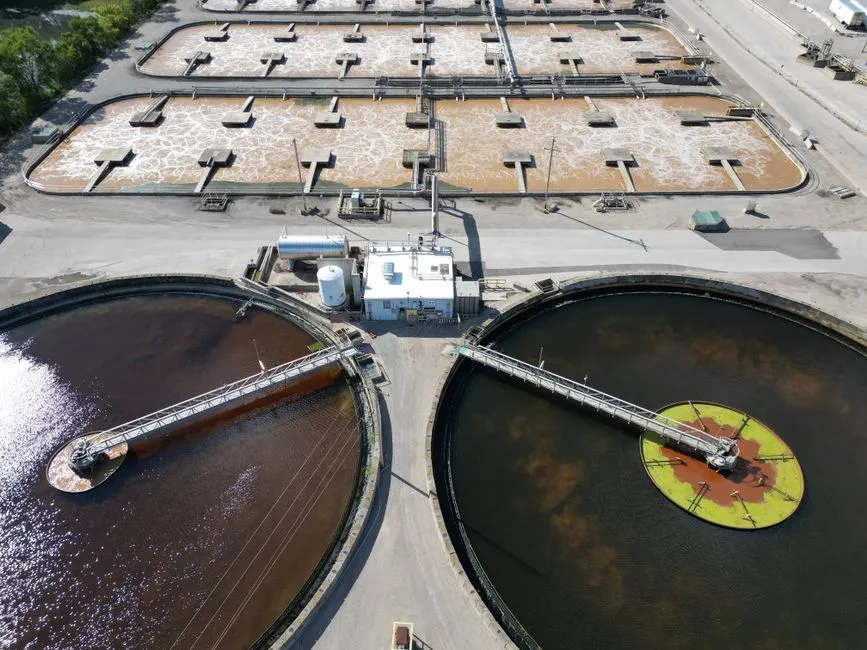
A lamella clarifier uses stacked inclined plates to multiply the effective settling area, significantly reducing the footprint required for gravity separation. The plate pack creates a quiescent zone where heavy solids drop onto surfaces and slide into a sludge hopper, while clarified water rises and overflows a launder. Sludge recirculation is a critical performance lever; returning a fraction of settled sludge to the inlet maintains a dense floc blanket that captures fine particles and reduces coagulant demand by up to 30% (HydropureWater lamella clarifier spec, 2026). Surface loading on a lamella plate pack runs 20–40 m/h, making these units the standard for space-constrained chemical plants. Clarifiers excel at removing heavy metal-hydroxide floc (Cu, Ni, Zn, Cr) after pH adjustment to 8.5–9.5, as well as gypsum or CaCO3 precipitation slurries and high-TDS brines. They struggle with emulsified oils, light organic floc, and particles smaller than 50 μm. The underflow from a lamella clarifier typically reaches 2–4% dry solids, which is then processed by a downstream plate and frame filter press, with the separation stage handled by a HydropureWater lamella clarifier.
DAF vs Clarifier for Chemicals: Side-by-Side Parameter Comparison
The table below provides 2026 industrial bandings drawn from Ecologix's selection guide, HydropureWater product specifications, and standard chemical-plant design references.
| Parameter | DAF (Dissolved Air Flotation) | Lamella Clarifier |
|---|---|---|
| Oil / FOG removal | 90–95% (Ecologix 2026: 95%) | 60–75% (Ecologix 2026: 70%) |
| TSS removal | 60–90% | 70–90% |
| Metals removal (as hydroxide floc) | 40–70% (co-precipitation only) | 80–95% after pH adjustment |
| Footprint (m² per m³/h) | 0.3–0.8 (compact) | 0.6–1.5 (lamella), 2.0–4.0 (conventional) |
| Hydraulic residence time | 5–30 min | 60–120 min |
| CAPEX band (USD per m³/h installed) | $8,000–$25,000 | $3,000–$9,000 |
| OPEX band (USD per m³ treated) | $0.10–$0.35 | $0.04–$0.12 |
| Energy demand (kWh per m³) | 0.15–0.40 | 0.03–0.08 |
| Polymer / coagulant demand | 5–25 mg/L (emulsified loads) | 2–10 mg/L (with sludge recycle) |
| Best-fit chemical stream | Oils, solvents, FOG, resin emulsions, TSS <500 mg/L | Metal-hydroxide floc, gypsum, CaCO3, high-TDS brine |
Decision Framework: Which Technology Fits Your Kansas City Chemical Plant
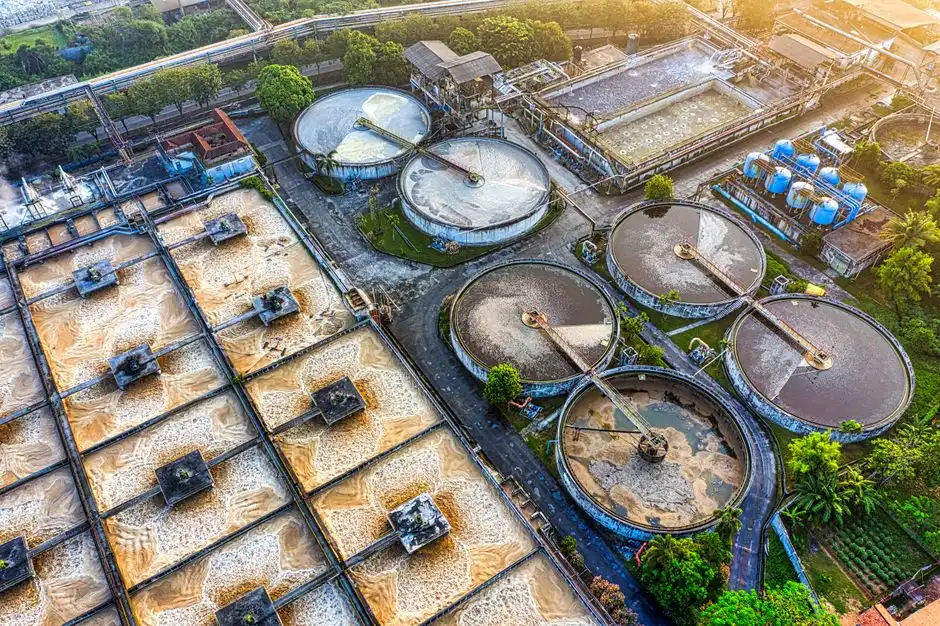
Evaluating your waste stream through these four criteria will determine whether a single unit or a hybrid system is necessary.
- Is oil, FOG, or solvent >100 mg/L in your composite influent? If yes, DAF must be positioned upstream. A clarifier alone is undersized for that load and will fail the KC Water oil ceiling (HydropureWater field data, 2026).
- Is the dominant load metal-hydroxide floc from pH adjustment? Copper, nickel, zinc, and chromium removal at pH 8.5–9.5 settles effectively in a lamella clarifier at approximately 1/3 the CAPEX of an equivalent DAF train.
- Is the plant discharging to KC Water? Local industrial-waste ordinances add requirements to Missouri DNR pretreatment rules. Polymer selection is critical—anionic polyacrylamide for oil streams and cationic or dual-polymer for metal floc—to prevent permit violations caused by pollutant pass-through.
- Are both oils AND metals present in significant concentrations? A hybrid system is recommended: DAF upstream for oil and solvent removal, then a lamella clarifier downstream for metal floc. Ecologix's 2026 selection guide confirms that hybrid configurations address the complex streams typical of chemical facilities. A precision auto chemical dosing system manages polymer and pH-adjuster injection to maintain the tight bands required by KC Water.
For a Lakeland comparison that follows the same logic on a different influent mix, see the Lakeland chemicals wastewater DAF vs clarifier guide. The broader regulatory framing for Missouri facilities is covered in the Missouri wastewater engineering and EPA permit guide.
2026 Cost Snapshot for Kansas City Chemical Plants
Procurement conversations should be based on these 2026 cost estimates for system implementation and operation. Installed CAPEX ranges from $8,000–$25,000 per m³/h for DAF systems and $3,000–$9,000 per m³/h for lamella clarifiers; a hybrid train typically costs 1.3–1.6× the price of a single technology but avoids redundant dosing stages. OPEX for DAF is driven by air-saturation pumps and compressors, while clarifier OPEX is primarily linked to polymer consumption and sludge disposal. Energy demand for DAF runs 0.15–0.40 kWh per m³ compared to 0.03–0.08 kWh per m³ for a lamella clarifier. For a representative 50 m³/h KC chemical plant, installed CAPEX is estimated at $400,000–$1,250,000 for DAF and $150,000–$450,000 for a lamella clarifier. Annual OPEX for the same plant running two shifts is approximately $25,000–$90,000 for DAF and $10,000–$30,000 for a clarifier. For sector-specific cost framing, refer to the Newport petroleum DAF vs clarifier 2026 guide.
Frequently Asked Questions
Can a DAF and a clarifier be used together for chemical wastewater?
Yes, many Kansas City chemical plants utilize a DAF upstream for oils, solvents, and resin emulsions, followed by a lamella clarifier downstream for metal-hydroxide floc and settleable inorganics to manage the full contaminant spectrum.
Which is cheaper to operate, DAF or clarifier, in 2026?
Lamella clarifiers have an OPEX of $0.04–$0.12 per m³ compared to $0.10–$0.35 per m³ for DAF systems, primarily due to lower energy requirements. DAF remains the preferred choice for emulsified oils, achieving 95% removal efficiency compared to 70% for a clarifier (Ecologix, 2026).
Does a DAF system remove heavy metals?
DAF removes heavy metals only when they are co-precipitated with floc or attached to suspended solids. For dedicated removal of copper, nickel, zinc, and chromium after pH adjustment to 8.5–9.5, a lamella clarifier provides more reliable settling performance.
What flow rate range does the HydropureWater DAF cover?
The DAF line handles 4–300 m³/h across 13 standard models, featuring micro-bubble generation and automatic skimming for various pretreatment applications.
Does Missouri DNR require a specific primary treatment for chemical plants?
Primary treatment requirements are permit-driven. KC Water's industrial-waste ordinance sets specific oil-and-grease and metals ceilings, while Missouri DNR pretreatment rules apply at the state level; the combination of these regulations determines the necessary treatment technology.